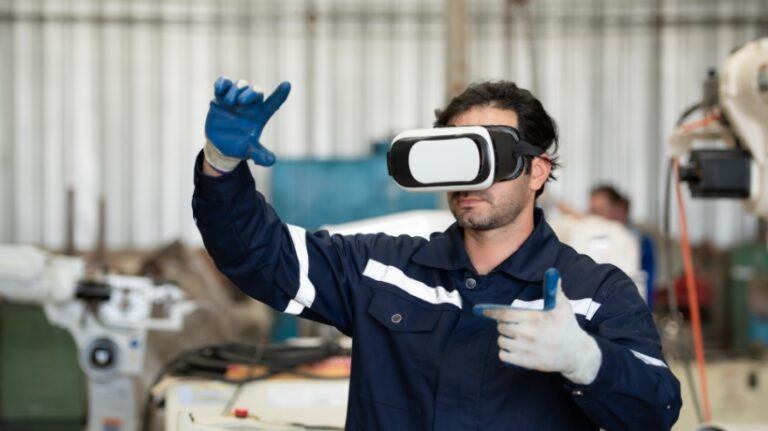





Five Deployment Mistakes That Kill Enterprise VR Training
The business case for Virtual Reality (VR) training is no longer theoretical. Organizations that deploy immersive learning report knowledge retention improvements of 50-90%, significant reductions in training errors, and measurable decreases in onboarding time. The technology works. The ROI is real. So why do so many enterprise VR training programs fail?
After nearly a decade of delivering enterprise VR training projects—working with organizations ranging from global automotive manufacturers to major utility companies—I have seen the same patterns repeat themselves. The failures rarely stem from the technology itself. They stem from how organizations plan, deploy, and scale immersive learning within existing training ecosystems. Here are the five most common failure points and the frameworks that address them.
In this article...
- Starting With The Technology Instead Of The Training Problem
- Treating VR As A Standalone Solution Instead Of An Ecosystem Component
- Underestimating The Change Management Challenge
- Building For The Demo Instead Of The Deployment
- Failing To Measure What Matters
1. Starting With The Technology Instead Of The Training Problem
The most common mistake I see is organizations that begin their VR training journey by purchasing headsets. They invest in hardware, demo a few off-the-shelf experiences, and then try to figure out where VR fits into their training curriculum. This approach is backward.
Effective VR training programs start with a specific, measurable training problem. What procedure has the highest error rate? Where are safety incidents most frequent? Which onboarding processes take the longest and produce the most inconsistent results?
One utility company we worked with came to us not because they wanted VR, but because they had a specific challenge: their customer service representatives were struggling with complex field scenarios, and traditional classroom training was not translating to real-world performance. By starting with the problem—not the technology—we were able to design a 360-degree VR simulation that directly addressed the performance gap. The result was a 30% reduction in training-related errors within the first six months of deployment.
- The framework
Before evaluating any VR platform or hardware, document the top three training challenges by cost impact. Quantify the cost of errors, incidents, or extended onboarding in each area. This creates a clear ROI model before a single headset is purchased.
2. Treating VR As A Standalone Solution Instead Of An Ecosystem Component
VR training does not exist in a vacuum. It must integrate with your existing Learning Management System (LMS), your compliance tracking, your reporting infrastructure, and your broader L&D strategy. Yet many organizations treat VR as a separate, siloed initiative. When VR training data does not flow into the same dashboards and reports that leadership already uses to evaluate training effectiveness, the program loses visibility. Without visibility, it loses executive sponsorship. Without sponsorship, it loses funding.
The organizations that succeed with VR at scale treat their immersive training platform as a component of their existing learning ecosystem—not a replacement for it. This means ensuring LMS integration from day one, building analytics that map to existing KPIs, and creating reporting workflows that put VR training data alongside traditional eLearning metrics.
- The framework
Before deployment, map every data touchpoint. Where does completion data need to go? Who needs access to performance analytics? What existing reports need to include VR metrics? Solving these integration questions early prevents the "orphaned pilot" problem that kills most VR programs after their initial launch.
3. Underestimating The Change Management Challenge
I have watched organizations build exceptional VR training content, deploy it on the latest hardware, integrate it with their LMS—and still see adoption rates below 20%. The reason is almost always change management.
Frontline workers, trainers, and middle managers all need to understand not just how to use VR, but why it benefits them specifically. A warehouse supervisor who has been training new hires the same way for 15 years is not going to embrace VR because someone in the corporate L&D department said so. They will embrace it when they see that VR-trained employees make fewer mistakes in their first month, reducing the supervisor's own burden.
One automotive manufacturer we partnered with deployed VR training across hundreds of locations. The technology rollout was straightforward. The change management was the real project. It required train-the-trainer programs, on-site champions at every location, a phased rollout that built momentum through early wins, and continuous feedback loops that incorporated frontline input into content updates.
- The framework
Allocate at least 30% of your VR training budget to change management. Identify champions at every level—not just L&D leadership, but floor supervisors and team leads. Create a communication plan that speaks to each stakeholder's specific concerns. And build feedback mechanisms that make frontline users feel heard.
4. Building For The Demo Instead Of The Deployment
There is a dangerous pattern in enterprise VR training that I call "demo-driven development." It happens when the primary goal of the initial VR build is to impress executives in a boardroom rather than to train employees at scale.
Demo-driven development produces beautiful, high-fidelity experiences that are impossible to maintain, expensive to update, and impractical to deploy across a distributed workforce. They look incredible in a conference room and fail completely in a training facility with limited bandwidth, varying technical literacy, and the need to cycle through dozens of trainees per day.
The organizations that succeed build for the deployment environment from the start. They prioritize content that can be updated without a complete rebuild. They design experiences that work within the bandwidth constraints of their actual facilities. They ensure that a trainer with basic technical skills can manage a class of VR learners without IT support.
- The framework
Before development begins, visit three actual deployment sites. Document the WiFi reliability, the physical space available, the technical skill level of the trainers, and the time available per training session. Design your VR experience to work within these real-world constraints, not around them.
5. Failing To Measure What Matters
The final—and perhaps most damaging—failure point is measurement. Many organizations measure VR training success by completion rates alone. How many people put on the headset? How many finished the module? Completion rates tell you almost nothing about training effectiveness. The metrics that matter are behavioral: Did error rates decrease? Did safety incidents decline? Did onboarding time shorten? Did customer satisfaction scores improve in the areas where VR-trained employees operate?
These outcome metrics require baseline measurement before VR deployment and ongoing tracking afterward. They require coordination between L&D, operations, safety, and HR. They are harder to capture than completion rates. And they are the only metrics that will sustain executive investment in VR training beyond the initial pilot.
- The framework
Establish baseline measurements for three to five operational KPIs before your VR training pilot launches. Track these KPIs monthly for at least six months post-deployment. Present the data alongside the cost of the VR program to demonstrate ROI in language that resonates with the C-suite.
The Path Forward
Enterprise VR training is not a technology problem. It is an organizational change problem that happens to involve technology. The organizations that succeed treat VR as a training methodology—not a gadget. They start with clearly defined problems, integrate VR into existing systems, invest heavily in change management, build for real-world deployment conditions, and measure outcomes rather than outputs.
The immersive learning space is maturing rapidly. Hardware costs are declining, content creation tools are becoming more accessible, and AI is beginning to enable adaptive simulations that respond to individual learner behavior. These trends make VR training more practical and cost-effective than ever. But technology alone has never been the barrier. The barrier is execution. And execution starts with understanding the human and organizational challenges that determine whether a VR training program scales or stalls.
If your organization is considering enterprise VR training—or has already tried and struggled—start by auditing your approach against these five failure points. The technology is ready. The question is whether your organization is ready for the technology.