


World Mental Health Day 2026: How L&D Can Turn Awareness Into Workplace Action
World Mental Health Day is held every October 10, but its importance for organizations goes beyond just one awareness campaign. For L&D, HR, and business leaders, it's a chance to check if employees and managers have the knowledge, skills, resources, and support they need to handle mental health challenges at work.
This difference is important. Raising awareness can spark helpful conversations, but by itself, it does not change how managers respond to employees in distress, help people find the right support, or fix workplace issues that affect mental health.
In 2026, this conversation is even more important. The official World Mental Health Day theme is "Lived experiences heard: real voices, real change." The World Health Organization (WHO) wants the campaign to show that people with lived experience should do more than just share their stories. Their knowledge should help shape policies, services, and decisions.
For learning leaders, this idea raises an important question: how can organizations move from talking about mental health to building the skills and workplace habits that drive real change?
What Is World Mental Health Day?
World Mental Health Day is observed annually on October 10 to increase awareness of mental health issues and encourage action to improve mental health support around the world. In 2026, the campaign focuses on recognizing lived experience as valuable expertise and moving from listening to meaningful participation and change.
For organizations, the day can therefore be more than an opportunity to share resources or organize workplace activities. It can also provide a natural point for reviewing mental health awareness training, manager development, employee support, workplace culture, and the learning resources employees can access throughout the year.
Put simply, October 10 can begin the conversation. But a strong workplace mental health strategy needs to keep going after that day.
What Is The World Mental Health Day 2026 Theme?
World Mental Health Day 2026 has the official theme "Lived experiences heard: real voices, real change." According to the WHO, the goal is to recognize the expertise of people who have personally experienced mental health conditions and ensure their perspectives influence the policies, services, and decisions that affect them.
This idea has practical meaning for L&D teams. Learning programs usually follow a familiar process: leaders spot a problem, experts share information, Instructional Designers create the content, and employees take the training. But when the topic is about real people's experiences, this process can miss key viewpoints.
Where appropriate, organizations can consider lived-experience input during needs analysis, learning design, scenario development, accessibility reviews, and program evaluation. For instance, people with relevant experience may identify unrealistic language in a manager-training scenario or point out barriers to accessing support that program designers had not considered.
However, participation must be handled carefully. Employees should never feel pressured to disclose a diagnosis or personal mental health experience to benefit a company initiative. Involvement should be voluntary, appropriately supported, and respectful of privacy.
The main idea is simple: involve people in the design process instead of guessing what they need.
Why Does World Mental Health Day Matter In The Workplace?
World Mental Health Day matters in the workplace because mental health at work is influenced by much more than an individual's ability to manage stress. Workload, job design, interpersonal relationships, management practices, organizational change, role clarity, job security, and workplace culture can all shape people's experiences at work.
The scale of the issue is significant. WHO estimates that approximately 15% of working-age adults have a mental disorder at any point in time, while depression and anxiety are estimated to cost the global economy around $1 trillion each year, predominantly because of lost productivity. However, numbers only show part of the picture.
Work itself can support well-being by providing structure, social connection, purpose, and economic security. At the same time, unhealthy working conditions can create or intensify psychosocial risks. WHO and the International Labor Organization, therefore, emphasize both preventing work-related mental health risks and promoting mental health at work.
For employers, that means the conversation should not become, "How do we make employees more resilient?" A better question is, "What knowledge, management practices, resources, and working conditions help people perform sustainably?" This change helps make sure employee mental health is not seen as just an individual's responsibility.
What Role Should L&D Play In Workplace Mental Health?
World Mental Health Day gives L&D teams an opportunity to evaluate the capabilities people need to contribute to a healthier working environment, rather than assuming the answer is simply another awareness course.
L&D cannot solve every factor affecting workplace mental health. Nor should training be used as a substitute for appropriate policies, job design, adequate staffing, professional mental health services, or organizational change. But learning can help fill important skill gaps.
For example, mental health awareness training can strengthen employees' mental health literacy and challenge misconceptions that contribute to stigma. Manager mental health training can help leaders recognize when someone may need support, communicate more effectively, understand the impact of workplace stressors, and direct employees toward appropriate resources.
WHO specifically recommends training managers to support workers' mental health. The organization notes that such training can improve managers' knowledge, attitudes, and behaviors while also supporting employees' help-seeking behaviors.
There is an equally important boundary, though: managers are not therapists. Mental health training for managers should not teach supervisors to diagnose or treat mental health conditions. Instead, the goal is to help them recognize concerns, communicate appropriately, understand their responsibilities, respond within their role, and connect employees with relevant support. This is a much more realistic and safer learning goal.
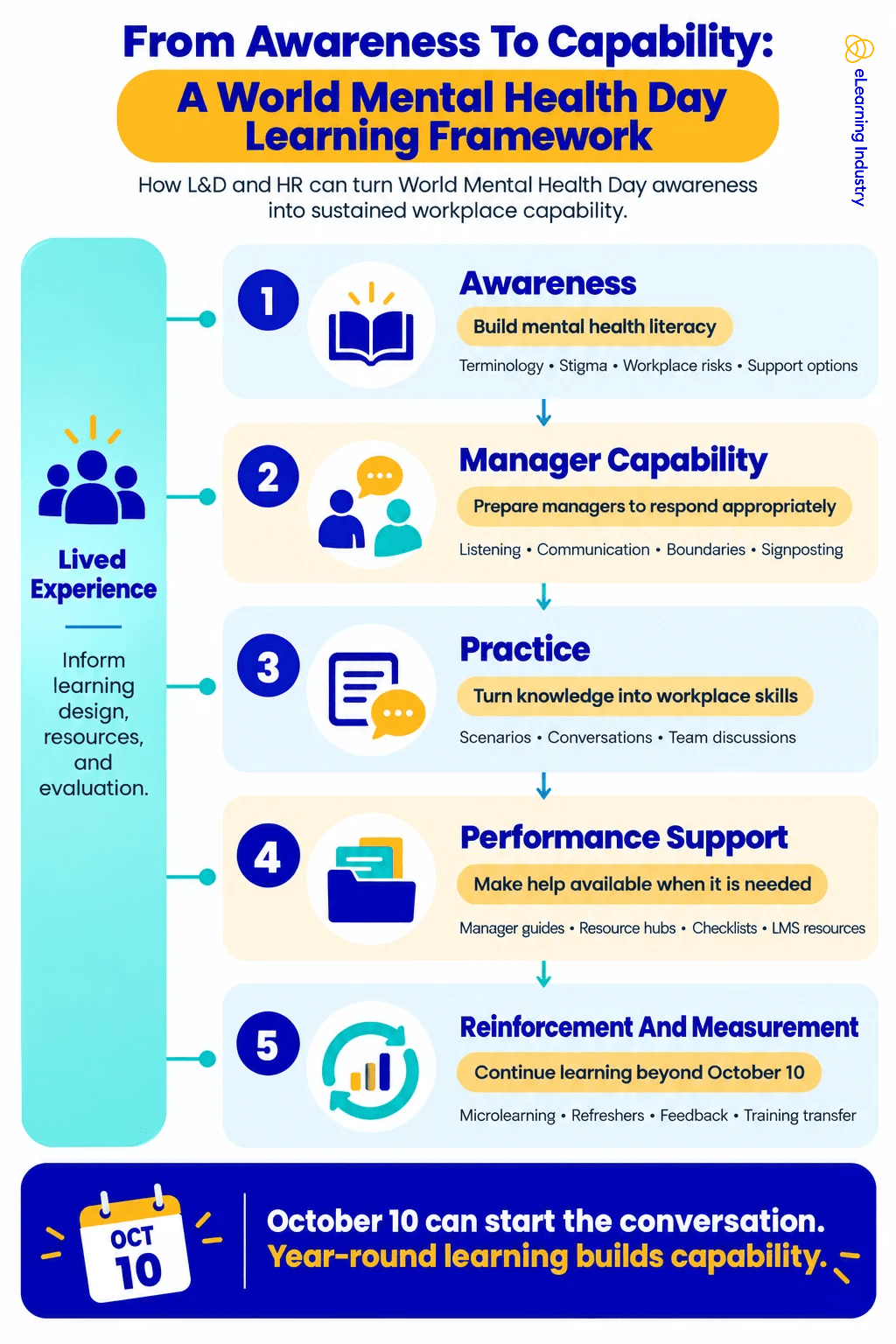
7 World Mental Health Day Activities That Build Lasting Workplace Capability
World Mental Health Day activities are most helpful when they lead to learning that lasts beyond October 10, instead of just a short burst of awareness. For L&D and HR teams, the best ideas link activities to specific skills, behaviors, resources, or company goals.
1. Run A Mental Health Literacy Learning Session
World Mental Health Day can provide a timely reason to strengthen mental health literacy across the workforce.
A focused learning session could cover common terms, misunderstandings, stigma, workplace stress, how to seek help, and what resources are available. The aim is not to make everyone an expert, but to help employees better understand mental health and feel more confident about finding support.
WHO recommends mental health literacy and awareness training for workers as part of efforts to protect and promote mental health at work.
2. Train Managers To Navigate Mental Health Conversations
World Mental Health Day can also become a launch point for manager mental health training rather than another company-wide awareness webinar.
Managers may need to practice starting sensitive conversations, listening without jumping to conclusions, responding in the right way, keeping boundaries, and guiding employees to available resources.
Scenario-based learning works particularly well here because managers can practice making decisions in realistic situations before encountering them at work.
3. Include Lived Experience In Learning Design
World Mental Health Day 2026 places lived experience at the center of the global conversation, making this an appropriate time to reconsider who contributes to workplace learning design.
Organizations could invite voluntary input through advisory groups, consultations, expert panels, program reviews, or carefully designed feedback processes.
However, lived experience should never be required as a story to share. Real participation means giving people a chance to influence decisions, not just asking them to share personal stories for emotional effect.
4. Use Scenario-Based Learning To Practice Responses
World Mental Health Day activities are more helpful when employees get to practice what they learn. For instance, a manager could practice handling situations like an employee feeling overwhelmed, a team member asking for changes, or a tough return-to-work talk.
Instead of giving managers a single perfect script, the training can let them compare different responses, spot possible issues, and think about how each choice might shape the conversation. This approach helps turn general awareness into real decision-making practice.
5. Create A Mental Health Resource Navigation Exercise
This day is also a good time to ask a practical question: do employees know where to find help? Organizations might already offer employee assistance programs, health benefits, policies, well-being resources, outside services, or internal contacts. But having resources and knowing how to use them are not the same.
A short resource-navigation activity can show employees what support is available, where to find information, who to contact, and what to do if they need more help. The goal should be for employees to feel comfortable using resources, not just knowing they exist.
6. Discuss Healthy Working Practices As A Team
Mental health conversations do not always need to focus on personal mental health stories. Instead, teams can look at daily work habits. Are workloads reasonable? Are after-hours boundaries respected? Do employees know their priorities? Do meetings add extra pressure? Do managers communicate well during changes?
This way, organizations can talk about mental health at work without asking employees to share personal details. It also highlights that a good mental health strategy should look at the work environment, not just how people react to it.
7. Build A Year-Round Learning Path
World Mental Health Day should be just one part of a longer learning plan, not the only time for mental health education at work. For example, organizations could start with an awareness session in October, then offer scenario-based manager training, give short refreshers later in the year, and share helpful resources before tough conversations.
The learning steps might look like this:
Awareness → Practice → Reinforcement → Performance Support → Refreshers
This approach builds a stronger learning system than just having a yearly event.
How To Design Mental Health Training That Is Safe And Inclusive
World Mental Health Day can spark interest in new learning programs, but mental health training needs more thought than just turning information into an online course.
- First, be clear about what the training should change. "Raise awareness" is hard to measure. Goals like helping managers learn about support options, building their confidence to communicate, or clearing up misunderstandings give L&D a clearer target.
- Next, use trustworthy information and the right experts. Since mental health is a health topic, training should be based on solid advice and checked by people who know the subject well.
- Learning design should also make sure training is easy to access and use. This means adding captions, transcripts, clear interfaces, inclusive language, different ways to join in, and careful handling of sensitive topics.
- Privacy is also important. People should not have to share personal experiences to take part in training.
- Finally, every mental health training should clearly show where people can get help. Someone might realize something important about themselves during the training, so knowing what to do next is key.
A World Mental Health Day Action Plan For L&D And HR
World Mental Health Day can be a helpful milestone in a broader workplace learning plan if organizations consider what happens before, during, and after October 10.
Before October 10, figure out what skills are missing. Check current resources, talk to experts and employees, look at manager development, and decide what you want the initiative to accomplish.
Around World Mental Health Day, share the 2026 theme, offer relevant training, create chances for conversation, and make support options easy to find. If building manager skills is important, use this time to start or strengthen manager development instead of just focusing on general awareness.
After October 10, keep going. Use microlearning, manager refreshers, support tools, feedback, and learning reviews to see what needs more attention.
Most importantly, link this initiative with leadership development, employee well-being, onboarding, inclusion, and people-management programs where it fits. This way, World Mental Health Day acts as a spark for learning, not the whole mental health strategy for the organization.
Conclusion
World Mental Health Day is a great chance for organizations to talk about mental health, but its value is not about how many activities happen on one day. For L&D and HR leaders, the real opportunity is to build mental health knowledge, manager skills, access to support, and healthy work habits all year long.
The 2026 theme brings something new. If organizations truly value lived experience, they should think about how these voices shape learning and workplace programs from start to finish. Awareness is important. But when awareness turns into real skills, better decisions and lasting action are much more likely.