

 ChatGPT
 Perplexity
 Claude
 Grok
Grok
How AI Is Changing Enterprise Learning
The LMS has been around for decades. For most of that time, its job was to store courses, assign them to learners, and track who finished. Completion rates became the default measure of a training program's success.
AI has changed what these platforms can do. The clearest shift has been in personalization. AI-powered learning platforms can now tailor learning to each individual based on their role, skill gaps, and goals, rather than pushing the same content path to everyone.
For organizations training employees, customers, and partners on the same platform, understanding what AI makes possible is a useful place to start.
What Is Personalization In Learning?
Personalization in learning means tailoring the content, pace, and path of a learning experience to the individual rather than the group. Instead of every learner in a cohort following the same curriculum, each person gets a path shaped by who they are, what they already know, and what they are working toward.
In an enterprise context, personalized learning goes deeper than matching someone to a course based on their job title. It takes into account:
- Role – The specific responsibilities and skills the learner needs to perform in their position.
- Department – The context and priorities of the team they work within.
- Seniority – Where they are in their career and the level of complexity they are ready for.
- Career aspirations – The direction they are headed and the skills they need to get there.
- Past learning interactions – Drawing on historical learning data across the platform to surface content that is most relevant to where each learner is today.
The closer the learning experience maps to the individual across all of these dimensions, the more likely it is to drive meaningful impact on performance.
How Does AI Personalize Learning?
At its core, AI-powered personalization works by collecting and analyzing data about each of your learners, then using that data to shape what they see next.
The process starts with building a learner profile. AI gathers information about who the learner is: their role, skill level, what they have already completed, and how they have engaged with content in the past. The more data points available, the more precise the picture becomes.
AI then draws on patterns identified across large volumes of learning interactions to understand what content tends to work for learners in similar situations. A sales rep at a certain seniority level working toward a specific skillset will get different recommendations than someone with a different profile, even within the same organization.
The system also adapts over time. As your learners continue to engage with content and complete learning paths, the AI refines its understanding of what each person needs. Personalization in AI learning is a continuous process, one that gets more accurate the longer a learner is on the platform.
What Is An AI-Powered Learning Platform?
An AI Learning Management System is something fundamentally different. AI reaches further than content recommendations. It can coach your learners through practice scenarios, build personalized learning paths from a single conversation, help any team member create a course from a text prompt, and give managers on-demand access to learning data without running a single report. Every layer of the platform is shaped by intelligence that was not possible in the traditional model.
A modern AI LMS makes it easier to surface what each learner needs, supports them in applying it, and gives the people overseeing your program better visibility into how it is performing.
For organizations running learning at scale, this is a meaningful change in what a platform can be.
How Is AI Changing Learning At Enterprise Level?
The capabilities AI brings to enterprise learning touch every function your team is responsible for. Here's how it shows up in practice.
How AI Personalizes Learning At Enterprise Scale
Personalizing learning across your workforce has always been resource-intensive. Mapping the right content to the right person, based on their role, skill level, and goals, takes time and effort that most L&D teams cannot sustain at scale. Personalized learning platforms powered by AI handle the mapping, so your team does not have to.
Recommendations Built Around The Individual
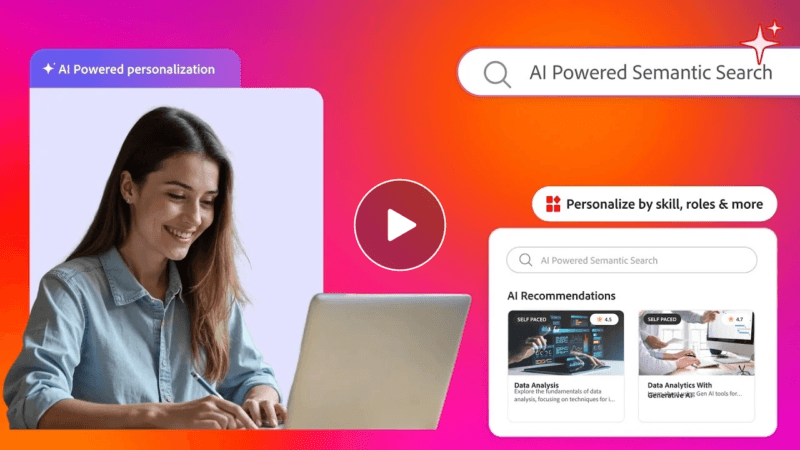
Your learners are not all at the same level. They have different roles, different goals, and different gaps. AI for personalized learning works by drawing on data from millions of learning interactions to recommend content that maps to where each person is. Search plays a distinct role in this experience. A learner does not always know the exact term they need. Intent-based search understands what they are trying to accomplish from the way they phrase their query, surfacing results that match the goal rather than the keyword.
Learning Paths Built From A Conversation
Learners often know what skill they want to build but are not sure where to start. AI-powered learning platforms can now turn a learner's goal into a structured path. A product marketing manager who wants to learn how to use Adobe Firefly for marketing collateral describes the skill, and the system pulls together relevant resources from your internal content library. What they get is a path calibrated to where they already are.
Answers Drawn From The Content Itself
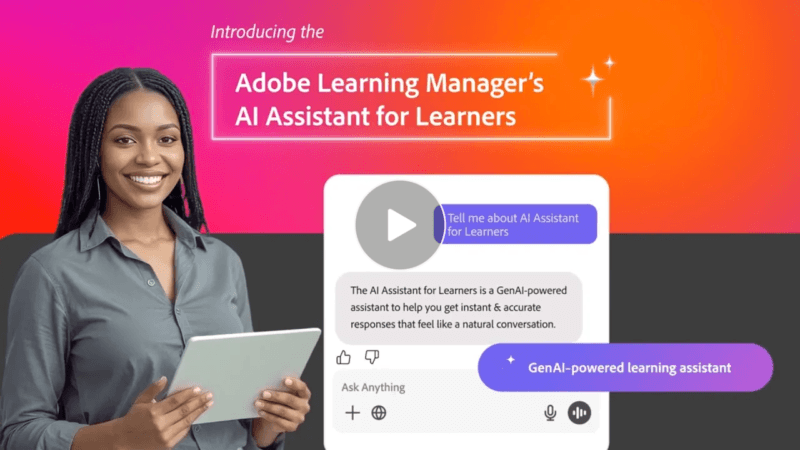
The ability to get answers from content is increasingly standard. An AI LMS can ground every response in the content your organization has already verified and published. Your learners get answers with citations attached, so they can trace exactly where the information came from. The system is designed to reduce hallucinations, which matters in a learning context where the accuracy of an answer shapes what your learners walk away believing they know.
When content accuracy is non-negotiable for your organization, in compliance training, product knowledge, or customer education, the sourcing of an AI-generated answer is as important as the answer itself.
How AI Is Changing Performance Coaching At Enterprise Level
The best way to prepare for a difficult conversation is to have one first. AI is making that possible for your learners, at scale, before it counts. Modern learners want to be tested in conditions that mirror their work. They want to practice the situations they face and come away knowing exactly where they stand.
Imagine building the scenario and configuring how performance will be judged. A sales training exercise might measure how a rep handles objections and how confidently they talk about specific features. A leadership scenario might focus on how someone responds when a conversation gets difficult. You can upload your internal documents too, so the simulation is grounded in the context your team works in every day.
Once the scenario is set, your learner steps in. They are met by an AI avatar and the conversation starts. Without a script or a safety net, they have to listen and respond as they would in a live conversation. The pressure is calibrated to the scenario you built, which means it can be as demanding as the situations your team regularly encounters.
After the exchange, an AI-powered LMS does something no end-of-course quiz can. It analyzes the full conversation and sends the learner a detailed report covering tactical knowledge and soft skills, rated against the rubric you defined when building the scenario. Over time, the feedback connects to the learner's broader profile, becoming more informed with each session.
How AI Is Changing The Way Learning Content Gets Created
Getting a course from idea to deployment has always required an Instructional Designer, a Subject Matter Expert willing to carve out time, a review cycle, and a production queue that most teams are perpetually behind on. For organizations running microlearning programs at scale, where the whole point is fast, targeted content delivered frequently, the traditional process simply cannot keep up.
For instance, with Adobe Learning Manager, you can now build instructionally sound course content with a single prompt. You can describe what you want your learners to know and be able to do, and the platform builds a structured learning experience around it. The course structure, the content flow, and the assessments come together without you having to design any of it. You can then refine the course in plain language, add AI voices and avatars, and have something ready to deploy it in hours.
This opens up content creation to everyone on your team. Anyone who spots a skill gap has the tools to address it directly. The iteration cycle with SMEs that used to span months closes in days.
When evaluating an AI LMS, you need to ensure your team creations also need to hold up ethically. AI-generated content should be free from bias and designed to resonate with everyone in your workforce, regardless of their background, role, or experience level. Content that reflects a narrow perspective or inadvertently targets a specific group is a risk at scale, and one worth being deliberate about.
How AI Is Changing The Way Admins And Managers Work
Running an AI Learning Management System at scale generates significant operational overhead for your team. Your admins spend time resolving queries, navigating platform features, and pulling reports. AI is changing how much of that work needs to happen manually.
Instant Answers For Admin Tasks
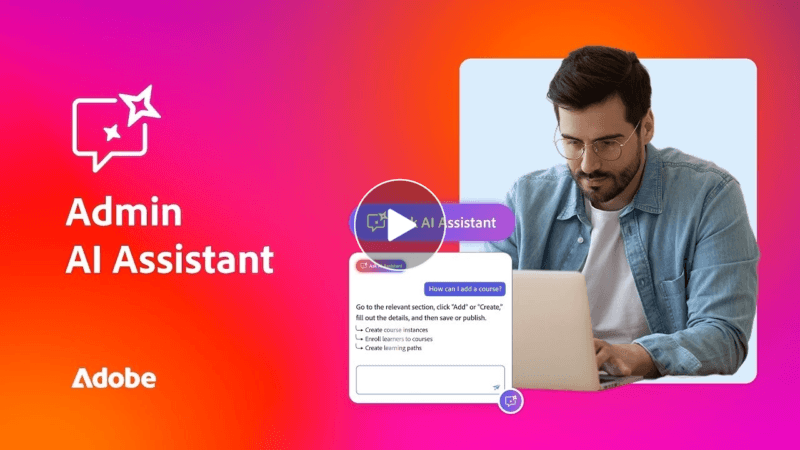
When your admins run into a platform query, the answer is usually buried in documentation somewhere. With a conversational AI interface, they can describe what they need and get a fast, accurate response instead of spending time searching for answers. And because the AI is trained exclusively on verified platform documentation, your team gets guidance that is accurate and the risk of errors stays low.
Insights Through Conversation
Getting meaningful insights from a learning platform has traditionally meant knowing which report to run, navigating multiple data views, and waiting on someone to build what you need. AI gives your managers a more direct route. They can ask questions about learning data in plain language and get answers on demand, without having to piece together information across multiple reports.
What Responsible AI Looks Like In Enterprise Learning
When evaluating the best LMS for your enterprise, responsible AI is one of the harder criteria to assess. The AI your learners interact with influences how they develop, what they believe they know, and how confident they feel going into high-stakes situations
Adobe's approach to AI development is built around three principles: accountability, responsibility, and transparency. Every AI-powered feature goes through rigorous testing before deployment, including automated testing and human evaluation to reduce the risk of harmful bias. Engineers developing AI features are required to submit an ethics impact assessment, and features with the highest potential impact are reviewed by a diverse, cross-functional ethics board.
For learning leaders, the implication is meaningful. The AI your learners are interacting with has been evaluated not just for performance, but for fairness. Adobe actively works to mitigate bias across a range of human attributes, designs for inclusivity, and maintains feedback mechanisms so issues can be identified and addressed after deployment.
Within Adobe Learning Manager specifically, the AI is grounded in verified, Adobe-owned documentation rather than open-ended generation. Your learners get answers that are accurate and traceable, rather than responses that could undermine trust in the learning experience.
Your organization can access all of these capabilities on Adobe Learning Manager. Book a demo to see what it looks like in practice.
Read More:
- The Great Learning Disconnect: What Your Employees Aren't Telling You
- How to evaluate AI features in a learning platform
- The complete guide to choosing the best learning management system for your business