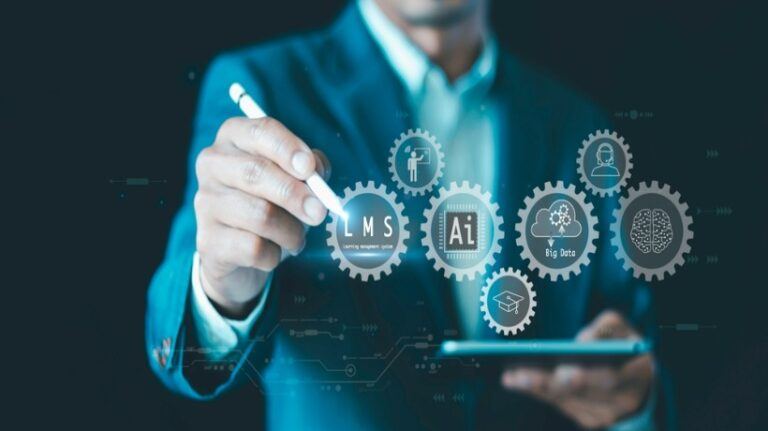





How AI Is Reshaping The LMS And LXP Landscape
For most of its history, the Learning Management System (LMS) has had a fairly simple job: put learning in one place and keep track of it. An LMS tells an employee which training they have been assigned, where to find it and whether they have completed it. For L&D teams, it provides administration, reporting and, particularly for compliance training, a record that the organization can rely on.
The Learning Experience Platform (LXP) emerged with a different emphasis. Rather than starting with administration, LXPs started with discovery. They brought together content from different sources and tried to make learning feel less like completing assigned courses and more like finding something useful.
AI is now being added to both. But the interesting question is not whether an LMS or LXP can generate a quiz, recommend a course, or answer a question. Those capabilities are rapidly becoming standard features. The more important question is whether AI changes the role these platforms play in the first place.
AI's First Job Is Making L&D Production Faster
This is where AI is already having a measurable effect: a 2026 survey of 421 L&D professionals by Synthesia found that 87% of respondents were already using AI, although the sample was deliberately distributed through AI-focused networks and therefore likely overrepresents early adopters. The most common uses were not particularly futuristic. They were practical production tasks: voice generation, quiz and content drafting, video creation, and translation. The biggest reported benefit was speed, with 84% citing faster production. AI is not suddenly designing perfect learning experiences from scratch. It is reducing the amount of manual work involved in producing them.
A learning designer can generate a first draft of an assessment, create variations of an explanation, translate material, or turn source material into a starting point much more quickly. The expert still needs to decide whether the result is accurate, useful, and pedagogically sound. For LMS and LXP vendors, this changes the economics of content creation. If creating another course becomes easier, producing more courses is not necessarily the answer. The value may instead move toward helping organizations decide which content they actually need, keeping it current, and making it easier for learners to find.
The Bigger Change Is Happening At The Point Of Discovery
The traditional LMS assumes that learning begins when someone enters the platform: they search for a course. They open it. They complete it. AI makes a different interaction possible. A learner can ask: "I have to give someone difficult feedback tomorrow. What should I know?" or "I'm moving into a management role. Which of our resources should I start with?"
The learner does not need to know that the organization calls the relevant program "Performance Management Essentials". They do not need to understand the L&D team's taxonomy. They can simply describe the problem.
This is particularly significant for LXPs, where discovery and recommendation are already central to the proposition. Current LXP products increasingly advertise AI-driven recommendations, personalized learning paths, and skills-based experiences alongside traditional LMS capabilities.
But better search does not automatically mean better learning. An AI assistant can only be as reliable as the material it can access. If an organization has outdated policies, duplicate courses, and poorly maintained content, putting a conversational interface on top of that information does not fix the underlying problem. It may simply make the problem easier to query.
Personalization Is Moving Beyond "People Who Liked This Also Liked That"
Personalized learning has been part of the LXP conversation for years, but AI gives vendors more ways to make those recommendations contextual. A platform might consider someone's role, previous learning, stated interests, skills, career direction and interaction with content when deciding what to recommend. The next step is adaptive learning: changing the experience itself according to what the learner appears to need.
The distinction is subtle but important. Recommendation asks: What should this person look at next? Adaptation asks: What should this person experience next?
The Synthesia research suggests that this is where much of the industry's attention is moving. While current AI use is concentrated on production, respondents expect future value to come increasingly from personalized learning, adaptive pathways, skills mapping and AI tutors. Whether those systems actually improve learning outcomes is a different question. The industry should be careful not to confuse more sophisticated personalization with evidence of better learning.
Skills May Matter More Than Courses
This could be the most consequential change for the LMS market. Traditional LMS reporting is largely activity-based: someone completed a course. Someone passed an assessment. Someone spent two hours learning.
Those are useful administrative measures, but they do not necessarily tell an organization what its people can do. Instead, skills-based learning starts somewhere else. What capabilities does a particular role require? Which skills are missing? What learning, practice or experience could help someone develop them?
AI is well-suited to working across large amounts of information and finding relationships between content, roles and skills. But there is an important infrastructure issue underneath this. Those relationships need to be represented consistently across systems: if organizations want AI to understand what someone should learn, the underlying systems need a reasonably reliable representation of what that person needs to be able to do.
The LMS May Become Less Of A Destination
There is already evidence that the industry is questioning the LMS's position at the centre of the learning technology stack. Synthesia's 2026 survey found that only 47% of respondents expected the LMS to remain the backbone of their L&D ecosystem over the next 3 years. The remaining respondents were either uncertain or expected the center of gravity to move elsewhere. Interestingly, respondents were almost evenly split on where AI might sit: inside the LMS or LXP, within productivity tools, in standalone systems or as a layer operating across systems.
That should not be interpreted as evidence that the LMS is disappearing: in fact, the more reasonable conclusion is that the boundaries around it are becoming less clear. An employee might learn something inside an LMS, ask a question through an AI assistant, practise it in another application and then receive a recommendation based on the resulting experience. The learning system does not necessarily have to own every part of that journey: after all, technology standards already support parts of this model. AI could accelerate this move towards a more connected learning environment.
That Creates A Problem For LMS Vendors
If learning can happen anywhere, what exactly is the LMS's job? Well, there are still strong reasons for having one: compliance records need to be managed; training needs to be assigned; certifications expire. Organizations need reporting, governance, and audit trails.
Those requirements are unlikely to disappear because generative AI exists: what may change is the value proposition around them. An LMS that primarily acts as a catalogue and reporting database is easier to displace or surround with other technologies. An LMS that can understand organizational skills, connect to other systems, provide useful recommendations, and support learning at the point of need has a much broader role.
That is why the distinction between LMS and LXP is becoming increasingly difficult to maintain. Vendors are moving towards each other, with LMS products adding learner-facing and AI capabilities and LXP products taking on more of the administration and reporting historically associated with the LMS. Current products in the market increasingly describe themselves as both.
There Is A Significant Catch: Data
The more intelligent these systems become, the more information they potentially need. Think about it: learning history is relatively straightforward, but an AI system that tries to infer skills, identify gaps, personalize recommendations, or provide performance support may interact with much more sensitive information.
That raises obvious questions about privacy, security, and governance. And it also raises questions about accuracy. An incorrect recommendation is inconvenient. An incorrect assessment of someone's capability can have consequences for their career.
UNESCO's guidance on generative AI in education stresses data protection, human agency, and mechanisms for validating AI systems for bias and suitability. Although the guidance is aimed at education broadly rather than enterprise LMSs specifically, the principles are directly relevant to organisations using AI to support learning. The implication for vendors is straightforward: AI cannot be treated as just another interface feature. The data behind it matters just as much.
The Real Competition Will Be About Usefulness
The LMS and LXP market does not need another round of claims that AI will "revolutionize learning". The more useful question is what learners and L&D teams can actually do better: can an employee find the right answer in 30 seconds rather than searching through 500 courses? Can a learning designer produce a first version of an assessment in an hour rather than a day? Can an organization see which skills it is developing rather than simply how many courses employees have completed?
AI is making content easier to create and information easier to retrieve. The next challenge is making the learning technology underneath it good enough to know what information matters, who needs it, when they need it and how it connects to the capabilities the organisation is trying to build. That is a harder problem than generating a course. It is also where the real competition in the LMS and LXP market is likely to be.