

 ChatGPT
 Perplexity
 Claude
 Grok
How Kashida Built The SWANA Region's First Arabic-Language Course On Sexuality, Gender, And Reproductive Health
Kashida is a learning design studio based in the MENA region. Over the past 20 years, we've built more than 200 hours of original learning content for organizations across the public, private, and non-profit sectors. In early 2026, we launched a project that pushed our team harder than almost anything we've worked on: Helem Academy, the first Arabic-language digital learning platform in the SWANA region dedicated to SOGIESC and SRHR education—sexual orientation, gender identity, gender expression, sex characteristics, and sexual and reproductive health and rights.
Our client, Helem, is the oldest LGBTQIA+ rights organization in Lebanon and the wider region, founded in 2001. For over two decades, Helem has done this work in person, through community meetings, capacity-building workshops, and advocacy training. That model works, but it has an obvious ceiling: it reaches one room, at one time, and it asks people to show up in person to something that, in this region, can carry real social risk. Our brief was to help Helem take that expertise digital, without losing what made it trustworthy in the first place.
The Challenge
Two problems sat at the center of this project, and they compounded each other.
The first was a content gap. Credible, accurate material on SOGIESC and SRHR topics in Arabic is genuinely scarce. Most of what exists is in English, and what circulates in Arabic is often dominated by stigma and myth rather than fact. A 2021 study found that 90.7% of Lebanese youth learn about sexuality online, and only 4.7% from a doctor. That's the vacuum this platform needed to fill, and it's not a small one: over 40% of Lebanese adolescents report lacking the confidence or knowledge to assert sexual refusal or practice safe sex. Formal sex and gender education is essentially absent from schools; a curriculum introduced in the 1990s was suspended for being "offensive to society" and never revived.
The second problem was access and safety. Given the sensitivity of the subject matter across the region, attending an in-person session on these topics isn't a neutral act for many people—it can expose them to stigma or worse. Any digital solution had to work for learners who might have no privacy at home, no safe device, and no ability to be publicly associated with the content they were engaging with.
There was also a quieter, more technical constraint: language itself. Arabic is heavily gendered, which makes neutral phrasing difficult by default, and several of the core concepts in this curriculum simply had no established Arabic equivalent yet because the topic had been so rarely addressed in the language at all.
The Solution

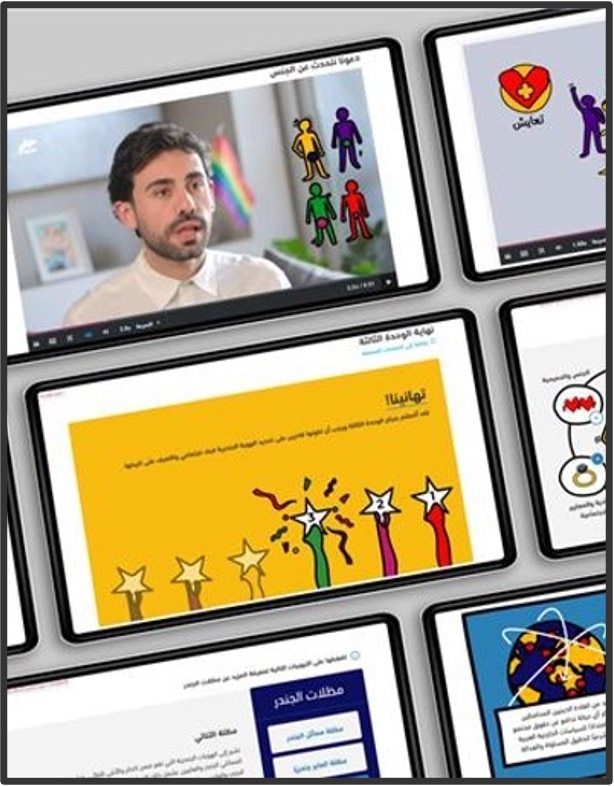
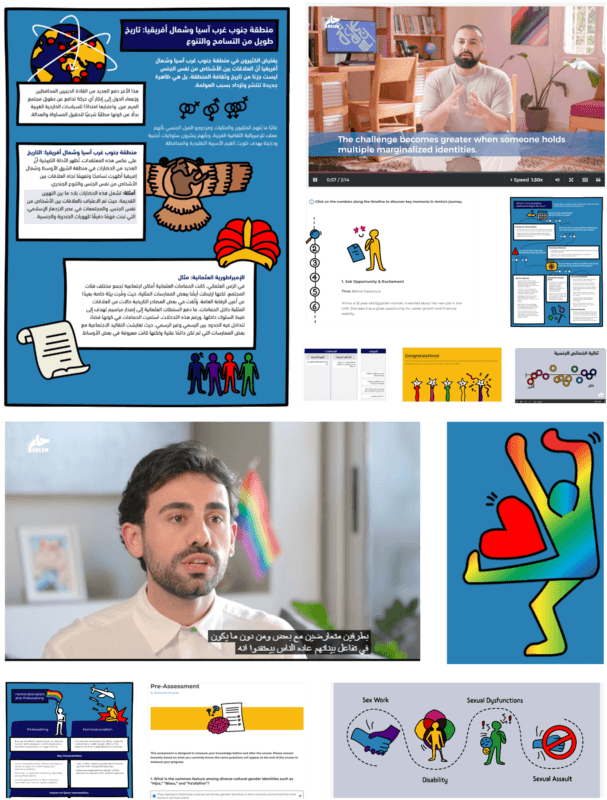
We built Helem Academy as a bilingual, certificate-based digital academy hosted on Open edX as a dedicated microsite. It consists of three courses: Introduction to SOGIESC, an advanced SOGIESC course, and a course on Sexual and Reproductive Health and Rights, each built natively in Arabic and English rather than translated from one to the other. Each course runs about two hours, is fully self-paced, and is free and with a certificate on completion.
Getting the language right took as much work as the instructional design. Because so many terms had no fixed Arabic equivalent, we built a dedicated glossary of Arabic terminology, developed and vetted alongside our subject-matter experts, and wrote every course using gender-neutral plural constructions to work around Arabic's grammatical gender. The SRHR content was separately reviewed and validated by Marsa, Lebanon's specialist sexual health NGO, to make sure clinical accuracy held up alongside cultural sensitivity.
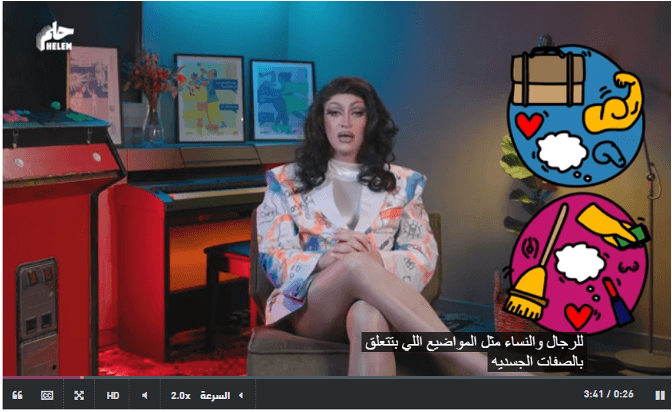
We grounded the instructional design in the AGES model (Attention, Generation, Emotion, Spacing) because the goal here wasn't just knowledge transfer, it was attitude change. Courses open with video designed to hold attention immediately; learners actively generate responses through case studies and branching scenarios rather than passively reading; emotionally heavy material—assault, gender dysphoria, religion—is handled deliberately and with care rather than glossed over; and content is spaced out with module summaries and recall checks to support retention. In total, the courses use 12 videos, 8 animations, 30 infographics, and more than a dozen other interaction types, from drag-and-drop to hotspots to branching scenarios. Every visual uses faceless, gender-neutral silhouettes; a small choice, but one that meant inclusive design was built into the graphics themselves rather than layered on top afterward.
Learner privacy was a requirement from day one, not a feature we added later. Sign-up asks for a username, not an identity. The platform is low-bandwidth and mobile-responsive so it works on a basic device and doesn't require drawing attention to itself, and it's built to WCAG 2.1 Level AA for accessibility. Every learner accepts a mandatory ethical commitment before the course content unlocks. We piloted the courses with a small learner group before the full launch, used that feedback to refine the experience, and rolled out fully in early 2026 across Lebanon, Jordan, Tunisia, Egypt, and Iraq.
The Results
Since launch, the online Helem Academy has reached over 250 learners with a 98% mastery rate on post-course assessments, a strong signal that the AGES-based design was driving real comprehension, not just completion. The social campaign supporting the launch reached over 209,000 accounts and generated more than 648,000 views and 32,000 interactions.
The number that stayed with me most wasn't a learning metric at all. In the period around launch, Helem's hotline recorded 496 individuals reaching out for support related to safety, housing, or legal advice. The Academy wasn't just teaching people—for some, it was the first door they found.
Organizations including UNHCR, MSF, and student clubs at AUB and USJ have since engaged with the platform, extending its reach into service-provider and academic networks that Helem's in-person programming alone couldn't access. As Tarek Zeidan, Helem's Executive Director, put it: "The Academy is our instrument to purposefully insert truth in spaces that purposefully deny it."
What This Taught Me
A few things from this project changed how I think about learning design generally, not just for sensitive topics.
Design for safety first, and the rest follows. I've designed for plenty of requirements before such as accessibility, low bandwidth and tight deadlines. Designing for safety was not merely a technical requirement but a lived reality for the learners we were designing for. On this project, "safe" didn't mean a password field; it meant someone's physical wellbeing, their identity, whether being seen learning could put them at real risk. I only understood that through the interactions this work put me in, and once I did, safety stopped being a line in the brief and became the thing every other decision had to answer to.
Translation is not localization. Arabic is my mother tongue. And this was the first time I truly registered how gendered my own language is, how much that quietly decides who feels spoken to and who feels left out. Working around Arabic's grammatical gender wasn't a technical puzzle for me. It made me hear my own language differently. That's why translating one course into the other was never going to be enough, real localization meant confronting things about Arabic I'd lived with my whole life and never had to notice. Building two native versions of each course, instead of translating one into the other, took longer and cost more. It was also the only way the Arabic content ended up feeling like it belonged to its audience instead of being borrowed from someone else's.
Frameworks like AGES matter more when you're trying to shift attitudes, not just transfer facts. For topics wrapped in stigma, comprehension isn't the finish line. A learner walking away with a different, more accurate mental model is.
Constraints can become part of the design instead of working against it. A gendered language, a scarce vocabulary, and real safety concerns could have limited what we built. Instead, they shaped decisions; the glossary, the anonymity, the tone, that made the final product stronger than a more conventional brief would have produced. Some of the hardest hours on this project weren't spent on instructional design at all, they were spent on single words. Concepts like allosexual had no settled, respectful Arabic equivalent, and sometimes no Arabic word at all, because the topic had been addressed so rarely in the language. Each was its own puzzle. And where nothing in Arabic fit, we borrowed from English rather than force a word that would do harm. Sitting with our subject-matter experts, the question was never just "what's the word" but "what will this word do to the person reading it." Building that glossary wasn't a side task, it was some of the most careful design work we did, and it taught me that on a topic like this, choosing a word is the design.
Working on Helem, I understood for the first time what a real barrier to knowledge looks like, not a difficult interface or a missing feature, but a whole region where content like this simply doesn't exist in your language, and where the little that circulates is stigma dressed up as fact. The Academy answers a genuinely humanitarian need: the right to accurate, dignified information about your own health, body, and identity safely, and in your own language.

Helem are already looking at what's next: expanding into more countries, embedding this content into schools and universities where formal sex and gender education is missing, and training service providers and professionals at scale. For a project built around a topic this sensitive, the most encouraging outcome so far isn't the completion numbers—it's that people came back, and some of them reached out for help they might not otherwise have found.