



Which Coursera Free Courses Are Worth Taking For L&D?
Coursera free courses can help L&D professionals develop skills in Instructional Design, Learning Experience Design, digital learning, assessment, AI, and learning technology. However, free courses do not always give you full access. Some let you preview content at no cost, but you may need to pay, subscribe, or apply for financial aid to access graded assignments, the full course, or certificates.
For learning professionals, choosing the right course is important. A long list of free Coursera courses only matters if the content helps you build real skills for your job. This is why we picked these free Coursera courses: they are relevant to L&D work, not just popular.
We reviewed the courses below for their value in instructional design, learning science, learning technology, AI in learning, digital learning design, assessment, and how useful they are for your work. These courses are meant to help L&D professionals make better learning choices, not just earn certificates.
Can You Really Take Coursera Courses For Free?
Coursera free courses do exist, but "free" does not always mean you get full access or a free certificate. Often, you can start a course without paying, which helps you decide if it's right for you before spending any money.
What "Coursera Free" Really Means
Coursera free courses let you access some course content without paying up front. This is usually through free previews, trials, or other options. Keep in mind, free access does not usually include a Coursera certificate.
Right now, you can preview the first module of many Coursera courses for free. Depending on the course, this preview might include videos, readings, assessments, and Coursera Coach. This is helpful for L&D professionals who want to check the course's depth, teaching style, and workplace relevance before signing up.
Coursera also has a seven-day free trial for some Specializations and Coursera Plus programs. Be sure to review the subscription terms before you sign up.
If you need full access to a course but cost is an issue, some programs offer financial aid. This can give you full access at a lower price or even for free if you qualify.
Finally, don't assume that Coursera's free courses with certificates are totally free. Usually, you need to upgrade, get financial aid, or use another option to earn the certificate.
10 Best Coursera Free Courses For L&D And EdTech Professionals
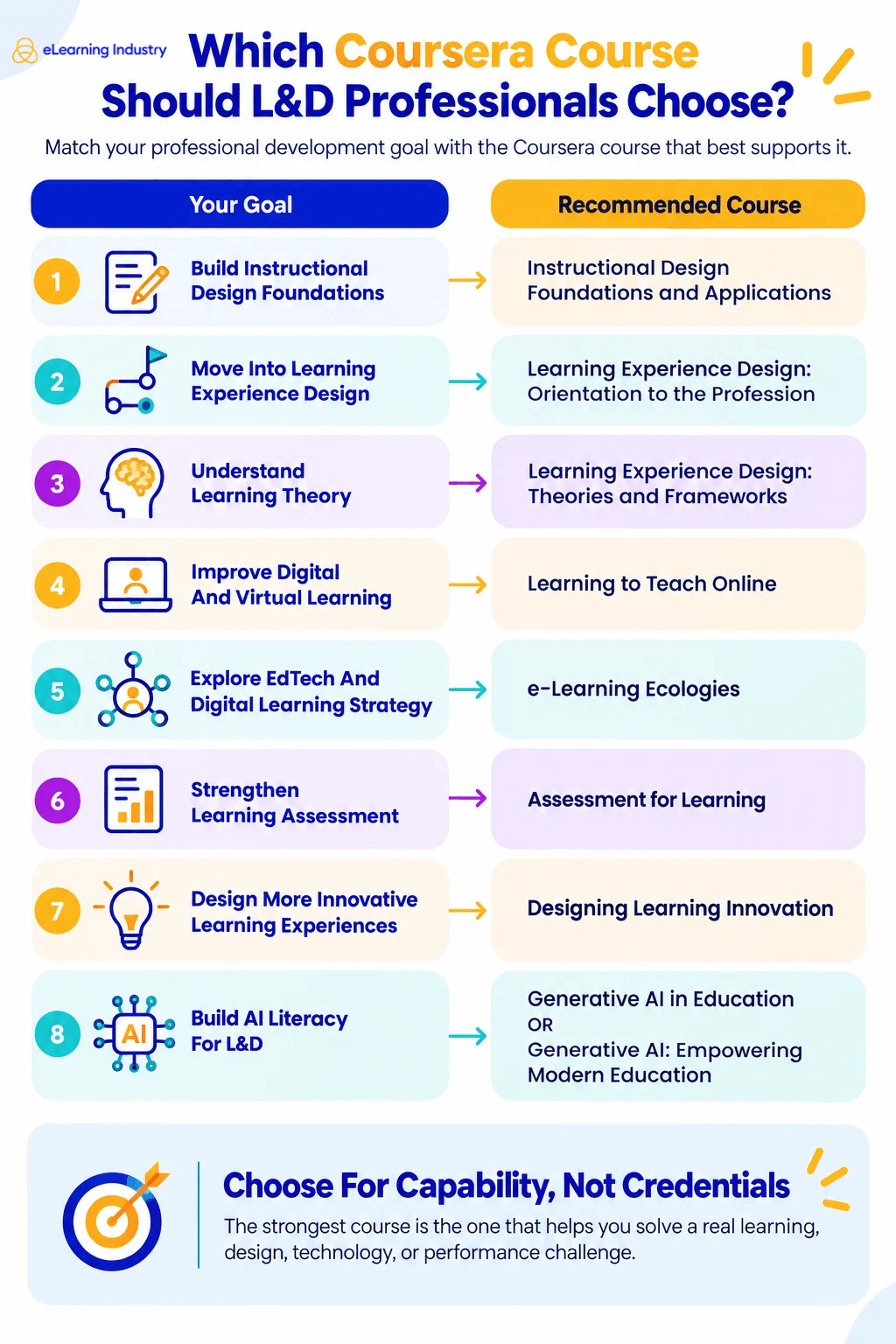
Coursera free courses offer L&D and EdTech professionals a hands-on way to build skills in areas like instructional design, learning experience design, assessment, digital learning, learning science, and AI. But just finishing another online course is not enough. It's important to pick courses that fill a real skill gap and can make a difference in how you design, deliver, or evaluate learning at work.
The free Coursera courses listed below were chosen because they are useful for today's L&D and EdTech roles. Keep in mind that Coursera's access options can change, and free enrollment does not always include graded assignments or certificates. If you want a free course with a certificate, be sure to check the current enrollment details before you begin.
1. Instructional Design Foundations And Applications
Provider: University of Illinois Urbana-Champaign
Best for: Instructional Designers and L&D professionals
If you want a free Coursera course that's directly relevant to corporate L&D, this is a great place to begin. The course covers instructional systems design, key learning and instructional theories, design models, needs assessment, learner and task analysis, learning objectives, project management, and how to work with Subject Matter Experts. It also links Instructional Design to talent development and organizational performance issues. This makes it especially useful for practitioners who need to figure out if there's a real performance need before choosing training as the answer.
Why it stands out: It offers a strong foundation for seeing Instructional Design as a way to improve performance, not just as a method for building courses.
2. Learning Experience Design: Orientation To The Profession
Provider: University of Michigan
Best for: Learning Experience Designers, Instructional Designers, and professionals exploring LXD
Learning Experience Design is more than just putting content into modules. This course gives professionals an overview of the full LXD process, covering topics like brainstorming, evaluation, inclusive design, learning theories, technology-supported learning, human-centered design, and Universal Design for Learning. It also looks at different career paths and shares insights from people working in the field. For L&D teams who need to focus on learner-centered experiences instead of just content, this broader approach is especially helpful.
Why it stands out: This course is a helpful starting point for professionals who want to see how modern LXD brings together learning theory, user needs, technology, and inclusive design.
3. Learning Experience Design: Theories And Frameworks
Provider: University of Michigan
Best for: Learning designers who want stronger theoretical foundations
Knowing how to build learning is important, but experienced practitioners also need to understand why certain design choices should work. This course examines behaviorism, cognitivism, constructivism, motivation, Bloom's Taxonomy, Fink's Taxonomy, Backward Design, Integrated Course Design, ADDIE, learning outcomes, learner personas, and needs analysis. It also shows how learner characteristics and context can influence learning goals, activities, and assessments.
For L&D professionals, this can provide a stronger evidence-informed basis for discussing design decisions with stakeholders instead of relying solely on preferences or established templates.
Why it stands out: It is particularly relevant for connecting learning theory with practical learning experience design decisions.
4. Learning To Teach Online
Provider: UNSW Sydney
Best for: Corporate trainers and virtual learning professionals
While Learning to Teach Online is mainly designed for educators, many of its ideas apply just as well to corporate digital learning. The course covers online teaching strategies, digital pedagogy, learning technologies, content management, Learning Management Systems, online activities, choosing the right technology, and designing effective online courses. It also encourages learners to think carefully about which technology fits each learning activity, rather than using new tools just because they are available.
This idea is important in workplace learning. Simply moving an instructor-led session online, without changing how it is taught, usually does not lead to effective digital learning.
Why it stands out: It is helpful for trainers who are moving from classroom teaching to virtual, blended, or digitally supported learning.
5. e-Learning Ecologies: Innovative Approaches To Teaching And Learning For The Digital Age
Provider: University of Illinois Urbana-Champaign
Best for: Learning strategists and EdTech professionals
Of the free Coursera courses listed here, e-Learning Ecologies offers a more strategic look at technology and learning. Instead of just teaching how to use certain tools, it explores how technology can open up new ways to learn. The course covers seven digital-learning features: ubiquitous learning, active knowledge making, multimodal meaning, recursive feedback, collaborative intelligence, metacognition, and differentiated learning.
For EdTech and L&D professionals, the main question is not just, "Which technology should we use?" but, "How can this technology help learners do things in new ways?"
Why it stands out: This course is a good choice for professionals who want to take a more strategic approach to connecting learning design with technology.
6. Assessment For Learning
Provider: University of Illinois Urbana-Champaign
Best for: Learning designers, evaluation specialists, and L&D teams
Assessment is one of the most important and often underestimated parts of learning design. This course looks at different ways to assess and evaluate learning, use learning data, apply predictive modeling, and consider knowledge inference and ethics in measuring learners. It also covers the differences between standardized, criterion-referenced, and other assessment methods.
This makes the course especially useful for organizations that want to go beyond just tracking completion rates. Good L&D measurement begins by deciding what proof shows that learning has happened and if learners can apply their knowledge.
Why it stands out: This course is a good choice for professionals who want to make assessment and evaluation more meaningful, instead of seeing measurement as an afterthought.
7. Designing Learning Innovation
Provider: Politecnico di Milano
Best for: L&D professionals and experienced learning designers
Designing Learning Innovation treats learning as a design challenge, not just a way to deliver content. The course covers tools like Constructive Alignment and the Learning Innovation Network, as well as active learning, assessment strategies, Instructional Design, Open Educational Resources, learner engagement, and learning theory.
Constructive Alignment is especially important for L&D teams. Learning objectives, activities, and assessments should support each other instead of being created separately. This approach helps connect course design with a more intentional learning strategy.
Why it stands out: This course is a good fit for professionals who want to go beyond just making training content and start designing more cohesive learning experiences.
8. Generative AI In Education
Provider: University of Glasgow
Best for: L&D and EdTech professionals developing AI literacy
AI literacy is quickly becoming relevant to learning professionals, but understanding AI requires more than knowing how to write prompts. This course covers generative AI fundamentals, prompt engineering, practical applications, ethical considerations, responsible AI, and the potential impact of generative AI on learning experiences. Coursera also identifies AI literacy, digital pedagogy, responsible AI, and education technology among the skills addressed.
For organizational L&D, that combination is important. Teams need to understand not only where generative AI can improve productivity but also where accuracy, ethics, governance, and learner experience require human judgment.
Why it stands out: A useful foundation for responsible AI adoption in learning.
9. Generative AI: Empowering Modern Education
Provider: IBM
Best for: Learning professionals applying AI to content and personalization
This IBM course focuses on practical uses of generative AI. It covers topics like creating personalized learning content, planning lessons with AI, adaptive learning, evaluating AI tools, privacy, reducing bias, inclusive learning, and responsible use. Learners get hands-on experience with tools such as ChatGPT, IBM watsonx, generative AI, and prompt engineering.
For L&D teams trying out AI for content development, this course encourages a shift in thinking. Instead of just asking, "How can we generate content faster?" it suggests focusing on, "How can AI help us improve learning while keeping quality, privacy, inclusion, and learning goals in mind?"
What makes it stand out: It is especially helpful for learning how to use AI in real-world learning processes.
10. Learning How To Learn
Provider: Deep Teaching Solutions
Best for: L&D professionals interested in learning science
Learning How to Learn covers a wider range of topics than the other free Coursera classes on this list, which is exactly why it belongs here. The course looks at learning strategies, concentration, habit formation, productivity, self-awareness, and learning theory. Over four million people have taken it, making it one of Coursera's most popular courses.
For L&D professionals, the benefit goes beyond learning how to study better. Knowing how people handle tough material, build habits, stay focused, and learn over time can help you design more practical workplace learning experiences.
Why it stands out: It gives professionals who design learning for others a solid foundation in learning science.
Do Coursera Free Courses Come With Certificates?
Coursera offers free courses that are a good way to try out new skills. However, most free options do not include a free certificate. Coursera separates free access to course content from earning a verified certificate. Usually, you can preview or audit the material at no cost, but earning a certificate requires paying for the course. Some programs may offer financial aid if you qualify.
This difference is important for professionals looking for free Coursera courses that offer certificates. Before you sign up, think about what you really want to get out of the course.
Learning value is about the knowledge and skills you can use in your job. Credential value is whether you need official proof of completion for your resume, LinkedIn, or to meet an employer's requirement.
For L&D professionals, learning value often matters more, especially if you want to learn about new trends, fill a skills gap, or make better decisions about learning strategy and design.
Conclusion
Coursera's free courses can be a great resource for L&D professionals, especially when you pick them to address specific skill gaps rather than just to earn certificates. For instance, courses in instructional design, learning experience design, learning science, EdTech, assessment, and generative AI can help you build skills that have a real impact on learning quality and business results. It's also important to think about how you'll use what you learn in your actual projects, systems, or performance challenges. In the end, the best course is not always the one with the most well-known certificate, but the one that helps you make better decisions about design, technology, and performance.