

 ChatGPT
 Perplexity
 Claude
 Grok
Customer Relation Training: Skills, Program Design, And eLearning
Every time a customer interacts with your team, it either builds trust or chips away at it. Because of this, companies now see customer relations training as essential for both onboarding and ongoing development. When done right, it helps representatives work together, handle pressure, answer product questions, and manage tough conversations with confidence. In this guide, you'll find what customer service training should include, which skills matter most, how to create a lasting program, and some eLearning examples you can start using immediately.
What Is Customer Relation Training?
Customer relation training shows employees how to interact with customers in ways that build loyalty, solve problems quickly, and reflect the company's values. This training is more than just memorizing scripts. It helps reps understand situations, adjust their tone, and respond in a way that feels real instead of scripted.
This training isn't just a one-time part of onboarding. Customer expectations, products, and communication channels are always changing, so training should keep up too. Companies that only train once often see their teams' skills fade, while those that train regularly keep their teams performing well.
Customer service training isn't just for frontline staff. Account managers, sales reps, and billing teams also shape how customers see your company. That's why many companies now include customer relations training for anyone who interacts with customers as part of their job.
Core Skills Covered In Customer Relation Training
A strong training program covers both technical and people skills, including the following:
Active Listening
Active listening means giving the customer full attention, responding to their questions, confirming what they say, and addressing real concerns rather than assumptions. Employees who practice this skill catch details others often miss, and customers usually notice immediately. Training exercises include role-playing scenarios where a rep summarizes what the other person said before offering a solution.
Empathy And Emotional Intelligence
Empathy is important because it helps reps notice when a customer is confused, frustrated, or in a hurry. This lets them respond with the right care. Emotional intelligence goes further by helping reps control their own reactions in tough situations, like when a customer is upset. Training here often uses practice scenarios and clear examples of professional, caring responses.
Conflict Resolution
Not every customer conversation goes smoothly. Sales reps need clear steps to calm things down and keep the conversation moving forward. Good conflict resolution training teaches how to handle complaints, avoid sounding defensive, and work toward a solution without making promises the company can't keep. Practicing with real-life scenarios, instead of just reading about them, helps reps get much better at this skill.
Product And Process Knowledge
A rep might be friendly and patient, but if they don't know the product or service, customers will still leave frustrated. Training should cover how products work, how to escalate problems, and common troubleshooting steps. Refresher training is especially important here, since products and services change often. Outdated knowledge can quickly undo the trust your company has built.
Communication Across Channels
Most businesses offer several ways for customers to get in touch, such as email, social media, website forms, chat, or phone. Customers often reach out as soon as they have a problem. Each channel needs a different tone and speed, so training should cover this. Reps should learn to write clearly in texts, be friendly on calls, respond quickly on social media, and keep messages consistent everywhere.
How To Design A Customer Service Training Program?
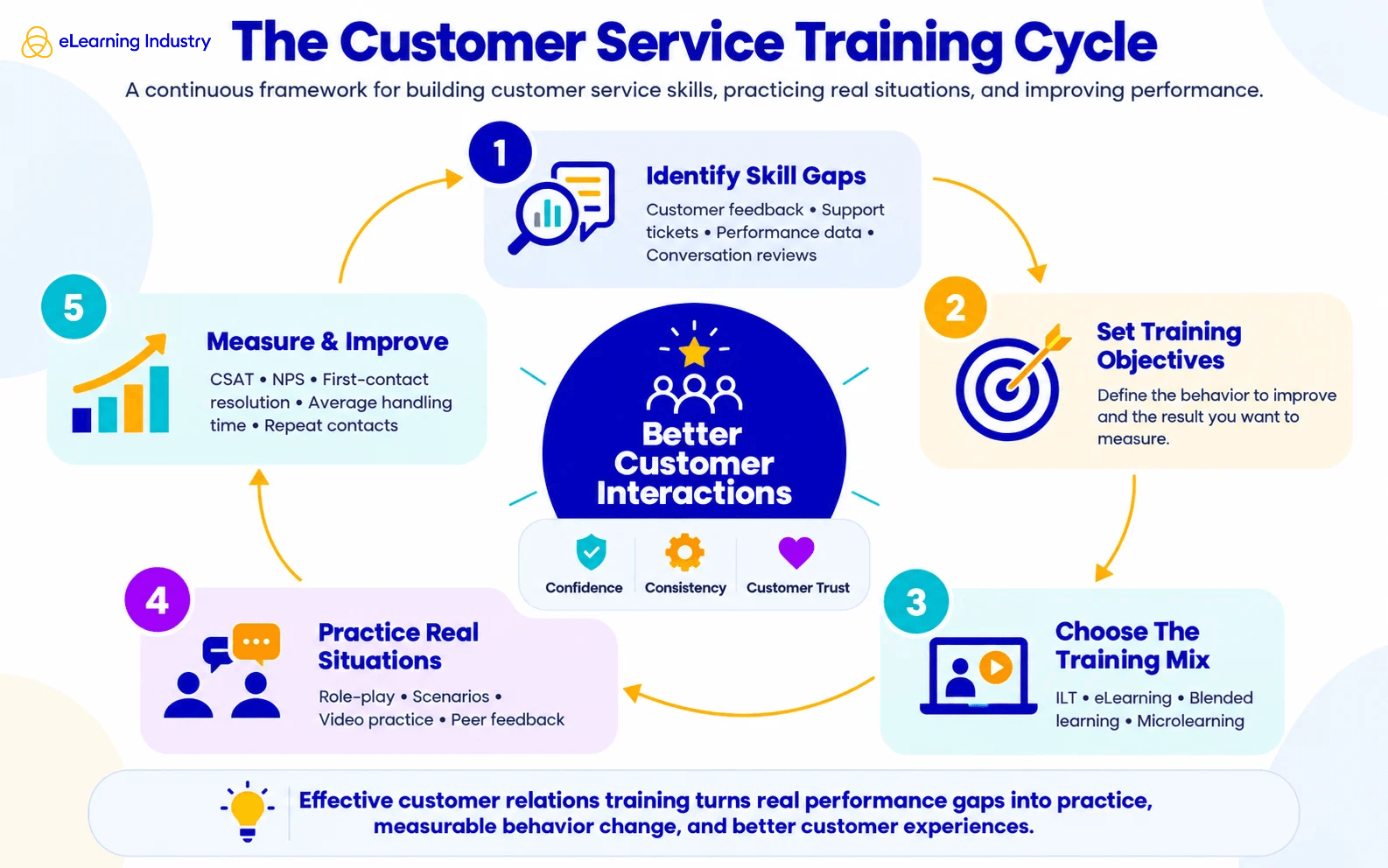
If you want your customer service training program to truly change how your team acts, just giving out a sales presentation won't cut it. Here are five practical steps you can follow to make a real difference.
Step 1: Identify Skill Gaps
Start by reviewing customer feedback, performance data, and support tickets to spot any recurring problems. Are there more complaints about how issues are resolved, how quickly your team responds, or the way they communicate? Talking directly with team managers and looking at conversation transcripts can also reveal patterns you might miss in the data. Doing this groundwork helps you focus your training on real issues.
Step 2: Set Clear Training Objectives
After you find the skill gaps, define what success looks like. Set clear, measurable goals, such as increasing first-time resolutions or lowering average handling times. Avoid vague goals like 'improving service.' Instead, tie each goal to a number and a deadline so you can see if your training works.
Step 3: Choose Training Formats (ILT, eLearning, Blended)
Customer service training comes in many formats, each fitting different needs. Instructor-led training works well when immediate feedback and live discussions are important. eLearning is a good choice for self-paced learning, especially for business products. Some programs use blended learning, which mixes both methods and gives reps more flexibility. The right mix depends on your team's size and location. If your team is spread out, eLearning may be more practical than gathering everyone together.
Step 4: Build In Practice And Role-Play
Knowing the material isn't enough to improve customer interactions. Reps need to practice in real situations and get feedback from managers or peers. Skills like active listening and conflict resolution are best learned this way, since just reading or watching videos doesn't build real confidence.
Step 5: Measure Training Impact
Even the best training won't work if you don't measure its results. After training, check the metrics you set for your customer service goals. KPIs like resolution times, customer satisfaction, and repeat contact rates show if the training worked or needs changes. It's best to review these numbers regularly, since improvements may take time to appear.
eLearning Examples For Customer Service Training
Online training gives reps more flexibility, which is important for hybrid or remote teams. Here are some eLearning examples you can try:
Scenario-Based Modules
Scenario-based eLearning puts reps in real customer situations, such as a customer asking for a refund that's not allowed. Reps choose how to respond and see different outcomes, so they learn about the impact of their words and tone without any real risk. These modules are great for new hires who need to build confidence. They can practice and improve their skills in a safe setting before working with real customers.
Video-Based Role Play
Short videos that compare a badly handled customer call with a good one are much more helpful than written manuals. Reps can see the differences in tone and pacing, practice these skills, and use them in real calls.
Microlearning Refreshers
Many companies still use yearly courses, but this doesn't help learning or memory. Microlearning breaks training into short, easy lessons over time. These lessons only take a few minutes and can be done anytime. This keeps skills fresh without interrupting work, and also helps teams stay up to date on new products or services.
How To Measure The Success Of Customer Service Training?
It's not always easy to measure how well customer service training works, but it's important. The key is to link training to your business metrics, not just check off tasks. Common metrics include Net Promoter Score (NPS), customer satisfaction (CSAT), average handling time, and first-contact resolution rate. Comparing these numbers before and after training gives you better insight than just looking at completion rates.
Customer Service Training Ideas To Keep Teams Engaged
Making training engaging is just as important as the content itself. Good ideas include short quizzes to reinforce product knowledge, peer-led practice sessions, and reviewing past customer complaints with managers or experienced reps.
Gamification can also help here. Leaderboards, badges, certificates, and similar rewards can be especially effective for microlearning content. Discussing real (anonymized) customer cases, both good and bad, keeps the training realistic instead of hypothetical situations reps aren't likely to face.


