

 ChatGPT
 Perplexity
 Claude
 Grok
Grok
What Is Customer Onboarding?
Customer onboarding is a step-by-step process that guides customers from their initial purchase to fully using and benefiting from a product or service. Simply put, it's how organizations help new users understand, set up, and start using what they've bought so they can see results quickly. Customer onboarding is more than just setup; it's about making sure customers reach their first "value moment" as soon as possible.
At its core, customer onboarding involves:
- Activating new customers
- Ensuring product adoption
- Driving early value realization
A good onboarding process makes things easier for customers, helps them feel confident, and improves the chances they'll stay long-term. This matters even more in B2B settings, where onboarding often includes several people, system integrations, and training steps.
It's also helpful to know the difference between similar terms. Product onboarding helps users learn about features inside the product, while customer onboarding covers the whole journey, including setup, training, and making sure customers succeed. Also, "client onboarding" is usually used in service industries, while "customer onboarding" is common in SaaS and product-focused businesses.
Why Customer Onboarding Matters As A Growth System
Onboarding customers is a critical part of any customer onboarding strategy because it directly shapes long-term business growth. When companies put effort into onboarding new customers well, they improve retention, increase customer lifetime value, and open up opportunities for future growth. A good onboarding experience helps customers reach their first "value moment" sooner, which boosts satisfaction and builds early trust in your product or service.
On the other hand, poor onboarding can make things difficult for customers. If the process is confusing, inconsistent, or takes too long, customers may not see value right away. This can lead to them leaving early in the relationship. That's why onboarding is often seen as the most sensitive stage in the customer lifecycle.
Therefore, a strong customer onboarding strategy gives every new customer a clear path to success, with specific steps and helpful guidance. This turns onboarding into a system that supports real growth and results. For many customers, onboarding is their first real experience of your value promise. It shows them what kind of support they can expect and lays the groundwork for long-term success, trust, and engagement.
Customer onboarding is more than just a step. It's the first real sign of our promise to the customer. When we do onboarding right, we don't just get users started, but set the stage for long-term growth.
- Christopher Pappas, CEO of eLearning Industry
The Modern Customer Onboarding Process
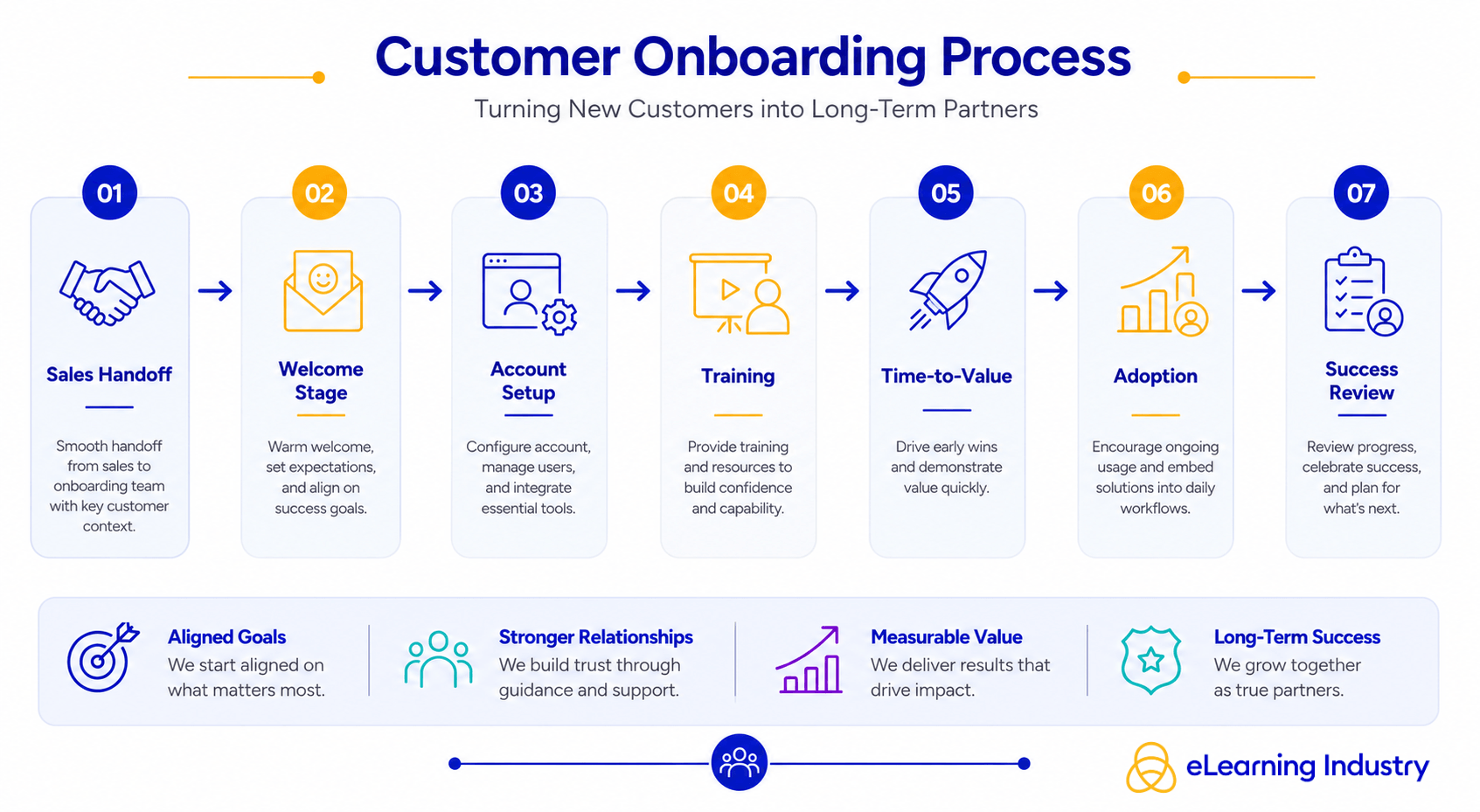
The customer onboarding process is a step-by-step approach that helps new customers move from making a purchase to using a product successfully. A good onboarding process is planned and consistent. It follows clear customer onboarding steps that guide both customers and internal teams through a predictable journey.
- Pre-onboarding alignment.
Here, sales and customer success teams work together to make sure the handoff goes smoothly. This step is important because it sets expectations, confirms customer goals, and helps avoid communication gaps. Without it, onboarding can begin with confusion instead of clarity. - Welcome and expectation setting.
This is where the customer is formally introduced to the process, timelines, and success criteria. This stage builds trust and sets the foundation for a structured onboarding journey. - Account setup and technical onboarding.
Here, teams make sure systems, integrations, and access are set up correctly. This is often where problems can happen, so clear instructions and good teamwork are important. - Training and enablement.
This is sometimes called customer onboarding training. It helps users learn how the product works, understand key features, and feel confident using it. - First value milestone.
This is the most important part of onboarding, when customers see their first real results from the product or service. It is often called the "time-to-value" moment. - Adoption reinforcement.
This means helping customers keep using the product, find new ways to use it, and make it part of their daily routines. - Success review and a check for expansion readiness.
At this stage, customer success teams look at the results and find ways for the customer to grow with the product.
If you picture the customer onboarding process, it looks more like a continuous loop than a simple checklist. Each stage leads into the next, creating an ongoing system. In the same way, the onboarding customer lifecycle shows how onboarding links directly to long-term success, retention, and growth.
Customer Onboarding Best Practices
Customer onboarding best practices help turn new users into loyal, long-term customers. When organizations use these practices, they create a clear process that reduces confusion, encourages product adoption, and boosts customer satisfaction from the start. The best onboarding is not about doing more, but about doing the right things consistently and focusing on delivering value.
Set Clear Milestones
One of the most important onboarding new customers best practices is to set clear success milestones early. Rather than using a generic checklist, define what "success" means for the customer in the first days, weeks, and months. These milestones help both the customer and your team track progress and make early wins easy to see and measure. This builds trust, as customers can see value delivered at each step.
Structured Onboarding Journey
Another important practice is to use a structured onboarding journey. A good onboarding journey gives customers a clear path from setup to adoption. Without structure, onboarding can become inconsistent and rely too much on individual effort. A structured process makes sure every customer gets a predictable, high-quality experience, no matter who manages their account. This matters even more in B2B settings, where things are more complex, and expectations are higher.
Focusing On Customer Goals
Effective onboarding means focusing on customer goals, not just your own processes. Many organizations build onboarding around their own systems or workflows, but it should always match what the customer wants to achieve. When onboarding is based on customer goals, they see value faster and are more likely to keep using your product or service.
Onboarding Support
Proactive onboarding support is also important. Rather than waiting for customers to ask questions, successful teams look ahead and offer help before problems come up. This might include scheduled check-ins, automated tips, or training sessions. Being proactive makes onboarding smoother and keeps customers engaged.
Feedback
Finally, building feedback loops into the onboarding journey is key for ongoing improvement. Regular feedback shows teams where customers struggle and which parts of onboarding need work. By gathering insights at different stages, organizations can keep making their onboarding better and support long-term customer success.
Customer Onboarding Software And Automation
Customer onboarding software helps organizations organize and manage the onboarding process more consistently and efficiently. Rather than using scattered spreadsheets, emails, or manual follow-ups, this software brings all key onboarding activities into one place. This makes it easier for teams to give new clients a smoother onboarding experience, even as the business grows.
Workflow Automation
A key benefit of customer onboarding software is workflow automation. Teams can set clear onboarding steps, assign tasks, and make sure nothing is overlooked during the process. This is especially helpful in complex B2B settings where many people are involved at different stages of onboarding.
Task Tracking
Task tracking is another important feature. Teams can easily see each customer's progress, what's been done, and what still needs work. This clear view helps avoid delays and improves teamwork between customer success, sales, and support. It also keeps the onboarding process consistent throughout the company.
Customer Engagement
Another big advantage is the ability to see customer engagement. With onboarding automation, teams can track how customers use onboarding content, training, and product setup. This helps spot where customers lose interest, so teams can make changes before people disengage.
Automation
Automation use cases are broad but highly practical. For example, welcome sequences can automatically guide new users through their first steps. Training delivery can be scheduled and personalized based on customer type or segment. Progress tracking helps teams measure onboarding success in real time. Trigger-based nudges can be used to remind customers when they stall or miss key onboarding steps.
Customer Onboarding Templates
A customer onboarding template lays the groundwork for a consistent and effective process, making sure every new client gets the same high-quality experience. For L&D, HR, and Customer Success leaders, templates are more than just paperwork. They serve as operational frameworks that help drive adoption, retention, and early value. Here are its must-have components:
- Clear goals: These goals show what success means for both the customer and the company, like activation milestones, product adoption targets, or time-to-value benchmarks. Without clear goals, onboarding can become scattered and reactive.
- Milestones: These are important checkpoints, like finishing account setup, first successful use, and completing training. Milestones help teams see progress and spot any issues early on.
- Roles: A good onboarding template assigns responsibilities to Customer Success Managers, support teams, and sometimes product or implementation specialists. This helps avoid gaps in accountability and keeps the onboarding process smooth.
- Clear timeline: It lays out onboarding activities over days, weeks, or phases, helping teams create a standard experience for new clients while still allowing for flexibility when things get complex.
- KPIs: Like activation rate, time-to-first-value, engagement levels, and onboarding completion rates. These metrics help turn onboarding into a system you can measure and improve.
How To Improve Customer Onboarding Process
Reduce Issues In The First Days
To improve customer onboarding, focus on reducing confusion, delays, and friction in the first 7 to 14 days. This early stage is important because it shapes how customers adopt and engage with your product. If customers have trouble getting started, they are much more likely to lose interest before seeing any value.
Create A Clear Handoff Process
One important way to improve customer onboarding is to strengthen the handoff between sales and customer success teams. Often, key details about the customer's goals and expectations are lost during this transition. By using a clear handoff process, customer success teams start with the right information instead of making guesses. This helps everyone stay aligned and makes onboarding smoother from the start.
Use Customer Onboarding Analytics
Rather than seeing onboarding as just a set of steps, top organizations track it as a whole system. Metrics like time-to-first-value, activation rate, training completion, and feature adoption show where customers face challenges. With this data, teams can keep improving the onboarding process instead of guessing what works.
Leverage Personalization
Customers have different needs, goals, and experience levels. By adjusting onboarding paths for each customer type, industry, or use case, organizations make the process more relevant and efficient. This keeps customers engaged and avoids extra steps that slow them down.
Customer Onboarding Process Examples
Customer onboarding process examples help Customer Success and Customer Education leaders see how onboarding works in real situations, not just in theory. Here are three practical models: SaaS, enterprise, and self-serve. Each one outlines the steps, tools, and outcome metrics.
SaaS Onboarding Model
In most SaaS settings, onboarding aims to help customers see value quickly.
- Steps: welcome email → guided product setup → interactive product tours → first activation milestone → usage-based nudges
- Tools used: customer onboarding software, in-app messaging tools (e.g., walkthrough builders), CRM integration, customer success onboarding platforms
- Outcome metrics: time-to-first-value (TTFV), activation rate, feature adoption rate, 30-day retention
This model focuses on automation and scalability, making it a good example of modern customer onboarding best practices.
Enterprise Onboarding Workflow
Enterprise onboarding is more complex and relies on building relationships. It often involves several stakeholders.
- Steps: contract handoff → kickoff meeting → onboarding plan creation → phased implementation → training sessions → quarterly success review
- Tools used: project management tools, customer onboarding templates, client onboarding process templates, shared success plans, onboarding support portals
- Outcome metrics: implementation time, stakeholder engagement score, milestone completion rate
This approach uses a structured client onboarding workflow, where alignment and coordination are more important than speed.
Self-Serve Onboarding Funnel
Self-serve onboarding aims to reduce human involvement and give users more control.
- Steps: sign-up → product tour → automated onboarding emails → in-app guidance → behavioral triggers → upgrade prompts
- Tools used: customer onboarding automation tools, lifecycle email platforms, analytics dashboards, and onboarding journey tracking systems
- Outcome metrics: signup-to-activation rate, drop-off rate at onboarding steps, free-to-paid conversion rate
This model is common in PLG (Product-Led Growth) environments and shows how to scale onboarding for new customers.
Conclusion
Customer onboarding should be seen as a growth system rather than just a checklist. When carefully planned, it becomes a reliable process that drives adoption, retention, and long-term customer value. Companies that treat onboarding as a system tend to do better in keeping customers, making them happy, and growing revenue. Therefore, leaders should think of onboarding as a key strategic skill, not just a routine step.