
 ChatGPT
 Perplexity
 Claude
 Grok
Grok
How Partner Readiness Affects Channel Sales
Most manufacturers already provide some form of partner training. But the real question is how much of that channel training actually helps partners sell more consistently. You can have a great product, a strong brand, and a solid value proposition, but the reality of a distributor model is simple: the product that is easier to understand is always the product that is easier to sell.
Consider two manufacturers selling comparable products through the same distributor network.
Brand A provides partners with formal certification, targeted objection-handling guidance, onboarding for new representatives, and systematic product updates. Conversely, Brand B distributes a handful of PDFs, hosts occasional ad hoc calls, and leaves product interpretation entirely to the distributor's team.
Brand A is more likely to sell better. Their reps know exactly how to bring the product into a conversation, pitch its value, and handle pushback from customers.
The Business Outcomes Of Structured Partner Enablement
Once you see distributor training through this lens, the business wins become obvious:
- Launch new products faster. Your training pipeline is already built, so partners catch on instantly and start selling sooner.
- Reduce lost sales. Reps understand product fit and objections, so they stop blowing deals with weak explanations.
- Prevent costly product mistakes. Partners stay aligned on warranties and pricing, preventing expensive post-sale issues.
- Monitor partner readiness. You can see exactly which distributors can handle leads right now and where training gaps still put your revenue at risk.
- Reduce manual channel support. You can support a growing distributor network without adding the same amount of manual follow-up.
Naturally, this also makes a significant difference for the distributors themselves.
When training is structured and easy to access, new employees ramp up faster, managers spend less time explaining product basics, and sales teams can build stronger cases for customers.
For top-performing partners, certification can also open the door to new products, joint campaigns, premium service levels, or other vendor opportunities.
5 Steps To Launch Structured Distributor Training From Scratch
If your current distributor training setup makes it hard to track partner readiness, support sales, or scale, it may be time to bring the process into a product training LMS. Let's see how you can do that in five simple steps.
Step 1: Set The First Business Priority
When manufacturers decide to build a distributor training program, the initial instinct is almost always to digitize everything overnight. But in reality, that first launch can quickly become too big to control and measure.
Look for a single, high-friction business problem where training can deliver a visible, immediate win. To choose the right case, look at the business data you already have:
- Sales metrics. Revenue by product line (basic vs. high-margin), the product mix per partner, average deal sizes, and conversion rates.
- Support and service analytics. The volume of technical tickets per partner, order error rates, and product return volumes.
- Network signals. Pay attention to customer complaints about poor product explanations, and count how often partners flood your internal teams with requests for basic product clarifications.
Step 2: Map Your Distributor Network
A typical manufacturing channel is complex, spanning large national dealers, tiny regional shops, independent branches, sales reps, service technicians, and regional managers. Сlarify three operational pillars:
- Partner companies — which distributors are included in the first rollout.
- Partner roles — which roles need training inside those companies.
- Local ownership — who will own coordination on the partner's side.
Once this structure is clear, you can mirror it on the learning platform. For example, iSpring LMS lets you recreate your org structure to automate routine tasks and manage large-scale programs with less manual follow-up. You can use departments and groups to set up partner hierarchies and target learning groups.
For local responsibility, you can add unlimited admins or create custom roles. A partner-side manager or regional coordinator can receive limited permissions to manage their team or view relevant reports, while the manufacturer maintains control over the entire training structure.
Step 3: Prepare Training Content For The First Rollout
You probably already have enough materials to start with: presentations, PDFs, manuals, sales sheets, demo recordings, and product notes. To make them interactive and trackable, you'll need an authoring tool.
With iSpring Suite AI, a static product deck can become a short online course with narration, visuals, knowledge checks, videos, and interactions. The tool works right in PowerPoint, which makes the creation process quick and easy, even if you've never done it before.
Still, this familiar authoring environment gives you everything you need for distributor training:
- Record training videos for product demos, service procedures, and walkthroughs.
- Prepare reps for customer conversations, price objections, and product-fit questions with role-play simulations.
- Generate a ready-to-review course and speed up writing and quiz generation with AI.
- Explain complex products visually with interactions, including hotspots, diagrams, steps, and labeled graphics.
- Build more reliable certifications with randomized question pools, time limits, attempt limits, and feedback.
- Streamline global rollouts with built-in localization into 70+ languages.
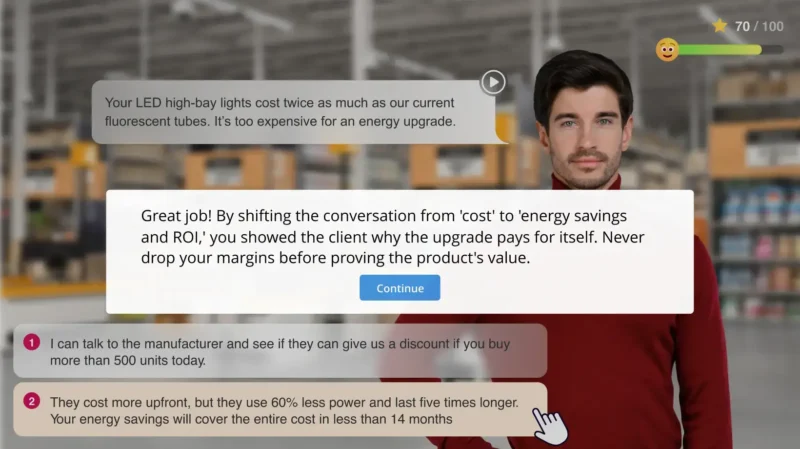
Pro tip: Product specifications alone rarely drive sales. To make the training effective, combine technical details with practical sales guidance, such as identifying the target audience and addressing the most common customer objections in that specific market.
Step 4: Set Up Partner Certification In The LMS
When it comes to full partner certification, it's much better to organize it as a single, sequential learning track than as separate, isolated courses. A learning track is a step-by-step chain of courses, materials, and activities that can automatically issue a certificate once it has been completed.
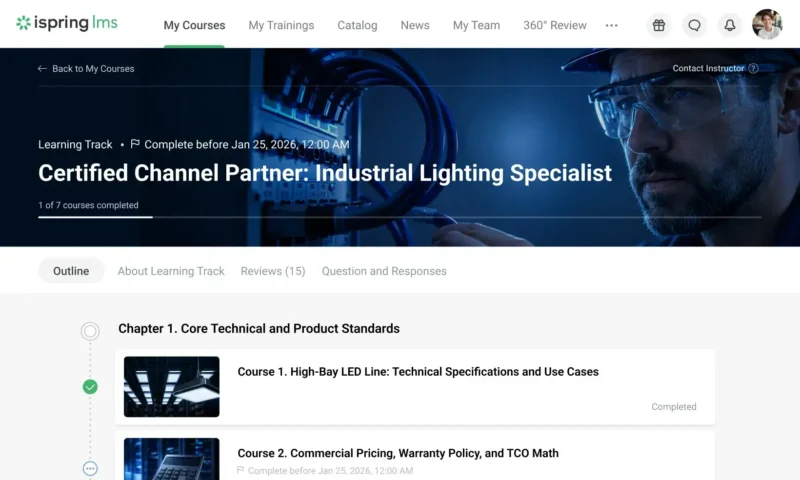
If your product specifications require periodic recertification, you can easily set an expiration date, configure reminders in advance, and set up auto-assignment rules. Partners will automatically get notifications about the new training and upcoming deadlines, completing the process with no manual control on your part.
To bridge the gap between digital theory and real-world practice, you can also use the on-the-job training module. Local supervisors can use mobile observation checklists directly within the LMS to grade live sales talks or technical service tasks, keeping a clear history of how partners apply their knowledge in live settings.
Step 5: Roll Out Training And Track Early Results
After rolling out the training, you need a checkpoint to see whether the training system works as expected. Start with three layers of data:
- Training activity — enrollment, progress and completion, overdue learners, and quiz scores and attempts.
- Readiness evidence — certification status, role-play scores, manager observations, and OJT checklist results.
- Channel impact — product adoption rate, average deal value, time-to-productivity for new reps, and speed of new product rollout.
In iSpring LMS, you can use 25+ real-time reports to track progress by learning track, course, department, region, or partner group.
For a broader view, the Supervisor Dashboard gives HQ a consolidated picture of partner readiness across the network. Instead of collecting updates from reports, emails, and managers, you can see where the rollout is on track and where follow-up is needed.
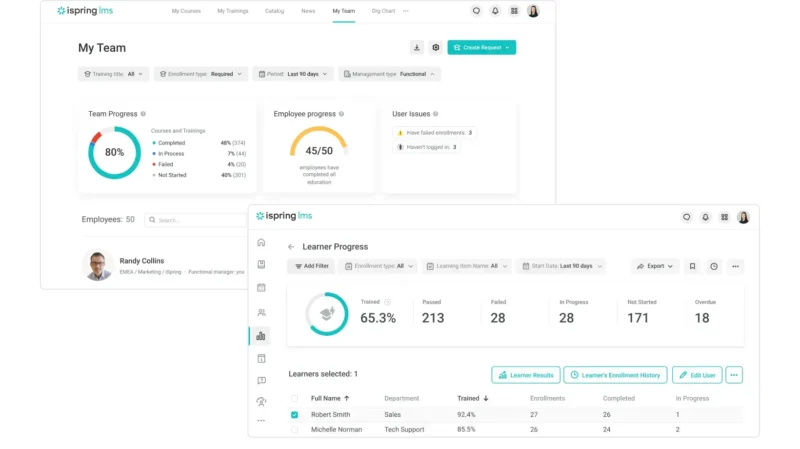
This data can not only prove training effectiveness but also directly drive high-stakes business decisions.
Take Suzuki, for example. During a new motorcycle launch, they used iSpring reports to track which dealerships had actually completed the mandatory technical and sales training. The rule was simple: if a dealer didn't finish the training, they didn't get the bike shipment. In this setup, training analytics became a critical gatekeeper for the entire product rollout.
From the Suzuki Australia success story:
We trained 100% of our selling dealers' technical and sales staff on a new model motorcycle throughout Australia, thanks to iSpring.
Final Words
Products change, new reps join partner teams, pricing and warranty rules get updated, and some certifications need to be renewed. That's why the program should be easy to update, reassign, and measure.
A strong training setup with iSpring LMS gives manufacturers a repeatable way to keep partners ready, protect product messaging, and understand where the channel still needs support.
If you want to see how this works in practice in iSpring LMS, book a short, free, personalized demo. We'll examine your partner structure and show how this setup would work for your organization.