



What Is Educational Inequality?
Educational inequality happens when learning opportunities, resources, support, and results are not shared equally among different groups of students. These differences can be linked to things like income, race, location, disability, language, school funding, access to technology, or other structural issues.
In simple terms, educational inequality means that students do not always begin with the same conditions or have the same chances. Still, educational inequality, educational inequity, and education gaps are not exactly the same.
Concept |
Meaning |
| Educational inequality | Observable differences in access, resources, opportunities, or outcomes |
| Educational inequity | Unfair or avoidable differences created or reinforced by systems |
| Education gap | A measurable difference between groups, such as achievement, participation, completion, or access |
This difference is important because just seeing a gap in education does not tell us why it exists. For example, if two groups have different completion rates, the numbers alone do not show if the reason is unequal access to technology, different levels of support, course options, accessibility issues, or something else.
That is why people studying educational gaps should look at more than just the results. It is more helpful to ask what conditions, resources, and learning opportunities students had before those results. Knowing these factors helps show where educational inequity starts and where action can make the biggest difference.
What Does Educational Inequality Look Like In Practice?
It is easier to understand educational inequality when we see how it affects the real opportunities students get. It is not just about being able to attend school. It also includes the quality of courses, support, technology, and options students have.
Unequal Access To Courses And Learning Opportunities
A clear example of educational inequality is when students do not have the same access to valuable learning opportunities. Some students can pick from advanced classes, STEM and computer science programs, college prep, career training, special programs, and extra activities. Others have far fewer choices.
The U.S. Civil Rights Data Collection shows these education gaps by tracking who has access to subjects and resources like math, science, computer science, staff, programs, and school climate. Differences in which courses are offered can lead to inequality even before test scores show a gap.
Unequal Access To Qualified Educators And Support
School inequality can also happen when there are differences in teacher availability and student support. Having access to experienced teachers, counselors, specialists, tutoring, and good professional development affects how well students do. If these resources are not shared fairly, students may face challenges that are not about their effort or ability.
Unequal Digital Access
Today, lack of access to education also includes digital issues. Real digital access means more than just having a laptop. Students need reliable devices, stable internet, easy-to-use platforms, digital skills, the right content, and help when technology issues arise.
This is important for EdTech leaders because, even if a platform is available to everyone, it can still lead to unequal education if some students cannot use it well.
Unequal Learning Outcomes
These differences show up later in things like achievement gaps, graduation rates, college enrollment, skills, and career paths. Still, education leaders should not look at these results alone. School inequality often starts much earlier, with unequal access to the chances and support students need to succeed.
What Causes Educational Inequality?
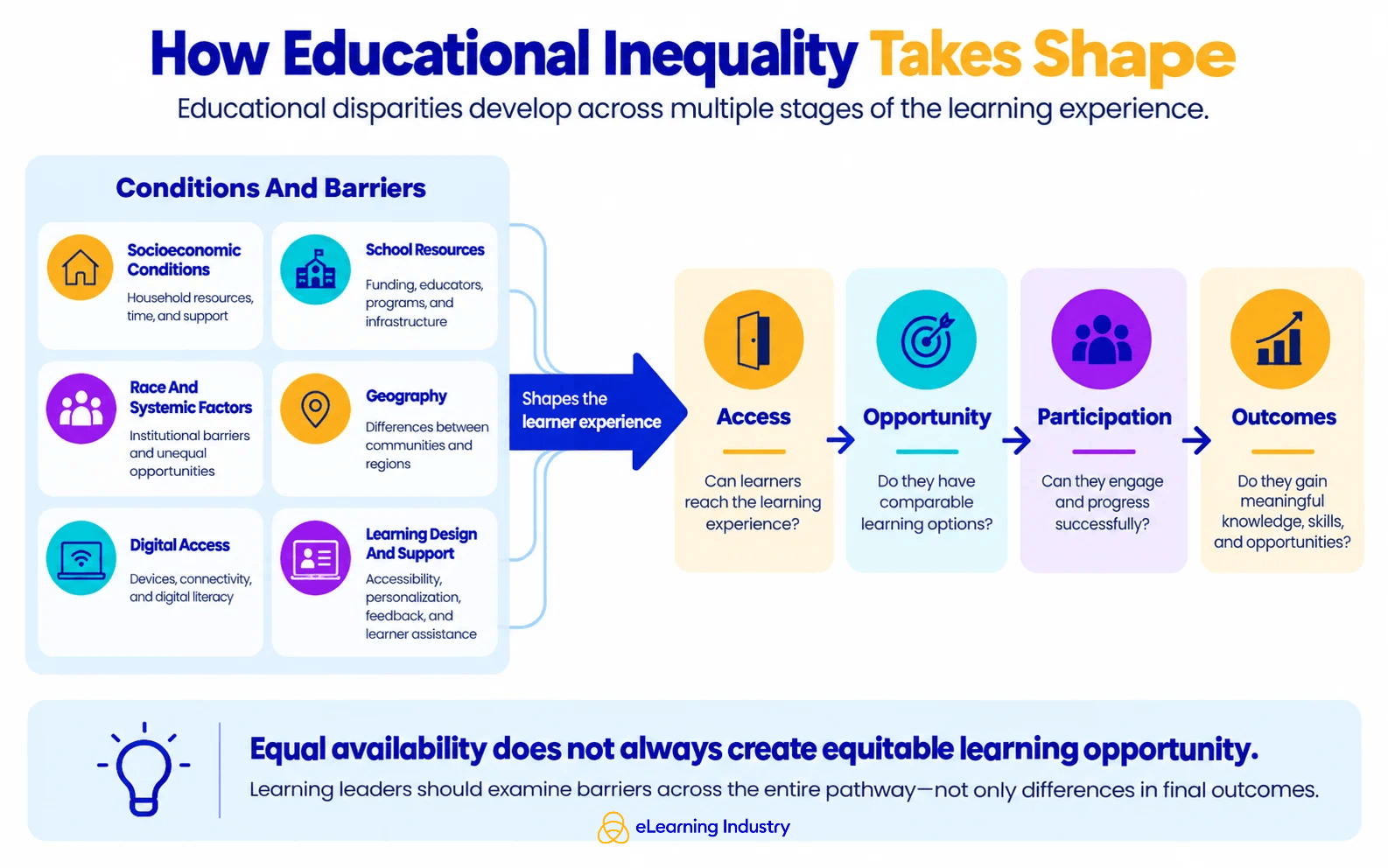
Educational inequality has many causes, so it cannot be explained by just one factor. Usually, it results from a mix of socioeconomic conditions, institutional systems, access to technology, and the quality of the learning experience.
1. Socioeconomic Inequality
Household income can affect a student's opportunities even before their achievements are measured. Families with more money often have better access to reliable internet, tutoring, enrichment programs, learning materials, and a good place to study. Income can also affect which schools students can attend and how much support they get at home. Because of this, social inequality leads to very different learning conditions.
2. Unequal School And Community Resources
Not all schools and communities can offer the same learning opportunities. Differences in funding, buildings, staff, available courses, and community services affect what students can access. Rural and urban areas also face different problems, like teacher shortages or fewer special programs. This does not mean that schools with fewer resources are always less effective, but they often have to work with more challenges than better-funded schools.
3. Systemic And Institutional Barriers
Some education gaps are made worse by problems within the system itself. Unequal access to advanced classes, how students are placed, barriers to accessibility, discipline rules, and admissions processes all affect who gets certain opportunities. Over time, these systems can create ongoing inequality, even if the policies seem fair at first glance.
4. Technology And Connectivity Gaps
The digital divide is no longer just about having a device. A student might have a laptop but still struggle with poor internet, low digital skills, hard-to-use platforms, or a bad study environment. Now, the quality of the digital experience is just as important as having access in the first place.
5. Differences In Learning Design And Support
Finally, providing everyone with the same content does not mean everyone will have the same learning experience. Factors like accessibility, language, cultural relevance, background knowledge, mental effort, feedback, personalization, and support all affect how well someone can learn. For leaders in learning and education technology, reducing inequality means looking beyond just making content available and asking if all learners truly have a fair chance to take part, make progress, and succeed.
Racial Inequality In Education: Where Do The Gaps Appear?
Racial inequality in education means that students from different racial or ethnic backgrounds often have unequal access to education, opportunities, resources, and support. These differences can start early and affect the courses students take, the help they get, and their future options.
Examples Of Racial Inequality In Education
Racial inequality in schools can show up in many ways.
- Some students may have less access to advanced classes, gifted programs, experienced teachers, technology, or well-funded schools.
- There can also be differences in discipline and in chances to go to college or other programs after high school.
The latest Civil Rights Data Collection helps us understand these patterns. In 2023–24, the U.S. Department of Education gathered data from almost every public school in the country. This data covers things like course access, programs, staff, and school climate. Much of it can be sorted by race, ethnicity, disability, and English learner status.
For L&D and EdTech professionals, this is important because unequal opportunities can still exist even if digital learning is available. Who benefits most from technology in education often depends on access to devices, the internet, good digital content, and strong support for learners.
Why Race And Socioeconomic Status Should Not Be Treated As Interchangeable
Race and income are connected, but they are not the same thing. Differences in education can also be linked to where students live, their disabilities, or whether they are learning English. If we treat income as a stand-in for race, we might miss racial bias or other issues that need different solutions. By understanding how these factors overlap, leaders can better find the real reasons behind education gaps instead of thinking there is only one cause.
Educational Inequality In America: What The Data Tells Us
Educational inequality in America is easier to see when we look past national averages and consider who really gets access to valuable learning opportunities. Federal data shows that these gaps can appear long before we notice differences in test scores or graduation rates.
Who Has Access To Advanced Learning Opportunities?
College-prep opportunities are not spread out equally, either. NCES data on Advanced Placement, International Baccalaureate, and dual-enrollment programs show that districts with over 90% Black students were less likely to offer AP courses than districts with fewer than 10% Black students: 52% compared to 61%. Students with disabilities and English learners were also much less likely to be in advanced courses.
Who Has The Technology Needed To Participate?
Technology access is another part of education inequality in the U.S. In the 2024–25 school year, 88% of public schools said they had a one-to-one computing program. But only 46% let students take devices home during the week and on weekends, and this dropped to 34% in high-poverty areas. NCES also points out that digital equity means having reliable devices, good internet, and technical support, not just owning a device.
Where Do Achievement And Opportunity Gaps Persist?
Recent NAEP results show that education gaps are still a big issue. In 2024, average math scores for twelfth graders dropped compared to 2019 for Black, Hispanic, and White students, as well as for students from both low- and higher-income backgrounds.
Why Should Leaders Examine Opportunity Gaps Alongside Outcome Gaps?
This difference is important for understanding educational inequality in the U.S. Outcome data shows where inequality shows up, while opportunity data helps leaders see where they might be able to make a difference.
For example, lower achievement or fewer students finishing advanced courses is only part of the story if some learners never had the same access to those courses, good teachers, reliable technology, or academic support. For L&D and EdTech leaders, looking at access and opportunity along with outcomes gives a much clearer picture of education gaps in America and helps them decide where technology and learning programs can make the biggest difference.
Can EdTech Reduce Educational Inequality?
EdTech can help reduce educational inequality, but only if access, design, implementation, and learner support are all considered together. Just giving out a platform, device, or digital course does not ensure fairness in education. If technology is not used well, it can actually make existing gaps worse by adding new challenges for students who already struggle to access education.
One helpful way to see if digital learning promotes equity is to look at the 5 key conditions.
1. Access
First, students need reliable access to the learning experience. This includes having the right devices, a stable internet connection, affordable access, and content they can use. If any of these are missing, technology could make educational gaps even bigger.
2. Usability
Access is just the first step. Students also need to be able to use the platform easily. Things like user experience, mobile compatibility, internet speed needs, and support for assistive technology all affect whether EdTech works well for everyone.
3. Relevance
Learning should match students' needs, backgrounds, language, what they already know, and their goals. If everyone gets the same experience, it might be available to all, but it can still lead to unequal participation and results.
4. Support
When students have trouble, they need help. Teachers, facilitators, coaches, tech support, and quick feedback all help make sure digital learning problems do not become another reason for inequality in education.
5. Outcomes
Finally, leaders should check if technology is actually helping students learn, not just boosting logins, course completions, or screen time. What really matters is whether students gain knowledge, skills, confidence, and new opportunities.
How AI Could Affect Education Gaps
AI has the potential to reduce educational inequality, but this will only happen if it is used to expand access instead of making current gaps worse. When applied thoughtfully, AI can:
- personalize learning
- translate materials into different languages
- make education more accessible
- offer tutoring to many students at once
- give quicker feedback
- help teachers update materials more easily and spot students who need extra help.
But if access to AI is not equal, it can actually make education gaps worse. How?
- Some of the best AI tools might only be available through paid subscriptions, and schools or students without good internet, devices, or tech support may be left out.
- Also, if the data used to train AI is biased, it can repeat old inequalities, and systems that are hard to use may leave out students with disabilities.
- Students and teachers having different levels of digital skills or training can add to the problem, too.
- There is also a risk in depending too much on automated suggestions or decisions without enough human input.
AI can help teachers, but it should not take the place of their professional judgment, especially when it comes to important choices for students.
Just because an education system uses AI does not mean it is fair for everyone. Fairness depends on who can use the technology, how it is built, how choices are made, and whether those who face the biggest challenges actually benefit.
What Can Learning And EdTech Leaders Do About Educational Inequality?
To tackle educational inequality, learning leaders need to look beyond what happens after a learner joins a platform or program. Start by checking if everyone has access. Before judging low engagement or completion rates, make sure learners have reliable devices, internet, accessible content, and a real chance to take part.
Measure Access Before Measuring Engagement
Low platform use does not always mean learners lack motivation. It could be due to unequal access, technical problems, or accessibility challenges. Leaders should look into these issues before making judgments based on engagement data.
Break Down Data to Find Hidden Gaps
Looking only at overall numbers can hide big differences in education. When possible, review results by location, language, accessibility needs, demographic groups, device type, internet access, and other important factors. This helps uncover gaps that averages might miss.
Design With the Most Limited Learners in Mind
Inclusive learning design needs to consider real-world limits. Using mobile-friendly formats, low-bandwidth options, downloadable materials, captions, transcripts, screen-reader support, and flexible pacing can help remove barriers while keeping learning standards high.
Evaluate Opportunity, Not Just Outcomes
Ask who was able to enroll, access the content, finish the program, get support, and benefit in the end. Measuring opportunity as well as results gives a better idea of where education gaps start.
Check Technology for Its Impact on Equity
Finally, before scaling an LMS, AI tool, or adaptive learning platform, check if it removes barriers or creates new ones. Equity should be a key part of design and measurement, not something assumed after the technology is in place.
Conclusion
Educational inequality is not just about whether learning is available. It is also about whether people can reach, take part in, and truly benefit from it. Factors like income, race, location, disability, school resources, digital access, and other barriers all affect these chances. This is why simply offering equal access is not enough. Learners often need different kinds of support to achieve fair results. EdTech can help close education gaps by making learning more personal, accessible, and scalable, but only if it is used carefully. In the end, education leaders should look at access, opportunity, participation, and results together to see if progress is really fair.

