

 ChatGPT
 Perplexity
 Claude
 Grok
Learning Objectives Examples: How To Write Them For Training
Even if a training program has great content, it may not succeed if learners do not know what they are supposed to achieve. Clear objectives help guide the training by specifying exactly what knowledge, skills, or behaviors learners should demonstrate by the end.
When learning objectives are clear and specific, it is easier to see if the training led to real improvements. But what does a good learning objective look like, and how can you tell if it is useful? Keep reading to learn more.
What Are Learning Objectives?
Learning objectives are short statements that explain what a learner should know, understand, or be able to do by the end of a lesson, course, or training program. Instead of listing what the instructor will teach, these objectives focus on what learners are expected to achieve. Simply put, a learning objective answers the question: what should a learner take away from the training session?
Why Clear Learning Objectives Matter For Training
Clear learning objectives act as a roadmap for training programs. They set out what should be achieved and help Instructional Designers choose content that supports business goals and leads to the right results.
Objectives also help make the best use of resources by focusing time and tools on key skills. Good learning objectives provide clear ways to measure participants' performance and the program's effectiveness. They show learners what to focus on, highlight practical value, and make it easier to remember important ideas.
Types Of Learning Objectives
Learning objectives can take different forms. Some check what learners already know, others look at how they respond or think, and some measure how well they perform a task. These objectives fit into three main categories: cognitive, affective, and psychomotor. Knowing the differences helps you pick the right objectives for your training goals.
Cognitive (Knowledge-Based) Objectives
Cognitive objectives are about what learners know and how they think. They cover facts, ideas, and information, and often involve understanding, remembering, explaining, analyzing, applying knowledge, or making decisions. You'll often see these objectives in product knowledge, compliance, technical, and professional training.
Example Verbs: Explain, define, list, and calculate.
Affective (Attitude-Based) Objectives
Affective objectives deal with feelings, values, motivation, and behavior. They support emotional growth and shape how employees interact with colleagues, customers, and workplace situations. Since it's hard to measure beliefs or attitudes directly, these objectives should describe a clear, observable behavior that shows the desired change.
Example Verbs: Defend, value, respect, and appreciate.
Psychomotor (Skill-Based) Objectives
Psychomotor objectives are about physical movement and coordination. They involve motor skills that need practice, speed, and action to turn knowledge into real skills. These objectives focus on hands-on practice instead of theory, which is important for technical, manufacturing, healthcare, and operational training. A good objective clearly states what learners should do and the standards they need to meet.
Example Verbs: Build, operate, sketch, and perform.
Frameworks For Writing Clear Learning Objectives
A good learning objective does more than list what a course includes. It tells learners what they can expect and gives trainers a way to measure progress. Using the right framework helps turn a general goal into a clear, specific result that learners can show.
Bloom's Taxonomy (Remembering To Creating)
Bloom's Taxonomy helps you decide how deeply learners need to think about a topic. Its levels go from simple recall to more complex thinking skills.
At the lower levels, learners remember and understand facts, terms, and concepts, then use them to finish a task or solve a familiar problem.
At the higher levels, learners analyze and break down information, judge evidence or standards, and combine ideas and skills to create something new.
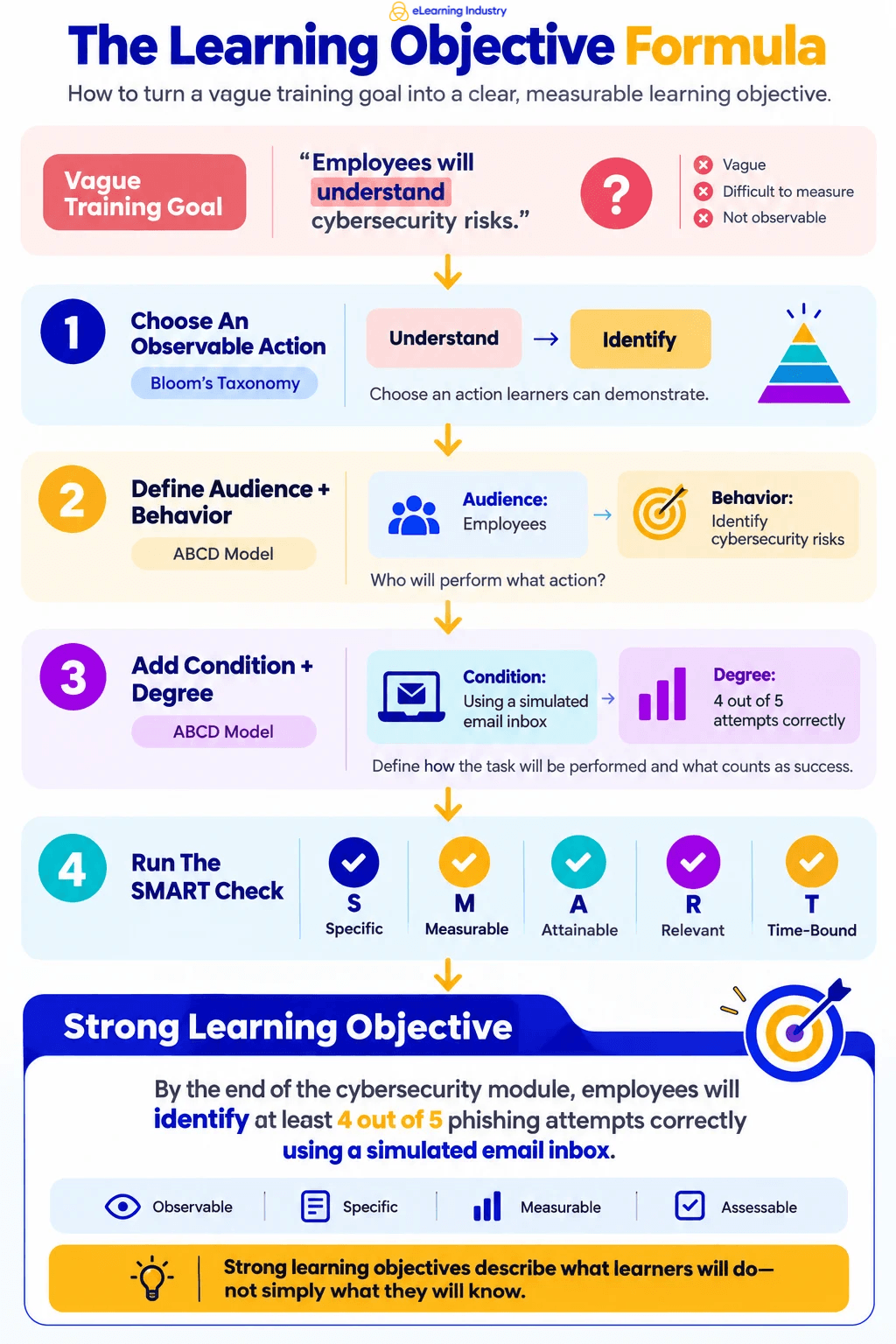
This framework helps you pick objectives that match the needed level of learning. For example, asking someone to spot data security risks is simpler than asking them to judge a security breach and make a response plan.
The SMART Criteria (Specific, Measurable, Attainable, Relevant, Time-Bound)
The SMART criteria (Specific, Measurable, Attainable, Relevant, and Time-Bound) help turn an idea into a clear and focused goal for learning and assessment.
- Specific: State in clear, simple language what the learner should achieve.
- Measurable: Pick a way to track, assess, or see progress.
- Attainable: Ensure the goal is realistic given the learner's current skills, resources, and available training time.
- Relevant: Connect the objective to the learner's job, growth needs, or the main purpose of the training.
- Time-Bound: Give a clear deadline or time frame for reaching the goal.
The ABCD Model (Audience, Behavior, Condition, Degree)
The ABCD model splits an objective into four key parts: audience, behavior, condition, and degree.
- Audience: Identifies who is expected to perform the task (e.g., new sales trainee or customer support representative)
- Behavior: States the specific action the learner should perform (e.g., operate the software or complete a thesis statement)
- Condition: Explains the circumstances under which the learner will perform (e.g., using a CRM tool or without AI tools)
- Degree: Defines the criteria for success (e.g., with 70% accuracy or within 10 minutes)
Using these frameworks can turn unclear training goals into clear objectives. They show learners what to achieve, how to do it, and what success looks like.
Action Verbs To Use (And Avoid) In Learning Objectives
The words you use in learning objectives can make them clear and measurable or leave them unclear. Good objectives use specific, measurable action verbs that align with Bloom's Taxonomy and specify what learners need to do. Pick clear verbs that fit the level of thinking or skills you want, instead of just using general instructional words. Below is a list of verbs to use and avoid.
Action Verbs To Use |
Action Verbs to Avoid |
|
|
Common Mistakes To Avoid When Writing Learning Objectives
Strong training content is important, but if your objectives are not well written, it becomes harder to design, deliver, and measure the learning experience. Watch out for these common mistakes to make your objectives clearer and more helpful.
- Using verbs that are too general, such as "understand," "know," or "learn."
- Focusing on what the instructor will do instead of what the learner should accomplish.
- Including too many unrelated skills, several verbs, or multiple steps in a single objective.
- Setting expectations that are not realistic for the learner's current knowledge, available resources, or time frame.
- Writing objectives that are too broad and do not clearly state what behavior or skill learners should develop.
- Ignoring assessment and failing to give learners the opportunity to demonstrate specific skills or abilities.
Learning Objectives Examples For Corporate Training
Corporate training includes topics like leadership, data security, and software skills. Learning objectives should match the real behaviors or skills employees need on the job. Here are some examples from common corporate areas:
- Identify five potential safety risks in the warehouse using the daily checklist within 10 minutes of shift start.
- Demonstrate five effective ways to handle complex customer complaints during phone support simulations
- Apply the SBI (Situation-Behavior-Impact) model to develop constructive peer feedback during a simulated employee conversion.
- Report compliance violations through the company ethics portal per the standard 24-hour protocol.
What Is The Most Important Objective Of Learning?
The main goal of learning is to help people apply their knowledge and skills in real-world contexts. After a training session, learners should feel confident using what they know, making better choices, working more effectively, and improving in their daily lives. When learning moves past memorizing facts, training becomes more useful, valuable, and easier to measure.


