



Learning Platform Trends: All You Should Know As A Vendor
Artificial Intelligence is influencing learning platform trends in 2026, but not exactly as many technology vendors expected. Providers are still investing a lot in AI platforms and automation, but L&D buyers are focusing on practical needs. Instead of seeking out every new AI feature, they want solutions that make learning better for users, work well with their current systems, and show clear business results. Simply being innovative is not enough; the technology must address real problems.
This change has led to what eLearning Industry calls the AI expectation gap, which is the difference between what vendors are creating and what buyers really want. Insights from over 500 L&D buyers and technology vendors around the world show both sides of the learning platform market, highlighting where their priorities match and where they differ.
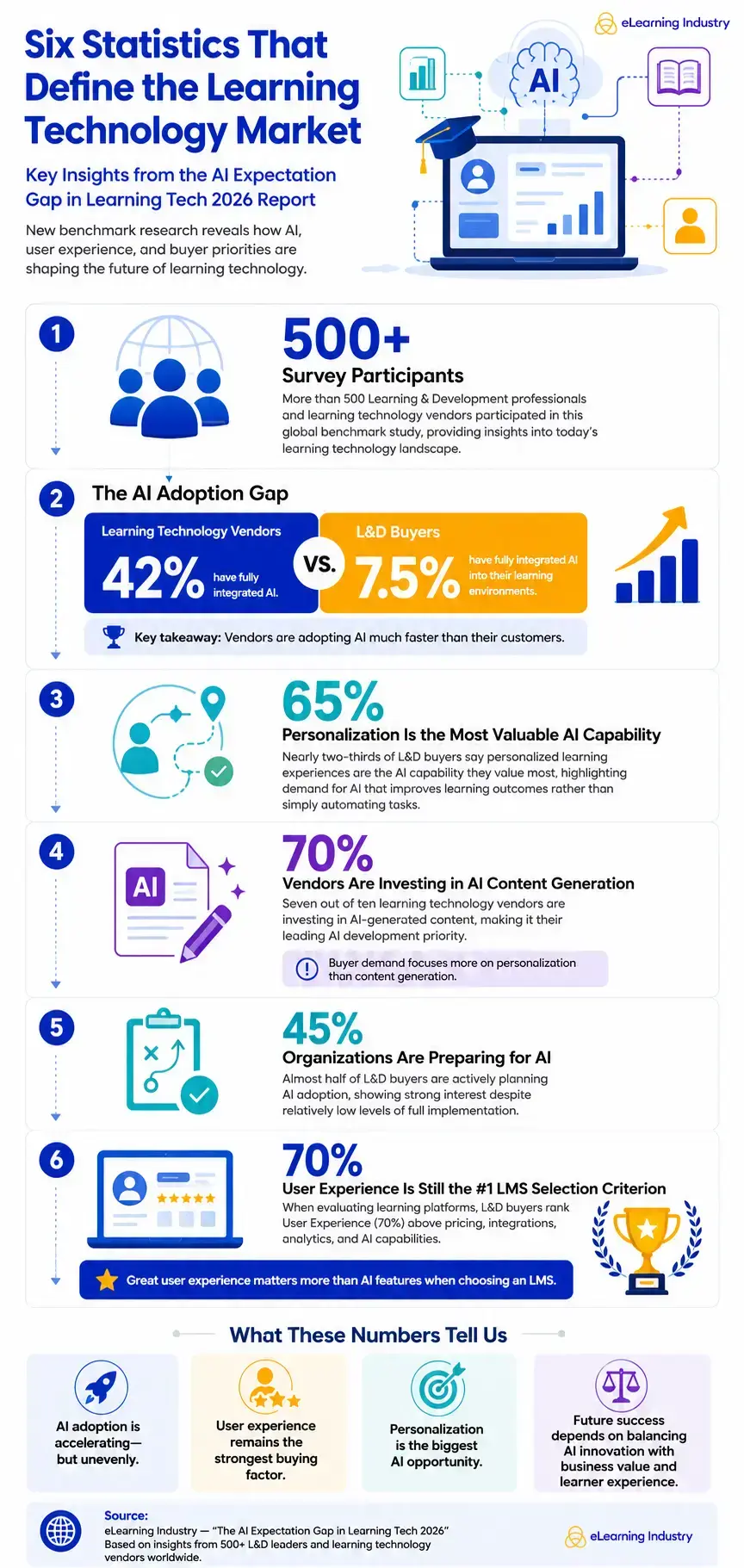
The findings of our exclusive benchmark report question some common beliefs about learning technology trends. For instance, 70% of L&D buyers say User Experience is their main reason for choosing a platform, while only 30% put AI features at the top. Also, even though 42% of vendors say their platforms have full AI integration, just 7.5% of buyers report that AI is fully integrated into their learning environments.
Vendors who want to create platforms that offer real, long-term value need to understand these trends in Learning Management Systems and how buyer expectations are changing. Focusing only on impressive AI features is not enough.
The AI Expectation Gap In Learning Tech 2026: What L&D Leaders Want From AI Platforms Vs. What Vendors Are Building
The Learning Platform Market Is Entering A New Phase
Learning platform trends in 2026 reveal a market that's shifting its focus from adding the latest AI features to delivering measurable value for organizations and learners. AI is still changing corporate learning technology, but vendors can no longer rely on innovation alone to stand out. Now, success depends on building platforms that help learners achieve better results, streamline work processes, and deliver a great User Experience.
Our report calls this change the AI expectation gap. Vendors are quickly adding AI features, expecting higher demand, but many L&D buyers are more careful. The research shows 42% of vendors have fully integrated AI, while only 7.5% of buyers say the same for their learning environments. Also, 45% of buyers are still planning their AI adoption, which means many organizations are still evaluating rather than fully using AI.
At the same time, AI is now seen as a standard feature, not the main reason for investing in new learning platforms. Over 80% of buyers think AI is very or somewhat important when choosing solutions, but they still focus on practical business needs instead of just the latest technology.
These new priorities are changing learning technology trends. Buyers want platforms that work well with their current systems, help them reach business goals, and make learning more engaging. They are interested in features like personalization, easy-to-use design, and clear results, not just AI-generated content and automation.
For vendors, the future of learning platforms is not about having the most AI features. It is about showing how these features make learning better, build trust, and solve real business problems. Platforms that find this balance will have the best chance to stand out in a competitive market.
7 Learning Platform Trends That Might Surprise You
Trend #1: User Experience Is Still The Biggest Competitive Advantage
While there is a lot of talk about AI in learning platform trends, the data shows that AI is not the main factor driving purchasing decisions. Organizations still focus on the basics when choosing new solutions. Specifically, our benchmark report found that:
- User Experience (70%) is the top selection criterion.
- It is followed by pricing (63%) and integration with existing systems (59%).
- Analytics and reporting (46%), content variety (31%), and AI capabilities (30%) are less important.
- Scalability, support, and onboarding each received 27% of responses.
These results show that organizations want technology that fits easily into their workflows and provides immediate value. Even though AI is becoming more important in learning platforms, it cannot make up for a difficult interface, confusing navigation, or a poor implementation experience.
Our report shows this trend throughout. L&D buyers usually judge platforms by how easy they are to use, how well they fit into operations, and the value they bring to the business, not just by new technology. Vendors also see this, listing User Experience, pricing, and integrations as more important than AI features.
For vendors keeping up with the latest learning technology trends and LMS trends, the message is clear: AI should make the learning experience better, not take away from it. The best AI learning platforms will mix smart features with easy-to-use design, smooth integrations, and an experience that helps learners get involved. In short, AI cannot make up for a bad User Experience.
Trend #2: AI Is Becoming A Baseline Feature, Not A Differentiator
Recent trends in learning platforms show that AI is now seen as a standard feature rather than a unique advantage. Although AI still influences the future of corporate learning technology, vendors can no longer rely on AI alone to attract buyers. Instead, buyers are looking at the complete experience a platform offers, such as how easy it is to use, how well it integrates with other tools, how it personalizes learning, and whether it delivers real business results.
Our report shows that:
- AI matters to L&D professionals, but not everyone sees it the same way.
Of those surveyed, 37% say AI is extremely important when choosing a platform, while 45% think it is moderately important. Another 12% are neutral, and just 3% say AI is not important. These results suggest that AI is now a standard part of modern learning platforms, rather than a new feature that guarantees a sale. - Learning technology vendors have noticed this change.
About 45% now promote AI as a way to boost performance, 44% highlight it as a top feature, and 38% see it as a basic part of their platform. Only 24% still treat AI as an extra option. However, the report also finds that buyers still care more about User Experience, price, and how well the platform integrates with other systems than about AI features.
So, here's the takeaway: do not focus only on AI features. Show how AI can make learning more personal, make admin tasks easier, boost learner engagement, and deliver real results. In 2026, the most successful Learning Management Systems will not be those with the most AI features, but those that use AI to create better learning experiences and stronger business results.
Trend #3: The LMS Continues To Dominate The Learning Technology Landscape
Despite talk about the end of LMSs, recent trends show they are still going strong. New tools like AI learning platforms and Learning Experience Platforms (LXPs) get a lot of attention, but the data shows that LMSs are still the main choice for corporate learning.
According to our report:
- 70% of L&D buyers use an LMS, making it the most popular learning platform by far.
- Authoring tools are next at 53%, followed by virtual classrooms at 48%, analytics tools at 31%, content libraries at 27%, and both LXPs and microlearning platforms at just 16%.
- Vendors show the same pattern. About 62% of learning technology providers offer an LMS, while 42% offer authoring tools, 37% have content libraries, 31% provide LXPs, 28% offer analytics tools, 24% have microlearning platforms, and only 18% offer virtual classroom solutions. This shows that the LMS is still the main platform that other learning technologies support.
Instead of replacing the LMS, AI is making it better. Features like AI-powered personalization, content recommendations, analytics, and automation are being added to existing LMS platforms, making them more valuable rather than outdated.
These trends suggest that vendors should focus on adding smart features to their LMS while keeping them easy to use, reliable, and well-integrated. Our report points out that the most successful vendors will balance new technology with the practical needs of today's learning platform market, using AI to improve the LMS rather than replace it.
Trend #4: Vendors Are Investing Ahead Of Customer Demand
Learning platform trends in 2026 show a clear gap between how fast vendors are building AI features and how quickly organizations are using them. Artificial Intelligence is now a key focus in the learning tech market, but our report points out a growing "expectation gap" between new ideas and real-world use.
The numbers highlight this difference.
- 42% of learning technology vendors say AI is already fully integrated into their platforms.
- In contrast, only 7.5% of L&D buyers report that AI is fully integrated in their own learning environments.
- Nearly 45% of buyers are still planning how to use AI, which shows that many organizations are still evaluating their options instead of rolling out AI widely.
This gap does not mean buyers are against using AI. Our report actually finds that over 80% of L&D professionals see AI as at least somewhat important when choosing learning platforms. Still, they want proof that AI can improve learning results, work well with their current systems, and provide clear business value before they use it on a large scale.
This situation gives vendors a chance to stand out. Instead of only adding new AI features, companies can set themselves apart by helping customers learn how to use these tools well. Offering real examples, onboarding help, support for getting started, and AI training could be just as important as new products. The report notes that vendors who help close the adoption gap with education and practical advice will be in a stronger position to compete as the learning platform market changes.
Trend #5: Personalization Is The AI Capability Buyers Actually Want
Learning platform trends show that while AI continues to transform corporate learning technology, buyers and vendors do not always share the same priorities. According to our report:
- 65% of L&D buyers see personalized learning as the most valuable AI feature, making it their top choice for modern learning platforms.
- In contrast, 70% of learning technology vendors are mainly investing in AI-generated content, as well as automation and course creation.
This gap shows a key opportunity for vendors. While AI-generated content can save time and make operations more efficient, L&D professionals want more than just content production. They are looking for AI learning platforms that offer personalized learning paths, suggest relevant courses, and create experiences tailored to each learner's skills, goals, and performance. In the end, they want solutions that boost learner engagement and deliver clear business results, not just faster content creation.
Vendors should let this shift guide their future product strategies. Personalization should not be an add-on, but a main feature that sets learning platforms apart. AI can study how learners behave, suggest useful content, find skill gaps, and adjust training in real time. This creates more meaningful learning experiences and helps organizations reach their goals.
As learning technology keeps changing, vendors who blend AI efficiency with personalized learning will be better able to meet what buyers want. The report points to personalization as the biggest AI opportunity because it matches what L&D teams care about most: learning that is relevant, engaging, and delivers better results for both learners and the business.
Trend #6: Trust Is Becoming The Next Competitive Battleground
In 2026, trust is becoming just as important as innovation in learning platforms. With AI now a standard feature, vendors cannot rely only on new capabilities to stand out. Organizations are looking more closely at how AI is used, managed, and governed. Our benchmark report shows that competitive advantage is moving from AI features to AI trust, making responsible AI a key factor when choosing a platform.
This change comes from rising concerns about data privacy, transparency, explainability, governance, accountability, and user control. L&D leaders want to know how AI makes its recommendations, how learner data is kept safe, and what steps are taken to reduce bias. These issues matter more as AI takes on a bigger role in personalizing learning, assessments, and decision-making.
For vendors keeping up with learning technology trends, building trust should be a main goal, not an afterthought. Features that let administrators see AI-generated results, allow users to review or change recommendations, and clearly explain how data is used can help buyers feel more confident. Responsible AI practices also help organizations meet compliance rules and internal standards, supporting long-term use.
As AI learning platforms evolve, vendors that combine innovation with transparency and accountability will be better positioned to succeed in the competitive learning platform market.
Trend #7: Human Learning Experiences Still Matter
A key trend for learning platforms in 2026 is that human interaction remains essential in workplace learning, even as AI grows quickly. Although much of the talk about AI in learning platforms centers on automation and efficiency, the report shows that L&D buyers still want collaborative, instructor-led experiences.
For example, 48% of buyers use virtual classrooms and live training tools, but only 18% of learning technology vendors highlight these options in their products. This difference suggests that many vendors might be overlooking the steady demand for real-time learning experiences.
These results highlight a bigger trend in learning technology: organizations do not want AI to replace people, but to improve the learning experience. Virtual classrooms help with discussion, peer learning, mentoring, and quick feedback, which are still hard for AI to fully match. The best AI learning platforms use Αrtificial Ιntelligence to help instructors by suggesting content, personalizing learning paths, handling administrative tasks, and giving insights about learners.
So, vendors should ensure AI works alongside human expertise, not try to replace it. Platforms that blend smart automation with real collaboration will be better able to meet the changing needs of today's L&D teams and deliver better learning results.
What These Learning Platform Trends Mean For Vendors In 2026
Current trends in learning platforms show that vendors who address real customer needs, instead of just adding AI features, are more likely to succeed in 2026.
According to our report:
- User Experience is still the most important factor for 70% of L&D buyers, followed by pricing at 63% and integration with existing systems at 59%.
- In contrast, only 30% of buying decisions are influenced by AI capabilities, which shows that having a solid product matters more than offering a long list of AI features.
- Providers who want to keep up with learning technology trends should focus on making their platforms easier to use before adding more AI features. When using AI, it should be tied to clear business results like better learner engagement, greater efficiency, and workforce development, instead of being promoted on its own.
- The report points out that buyers value personalization in AI more than just faster AI-generated content, making it a better investment area.
- Vendors should also focus on building trust by being transparent, protecting data privacy, and using AI responsibly, since trust is becoming a key way to stand out.
- Helping customers with guidance and education about AI can close the adoption gap, since only 7.5% of buyers have fully integrated AI, and 45% are still planning to adopt it.
- Vendors should also keep improving their LMS products rather than replacing them, because the LMS is still central to corporate learning technology.
The next generation of learning platforms won't be defined by how much AI they include, but by how effectively they help organizations develop people, solve real business challenges, and earn users' trust. Innovation only matters when it delivers meaningful outcomes. Our research proves that.
-Christopher Pappas, CEO and founder of eLearning Industry
Conclusion
In 2026, the most important trends in learning platforms will be about more than just adding new AI features. Although Artificial Intelligence is now a common part of modern learning platforms, buyers are still looking for solutions that offer real value through easy-to-use interfaces, smooth integrations, fair pricing, personalized learning, and reliable AI. Vendors who combine innovation with these practical needs will be better prepared to meet changing customer expectations and build strong relationships. In the end, the future of learning technology will not go to the companies with the most AI features. It will go to those who use AI to create better learning experiences and deliver stronger business results.