

 ChatGPT
 Perplexity
 Claude
 Grok
Learning Transfer: Training Is Not Successful Until Learning Is Used
Learning transfer is about whether employees actually use the knowledge, skills, and behaviors they gain from training in their daily work. Someone might finish a course, pass a test, and understand a new idea, but never change how they work. For Learning and Development (L&D) teams, this difference is important.
In the end, organizations don't invest in training just so employees know more. They want people to work differently, solve problems better, learn new skills, and help achieve business goals.
So, things like course completions, test scores, and learner satisfaction only show part of the picture. The real question is what changes when employees go back to their jobs. When L&D leaders understand learning transfer, they can answer that question and create training that goes beyond just learning facts. It can help employees apply what they learn, change how they act, and improve their performance.

What Is Learning Transfer?
Learning transfer means people can apply and sustain the knowledge, skills, or behaviors they learned, especially when they're back on the job and outside the training room. Put simply, it's not enough for employees to show they learned something in a course. They have to use what they learned when it counts. The CDC also points out the difference between learning something and being able to use it at work. They call this learning transfer.
Think about a manager who finishes training on giving constructive feedback. They might know the feedback framework and pick out its steps on a test. But real transfer only happens when they use that framework in a real conversation with an employee and keep using it well over time. This difference changes the question from, "Did employees finish the training?" to, "What can employees do differently now because of it?"
Learning Transfer Vs. Training Transfer
Learning transfer is a broader idea. Training transfer usually refers to applying knowledge, skills, and behaviors learned in a formal training session back on the job. Because of this, people in corporate L&D often use these terms interchangeably.
However, the broader term is becoming more helpful, since workplace learning now happens in many ways, not just in formal courses. Employees can build new skills through coaching, social learning, challenging projects, performance support, AI-powered learning, communities of practice, or self-directed learning. No matter how people learn, the main challenge is still the same: making sure learning leads to real results on the job.
Learning Transfer Vs. Learning Retention
Learning transfer is not the same as learning retention, even though they are closely linked. Retention is about whether employees can remember or repeat what they learned. Transfer is about whether they can actually use it in real situations.
For example, if an employee can remember the five steps of a negotiation framework three months after training, that shows retention. If they use those steps well in a tough client negotiation, that shows transfer.
Here's a simple way to tell the difference between the two:
Stage |
Core Question |
| Learning | Did employees acquire the knowledge or skill? |
| Retention | Can they still remember or perform it? |
| Transfer | Are they applying it in their work? |
| Impact | Is that application improving performance or outcomes? |
Why Does Learning Transfer Matter To L&D And Business Leaders?
Learning transfer is important because organizations invest in learning to boost capability and performance, not just to run training sessions. This means transfer is a key connection between an L&D program and the business results it aims to achieve.
For instance, if a company offers sales training to improve discovery conversations, a 95% completion rate shows people took part, and high test scores show they understood the material. But neither proves that salespeople actually changed how they talk to prospects. This challenge also comes up in leadership development, compliance, customer service, technical training, onboarding, and almost every other area of workplace learning.
Therefore, organizations should separate learning metrics from application metrics. Completion rates, quiz scores, and satisfaction surveys are still helpful. But the CDC suggests measuring both learning and learning transfer when possible, and points out that right-after-course surveys do not objectively show if learning is used at work. For L&D leaders, this means success should also include proof of what happens after training ends.
What Determines Whether Learning Transfers To The Workplace?
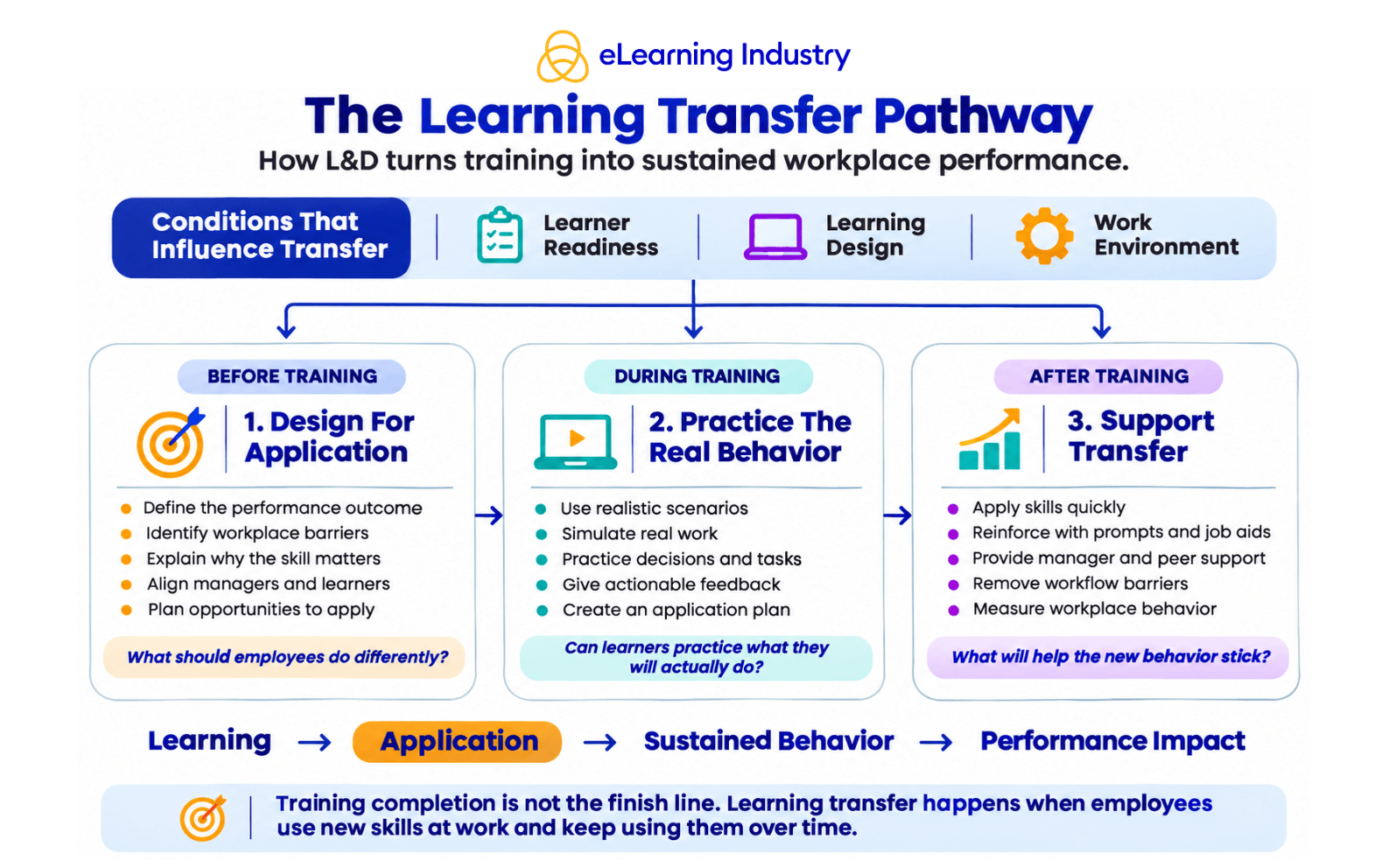
Learning transfer depends on a mix of learner traits, training design, and the work environment. No single factor is responsible on its own.
Studies on training transfer have examined how these factors interact. Influential research by Timothy Baldwin and Kevin Ford, along with later studies, has explored how learning carries over to the job and lasts over time.
For organizations, the key takeaway is that simply improving the course may not resolve transfer issues.
1. Learner Readiness And Motivation
Employees are more likely to transfer learning when they know why it matters and feel confident they can use it.
Relevant factors can include:
- Motivation to learn
- Motivation to apply the learning
- Prior knowledge and experience
- Confidence and self-efficacy
- Clear goals
- Perceived relevance to the employee's role
This means transfer starts even before training begins. Employees need to know what problem the training solves, what they should do differently, and why the change is important.
2. Learning And Training Design
Learning transfer works best when training prepares employees for real situations they will face on the job. A presentation can explain a concept well, but just explaining it doesn't always help someone use it at work. Instead, training should include realistic practice, like simulations, scenarios, role-plays, case studies, decision-making exercises, demonstrations, or real work tasks.
The more employees can practice the right behaviors in real situations, the easier it is to turn knowledge into action.
3. The Work Environment
Even if learning transfer works during training, it can fail if employees return to a workplace that doesn't support the use of new skills. Employees need chances to use their skills. They might also need time, tools, resources, feedback, managerial support, and encouragement from coworkers.
The CDC's guidance on evaluating transfer specifically identifies factors such as having opportunities and time to apply learning, access to necessary resources, reminders, supervisor support, and colleague support. So, workplace conditions should be seen as part of the learning system, not something separate from L&D's responsibilities.
Why Does Training Fail To Transfer?
Learning transfer often fails when organizations see application as just an individual's job rather than creating the right conditions to make it possible. Even a motivated employee can finish a course and still find it hard to change their behavior.
For example, training might show managers how to delegate, but the company still rewards them for handling every urgent issue themselves. Employees could learn a new software workflow but lack permission to use the required features. Or a customer service team might practice a new conversation model, but their performance targets make it hard to use in real calls.
Some common barriers are:
- Training that doesn't match real work.
- Not enough chances to use new skills.
- Processes or incentives that conflict with new skills.
- Little or no support from managers or peers.
- Insufficient time or resources.
- Weak feedback after application.
- No post-training reinforcement.
- Going right back to old habits and workflows.
So, when training transfer is poor, it doesn't always mean the learner wasn't motivated, or the course was badly designed. Sometimes it points to a bigger problem in the organization's systems. Offering more training won't fix a lack of opportunity, clashing processes, or other organizational barriers.
7 Learning Transfer Strategies That Improve Workplace Application
Learning transfer works best when the learning experience is connected to the real environment where employees will use their skills.
Instead of expecting learners to make that connection on their own, L&D teams can design learning with application in mind.
1. Start With The Performance Outcome
Learning transfer should shape the initiative before content is created. Rather than starting with, "What information should this course contain?" begin by asking:
- What should employees do differently?
- In which situations should they do it?
- What does successful performance look like?
- What currently prevents that behavior?
These questions help keep the learning focused on performance, not just on how much content is included.
2. Make Practice Resemble Real Work
Learning transfer is easier when employees practice the decisions, behaviors, and tasks they will need to use later. Depending on the capability, this could involve:
- Branching scenarios
- Simulations
- Role-plays
- Case-based exercises
- Realistic problem-solving
- Practice inside actual systems
- Guided workplace activities
For instance, leadership training on difficult conversations should let managers practice real conversations, not just read about communication techniques.
3. Give Employees Opportunities To Apply Learning Quickly
Learning transfer improves when employees get real chances to use new skills in their work. This could mean assigning a real project, giving a stretch task, scheduling a practice conversation, or asking employees to use a new process in their next workflow.
If employees have to wait months before using new skills, it becomes much harder to apply what they learned. Organizations should consider when employees can apply new skills, not just when they are available for training.
4. Create A Clear Application Plan
Learning transfer is more effective when employees finish training with a clear idea of what they will do next. Before finishing a learning experience, ask learners to identify:
- What they will apply.
- Where they will apply it.
- When they will use it.
- What successful application looks like.
- Which barriers they may encounter.
- Who can support them.
This changes a vague intention like "I'll use this more often" into a clear plan for action.
5. Build Manager And Peer Support Around Application
Learning transfer lasts longer when managers and colleagues support the new behavior instead of undermining it. Managers do not have to be trainers, but they can help by creating chances to practice, discussing progress, giving feedback, removing obstacles, and recognizing employees who try new things. Peers can also help by sharing experiences, solving problems together, and making new ways of working feel normal. The aim is to make applying new skills part of the team's work, not just something the learner does alone.
6. Use Post-Training Reinforcement Strategically
Post-training reinforcement can help learning transfer, but it should focus on helping employees use what they learned, not just repeat the same content. Useful methods include:
- Spaced retrieval
- Scenario challenges
- Reflection questions
- Job aids
- Coaching
- Practice prompts
- Microlearning refreshers
- Peer discussions
- Communities of practice
- Performance support
Ideally, follow-up support should be planned during the learning design, not added later. CDC guidance also recommends planning early follow-up support to reinforce learning and help it last. A five-minute refresher can help, but a timely prompt that supports an employee with a real task can be even more valuable.
7. Remove Workplace Barriers To Transfer
For learning transfer to work, L&D and business leaders need to find out what might stop employees from doing the desired behavior. Ask questions such as:
- Do employees have enough time?
- Do they have the required tools and permissions?
- Does the workflow support the new behavior?
- Do managers expect employees to use it?
- Do performance metrics encourage or discourage it?
- Are employees rewarded for continuing the old behavior?
Sometimes, the best way to support learning transfer is not more training, but removing the barriers that stop people from using what they already know.
How Should Organizations Measure Learning Transfer?
To measure learning transfer, look for proof that employees are actually using what they learned at work, instead of just tracking participation or satisfaction. This means focusing measurement more on behavior and performance.
Measure Behavior, Not Just Knowledge
When measuring learning transfer, check what employees actually do after the training. Depending on the program, you might find evidence from:
- Manager observations
- Work samples
- Performance demonstrations
- Employee self-reports
- Peer feedback
- System usage data
- Workflow analytics
- Behavioral KPIs
- Operational performance measures
The best way to measure depends on which behavior the training aims to change.
For example, if training helps managers run better one-on-ones, testing their leadership knowledge gives you learning data. But seeing if they actually have more structured, effective conversations shows real transfer.
Measure Transfer When Employees Have Had Time To Apply Learning
Learning transfer cannot always be meaningfully evaluated immediately after a course. Instead, the best time to measure depends on the skill and how often employees get to use it. There's no single rule for when to evaluate, like after 30, 60, or 90 days. If a skill is used every day, you can measure it sooner. Other skills might only matter during reviews, big projects, or rare events.
The CDC says that waiting to evaluate, or doing a follow-up, is best for measuring transfer. Learners need time to return to work and apply what they learned.
Measure Transfer Outcomes And Transfer Conditions
Measuring learning transfer is more helpful when you look at both whether employees applied what they learned and why they did or didn't. So, you should measure two things:
- Transfer outcome: Did employees actually use what they learned?
- Transfer conditions: What helped or got in the way of using what they learned?
If your organization wants a formal approach, the Learning Transfer System Inventory (LTSI) is a well-known tool for looking at what affects transfer. A 2026 review of 45 studies found that LTSI was the most commonly used tool for this purpose. But you don't always need a complex evaluation model for every project. Just gather evidence that fits the business question you want to answer.
A Learning Transfer Checklist For L&D Leaders
Organizations should think about learning transfer before starting a learning initiative, rather than waiting until after the course is over. L&D and business leaders should be ready to answer these questions before moving ahead:
1. What workplace behavior should change?
2. Does the learning experience allow employees to practice that behavior?
3. How soon will employees have an opportunity to apply it?
4. Do managers and peers understand how to support application?
5. Are workplace processes or incentives likely to prevent transfer?
6. What post-training reinforcement will support continued application?
7. How will we observe or measure the desired behavior?
8. What performance or business outcome should eventually improve?
If you can't answer several of these questions, your organization might need to address transfer issues before focusing on training.
Conclusion
Learning transfer shouldn't start only after a course is over. It should guide how an organization analyzes needs, designs learning, creates practice opportunities, supports employees, reinforces behaviors, and measures results. This means L&D teams need to look past the learning event itself. Employees work within systems that include managers, peers, technology, workflows, incentives, resources, and other priorities. These factors all affect whether a new skill becomes part of daily work. The best L&D strategies don't just ask if employees learned something. They check whether people can apply what they learned, continue using it, adapt it to real situations, and improve their performance as a result.


