
 ChatGPT
 Perplexity
 Claude
 Grok
What Does An LMS RFP Template Solve?
An LMS RFP template helps organizations organize their learning needs, technical requirements, and business goals into a clear process for choosing a vendor. Why is this needed, though? Most LMS vendors can show off many features. The real challenge is figuring out if those features actually support your learning strategy, systems, administrators, learners, security needs, and budget. A well-designed LMS request for proposal helps answer that question. Rather than letting each vendor present their platform however they want, an RFP sets clear requirements and evaluation criteria. Vendors reply to the same questions, pricing details, use cases, and implementation scenarios, which makes comparing them much easier.
For L&D, HR, IT, and procurement leaders, the goal is not to write the longest requirements document. The real aim is to collect enough clear information to make a confident LMS choice. This guide offers a practical Learning Management System RFP template, including LMS RFP requirements, vendor questions, functional and technical criteria, pricing tips, and an LMS vendor evaluation scorecard.
What Should An LMS RFP Include?
An LMS RFP template needs to give vendors a clear picture of your organization, show how they can meet your needs, and let you compare their proposals fairly with others.

At a minimum, your LMS RFP should include:
1. Organization and project background
2. Business and learning objectives
3. Learner populations and use cases
4. LMS functional requirements
5. LMS technical requirements
6. Security, privacy, accessibility, and governance
7. Implementation and data migration
8. Customer support and service levels
9. Vendor experience and product strategy
10. Pricing and LMS total cost of ownership
11. Contract and exit requirements
12. Proposal instructions and LMS evaluation criteria
These categories are a good starting point for your LMS requirements checklist. You should adjust them to fit your learning strategy, technology setup, risk level, and procurement process.
What Is An LMS RFP?
An LMS RFP template is a document that organizations use to request detailed proposals from Learning Management System vendors. It outlines the business, learning, technical, and commercial requirements the organization needs. Organizations usually create an LMS request for proposal after deciding why they need a new platform and what it should do. The RFP provides shortlisted vendors with a clear way to demonstrate how their solutions meet these needs.
It's helpful to know how an RFP differs from other similar procurement documents.
Document |
Primary Purpose |
| LMS requirements checklist | Defines what the organization needs from the platform. |
| Request For Information (RFI) | Collects preliminary information about potential solutions. |
| Request For Proposal (RFP) | Requests detailed proposals from qualified vendors. |
| LMS vendor evaluation scorecard | Scores and compares vendor responses. |
Organizations should think through their LMS requirements before creating an RFP. It's best to have learning objectives, use cases, technical needs, stakeholder input, and key criteria clear before reaching out to vendors. The LMS RFP template helps you compare potential solutions to your requirements.
Before Writing The RFP, Define What The LMS Must Achieve
An LMS RFP template leads to useful vendor responses only when the organization first defines the outcomes it expects the LMS to support. Many LMS selection processes start with a list of platform features. However, features only matter when they support real business and learning needs.
For example, an organization replacing its LMS because administrators struggle to produce reliable compliance reports has different priorities than a company building a customer academy. Similarly, a business operating in several countries may need advanced localization, permissions, integrations, and data governance that a smaller company might not require.
Identify The Business And Learning Use Cases
An LMS RFP template should link platform requirements to specific learning and business use cases.
Common examples include:
- Employee onboarding
- Compliance training
- Leadership development
- Reskilling and upskilling
- Sales enablement
- Customer education
- Partner or channel training
- Professional certification
- Extended enterprise learning
Record details like expected learner groups, number of administrators, geographic coverage, languages, yearly learning volume, expected growth, current systems, and reporting needs. These details help vendors understand your needs. A platform that fits 500 internal learners might not work as well for 50,000 employees, customers, and partners in different regions.
Involve The Right Stakeholders
An LMS RFP template should include requirements from every team that will affect implementation, governance, or the platform's long-term success. Depending on the organization, stakeholders may include:
- Learning and Development
- HR
- IT
- Information security
- Data privacy or legal teams
- Procurement
- Finance
- Business-unit leaders
- LMS administrators
- Representative learners
L&D should not set infrastructure requirements on its own, just as procurement should not decide on learning needs without input from learning experts. A good LMS selection process brings together learning expertise, technical review, user needs, commercial evaluation, and business priorities.
LMS RFP Template: The 10 Sections To Include
When creating an LMS RFP template, group your requirements into clear categories. This helps vendors respond in a consistent way and makes it easier for evaluators to compare proposals.
1. Organization And Project Overview
Start your LMS RFP template by giving vendors enough background so they understand the problem you want them to solve. Include:
- Organization overview
- Current learning environment
- Existing LMS or technology stack
- Reason for seeking a new platform
- Business and learning objectives
- Number and types of users
- Geographic scope
- Major use cases
- Target implementation date
- Key project stakeholders
This section helps vendors understand the requirements that come later.
Rather than just stating that advanced reporting is needed, explain what you want those reports to do. For example, compliance leaders might need monthly regional certification reports, or executives may want combined learning data from different business units. The more helpful background you give vendors, the better their responses will be.
2. LMS Functional Requirements
Your LMS RFP template should list the functional requirements that directly affect learning delivery, administration, and user experience.
Depending on your use cases, requirements might include:
- Course and content management
- Learning paths
- Assessments
- Certifications
- Instructor-led and virtual training
- Blended learning
- Mobile learning
- Social or collaborative learning
- Notifications and reminders
- Personalized learning
- User and role management
- Reporting and dashboards
- Localization
- Accessibility
- Content libraries
- Skills management
But try not to make a huge, unorganized list of features. Instead, classify each requirement as:
Must Have / Should Have / Nice To Have / Not Required
This way, your LMS requirements checklist will be much more helpful when you evaluate options.
3. LMS Technical Requirements
Your LMS RFP template should list the technical requirements needed for the platform to work well with your organization's technology. Questions may cover:
- APIs
- HRIS or HCM integrations
- Single sign-on
- Identity management
- SCORM and xAPI
- Data imports and exports
- System architecture
- Scalability
- Uptime
- Browser support
- Mobile access
- Sandbox environments
- Reporting integrations
Don't just ask vendors if they support a requirement. Ask them to explain how they support it:
Native / Configurable / Third-Party Integration / Custom Development / Not Supported
This approach makes it much easier to compare LMS vendors later. For instance, a vendor who just says "yes" to HRIS integration is not the same as one who offers a ready-made native connector.
4. Security, Privacy, Accessibility, And Governance
Include security and governance requirements early in your LMS RFP template to avoid moving forward with vendors who aren’t a good fit. Relevant areas may include:
- Authentication
- Role-based permissions
- Encryption
- Audit logs
- Backup and disaster recovery
- Privacy controls
- Data residency
- Accessibility
- Regulatory requirements
- AI governance
- Data use within AI-enabled capabilities
Organizations now need to know not just if an LMS uses AI, but also how learner and organizational data are used with those features. These requirements may also function as mandatory gate criteria rather than weighted preferences.
5. Implementation And Data Migration
Ask vendors to explain exactly how implementation will work, not just give an estimated launch date. Ask them to describe:
- Implementation phases
- Project timeline
- Vendor responsibilities
- Customer responsibilities
- Data migration
- Configuration
- Integrations
- Testing
- Administrator training
- Change management support
- Launch support
- Post-launch optimization
One particularly useful LMS RFP question is:
What resources will our organization need to provide during implementation?
This helps you see the actual internal work your team will need to do.
6. Support And Service Levels
Your LMS RFP template should look at what happens after implementation just as carefully as what happens before launch. Ask vendors about:
- Onboarding
- Customer success
- Dedicated account support
- Support channels
- Support hours
- Response times
- Issue severity levels
- Escalation procedures
- Administrator training
- Knowledge bases
- Ongoing optimization services
Even a strong LMS can be hard to manage if the support doesn't fit your organization's needs.
7. Vendor Experience And Product Strategy
Include vendor selection criteria in your LMS RFP template to help you assess both the provider and the platform. Relevant questions may include:
- What organizations similar to ours use your LMS?
- What experience do you have with our primary use cases?
- Can you provide relevant customer references?
- How frequently is the product updated?
- How are customers informed about changes?
- What is your product roadmap?
- How do customers influence product development?
- How do you approach emerging AI capabilities?
The goal isn't just to find out how long a vendor has been around. You want to know if their strategy, way of working, and experience fit your organization's needs.
8. Pricing
Make sure your LMS RFP template asks every vendor to price the same scenario. Otherwise, it will be much harder to accurately compare LMS pricing. Ask vendors to separate:
- Licensing or subscription fees
- Implementation
- Data migration
- Integrations
- Configuration
- Premium modules
- Storage
- Support
- Professional services
- Administrator training
- API or usage fees
- Future learner growth
- Renewal increases
The lowest license price isn't always the most affordable solution overall.
9. Contract And Exit Requirements
Your LMS RFP template should cover how your organization could leave the platform before you sign a contract. Important questions include:
- What is the minimum contract term?
- How are renewals handled?
- Are annual price increases capped?
- What termination conditions apply?
- Who owns organizational and learner data?
- How can data be exported?
- In what format is data provided?
- Is transition assistance available?
These questions might not seem urgent during the selection process, but they become very important if your organization’s needs change later.
10. Proposal Instructions And Timeline
Give vendors clear instructions in your LMS RFP template about how and when to respond. Specify:
- Proposal deadline
- Required response format
- Contact person
- Clarification process
- Demo dates
- Required supporting evidence
- Pricing format
- Expected decision date
Standardized responses make it easier to interpret answers and complete your LMS evaluation matrix.
LMS Requirements Checklist: How To Prioritize Requirements
An LMS RFP template should clearly distinguish between essential requirements and features that are just nice to have. One useful way to organize these is:
Priority |
Meaning |
| Mandatory | Vendor cannot progress without meeting the requirement |
| High | Strong influence on the final decision |
| Preferred | Valuable but negotiable |
| Optional | Useful but not essential |
It's also important to understand the difference between gate criteria and scored criteria.
Gate criteria decide if a vendor can move forward in the process. For example, an organization might need a certain security standard, integration, accessibility feature, or hosting setup. If a vendor doesn't meet that requirement, it's usually not worth scoring the rest of their proposal. On the other hand, scored criteria help you compare vendors who already meet the basic requirements.
Keeping these two types of criteria separate makes sure that a great demo or a tempting offer doesn't distract from a requirement the organization really can't give up.
LMS RFP Questions Vendors Should Answer
When creating an LMS RFP template, focus on questions that show how the system works in real situations instead of just asking lots of yes-or-no questions.
Consider asking:
1. Which requirements are supported natively?
2. Which require configuration, third-party integrations, or custom development?
3. Can you demonstrate our primary learner use case from start to finish?
4. Can you demonstrate one of our recurring administrator workflows?
5. Which of our existing systems have native integrations with your platform?
6. What internal resources will we need during implementation?
7. What data can administrators export without vendor assistance?
8. What reports can our team create independently?
9. How is accessibility supported across both learner and administrator experiences?
10. Which services are excluded from your implementation price?
11. How would pricing change if learner numbers increased significantly?
12. How do we retrieve our data if the contract ends?
13. Which capabilities shown in your proposal require additional modules?
14. What platform limitations are most relevant to our use cases?
15. What implementation risks should we anticipate?
Scenario-based questions are especially helpful. Instead of asking:
"Does your LMS support reporting?"
ask:
"Show us how an administrator would create, schedule, and distribute a monthly compliance report by region without vendor assistance."
The second question gives you real proof instead of just a marketing statement.
How To Build An LMS Vendor Evaluation Scorecard
Include an LMS vendor evaluation scorecard in your RFP template before you receive any proposals. This helps your team agree on what’s important before looking at specific solutions. Here's an example of what an LMS vendor scoring matrix might look like:
LMS Evaluation Criteria |
Example Weight |
Functional fit and learning workflows |
20% |
Learner and administrator UX |
20% |
Technical fit and integrations |
15% |
Pricing and total cost |
15% |
Reporting and analytics |
10% |
Security, privacy, and accessibility |
10% |
Implementation and support |
5% |
Vendor strategy and innovation |
5% |
Total |
100% |
Think of these weights as a template for evaluating LMS vendors, not as a one-size-fits-all formula. Organizations can adjust these weights to match their own priorities. For example, eLearning Industry's 2026 buyer research showed that buyers ranked user experience, pricing, and integrations higher than AI in their evaluations of LMS platforms. This highlights a key lesson: just because an innovation is highly visible, it should not automatically be valued more than usability, technical fit, or business basics.
A straightforward scoring scale can help make the LMS evaluation matrix easier to use:
0: Does not meet the requirement
1: Major gap or workaround required
2: Partially meets the requirement
3: Meets the requirement
4: Exceeds the requirement
5: Significantly exceeds the requirement and provides clear evidence
But written claims alone should not always get the highest score. It's important to verify key criteria through scripted demos, technical documentation, customer references, security reviews, or pilot tests as needed. This approach turns the LMS vendor evaluation template from just a spreadsheet into a tool for making decisions based on real evidence.
LMS Pricing Comparison: Calculate Total Cost Of Ownership
When creating an LMS RFP template, ask for enough financial details to figure out the total cost of ownership, not just the subscription price. Have each shortlisted vendor provide pricing for the same scenario over a set period, like three years.
When comparing LMS pricing, it's important to consider how your needs might grow over time. Ask for pricing based on your current number of learners and also for the numbers you expect in two or three years.
Also, look into costs for things like integration maintenance, premium support, storage, professional services, configuration changes, and future migration.
Sometimes, a platform that costs a bit more each month can actually save you money overall if it's easier to set up, manage, integrate, and support.
Common LMS RFP Mistakes That Make Vendor Comparison Harder
An LMS RFP template may end up causing confusion instead of helping if the procurement team does not have a clear evaluation strategy. Some mistakes tend to come up again and again.
Focusing On Features Instead Of Outcomes
An LMS RFP template can become overloaded if teams start by listing every possible LMS feature instead of first determining what the organization actually needs to achieve. Begin by looking at your use cases and desired outcomes, then build your requirements from there.
Relying On Too Many Yes/No Questions
The template is less useful if vendors can just check off most requirements without giving real details. Ask vendors to describe how key features work and, if possible, provide proof or examples.
Treating All Requirements As Equally Important
A template should not treat a small convenience as being just as important as a critical integration or security need. It's important to set priorities.
Setting Evaluation Weights After Looking At Vendors
You should decide on your scoring method before you start reviewing proposals. If you don't, teams might unintentionally adjust the criteria to favor a platform they already like.
Comparing Only Headline Prices Instead Of Total Cost Of Ownership
An LMS RFP template should require vendors to share costs for implementation, integration, support, and growth, not just the subscription fees. Without this information, platforms that look cheap at first can end up costing much more in the long run.
Letting Vendors Control The Demo
A template should produce scripted demos based on your organization's real use cases. When vendors run the demo, they naturally highlight their platform's best features. A structured demo ensures every vendor shows the same workflows, making it easier to spot the differences.
From RFP To Final LMS Vendor Selection
An LMS RFP template is meant to support the overall LMS selection process, but it should not replace professional judgment.
A standard procurement process often follows these steps:
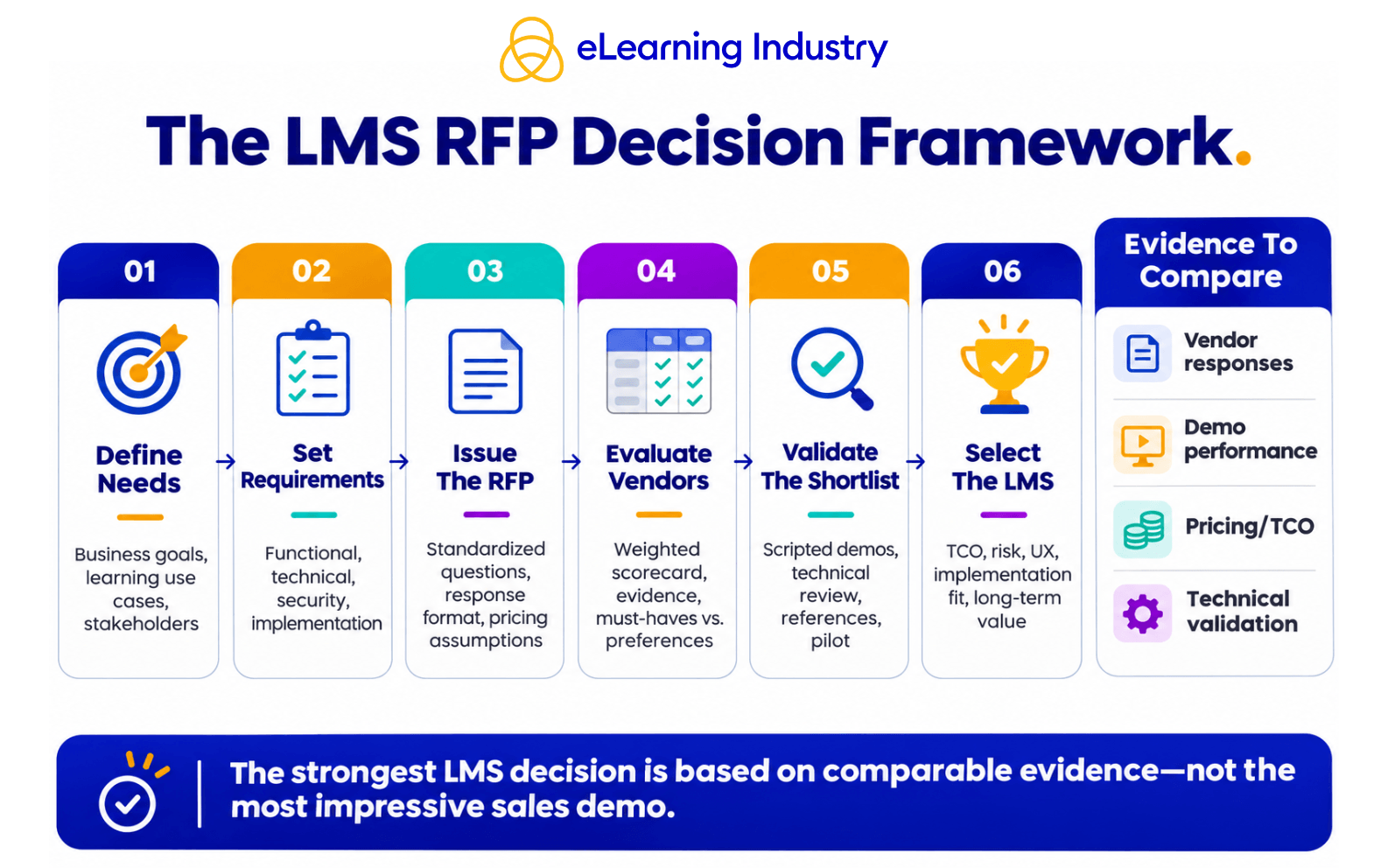
Requirements → RFP → Compliance Review → Weighted Evaluation → Scripted Demo → Technical And Security Review → References Or Pilot → Pricing/TCO Review → Contract Negotiation → Final Selection
The RFP score is helpful for organizing information, but it should not be the only factor in making a final decision. For instance, a vendor might seem to meet almost all functional requirements on paper, but show major usability issues during a scripted demo.
Another vendor might have fewer extra features, but offer a better experience for administrators, smoother integrations, stronger support during implementation, or a lower total cost of ownership. This is why a thorough LMS vendor comparison should use different types of evidence. Organizations should look not just at what a platform says it can do, but also at how well it handles key workflows, how complex the implementation is, what the user experience is like, and what risks come with the decision.
Conclusion
An LMS RFP template is most helpful when it makes a complicated technology purchase into a clear decision based on evidence you can compare. The goal isn't to make the longest LMS RFP or ask vendors endless questions. Instead, focus on what matters, set clear selection criteria, ask for evidence, and review each option in the same way. A good process follows a simple path:
Requirements → Questions → Evidence → Weighted Evaluation → Informed Selection
When you use it this way, your LMS RFP is more than just a buying document. It becomes a decision tool that links your learning strategy, technology needs, user experience, costs, implementation, and long-term value for your organization.