

 ChatGPT
 Perplexity
 Claude
 Grok
Management Skills: 10 Essential Skills, Examples, And How To Develop Them
Management skills matter most when doing your own job well is no longer enough. If you're an Instructional Designer moving into a manager role, you'll need to coordinate workloads, help colleagues grow, set priorities, and explain your decisions to others. Creating great content is still important. But as a manager, you also need to ask yourself: can you help others do their best work?
For L&D leaders, this difference should guide how you develop managers. Begin by looking at real situations managers deal with, figure out what behaviors are needed, and give people chances to practice. Focus on changes in the workplace, not just whether training is finished.
What Are Management Skills?
Management skills help people plan work, organize resources, lead teams, solve problems, and reach company goals. These skills include working well with others, using technical knowledge, and thinking strategically when making decisions and supporting performance in different business settings.
However, managerial skills are different from job duties. For example, "conduct performance reviews" is a task. Skills like listening carefully, explaining expectations, and agreeing on next steps are what help someone do that task well.
Therefore, when thinking about a manager's skills, focus on what someone needs to do well. This approach is more helpful for growth than just using labels like "excellent communicator."
What Are The 3 Types Of Management Skills?
Management skills can be organized into technical, human, and conceptual categories using Robert Katz's foundational framework.
Category |
What It Covers |
L&D Example |
Technical |
Role-specific methods, processes, and knowledge | Preparing a training budget |
Human |
Working effectively with other people | Coaching an employee |
Conceptual |
Understanding organizational relationships and priorities | Connecting learning investment with business needs |
Technical skills in management go beyond just knowing how to use software. They also involve understanding the work, judging its quality, and applying the right methods.
Human and conceptual skills help link your expertise to people and the goals of the organization. It is best to use these skills together, instead of seeing technical knowledge and people management as separate or competing.
Top 10 Management Skills To Develop
These 10 management skills provide a practical plan for development, rather than a ranked list. Some of them are similar to behaviors found in Google's internal manager research, such as coaching, empowerment, communication, and decision-making. However, that research is specific to Google's environment. Here are some examples to show how these skills work in practice.
1. Communication And Active Listening
Good management begins with listening and making expectations clear, rather than just giving instructions.
For instance, a learning manager might turn a vague request from a stakeholder into a clear brief that outlines the audience, desired behavior, limits, and what success looks like. Before signing off, they ask colleagues to point out any uncertainties rather than assuming silence means everyone agrees.
2. Delegation And Empowerment
When delegating, good management means making outcomes, decision-making power, resources, and checkpoints clear, not just handing out tasks.
An LMS administrator could be responsible for a rollout project and know which risks to escalate. Rather than approving every detail, the manager sets clear boundaries and stays available to offer guidance or support when needed.
3. Planning, Prioritization, And Resource Allocation
When planning, use management skills to highlight tradeoffs early, before workloads get out of hand.
An L&D manager might postpone a less important course update to make sure there is enough capacity for onboarding. They explain the decision, adjust deadlines, and confirm who is responsible. Not everything can be urgent, though, so deciding what can wait is part of prioritizing.
4. Coaching And Constructive Feedback
Coaching uses management skills in conversations to help employees examine their work and develop better judgment.
Instead of rewriting a colleague's storyboard, talk about where the activity does not meet its learning goal. Ask them to suggest changes, give clear feedback, and review the next version together. The goal is to help them build judgment, not to make them rely on the manager for corrections.
5. Performance Management And Accountability
Good management links performance standards with support and consistent follow-up.
If delivery falls behind, review expectations, workload, resources, and skills before deciding on next steps. Write down what needs to happen next and check progress later. Accountability should clarify responsibilities, not assume that every missed deadline is due to a lack of motivation.
6. Emotional Intelligence And Inclusive People Management
People management skills include noticing your own reactions and making sure everyone has a fair chance to contribute.
In a tough project review, take a moment before reacting defensively. Ask remote colleagues to share their challenges and address the issue without ignoring their point of view. Focus on what you can see people do, rather than assuming that confidence or being outgoing means someone is competent.
7. Conflict Resolution And Negotiation
Using management skills in conflict means dealing with competing interests and not ignoring the real disagreement.
For example, if an SME and a designer are debating how deep the content should go, the manager can bring the conversation back to the learning goal, separate what is essential from what is just a reference, and agree on how to test the plan.
8. Decision-Making And Problem-Solving
Use management skills in decision-making to examine evidence, alternatives, and consequences before committing resources.
Before starting another course, check whether poor performance is due to a lack of knowledge, unclear processes, or the absence of the right tools. Ask what evidence would make you change your mind. If not, it's easy to fall back on familiar solutions before really understanding the problem.
9. Strategic Thinking And Business Acumen
Strategic management skills connect team activity with organizational priorities and resource decisions.
A learning leader could explain how a new project fills a skills gap, what the results are, and what investment is needed. It's also important to say what the team will stop doing, since strategy is about making choices, not just adding more projects.
10. Digital Fluency And Change Management
Effective management skills include evaluating technology and helping people adjust how they work.
When rolling out an LMS, test workflows with users, clarify responsibilities, and adjust the rollout based on feedback. Focus on the improvement you want to achieve, not just launching the platform. Bringing in new technology and making it useful are two separate challenges.
Management Skills Vs. Leadership Skills: What Is The Difference?
Management and leadership skills often overlap, but they focus on different things. Management is about organizing work, resources, and accountability. Leadership, as the Center for Creative Leadership explains, is about building shared direction, alignment, and commitment.
Take an LMS implementation as an example. Managing schedules, budgets, and responsibilities is important. At the same time, teams need to agree on the purpose and stay committed, which calls for leadership.
Managers should use leadership skills to support, not replace, strong operations. Instead of picking between being a 'manager' or a 'leader,' focus on what the situation needs. Make sure both the practical details and team commitment are in place.
Which Management Skills Should You Develop First?
Focus on building management skills by looking for situations that often lead to performance issues.
If you are a new manager, work on delegation, giving feedback, and planning workloads. More experienced managers may need to improve conflict resolution or work better with other teams. Senior learning leaders might focus on making stronger strategic decisions and managing resources well.
See these ideas as starting points. Ask employees, coworkers, and your supervisor where a change in behavior could have the biggest impact.
Also, distinguish capability gaps from structural problems. When authority is unclear or the workload is unmanageable, additional training alone does not resolve the underlying constraint.
How Can L&D Develop Management Skills?
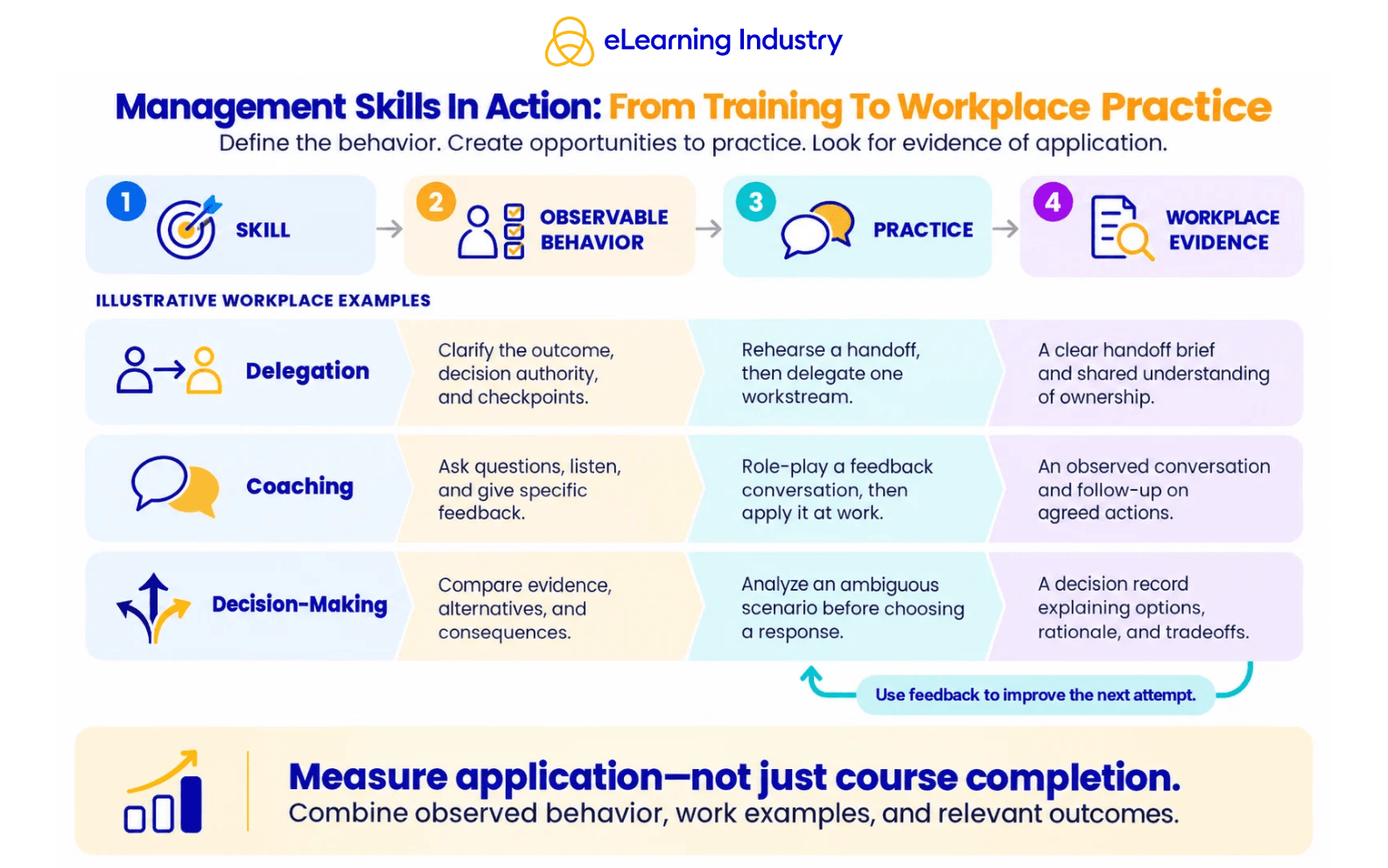
Building management skills takes more than just giving people access to a set of courses. A 2017 meta-analysis of 335 studies found that leadership training works best when it includes needs analysis, feedback, practice, and sessions spaced out over time.
Use these principles in a clear, step-by-step development process.
Diagnose A Specific Behavior
Make management skills into clear, observable goals before choosing training materials. For example, instead of saying "improve delegation," try "clarify the outcome, decision boundaries, and checkpoint before assigning work."
Talk with the manager about a recent situation. Discuss what happened, what was missing, and what a better response could look like.
Rehearse Realistic Situations
Build management skills by using role-play, branching scenarios, or decision-making exercises that include feedback.
For instance, have managers respond to a missed deadline without blaming the employee right away. Digital simulations can help organize practice, but make sure to check the feedback criteria. When using AI for practice, use made-up cases, keep real information private, and remember that AI-generated scores are not official assessments.
Apply Learning At Work
Link management skills practice to a real, manageable task at work. For example, a manager might delegate one project using a clear brief, then talk about the experience with a coach.
Use an LMS to give prompts, job aids, and follow-up activities. Make sure resources are easy to access during the task, instead of expecting managers to remember everything from a course.
Review And Repeat
After using new management skills, check in through observation, reflection, and feedback. Ask what has changed, where the manager had trouble, and what they plan to try next.
Google is one example of an organization that supports manager development by combining onboarding, coaching, digital resources, and peer learning.
The key takeaway is to connect support over time. Use technology to help organize development, but keep human judgment and real workplace evidence at the center.
How To Demonstrate Management Skills On A Resume
When listing management skills on your resume, focus on showing evidence instead of just using adjectives. It's recommended that you use clear, active language that highlights real results and matches the job you want.
- As you choose management skills for your resume, link each one to something you have actually done.
Use this structure: Action + Scope + Relevant Outcome.
Here are some example statements to compare:
Weak: "Responsible for managing training projects."
Stronger: "Coordinated HR, IT, and L&D stakeholders through an LMS migration, clarified ownership, and delivered the agreed launch milestones." - Include real numbers when you can, like team size, budget, or improvements made. Do not make up any figures.
For example, a manager's resume summary might say:
"L&D manager experienced in leading learning teams, coordinating technology implementations, and aligning employee development with business priorities." - Make sure to adjust your management resume summary to match your actual experience. Back it up with specific examples of what you have achieved.
- When writing a resume for a manager role, include terms such as coaching, resource allocation, and stakeholder management if your experience supports them. Use these keywords where they fit, instead of adding every possible one.
- Finally, distinguish project coordination from direct employee supervision. Both show management experience, but they have different responsibilities.
Conclusion
Management skills matter most when they actually improve how work is done. Simply listing these skills is just the first step, not a full plan for development. Pick one key skill, describe what it looks like in action, practice it, and then reflect on how it went. For L&D teams, the aim is not just to finish more training, but to make decisions clearer, offer better support, and help teams work together more smoothly.


