


What Is Performance Management Training?
Performance management training helps managers and leaders gain skills to set goals, give feedback, evaluate performance, and support employee growth. It emphasizes fair, consistent, and data-driven practices that enhance both individual and organizational results.
It's important to understand the difference between performance management training and performance appraisal training. Performance appraisal training teaches how to conduct formal evaluations, like annual reviews. In contrast, performance management training covers a wider range of topics. It includes ongoing feedback, coaching, goal alignment, and continuous development. Similarly, performance evaluation training supports structured assessments, but it's just one part of a comprehensive performance management strategy.
More organizations are moving away from annual reviews and have started adopting continuous performance management. This is because traditional reviews don't show real-time performance. On the other hand, ongoing conversations, flexible goal-setting, and quick feedback are more relevant today and keep employees engaged and aligned.
Training plays a key role in this process. It helps managers apply performance frameworks consistently, use tools effectively, and turn performance processes into valuable development opportunities instead of just administrative tasks. Below, we will explore everything regarding performance management training and what an effective program looks like.
Why Performance Management Training Matters In Modern Organizations
Performance management training is essential for organizations. It impacts how they perform, grow, and keep their talent. At its core, it links individual efforts to business results.
Improving Employee Engagement
When done well, corporate performance training improves employee engagement. People are more motivated when expectations are clear, feedback is consistent, and development feels real. Instead of waiting for annual reviews, employees receive ongoing guidance that helps them stay aligned and confident in their roles.
Helping With Employee Retention
It also plays a critical role in retention. Poor performance management is one of the top reasons employees disengage or leave. When managers lack the skills to give meaningful feedback or support growth, high performers often look elsewhere. In contrast, training to improve employee performance equips managers to have better conversations, recognize progress, and address issues early, before they turn into turnover.
Boosting Productivity
Productivity is another key outcome. Clear goals, regular check-ins, and structured performance reviews reduce confusion and wasted effort. Teams spend less time guessing priorities and more time delivering results that matter. The cost of poor performance management is often underestimated. It shows up as low morale, inconsistent performance, and misaligned teams. Over time, this affects not just individual output but overall business performance.
Core Components Of Effective Performance Management Training
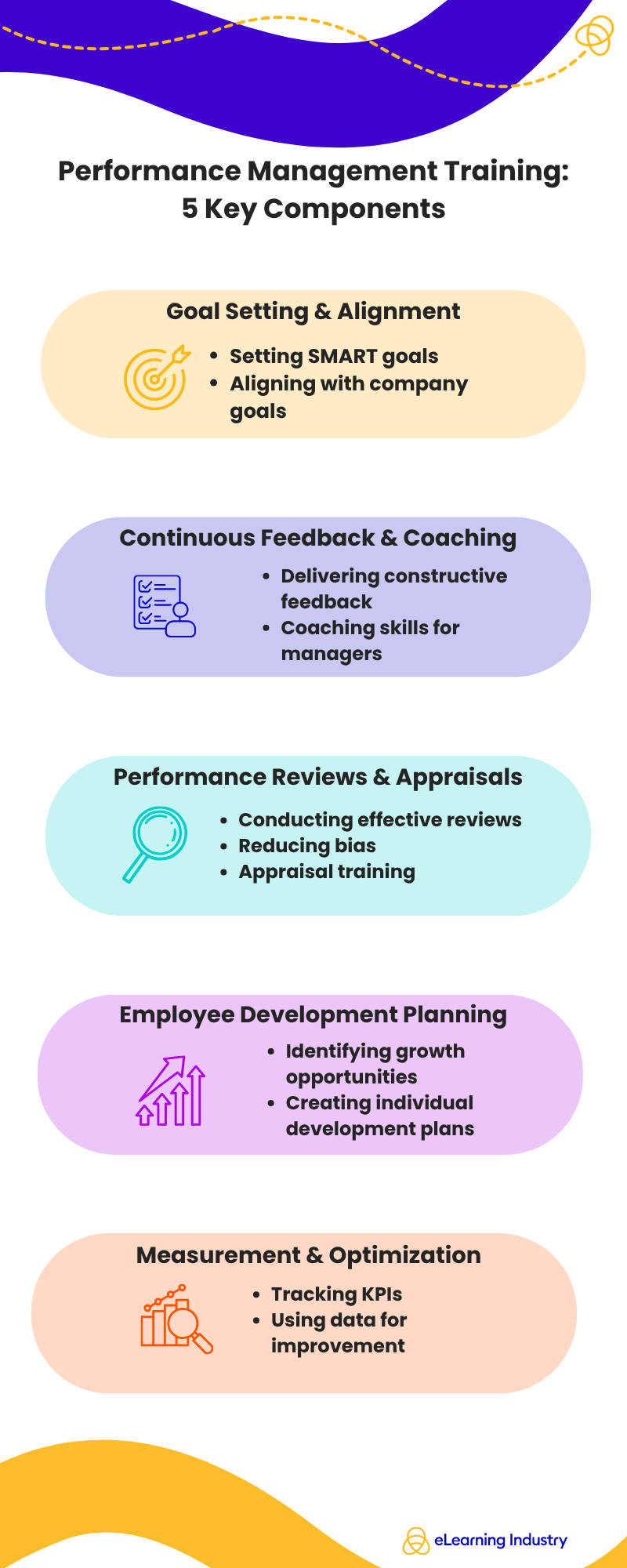
Effective performance management training helps managers consistently align, evaluate, and develop their team members. Specifically, L&D leaders should focus on creating practical and repeatable behaviors that boost performance over time, rather than relying on compliance-based evaluations. Let's make this clearer by breaking down effective performance management training programs.
Goal-Setting And Alignment
Good performance training starts with clear goal-setting. This means managers need to translate business goals into individual objectives using tools such as OKRs and KPIs. This helps ensure that employees' work supports the organization's strategy. When everyone is aligned, there is less confusion, and performance can be measured from the start.
Continuous Feedback And Coaching
Modern performance management training focuses on ongoing feedback instead of yearly reviews. Managers should be ready to provide timely, helpful feedback and coach employees in real time. Many organizations find this challenging, not because they lack tools, but because they lack skills. Training should help managers feel confident in having performance discussions, addressing issues early, and encouraging positive behaviors. Over time, this builds a culture of continuous improvement instead of just reacting to problems.
Performance Reviews And Appraisals
While continuous feedback is critical, structured evaluations still play a key role. Performance review training helps managers conduct fair, consistent, and meaningful assessments. This includes defining evaluation criteria, documenting performance, and reducing bias in decision-making. When done well, performance reviews are part of ongoing conversations instead of just a one-time event.
Data-Driven Decision-Making
High-impact performance evaluation training should include data literacy. Managers need to know how to use metrics, dashboards, and performance indicators to make informed decisions, thus helping them conduct more accurate evaluations. Training must also show how to interpret data in context, ensuring that numbers support, not replace, a manager's judgment.
Employee Development Planning
Finally, effective performance training links evaluation to growth. Performance discussions should result in clear development plans that connect current performance with future potential. Managers need tools for that to identify skill gaps, set development goals, and track progress. This changes performance management from looking back at past performance to focusing on future improvement.
Types Of Performance Management Training Programs
Choosing the right performance management training format depends on your organization's structure, manager capability, and scale. High-performing L&D teams rarely rely on a single approach. Instead, they combine formats to build both foundational knowledge and real-world application.
Performance Management Training For Managers
Performance management training for managers focuses on building coaching capability and improving the quality of feedback. Managers learn how to set clear expectations, run effective 1:1s, and deliver feedback that drives behavior change. Strong programs move beyond theory and use scenarios to practice difficult conversations, making feedback timely, specific, and actionable.
Performance Management Training For Supervisors
Supervisors handle day-to-day performance. Their training focuses on consistency, fairness, and execution. They learn to apply frameworks in real time, track performance, address issues early, and uphold standards. This type of training for performance management helps frontline leaders turn strategy into daily actions.
Corporate Performance Management Training
Corporate performance management training helps organizations align their systems, processes, and leadership behaviors. It often works with HR technology, goal-setting methods, and company-wide performance cycles. This approach creates consistency across departments and supports a common understanding of how performance is measured, reviewed, and improved.
Performance Management Workshops
A performance management workshop offers a more interactive, instructor-led experience. These sessions are typically cohort-based, allowing managers to learn from peers, discuss real challenges, and practice skills in a safe environment. Workshops are especially effective for behavior change, as they create space for reflection and immediate feedback.
Performance Management Online Courses
A performance management online course provides scalable and flexible learning. It is ideal for distributed teams or organizations looking to quickly standardize training. While online formats support accessibility and consistency, they are most effective when combined with live practice or coaching to reinforce application.
Comparison Of Training Types
Type |
Best For |
Pros |
Limitations |
| Performance management training for managers | Mid-level leaders | Builds coaching and feedback skills | Requires reinforcement over time |
| Performance management training for supervisors | Frontline leadership | Improves execution and consistency | Can be too tactical without a strategy context |
| Corporate performance management training | Enterprise organizations | Aligns systems and processes | Complex to implement across teams |
| Performance management workshop | Skill-building and behavior change | Interactive, practical, peer learning | Less scalable |
| Performance management online course | Large or remote teams | Scalable, flexible, cost-effective | Lower engagement without live elements |
How To Choose The Right Performance Management Training Course
Choosing the right performance management course is about finding the right fit, not just picking one with a lot of content. L&D leaders should match the training to how the organization works now and what it needs for the future.
Consider Organizational Maturity
Early-stage organizations often depend on informal feedback and annual reviews. In contrast, more mature companies use continuous performance models backed by data. If managers are still having difficulty with basic feedback conversations, a course on advanced analytics and calibration practices will not be effective. So, the training needs to match the current needs of the organization.
Assess Manager Skill Gaps
Many performance issues are skill-related. Managers may lack confidence in coaching, delivering feedback, or running effective performance reviews. The right performance management course should directly address these gaps through practical, scenario-based learning rather than relying solely on theory.
Reflect On Business Goals
Business goals should also guide your decision. If the organization is focused on growth, the training should emphasize goal alignment and performance acceleration. If retention is the priority, then coaching, engagement, and development planning become more critical. This is where business performance management courses can offer more strategic alignment, connecting individual performance to broader business outcomes.
Decide Between Ready-Made Or Custom Programs
Finally, consider the build vs. buy decision. Off-the-shelf courses offer speed and scalability, especially for foundational skills. However, building a custom program allows you to reflect internal processes, tools, and culture. Many organizations adopt a hybrid approach, using external expertise for structure while tailoring content to internal realities.
Key Features Of High-Impact Performance Management Training
High-impact performance management training goes beyond just teaching theory. It aims to change how managers think, act, and make decisions in real situations. Many programs fail because they only explain concepts, not help managers apply them. Let's see what effective programs look like.
Scenario-Based Learning
Instead of presenting abstract models, scenario-based learning places managers in realistic situations, such as handling underperformance, giving difficult feedback, or aligning goals with business priorities. These performance management training examples help learners practice judgment rather than just recall information. As a result, managers become more confident when similar situations arise in the workplace.
Real-World Simulations
These go a step further by replicating workplace dynamics, often through role-playing, digital simulations, or guided exercises. In strong training performance management programs, simulations mirror actual organizational challenges. This allows managers to experiment, make mistakes, and refine their approach in a low-risk environment. For L&D leaders, this is where training starts to translate into measurable capability.
Manager-Specific Pathways
Not all managers face the same challenges. First-time supervisors need foundational support, while experienced leaders require advanced coaching and performance strategy skills. High-quality performance management training adapts to these differences, offering tailored learning journeys that reflect role, seniority, and organizational context.
Checklists And Templates
Training should not end when the session is over. Providing practical resources, such as performance review templates, feedback frameworks, and development planning guides, ensures managers can immediately apply what they have learned. These tools reinforce consistency and reduce uncertainty in day-to-day performance conversations.
Measurement And ROI Tracking
Organizations need to understand whether training is improving performance outcomes. This includes tracking manager effectiveness, employee engagement, and performance review quality. Strong training on employee performance connects learning initiatives directly to business results, making it easier for stakeholders to justify continued investment.
Real-World Examples Of Performance Management Training
Knowing how organizations use performance management training helps L&D leaders put ideas into action. Here are some performance management training examples that show patterns that can be used in different business settings.
Example 1: Scaling Manager Capability In A Growing Organization
A mid-sized company that was growing quickly found that its newly promoted managers lacked the skills to lead performance conversations. Instead of using a one-size-fits-all program, the L&D team introduced appraisal training, which included coaching simulations and feedback methods.
The training covered goal setting, giving constructive feedback, and conducting structured performance reviews. Managers practiced real-life scenarios using tools that matched the company's Key Performance Indicators. Within months, the company saw better consistency in performance evaluations and stronger alignment between team goals and business objectives.
Example 2: Transitioning From Annual Reviews To Continuous Feedback
A global organization struggled with outdated annual review cycles that failed to drive meaningful performance improvements. The L&D team redesigned their approach by introducing performance review training for managers focused on continuous feedback and coaching.
The program included microlearning modules, live workshops, and digital tools to support regular check-ins. Managers were trained to shift from evaluation to development, using real-time feedback rather than retrospective reviews. Over time, employee engagement scores increased, and performance discussions became more frequent and actionable.
Example 3: Embedding Performance Training Into L&D Strategy
A large enterprise integrated corporate performance management training into its broader learning ecosystem. Instead of offering one-off sessions, the organization embedded training on employee performance into leadership development pathways.
This included a blend of performance management courses, peer learning, and ongoing reinforcement through digital platforms. Performance conversations became part of everyday leadership behavior, not a compliance exercise. The L&D team also introduced shared performance management templates to standardize processes across departments, ensuring consistency while allowing flexibility.
Conclusion
Performance management is not just a one-time evaluation; it is an ongoing process that helps both managers and employees grow. Effective training focuses on building skills, encouraging growth, and aligning personal goals with the company's goals. By including feedback, coaching, and useful tools in daily work, organizations can create a culture where improving performance is natural and lasting. The main goal of training is not only to manage performance but also to enable it, helping leaders and teams achieve real, measurable results consistently.