


 ChatGPT
 Perplexity
 Claude
 Grok
Grok
A Practical Look At AI-Powered Learning Design
In a previous article, we explored a growing concern in Learning and Development: much of today's use of AI is accelerating content production but not necessarily improving learning quality.
The risks are becoming clearer.
AI-generated learning can easily become generic, too focused on knowledge delivery rather than skill development, and still leave organisations with a one-size-fits-all model. In some cases, learners are not challenged enough, and the combination of instant answers, simplified content, and predictable assessments can gradually weaken critical thinking, reflection, and real capability-building.
That is why the main question remains as important as ever: Are we truly improving learning with AI, or simply producing more of it?
At the same time, the opportunity is enormous.
AI can help us move closer to more personalised, adaptive, and practice-based learning experiences. It can support stronger scaffolding, more responsive feedback, and more relevant forms of learner challenge. In that sense, AI gives L&D teams an opportunity to move closer to the kind of tailored support long associated with Bloom's 2 Sigma ideal, not by replacing human expertise, but by extending what well-designed learning can do at scale.
This is where platforms like gAImify Hub become especially relevant.
It was designed to help organisations respond to those risks while making the most of those opportunities by combining AI-assisted course design, contextual customisation, adaptive quizzes, open-ended scenarios, coaching-style feedback, AI avatar simulations, and human-in-the-loop review into a more engaging and more meaningful learning experience.
So, if the previous article focused on the question and the risks, this one focuses on the response:
How can AI be used more thoughtfully to create learning that is not only faster to build, but far more relevant, adaptive, and connected to real workplace performance?
The Opportunity: More Personalisation, More Adaptation, More Practice
If used well, AI can help address some of the oldest and hardest challenges in human-centred learning design. It can support:
- Personalisation through role, competency, and context-based design
- Adaptive learning through responsive assessment and learner support
- Scaffolding through timely feedback and guided progression
- Real-life practice through scenarios and simulations
- More engaging learning journeys through storytelling and gamification
A Human-Centred Model For AI-Powered Learning
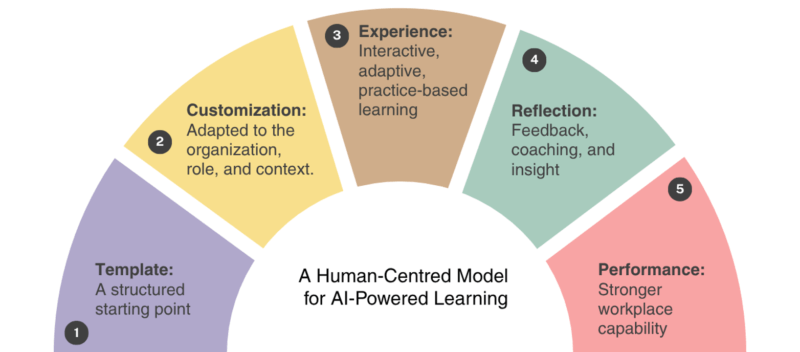
Image by Human Asset
Our human-centred model for AI-powered learning starts with structure and moves progressively toward real workplace capability. It begins with a clear template, is shaped through customisation to the organisation and role, and becomes meaningful through interactive and practice-based experiences. Reflection through feedback and coaching helps learners improve, while the ultimate goal is stronger performance in real work situations.
Customisation: From Generic Content To Contextual Learning Design
One of the most common risks of AI in learning is genericity. A course may be generated quickly, but still feel detached from the organisation, the learner, and the real workplace. That creates a familiar problem: more content, but limited relevance.
For example, gAImify Hub addresses this by starting with structured templates and then helping learning teams customise the experience around:
- The organisation's context
- The target role
- The competency framework
- The workplace challenges
- The values, language, and expectations of the organisation
This is a meaningful response to one of the central risks of AI-generated training. Instead of beginning from a blank prompt and hoping the output is good enough, the platform supports a more disciplined approach to AI-assisted course design. Templates provide structure. AI adds speed and variation. Human review protects quality and relevance.
Adaptive Quizzes That Support Learning, Not Just Testing
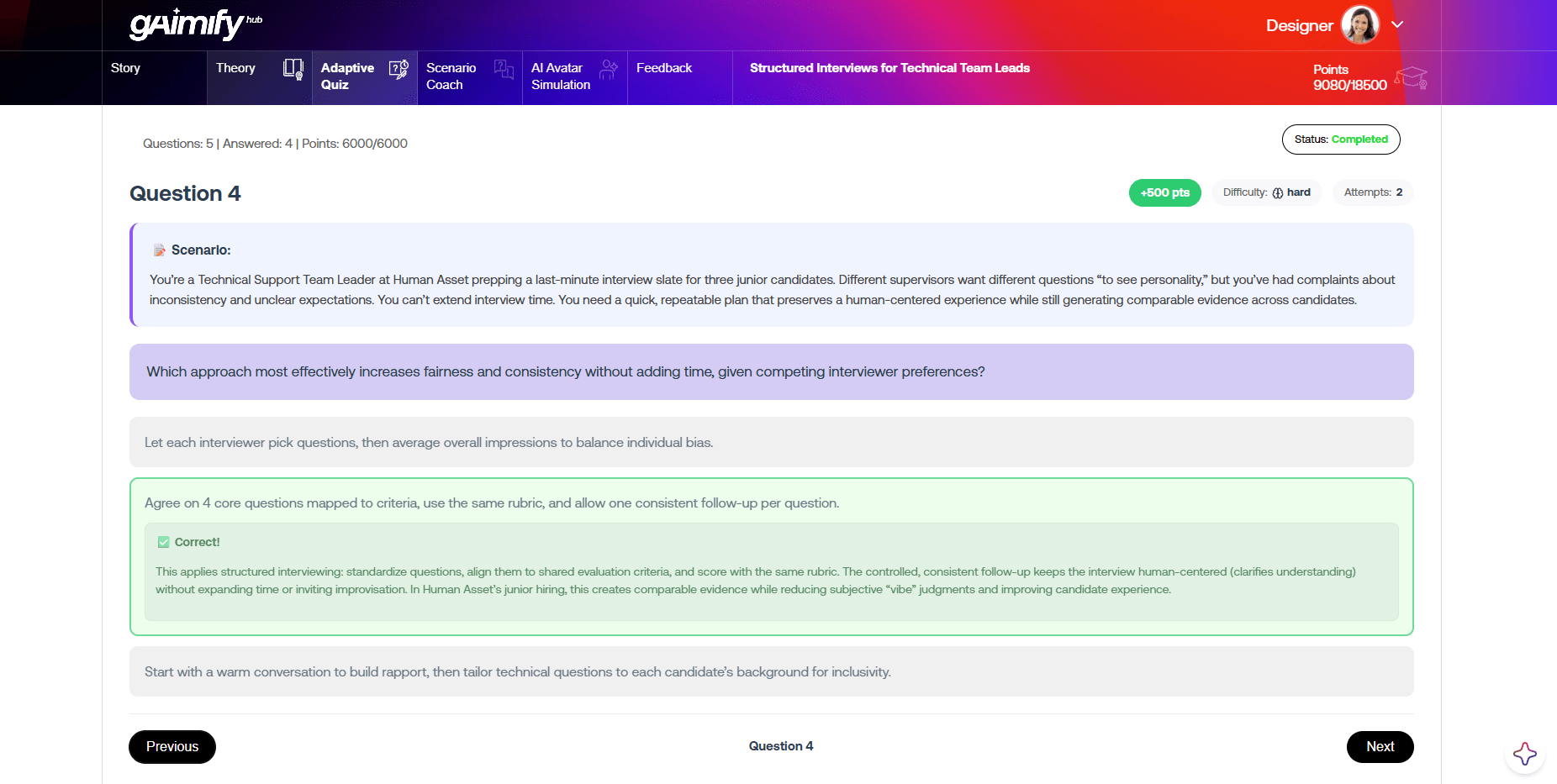
Quiz practice is one of the clearest areas where AI can create real value.
In many traditional courses, quizzes are static. Every learner gets the same questions, in the same order, at the same level of difficulty. This limits both relevance and challenge. It also misses an important opportunity: a quiz may become part of learning itself.
With adaptive quizzes, you can turn that opportunity into a more dynamic experience. Difficulty can shift according to learner responses, weaker areas can be reinforced, and feedback can be given instantly in a way that supports growth rather than simple scoring. This is where adaptive learning becomes tangible.
The value is not only technical. It is educational.
A learner who is progressing well should meet deeper challenge. A learner who is struggling should receive support and clearer direction. This is one of the ways AI can move learning closer to a more personalised and developmental model, something that resonates strongly with the logic behind Bloom's 2 Sigma. It is not full one-to-one tutoring, but it is a meaningful step toward more responsive learning.
Open-Ended Scenarios That Build Judgement And Reflection
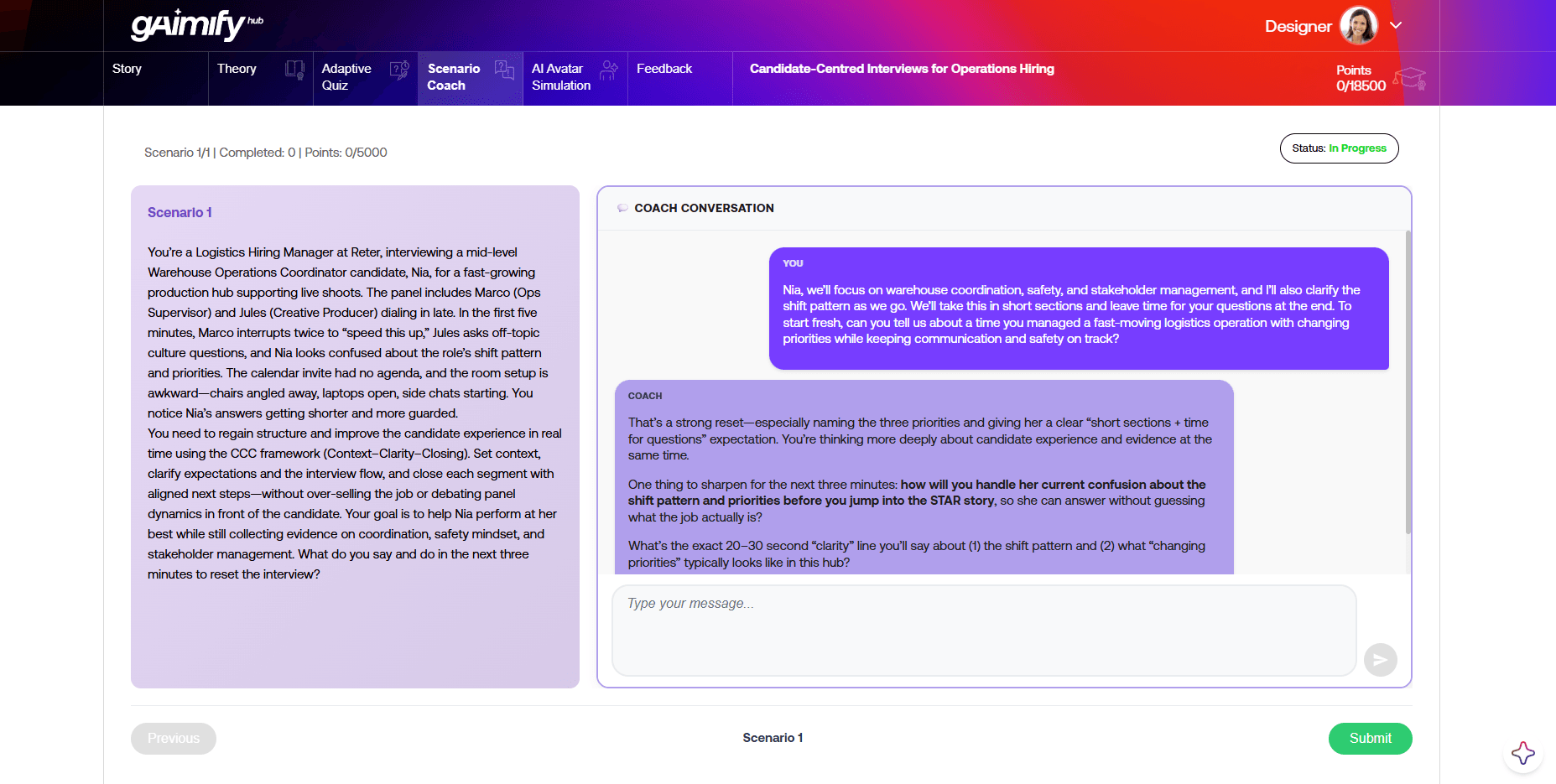
Many workplace skills cannot be developed through multiple-choice questions alone. Skills such as interviewing, giving feedback, coaching, handling conflict, and customer communication depend on judgement, tone, reasoning, and response quality.
This is why open-ended scenarios are such an important opportunity in AI-powered learning. Learners respond in their own words to realistic situations and receive feedback linked to intended competencies, learning outcomes, and rubrics. This makes learning more demanding, more reflective, and more connected to real performance.
Another major opportunity lies in the quality of feedback. Instead of simply giving a score and moving on, gAImify Hub provides more targeted, coaching-style guidance.
Learners can reflect in real time on clarity, reasoning, empathy, intent, and overall communication quality. This creates a stronger link between action, reflection, and improvement, which is essential in adult learning.
From Reading About Skills To Rehearsing Them: AI Avatar Simulations
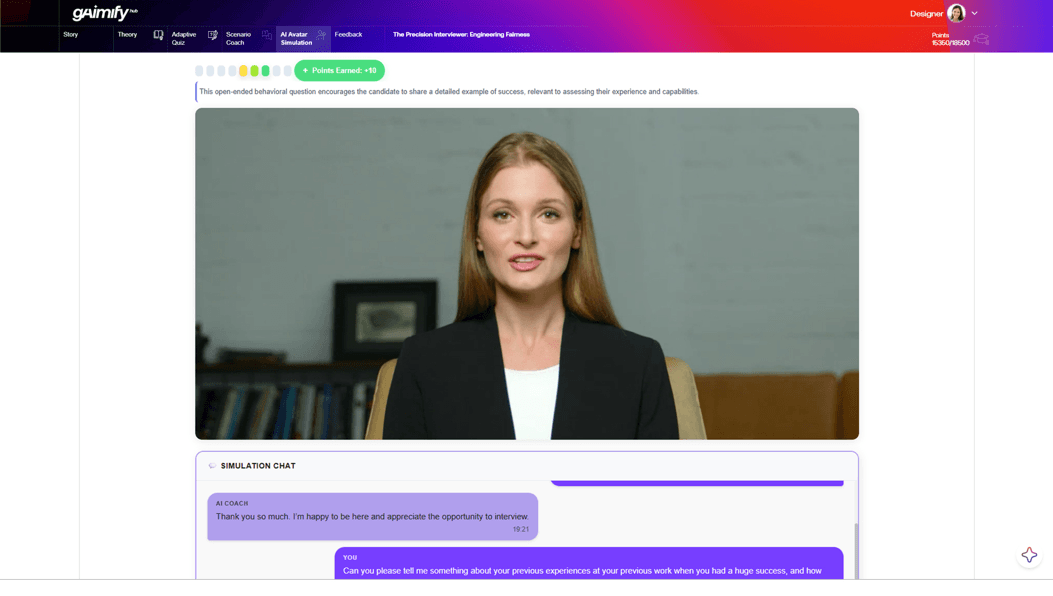
One of the most exciting developments in AI and adult learning is the possibility of realistic simulation practice.
Static eLearning has always had limitations when it comes to developing communication-heavy skills. Reading about how to conduct an interview is useful. Rehearsing it in a realistic conversation is much more powerful.
This is where real-time AI avatar simulations create a strong learning opportunity. Learners can interact through voice-to-voice practice in realistic situations, rehearse difficult conversations, and build confidence through safe repetition. This is particularly relevant in contexts such as:
- Interviewing skills
- Feedback conversations
- Coaching discussions
- Customer interaction
- Onboarding
This kind of simulation brings learning much closer to actual workplace performance. It supports experiential learning in a way that static content cannot easily achieve. It also helps learners move from theoretical understanding to behavioural readiness.
Qualitative Feedback Report
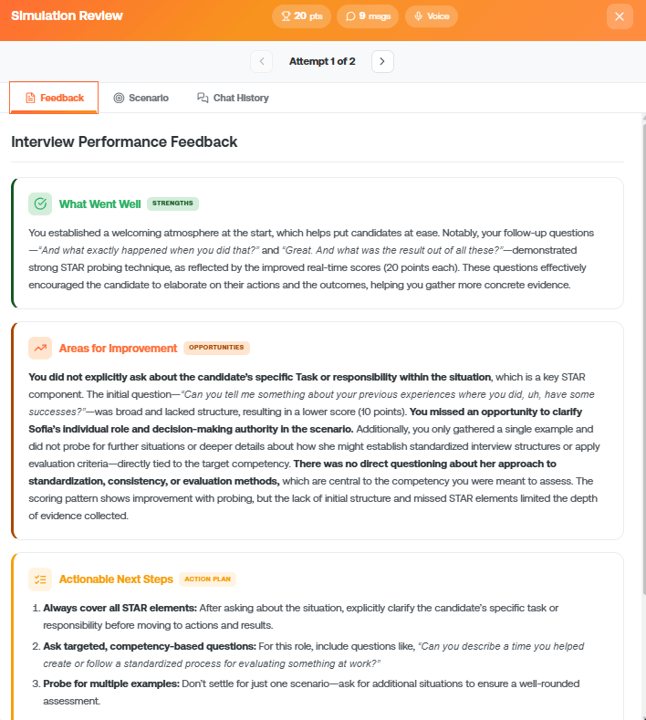
Each AI simulation can generate a qualitative feedback report that goes beyond a score and helps learners understand how they performed in the conversation.
The report includes:
- Word-for-word analysis of strengths. Highlights effective parts of the learner's responses, including examples of clarity, empathy, structure, tone, and decision-making.
- Areas for improvement. Identifies weaker moments in the interaction, such as missed opportunities, unclear wording, limited empathy, weak reasoning, or ineffective handling of the situation.
- Actionable next steps. Provides practical suggestions on what the learner should continue doing, what to improve, and how to respond more effectively in similar situations.
- Full access to the simulation discussion. Learners and reviewers can revisit the scenario and the complete chat/conversation history to analyse the interaction in context and better understand how the discussion evolved.
This makes feedback more transparent, more developmental, and more useful for real skill growth. Instead of only seeing a result, learners can review the full interaction, understand the reasoning behind the evaluation, and improve through targeted reflection and practice.
Engagement With Purpose: Storytelling And Gamification
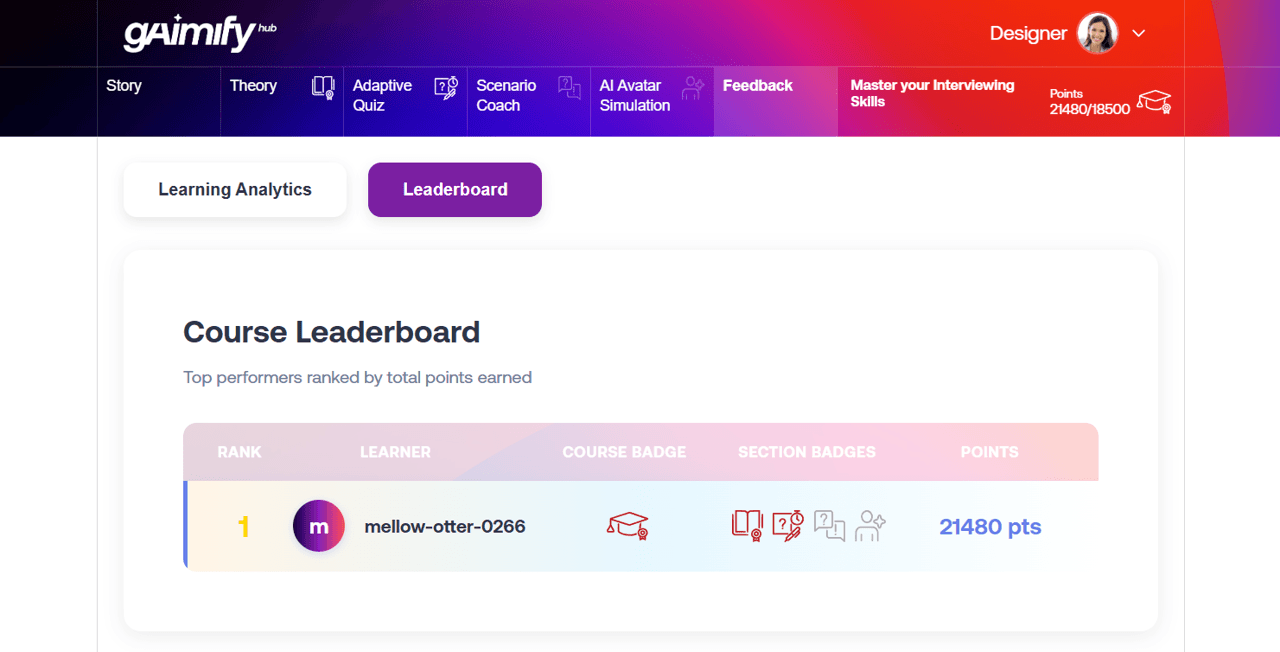
Engagement is another area where AI can open new possibilities when used thoughtfully.
In many digital courses, learners move through disconnected screens of content. The experience may be clear, but it often lacks momentum. This affects motivation, attention, and retention.
gAImify Hub responds to this through custom storytelling and gamified learning journeys. Story gives context. Gamification gives movement. Together, they help learning feel more purposeful and memorable. Learners can move through experiences that are better connected to role reality, while challenges, progress markers, and visible development help sustain engagement over time.
This matters because engagement is not a decorative add-on. In adult learning, it is one of the conditions that supports persistence, focus, and deeper processing.
Learning Analytics Dashboard
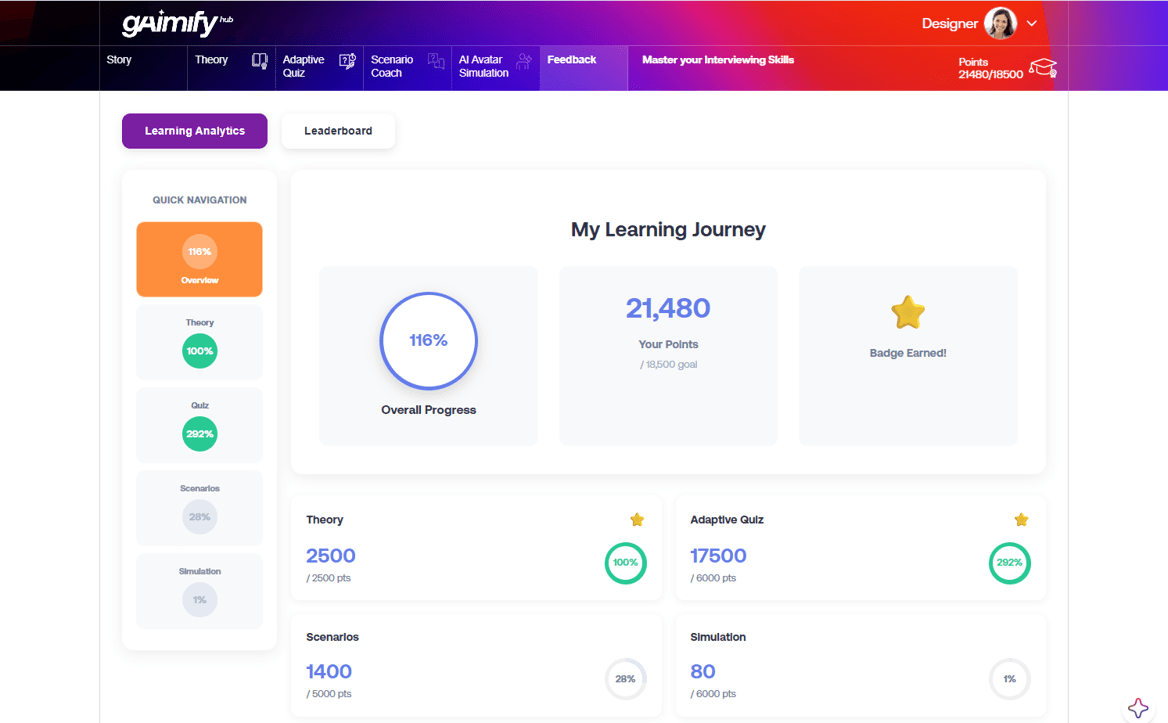
Many platforms also provide a learning analytics dashboard that gives learners, designers, and administrators a clear view of progress across the full learning journey.
It can show:
- Overall progress and completion
- Points, badges, and milestones
- Performance by section, such as theory, quiz, scenarios, and AI simulation
- Quick navigation across the learner journey
- Leaderboard and engagement data, where relevant
Responsible AI And Human Oversight Still Matter
Any optimistic view of AI in learning must also stay careful.
In the Human Asset philosophy, AI should support thinking, reflection, and learning design, not replace professional judgement. This is reflected in gAImify Hub through review, editing, and approval processes that keep humans in control. It is also reflected in the broader attention given to responsible AI, GDPR, EU AI Act readiness, and organisational trust.
Conclusion: From AI Content To Better Learning
At Human Asset we believe the real opportunity with AI in learning is not simply to produce more content faster. It is to create learning experiences that are more human-centred, more adaptive, and more closely connected to real workplace performance.
These innovations can be applied through two practical paths.
Path 1: Build New
You can use a platform like gAImify Hub for:
- AI-assisted course design
- Custom storytelling and gamified journeys
- Adaptive quizzes and open-ended scenarios
- Voice-to-voice avatar simulations
Path 2: Upgrade Existing SCORM
You can use a tool such as inSCORM AI to:
- Keep existing learning assets
- Add mentor-style support
- Add adaptive quizzes and open-ended practice
- Modernise without rebuilding from scratch
Interested in exploring what this could look like in your organisation? Book a demo or explore a pilot to examine together how these innovations can support your learning goals.