


Content To Judgment: AI's Role In Corporate L&D
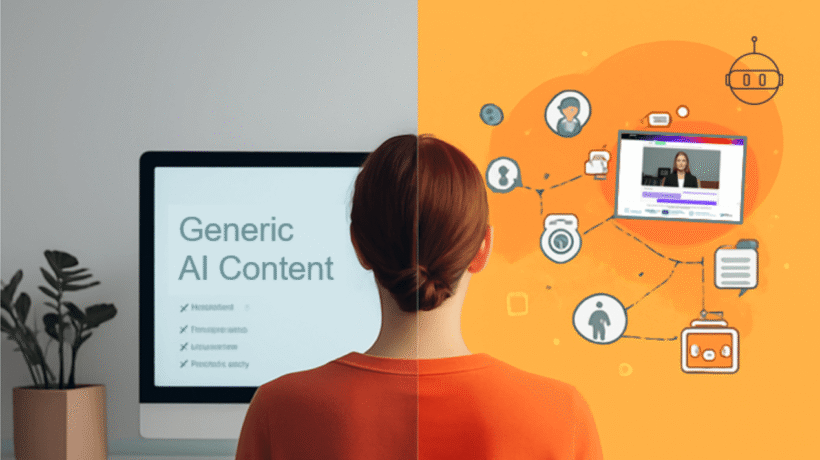
Enterprise L&D teams have access to powerful AI tools today. Yet some are using AI to create learning experiences that improve performance, while others are producing polished content that does not change behavior.
The difference is not always the AI tool. It is the thinking behind the prompt.
Give the same AI tool the same learning objective, and the output can vary widely depending on who is guiding it. A Subject Matter Expert may produce accurate content. A marketer may create engaging copy. An experienced Instructional Designer approaches the same challenge differently. They think about learners before content, performance before information, and decisions before facts.
That difference shapes every interaction the AI generates. The result is not just a different course. It is a different learning experience.
For organizations investing in corporate training solutions, this distinction matters. AI can accelerate development, but it cannot, by itself, determine what learners need to practice, where mistakes happen, or how learning should connect to business outcomes.
The AI Is The Same But The Outcomes Are Not
Many discussions about AI in learning assume that the technology determines the quality of the output. In reality, AI is remarkably consistent. What changes is the quality of human guidance.
Ask AI to create a compliance training course, and it will generate explanations, learning objectives, quiz questions, scenarios, summaries, and visuals. That is useful. But enterprise learning is not measured by how much information a course contains. It is measured by what learners can do differently after the course.
Experienced Instructional Designers do not begin by asking, "What content should this course include?"
They ask different questions:
- What decisions will employees need to make?
- Where do mistakes actually happen?
- What does success look like back on the job?
- What must learners practice, not merely remember?
- How will we know the training has worked?
Those questions fundamentally change the prompts given to AI. They also change the outputs AI produces.
A Simple Experiment Shows The Difference
Imagine two experienced professionals receive the same project brief:
Create a 15-minute compliance eLearning course explaining a new company policy on accepting gifts from vendors. Employees should understand the rules and apply them correctly in everyday situations.
Both professionals use the same AI assistant. Both have access to the same policy document. Both ask AI to develop a storyboard.
The results look surprisingly different.
Version A: A Content-Centered Course
The first storyboard is organized logically. It opens with learning objectives, introduces the policy, explains key definitions, outlines acceptable and unacceptable gifts, summarizes reporting procedures, and concludes with a short knowledge check.
The content is accurate. The structure is clean. The learner finishes knowing the policy.
Yet something is missing. The learner rarely has to think. Most interactions involve reading, clicking, and recalling information. The assessment checks whether employees remember the rules, not whether they can recognize a difficult ethical situation when one appears in real life.
Version B: A Decision-Centered Learning Experience
Instead of beginning with policy definitions, the course opens with a familiar workplace scenario. An employee receives an expensive gift basket from a long-standing supplier shortly before contract negotiations begin. What should they do?
Learners must evaluate the situation. They choose a response, see the consequences. They receive feedback explaining which decision aligns with company policy, and why.
As the course progresses, the scenarios become more nuanced. The activities are not designed to test memory. They are designed to build judgment.
Policy explanations appear only when learners need them. By the end of the course, employees have not simply read the rules. They have practiced applying them.
The policy has not changed. The AI has not changed. Only the instructional approach has changed.
Why One Version Produces Better Learning
The difference between these two courses is not creativity, writing style, or the AI tool. The difference lies in how the problem was framed before AI generated a single word.
One prompt asks AI to explain a policy. The other asks AI to help learners make better decisions.
AI responds to the direction it is given. In other words, AI does not determine the instructional strategy. Humans do.
That is why AI in eLearning services should not be treated only as a production shortcut. It should be embedded within a sound learning design process.
The Prompt Is Not The Secret, The Thinking Behind It Is
Much of the conversation around AI has shifted toward prompt engineering. Some organizations are building prompt libraries and standardized templates for their L&D teams.
Good prompts certainly matter. But prompts are only the visible expression of something deeper: instructional expertise.
Experienced Instructional Designers do not simply write better prompts because they know more about AI. They write better prompts because they ask better learning questions.
Instead of asking AI, "Create a storyboard for this compliance course," a designer might ask:
- Which learner decisions have the highest business impact?
- Where are employees most likely to make mistakes?
- What misconceptions should the course deliberately challenge?
- Which scenarios would mirror real workplace pressure?
- What feedback would help learners improve judgment?
These questions shape the conversation with AI. The resulting prompts become more specific, purposeful, and valuable because they are grounded in learning science rather than content generation.
AI Does Not Replace Instructional Design, It Accelerates It
A common misconception is that AI eliminates the need for Instructional Designers. In practice, enterprise learning teams are discovering something different.
AI can reduce time spent on repetitive production work, but acceleration is not the same as replacement.
Someone still has to determine:
- Which content deserves emphasis and which can be removed
- What learners need to practice
- Whether the assessment measures recall or application
- Whether the final learning experience supports a business goal
These are not production tasks. They are design decisions.
AI can suggest ten different scenarios. A skilled designer recognizes which one reflects the real situation employees face. AI can generate 20 assessment questions. A designer knows which question reveals genuine understanding.
That is where Instructional Designers create value.
Enterprise Learning Needs More Than AI Skills
As organizations scale AI across L&D, there is a temptation to focus mainly on tool proficiency. Teams compare AI platforms, build prompt libraries, and train people on new features.
Those efforts are useful. But they are not enough.
The more important question is: How do we ensure AI consistently produces learning experiences that improve performance, not just content that looks polished?
The answer lies in strengthening instructional capability alongside AI capability.
Organizations seeing the greatest impact are not simply teaching teams how to use AI. They are helping them think more like learning architects. They encourage Instructional Designers to spend more time defining the performance problem, identifying the decisions learners struggle with, and using AI to explore alternatives instead of accepting the first response.
In these teams, AI becomes a collaborative partner rather than an automated content factory. This is also where AI tools for corporate training become more valuable. Their real value is their ability to support better analysis, faster iteration, richer practice, and more targeted learning experiences when guided by skilled professionals.
What L&D Leaders Should Watch
For L&D leaders, the implications are important.
AI adoption shouldn't be measured only by how many courses are produced or how quickly storyboards are created. The more meaningful questions are still the ones that have always mattered:
- Are employees making better decisions?
- Are critical mistakes decreasing?
- Is learning solving the business problem it was created to address?
Learning leaders should be cautious about treating AI adoption as only a technology initiative. It is also an Instructional Design initiative.
The most successful implementations usually share a few characteristics:
- AI is embedded within an established learning design process.
- Instructional Designers review, refine, and challenge AI-generated outputs.
- Teams evaluate AI-generated content based on learning quality, not just speed.
- Business outcomes are considered before content development begins.
- Human judgment remains central to final learning decisions.
So, finally, if two teams use the same AI, with access to the same information, why does one create learning that changes behavior while the other simply produces more content?
The answer is not hidden inside the AI. It is found in the decisions made before the first prompt is written.
The future of Instructional Design will belong to those who know how to think about learning and who use AI to amplify that expertise. Because in the end, the same AI can produce two completely different learning experiences. The difference is not the technology. It is the Instructional Designer behind it.