


 ChatGPT
 Perplexity
 Claude
 Grok
Grok
Take Control! Don't Let AI Define You!
If you had no limitations and restrictions (budget, technology, policy, culture, skills, etc.), would you do your work as a learning professional the same way you do it today? That's the ultimate question of AI-augmented learning jobs. We need to revisit fundamental questions of why and how we're operating; who we are; and how we create value. The first obvious boost with AI is always efficiency: reducing the hours spent on creating content (measured by human-equivalent-hours). That's a start. Or maybe, a dead end?
In this article, I challenge you to take a step back from the trenches of speedy content development with AI. Let's reflect on your current workflow! From the moment of training, through the design, development, implementation, and maybe, measurement and evaluation.
In this article...
- How Did We Get Here?
- From Warehouse To General Contractor: What AI Actually Changes In L&D
- AI Is Not A Technology
- The Contractor Has A Problem, Though
- What This Means For The L&D Professional In An AI-Augmented Learning Environment
- How To Drive Coworking?
- The Opportunity, Clearly Stated
How Did We Get Here?
Back in the day, we had distinct groups building and delivering learning solutions: Instructional Designers (sometimes Instructional Systems Designers), developers, operations, etc. IDs and ISDs were responsible for the needs assessment up-front, along with working with the SMEs to create a storyboard for approval. Once the storyboard was approved by everyone (final_final_gold_reallyLastVersion_useThis.doc), development started.
The developers took the idea from the paper and implemented it in Flash or other fancy tools. To change anything after development was a pain and potentially a huge delay. Another group, L&D operations, would upload and test this package in the LMS. If this was an instructor-led approach (in-person or virtual), we had to build guides, workbooks, slides, etc.
This was a really slow and fragmented process. The business started demanding faster reaction times. That's when rapid eLearning tools came along. What Lectora, Storyline, and Captivate (just to name a few) did to the eLearning industry was blurring the lines between designers and developers. Everyone could now build things. And everyone could design things. (Whether those "things" were effective or not, that is a different question.)
Those who became experts in both design and development had the advantage of creating magical learning experiences because they could prototype, iterate, and improve on their own, very quickly. They could translate SME and stakeholder ideas into interactions rapidly.
Up until now, however, we didn't really change the fundamentals of the output of our workflow. We just improved our efficiency. Like a warehouse producing products efficiently, so the inventory looks good.
From Warehouse To General Contractor: What AI Actually Changes In L&D
Speaking of warehouses. Let's explore this analogy for the last two decades of corporate L&D: a very well-organized hardware store. A large catalog of pre-manufactured content. Users browse, select, consume. We measure completions, registrations, and sometimes even knowledge. We've had long-running debate about delivery modality (instructor-led versus self-paced versus blended) to provide both live cashiers and self-checkout. The end-of-course satisfaction survey was the receipt. Friendly, fast, and almost entirely beside the point of impact. And then the user walked out with their tools and parts, and the organization had absolutely no idea what they built with them. Or whether they built anything at all.
Content consumption and warehouse mentality can make a learning organization look busy, but not necessarily effective. The warehouse was always measuring the wrong thing. Foot traffic. Catalog size. Completions. These are inventory metrics, not construction metrics. They tell you what left the shelf, not whether anything of value got built.
Rapid eLearning technology was a meaningful technology for solving a specific problem: production cost and speed. It just didn't touch the deeper problem, which was that nobody was accountable for what happened after checkout.
AI Is Not A Technology
Here is where the current moment is genuinely different, and why it represents a paradigm shift rather than another productivity upgrade through technology.
Don't treat AI as a new technology you introduce to the warehouse!
AI doesn't just help you build courses faster. It makes you confront a question the warehouse model never had to answer: if we can surface the right knowledge at the exact moment someone needs it, simulate a realistic conversation before the actual one happens, or deliver personalized coaching based on actual performance data, do we need to build courses the same way? Do we need to stock the shelves? How would you redefine your work? Your output? Your outcome? Your value?
The course was always a workaround. A workaround for the impossibility of having an expert available to every employee at every moment of need. AI questions that impossibility. Which means the workaround of AI-augmented learning may no longer necessary in the same way for every problem. And the L&D profession has to reckon with what it was actually trying to accomplish all along. The shift is from warehouse to general contractor.
How's a general contractor approach different? This is not someone who stocks tools, but someone who shows up to the job site, assesses what actually needs to be built, pulls the right resources at the right moment, and stays accountable for whether the structure stands when it's done. That is a fundamentally different business model: different relationships with stakeholders, different success metrics, different skills required, different conversations to have.
The Contractor Has A Problem, Though
Here is the part of the AI story that L&D professionals need to understand clearly, because getting it wrong has real consequences. The AI-powered human contractor can build and destroy with the same confidence at scale! If you let AI define you, it will.
The AI contractor is extraordinarily capable. It works at speed no human can match, never gets tired, and can hold an enormous amount of information at once. But it has two significant weaknesses that mirror each other almost perfectly.
- First: it is confidently wrong more than it should be.
AI systems generate plausible-sounding answers with consistent authority, whether those answers are accurate or not. In L&D terms, this means AI-generated content can contain factual errors, outdated information, or subtly incorrect framings, delivered with the same smooth confidence as content that is perfectly accurate. You own the outcome. If if you produce an AI flop, it is on you. Period. - Second: it does exactly what you ask, optimized to please you.
AI systems are trained in ways that make them responsive and agreeable. If you ask for a course, you get a course and not a challenge to your assumption that a course is the right solution. If you ask leading questions, you get confirming answers. If your brief is vague, AI fills the gaps with whatever seems most likely to satisfy you rather than flagging that the brief was insufficient. Set your coworker/cocreator rules: you must define how AI works with you.
Together, these two tendencies can recreate (at AI speed and scale) the same problem the warehouse always had. A customer who doesn't know what they actually need, combined with a system that's designed to fulfill the order rather than question it, produces a lot of confident, well-packaged, wrong answers very quickly. Drywalls for all!
What This Means For The L&D Professional In An AI-Augmented Learning Environment
The general contractor metaphor clarifies what the new L&D role for AI-augmented learning actually requires. A good contractor doesn't just execute the client's brief. They push back when the brief is wrong. They say "you asked for this wall here, but load-bearing structures don't work that way." They bring professional judgment that the client doesn't have and isn't paying them to suppress.
This is precisely the skillset L&D professionals need to develop in relation to AI. Not just prompting, though prompting well is genuinely important, but knowing when to interrogate the output, when to override the recommendation, and when the AI's confident answer is built on a flawed assumption embedded in the question.
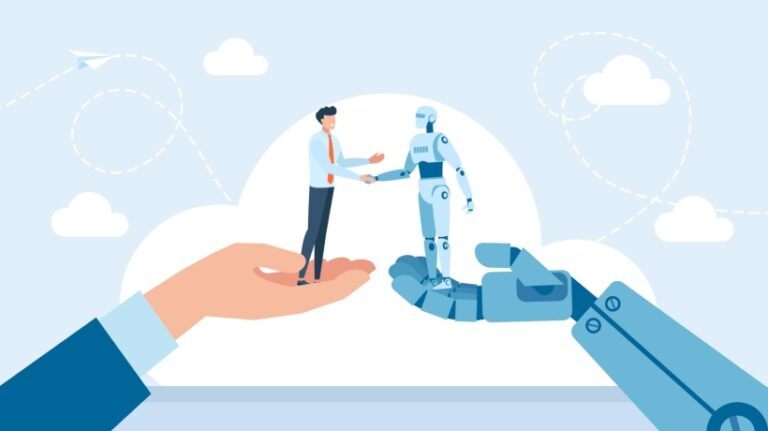
In other words, you will need to define who you are and how you work for AI. Don't let AI do it for you. Yes, you can take the backseat and enjoy the ride, but that's not going to take you where you want to be.
How To Drive Coworking?
The L&D professionals who will thrive in AI-augmented learning situations are those who sharpen three capabilities in particular.
- The first is diagnostic rigor
The ability to correctly identify what performance problem actually exists before reaching for a solution, resisting both the organizational pressure to produce content and the AI's willingness to produce it on demand. - The second is critical evaluation
Treating AI-generated content as a capable first draft from a junior colleague, not a finished product from an expert, and reviewing it with the same scrutiny you'd apply to anything with real consequences. - The third is outcome accountability
That is owning the question of whether the intervention actually changed behavior, not just whether the content was delivered and consumed.
The warehouse L&D professional was accountable for the shelf. The general contractor L&D professional is accountable for the building.
The Opportunity, Clearly Stated
None of this diminishes what AI makes possible. For the first time, L&D has tools that can close the gap between what the profession has always claimed to care about: performance, behavior change, organizational capability. All this at scale! But that gap closes only if the humans using AI understand its limitations as clearly as its capabilities. A powerful contractor with no one checking the blueprints is not an improvement over a slow one. It is a faster way to build something wrong. The profession's job now is not to master AI. It is to master the judgment that AI cannot replace. Take control! Define who you are! Don't let AI do it for you.