





L&D Is Active With Tools, Absent From Decisions
L&D teams are more active with AI than ever. Teams are creating content faster, building courses in hours instead of weeks, and experimenting with chatbots, quiz generators, and translation tools. By most activity measures, things are moving.
So why are so many L&D leaders still fighting for a seat at the AI strategy table?
Because activity and impact are two different things, and the gap between them is where L&D's credibility is getting lost.
We surveyed over 1700 learning professionals to find out where AI in L&D stands today. 78% of L&D teams said they aren't in the room when budgets and priorities get decided, and they're executing someone else's vision.
Influence compounds in organizations just like capability does. The teams shaping AI strategy now will get credit for outcomes later, and the ones left out of those conversations won't. What's at stake is the ability to matter at the moment that matters most.
Here's what the rest of the data shows, and what you can do about it before your next stakeholder conversation.
The Number That Should Worry Every L&D Leader
25% of L&D teams say their primary reason for adopting AI is personalization at scale. Fewer than 4% are prioritizing business performance.
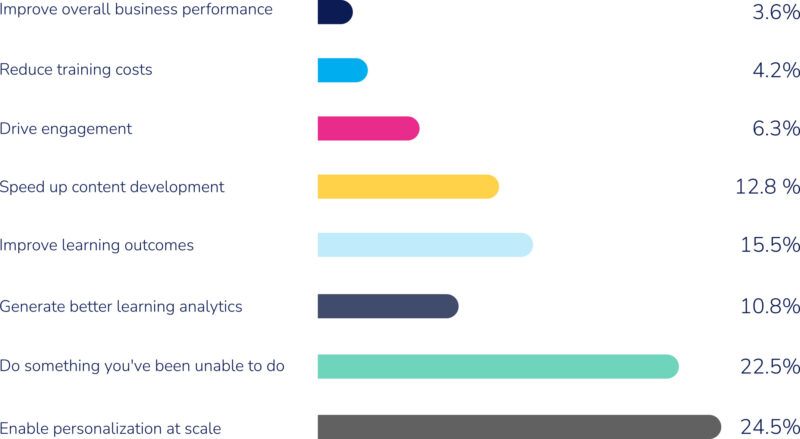
Now think about your next exec conversation. When your CFO walks into the room and asks what L&D's AI investment is delivering, which answer lands? "We're personalizing the learner experience at scale," or "We reduced time-to-productivity for new hires by 30% and here's the data"?
Personalization without a business case falls flat in executive conversations. L&D tends to speak in the language of learner experience, while executives speak in revenue, retention, and productivity, and right now those two languages aren't meeting in the middle. The cost of that disconnect is credibility.
Try this before your next stakeholder conversation. Take whatever AI initiative you're currently running and ask: What business metric should this move? A learning metric won't cut it here, so think time-to-productivity, sales win rate, compliance incident rate, or customer churn. If you can't name one, that's your first problem to solve, and it's solvable before you walk into the room.
Reframe the initiative around that number and lead with it. Rather than "We're improving the learner experience," try "We're using personalized learning to close the skill gaps that are slowing your sales cycle."
Same initiative, but a completely different conversation.
The Resistance Problem Isn't What You Think, And It's Not Coming From Where You Think
37% of L&D teams say stakeholder resistance is their biggest challenge to AI adoption. Only 12% say the barrier is a lack of internal expertise.
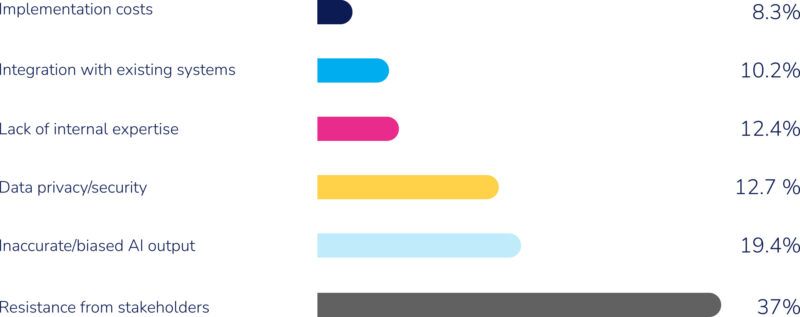
The resistance most L&D leaders navigate rarely comes from a single direction. It's coming from several, for different reasons, often at once. Treating it as one problem with one solution is why so many teams hit the same wall.
Think about who's actually pushing back in your organization right now.
Senior leaders who haven't seen a business case they believe in aren't anti-AI. They're weighing risk, and nobody has yet shown them proof that the return justifies the investment. That's a credibility problem, and it's solved with evidence.
Managers who don't trust AI-generated content to meet their team's standards have probably seen something miss the mark, or heard enough about AI hallucinations to be cautious. That's a quality concern, and it's solved by showing them your review process.
Employees who feel uneasy about what AI means for their jobs aren't resistant to learning. They're resistant to a version of AI adoption that feels imposed on them rather than designed for them. That's a change management problem, and it's solved by involving them early, being transparent about what AI will and won't change, and making the learning experience feel like development.
Subject Matter Experts who feel bypassed when AI drafts content they used to own aren't being obstructionist. They're protecting something they care about. That's a co-ownership problem, and it's solved by repositioning them as the expert reviewer and quality filter rather than sidelining them.
IT or legal teams slowing things down through governance concerns aren't resisting. They're flagging a process gap, and it's solved by bringing them in as partners before you need their approval.
The point isn't that all of these are equally common in your organization. Diagnosing where the resistance is coming from is the actual first step, before you decide how to respond. Teams that treat every concern the same way often default to more communication or more AI training, and end up frustrated because they're applying the right answer to the wrong question.
Here's the tactic that works regardless of where the resistance lives. Go to the most resistant person in the room, whoever that is for you, and ask them one question: "What would success look like to you?"
Skip "What are your concerns," which invites a list of objections, and skip "Let me show you what AI can do," which triggers defensiveness. Stay with the question, then build your next pilot to deliver exactly that. When a skeptic helps define the success criteria, they become accountable, shifting from judge to co-owner.
That dynamic works whether the skeptic is a CFO, a line manager, a nervous employee, or a Subject Matter Expert worried about their role.
Resistance usually comes back to trust, proof, and a sense of control. Give people that, in the form most relevant to their specific concern, and the resistance tends to move.
A Market Splitting, And The Gap Is Already Wider Than You Think
27% of L&D teams have been using AI for years, 46% have started recently, and 27% haven't started at all.
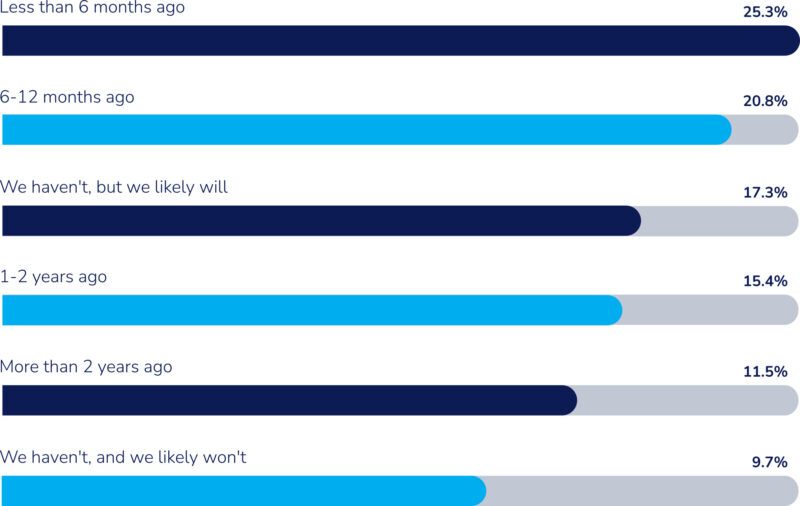
Reading that as a gradual curve, with early adopters, mainstream, and laggards, misses what's actually happening. This is a divide, and the distance between the groups is growing every quarter.
The teams with the longest track record already have a lead, and they keep adding to it. Every pilot builds institutional knowledge, every win earns more budget and more permission, and every quarter of execution makes the gap harder to close.
The more telling detail is where teams are investing AI effort. The most common uses are content creation (30%) and research (21%). The least common are enhanced reporting (11%) and streamlined delivery (11%). Teams are concentrating AI effort in parts of the work that feel familiar, such as drafting content and summarizing research, while underinvesting in the parts that would actually change their strategic position: connecting learning to outcomes, delivering it where and when it's needed, and proving its impact.
Using AI to do the same things faster is an efficiency gain. Using AI to tackle fundamentally different problems is the strategic shift, and one earns you time while the other earns you influence.
If you're in the 46% who have recently started, here's the move. Pick the single highest-visibility business problem in your organization right now, whether that's a new product launch, a retention crisis, or a compliance deadline, and build one AI-assisted learning intervention around it. Measure it against a business metric from day one. A focused win in a high-visibility area does more for your strategic position than ten efficiency improvements running quietly in the background. Start small, but start where people are watching.
The Exclusion Cycle, And How To Break It
Only 22% of L&D teams are included in AI strategy discussions.
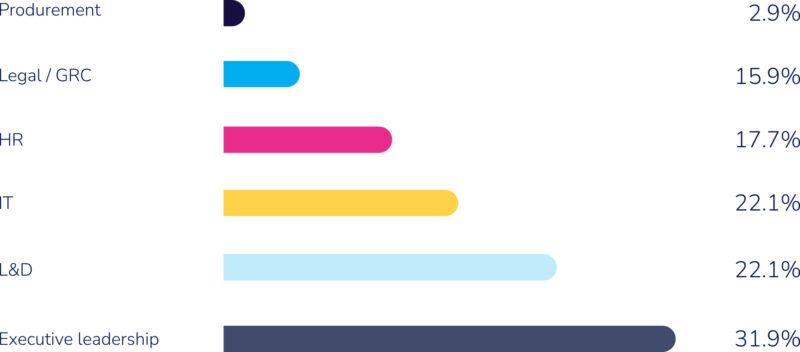
AI is reshaping how organizations hire, develop, and retain their people, yet in 78% of organizations the function responsible for building capability is excluded from the conversation.
The cycle runs like this: L&D isn't included in strategy discussions, so it can't shape the direction of AI adoption. Without a seat at that table, it can't run the experiments that would generate proof. Without proof, it can't make the case for inclusion. The cycle continues.
Breaking it means generating proof before the invitation arrives. Proof requires access, and access requires a wedge, so find yours.
Look for the business leader in your organization who is currently losing sleep over a people problem: a skill gap affecting delivery, a new system nobody knows how to use, or a team that keeps missing targets. Approach them not with a learning solution but with a question: "Can I run a six-week pilot to help with this, and can we agree upfront on how we'd know if it worked?" Most will say yes. Six weeks later, you have data, and data is how you get inside the conversation. Make exclusion look like a business risk, one outcome at a time.
The Ethical Gap Nobody Is Talking About
15% of learning professionals feel prepared to manage the ethical implications of AI in learning.
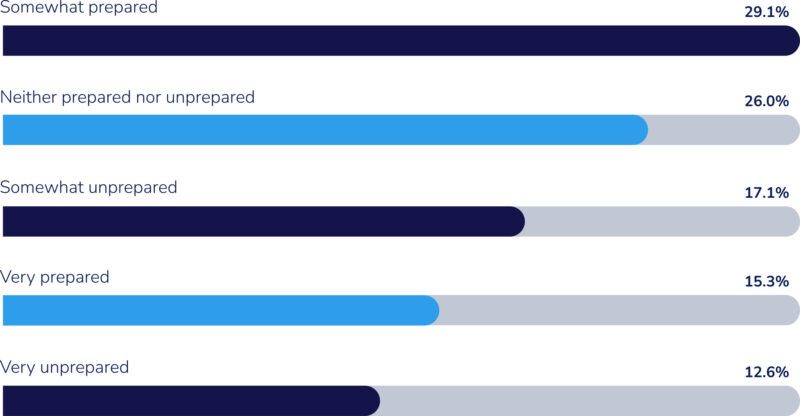
AI is already informing learning and people strategies, influencing who gets development opportunities, which learning pathways are recommended, and how performance is evaluated. The vast majority of L&D professionals, however, don't feel equipped to manage the risks that come with that.
Organizations that haven't thought carefully about bias in AI-generated content, transparency in algorithmic decision-making, or data privacy in learner analytics aren't avoiding ethical risk. They're deferring it. Deferred ethical risk doesn't disappear; it lurks quietly until something surfaces publicly that's very hard to walk back.
You don't need a full ethics framework on day one. You need three things. First, a review step in every AI content workflow, where a human checks content before it goes to learners, every time. Second, a clear internal answer to the question "What learner data are we using and who has access to it?" Third, a conversation with your legal or compliance team before you scale, not after something goes wrong. Those three things won't cover every ethical scenario AI creates, but they'll give you a solid foundation to build from.
What The Data Is Really Saying
Strip back every stat in this piece, and the story is consistent: L&D is capable, but isn't always positioned where the business needs it to be.
The gap comes down to the distance between optimizing for learner experience and driving business outcomes. It also shows up in how AI is used, whether to move familiar work faster or to take on more strategic problems.
The teams closing that gap are running one small experiment, measuring the right things, building one piece of credibility at a time, and using each win to earn the next one.
Every action in this piece is singular: one metric, one question, one pilot, one wedge, one review step. That's deliberate. Teams that try to solve the AI shift all at once tend to end up in analysis paralysis, while teams that pick one thing and prove it works are the ones building the compounding advantage that matters.
A strategy for all of AI in L&D can wait. What you need right now is one intentional next move.





![From AI Promise To Capability: What L&D Teams Need To Close The Skills Gap [eBook Launch]](https://cdn.elearningindustry.com/wp-content/uploads/2026/05/From-AI-Promise-To-Capability_-What-LD-Teams-Need-To-Close-The-Skills-Gap-eBook-Launch.jpg)