

 ChatGPT
 Perplexity
 Claude
 Grok
Grok
A Practical Guide From Michael Allen
All organizations depend on performance excellence. Effective ongoing training and motivation are essential to performance excellence. Unfortunately, it's easy to think that good training isn't a difficult initiative and therefore should claim a minimal budget. Becoming just another box to check and provided only halfhearted support, the resulting training is not only ineffective but, ironically, incredibly expensive.
What? Low-budget training is expensive?
Yes. Time is not refundable. Learning that doesn't upgrade behavior wastes everyone's time—and that's expensive. It drains productivity, frustrates learners, and squanders resources that could be fueling your organization's growth.
Of course, just spending more doesn't ensure higher quality. To demystify the costs of developing effective custom eLearning, I'll draw from our decades of experience at Allen Interactions, where we've encountered and successfully solved a wide variety of training and performance challenges in nearly every industry, involving almost every imaginable constraint.
The Myth Of One-Size-Fits-All Pricing
Pricing eLearning development based on projected learning time is traditional and convenient, but it's flawed. Not every student needs the same amount of seat time to master a skill. So, while we often use "per hour" cost estimates for simplicity, this presumes the same experience for every learner—which simply isn't true. With adaptive learning solutions that dynamically adjust to individual needs, tailoring content to strengths, weaknesses, and prior knowledge, we ensure all students reach mastery, not just some, and do so in minimal time.
Seat time can and should vary tremendously. So how about using the average expected seat time? The average time to completion isn't indicative of the amount of training that needs to be created. What needs to be considered is the breadth of learner needs and the appropriate eLearning experiences for learners across the entire range and advance preparation and ability.
Adaptability is a game-changer. eLearning, when done right, can reduce time to mastery by over 40% getting trainees through training and back on the job as quickly as possible. Although achieving this outcome requires advanced design and technology to adapt to varied needs, the greater outcomes easily pay for the associated development costs. For example, in our work with AutoNation, adaptive eLearning led to a 22% increase in productivity and $10 million in additional profit, all while streamlining onboarding and reducing time away from core work. We can develop a lot of superb eLearning for a fraction of $10 million–a benefit that will pay back year after year.
Moreover, once eLearning is developed, the cost to deliver it is nearly free. Unlike traditional training, which scales linearly with headcount (think facilitators, venues, and travel), digital solutions can reach thousands—or millions—with negligible incremental costs. This scalability makes eLearning ideal for distributed workforces, as seen in our Mary Kay Cosmetics project, where 3.5 million learners were onboarded across 35+ countries with 90% engagement and 80% completion rates through personalized microlearning.
Key Factors Influencing eLearning Development Costs
The primary drivers of eLearning development costs are:
- Content readiness and complexity
- Range of trainee readiness
- Motivation to learn
- Appropriate instructional paradigm
- Level of mastery required (considering cost of performance errors)
- Frequency of performance (long term retention requirements)
Why Invest In Performance-Focused eLearning?
Ineffective eLearning is a hidden cost killer. It leads to lack of knowledge, no skills upgrades, and lost productivity—potentially millions in opportunity costs. But with well-designed learning experiences, we get measurable wins: faster mastery, scalable delivery, and assured proficiency for all learners.
As the conceptual table below shows, the cost per learner declines as training becomes more effective. It's true the initial investment cost rises, but at the lowest investment organizations are penalized with ultimately the highest expense.
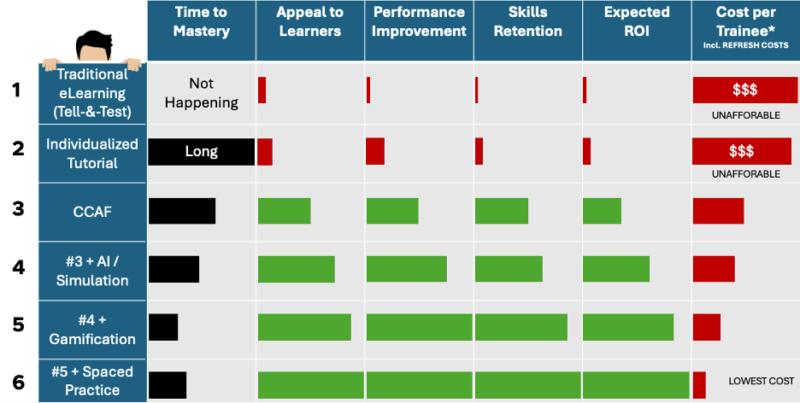
It's important to note that the table isn't based primarily on investment amount, however. It's based on the effectiveness of digital training delivery. At Levels 1 and 2, training has negligible effectiveness. It really makes no sense to invest in tell-and-test or tutorial eLearning. The forgetting curve is steep, and learners have no opportunity to practice. Practice is essential for skill development and retention.
The very best eLearning uses smart and adaptive simulations and provides continuing practice spaced out over weeks and months after initial training has been completed. This keeps learners performing at their best and provides a basis to continual upgrades as tools and procedures in the workplace are refined.
Expenditure Vs. Cost
Many organizations, especially larger ones, have responsibilities divided among various persons and departments. Some are responsible for keeping expenses low while others are responsible for the quality of services or sales revenue. This division of perspectives often results in looking at training as a cost unlike, for example, the investments made in equipment or facilities. But there are few more important and valuable investments than investments in people.
Training is, indeed, an investment—an investment in people with the payoff being not only more efficient and effective performance, but also greater retention of staff who reap the personal rewards of performance excellence and up their loyalty to their appreciative organizations.
Poor training, on the other hand, is costly. In fact, poor training is the most expensive and most unaffordable training. It results in errors, lost customers, product returns, on-the-job injuries, high employee attrition, and even lawsuits. It ramps up the need for additional and recurring training to counter the ineffectiveness of previous training.
Let's create eLearning that changes behavior and drives your success. – Michael Allen, PhD, CEO and Founder, Allen Interactions Inc.
Go One Step Further
This compendium of Buyer's Checklists are excerpts from my book, Rethinking eLearning: What works.What doesn't. What's missing.
They are designed to help buyers of either custom-built or off-the-shelf eLearning make smart investments.
As a buyer of training, you don't need to have all the skills an Instructional Designer or developer must have to create great eLearning, but you need to know what to look for when specifying your criteria.