

 ChatGPT
 Perplexity
 Claude
 Grok
Grok
CPD Visibility Gap
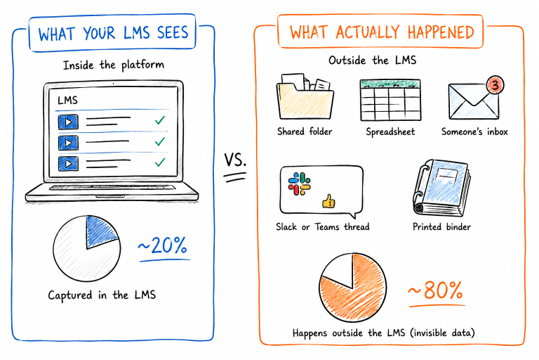
When companies buy a Learning Management System (LMS), they expect full continuing professional development (CPD) tracking to come with it. It reports completions and generates dashboards. Easy to assume it shows you everything your people do to stay compliant. But this "everything" relates to only what's inside the platform. It's around 20% of all CPD activity.
Think about conferences, webinars, self-funded courses, employer-run training, professional events, reading, mentoring, and on-the-job learning. All of that happens outside the LMS, and stays invisible to it. We call it the CPD visibility gap. It's the difference between the CPD your LMS can see and the CPD your people are actually completing.
TL;DR
- The CPD visibility gap is the difference between what your LMS tracks and the CPD your people complete.
- Your LMS captures what happens inside it, which may account for 20%.
- The other 80% (conferences, self-funded courses, webinars, on-the-job learning) lives in spreadsheets, shared folders, and inboxes the LMS can't see.
- The gap stays invisible until an audit happens or a regulator asks for proof. Then it turns into days or weeks of manual reconciliation.
- To fix the gap, you need a compliance layer connected via API that catches the other 80% without replacing what already works.
- A leading Irish law firm closed this gap in two months with a separate CPD dashboard connected to its existing setup.
Your LMS Is Tracking Only 20% Of The Picture
The easiest way to understand the CPD visibility gap is to look at how CPD tracking works in real organizations. When we speak to our clients, we usually hear the same story, told in different words. The LMS captures what happens inside it, and everything else gets tracked somewhere else. Or not tracked at all. Here are a few situations you might recognize:
- A professional association tracks CPD through its own course library. But most members meet their required hours in a self-funded course or through training their employer ran. Those activities stay off the association's platform, so the record can't show them.
- A regulated organization that's run CPD the same way for years. They've saved certificates as PDFs, logged hours in a spreadsheet, and manually sent reminders when they remembered to. It worked until a regulator asked for a complete record across every category. Half the hours had no paper trail to produce right away.
In each case, the LMS has a record of some CPD, but not all of it. Your LMS might also have a blind spot, and it's 80% wide. So what happens to all that CPD the LMS can't see?
Where Does The 80% Go?
Ask compliance leads where CPD evidence sits, and the honest answer includes at least these places:
- A shared folder
Certificates, screenshots of confirmation emails, PDFs nobody has opened since the day they were uploaded. - A spreadsheet kept by whoever remembered to, whenever they remembered to
- Someone's inbox
Nobody planned for it, but it's doing real CPD tracking anyway. - A Slack or Teams thread
"Here's my certificate!" acknowledged with a 👍. - A printed binder last updated by someone who left the company two years ago
Of course, your LMS can't track any of this. Why would it? These systems don't talk to each other or to the LMS. Your LMS catches what happens inside its walls. Outside them, it's flying blind.
For a while, this arrangement is fine. Then an auditor asks for the full CPD record, or reporting requirements change. At that point, "we track CPD" has to become "we can prove it." Then go days or weeks of manual reconciliation. And the conversation turns to why the numbers on the spreadsheet don't match those in the system.
This costs time and risk. In regulated professions, missing a CPD deadline can mean mandatory audits or a lapsed license. For associations, an unreliable CPD record puts the credential itself at risk.
So if it takes three weeks to pull a complete record, that's a sign your CPD tracking needs work. Better yet, you can find those weak spots before an audit does.
Self-Check: Do You Really Have CPD Tracking?
A quick self-check can tell you if your current setup gives you a complete view of CPD or only records what happens inside the LMS.
- Can your LMS capture external activity as it happens, not months later?
If evidence enters the system when someone remembers to upload it, the record is running behind reality. - Can your LMS enforce rules by role, department, or region without someone tracking it manually?
Different roles owe different hours in different categories. A spreadsheet doesn't apply that logic on its own. Someone has to apply it for every person. - Can your LMS produce an audit-ready report in seconds?
There's nothing to think through here, as the answer is yes or no. If no, your CPD record isn't complete.
And any "no" means there is a gap in your CPD tracking. But don't start shopping for a new LMS just yet. A migration is a lot of work, and you may not need one.
You Don't Need To Replace Your LMS To Fix Your CPD
If your current system handles courses, completions, and content fine, why abandon it? Add a CPD layer on top of it and cover the other 80% through your existing LMS setup.
You can build a custom CPD dashboard and connect it to your current LMS through an API. That layer captures external activity and applies compliance rules by role, department, or category. Multiple rules can run at the same time and not conflict with each other. If someone's circumstances are different, an admin adjusts that one person's requirement, and everyone else stays as it was.
The CPD dashboard gives learners, managers, and admins real-time visibility into where everyone stands. It's also a live view that's accurate whenever someone asks. And because it sits on top of your LMS, you can change your CPD rules without opening a ticket with your LMS vendor. Instead of replacing the system you already have, you extend what it can see.
Building The CPD Layer? Get These Right
Once you decide to add a CPD layer to your LMS, the build itself deserves some thought. A setup that works well at first can become a headache a year later if you haven't planned for a few things:
- It should grow with your rule set
Today's rules probably cover seniority and category. Next year, a professional body might add a requirement, or you might expand into a new region. Build for new rules as they come, or you'll be rebuilding this again in a year. - It shouldn't depend on someone remembering to feed it
If external activity relies on someone manually uploading a certificate or forwarding an email, the weak point hasn't moved. Make sure the layer captures that activity directly. - It should stay separate from your LMS
Connect via API and keep the layer independent. An LMS upgrade shouldn't be able to break your compliance tracking. - Changing a rule shouldn't need a developer
Whoever owns compliance should be able to add a category or adjust a threshold directly, without a ticket or a release cycle. - Plan for a full audit trail early
A live dashboard answers "Are we compliant now?" question. A regulator might ask "Were we compliant in March?" Build for that from the start.
One Irish law firm's setup checks most of these boxes. They kept the LMS in place and added a separate CPD layer to handle compliance tracking [1]. Here's how it worked.
How An Irish Law Firm Added CPD Compliance Tracking In Two Months
A leading Irish corporate law firm ran on our LMS. It handled internal training well, but had no way to capture external activity and track CPD hours against regulatory requirements. For solicitors, a missed CPD deadline means up to two years of mandatory audits, so they couldn't afford to miss deadlines.
As the LMS couldn't be extended directly, the firm brought a team in to build a separate CPD platform and connect it to the LMS setup via API. External activity now logs directly into the platform with full compliance credit, and CPD rules apply automatically by seniority and category. A pro-rata adjustment system accounts for parental leave, part-time schedules, and mid-year hires, so each person's threshold reflects their actual working year.
The CPD visibility gap isn't unique to law firms. And it isn't a reason to distrust your current LMS. But remember that "we have an LMS" and "we have the full CPD picture" are two different claims. Only one of them is usually true.
References:
[1] Our Client Adds CPD Compliance Tracking to LearnUpon, Delivered in 2 Months
Image Credits:
- The image within the body of the article was created/supplied by the author.