

 ChatGPT
 Perplexity
 Claude
 Grok
Grok
How To Train Sales Reps Who Rarely Sit At A Desk?
According to Boston Consulting Group, [1] deskless workers make up 70–80% of the global workforce. Yet most corporate training and sales enablement programs are designed as if employees spend their days sitting behind a laptop.
That's a problem. Because many of today's revenue-generating employees don't work at desks. They work in hospitals, retail stores, manufacturing facilities, distribution centers, customer sites, and field locations. They are pharmaceutical representatives, financial advisors, retail associates, field sales professionals, channel partners, service technicians, and customer-facing teams.
And they're expected to sell increasingly complex products in markets that change almost daily. New product launches. Competitive threats. Regulatory updates. Pricing changes. New customer expectations.
The pace of change is accelerating, but traditional sales enablement hasn't kept up. This is where Artificial Intelligence (AI) is beginning to reshape the rules. Not by replacing trainers, Instructional Designers, or sales enablement leaders. But by helping organizations deliver knowledge, coaching, reinforcement, and performance support exactly when deskless employees need it.
AI-Powered Sales Enablement Training: Solving Real Sales Problems Without Losing The Human Edge
Why The Deskless Workforce Creates A Unique Sales Enablement Challenge
Traditional sales enablement training programs assume employees have dedicated learning time. The reality for deskless workers is very different. A medical device representative spends most of the day meeting healthcare professionals. A field sales representative is traveling between accounts. Their workday is defined by customer interactions, not calendar invitations.
As a result, many organizations struggle with the same challenge: they create excellent training programs, but employees have limited opportunities to consume them.
The issue becomes even more complex in large enterprises. Sales enablement leaders often need to support thousands of employees spread across multiple geographies. Product portfolios evolve constantly. Business units launch new offerings at different times. Regulatory requirements vary by market. Some teams require highly technical knowledge while others need customer-facing selling skills.
The result is a continuous cycle of learning demand that can quickly overwhelm even well-established enablement teams.
Many organizations respond by creating more training. Unfortunately, more training rarely solves the problem. The challenge is ensuring the right information reaches the right employee at the right moment.
The Shift From Sales Training To Continuous Sales Readiness
Leading organizations are beginning to rethink sales enablement altogether. Instead of measuring success by course completions or certification rates, they're asking a different question: How quickly can we make our sales teams ready for change?
This represents a fundamental shift:
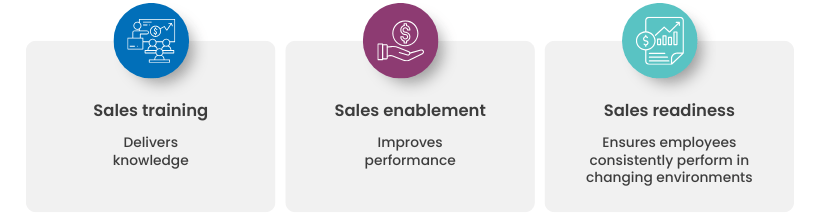
- Sales training focuses on delivering knowledge.
- Sales enablement focuses on improving performance.
- Sales readiness focuses on ensuring employees can consistently perform in changing environments.
How AI Is Transforming Sales Enablement for Deskless Teams
The most significant impact of AI isn't that it creates training content faster. Its real value lies in helping organizations support employees before, during, and after customer interactions.
Personalized Learning Instead Of One-Size-Fits-All Training
Most sales enablement programs still push identical learning experiences to large groups of employees. AI allows organizations to move beyond this model.
Instead of assigning the same content to every employee, AI can recommend learning based on role, region, product focus, performance data, certification status, and business priorities.
Microlearning Becomes Truly Useful
Microlearning solutions have been a major trend in learning and development for years. But AI makes it far more powerful. Rather than requiring employees to search through learning libraries, AI can surface the most relevant content based on context.
Imagine a field sales representative preparing for a customer meeting. Instead of spending twenty minutes searching through documents, the representative receives a three-minute refresher on product benefits, common objections, competitive differentiators, and recent updates.
Learning becomes immediate. Accessible. Actionable. For deskless workers, that shift can dramatically improve adoption and engagement.
AI-Powered Coaching At Scale
One of the biggest challenges in enterprise sales organizations is coaching.
Managers want to coach more frequently. Salespeople want more feedback. But time remains limited. AI-powered coaching tools are helping bridge this gap.
Representatives can practice conversations, product pitches, objection handling, and customer interactions through AI-powered role-play platforms such as Cicero, Second Nature AI, and Quantified AI.
These tools simulate discovery calls, product discussions, objection handling, negotiations, and competitive conversations, allowing reps to rehearse in a risk-free environment before engaging with customers. The platforms provide immediate feedback on messaging, questioning techniques, confidence, and adherence to sales methodologies—creating coaching opportunities that can be scaled across thousands of employees.
While human coaching remains essential, AI allows organizations to extend coaching opportunities far beyond what managers alone can provide. This is particularly valuable for distributed teams where face-to-face coaching opportunities are limited.
Performance Support At The Moment Of Need
This may be the most transformative application of AI in sales enablement.
Historically, organizations expected employees to remember what they learned during training. AI enables a different model. Instead of memorizing everything, employees can access trusted information instantly when they need it.
Whether it's a product specification, pricing update, competitor comparison, or sales process question, AI-powered assistants can help employees find answers in seconds.
For deskless workers operating in fast-moving environments, this capability can have a direct impact on performance. The goal shifts from knowledge retention to knowledge accessibility.
The Role Of AI Agents In Sales Enablement
While AI assistants help employees find information, AI agents are beginning to take things a step further.
Consider a global product update. In a large enterprise, that update may affect sales teams across regions, roles, product lines, and languages. An AI agent could:
- Scan the approved source material.
- Identify which sales roles are impacted.
- Flag outdated enablement assets.
- Recommend what needs to be updated.
- Trigger the creation of microlearning, FAQs, manager talking points, reinforcement nudges.
- Help route content for SME review.
- Track which regions are still pending approval.
- Alert enablement owners when launch-readiness gaps appear.
That is where AI agents become especially relevant for deskless sales enablement. They don't just support the individual rep. They help sales enablement and L&D teams keep learning execution moving across a complex, distributed workforce.
In the future, AI agents could monitor product launches, identify which sales teams need enablement, recommend learning paths, generate reinforcement content, schedule coaching activities, and even alert managers to emerging skill gaps. Rather than waiting for employees to seek support, AI agents can proactively deliver it.
For sales enablement leaders, this represents a shift from managing training programs to managing intelligent enablement ecosystems. The technology is still evolving, but many enterprises are already experimenting with agentic AI to reduce administrative effort and accelerate workforce readiness.
Why Multilingual Sales Enablement Is Becoming A Competitive Advantage
For global enterprises, sales enablement rarely happens in a single language.
Products are launched across regions. Sales teams operate across countries. Partners and distributors require localized support. Yet many organizations struggle to maintain consistency across languages.
This is another area where AI is creating new possibilities. Tools such as DeepL, Smartcat, and Phrase can accelerate eLearning translation and localization workflows, while Synthesia, ElevenLabs, and HeyGen can help generate multilingual voiceovers and localized video assets.
Combined with AI-assisted content adaptation, these tools allow organizations to scale multilingual sales enablement more efficiently without compromising consistency across regions.
The objective isn't simply translation. It's ensuring every sales representative receives the same quality of information, regardless of geography.
What Sales Enablement Leaders Should Focus On Next
The organizations achieving the greatest success with AI are not treating it as a content creation tool. They're treating it as an operational capability.
Instead of asking, "How many courses did we launch this quarter?", they're asking: "How quickly can we prepare our workforce for change?"
Instead of measuring learning activity, they're measuring readiness. Instead of focusing exclusively on training delivery, they're focusing on performance support.
The shift may seem subtle, but it changes everything. Because business leaders don't ultimately care about course completions. They care about product adoption. Revenue growth. Faster ramp-up times. Improved customer conversations. Higher sales performance.
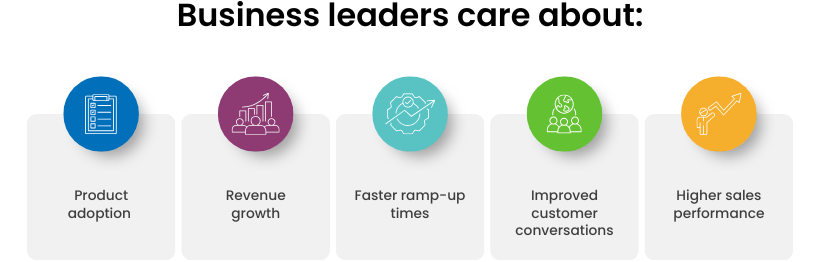
AI helps connect learning more directly to those outcomes.
AI-powered assistants will provide answers during customer conversations. Microlearning will arrive precisely when needed. Coaching will become continuous rather than occasional. Learning experiences will adapt to individual needs. Performance support will become embedded within daily workflows.
For deskless workers, this evolution is particularly important. They don't need more content, more courses, or more time away from customers. They need immediate access to knowledge, guidance, and support that helps them perform when it matters most.
The organizations that recognize this shift early will build a significant competitive advantage. Because in today's environment, sales success isn't determined by who learns the most. It's determined by who stays ready the longest.
Reference:
[1] Facing Deskless Labor Shortage with Technology