![Top Learning Management System (LMS) Statistics You Need To Know [Infographic]](https://cdn.elearningindustry.com/wp-content/uploads/2019/11/Top-Learning-Management-System-LMS-Statistics-You-Need-To-Know-Infographic-768x431.jpg)



Top Learning Management System (LMS) Statistics For 2025 You Need To Know [Infographic]
When you want to buy or replace your current Learning Management System (LMS), there are certain aspects that you should consider. From data migration to built-in gamification, collaborative learning, and collaboration tools, there are specific features that you must prioritize. It's important that when you’re researching, you consider the tools that will bring the most value. It's advisable to budget the costs for each feature before committing to an LMS.
Before you invest in a new eLearning system for your workplace, it's a good idea to uncover vital statistics that could affect your decision. These LMS statistics will prove why an LMS is essential for any corporation. Technology is constantly evolving, and as a result, LMSs must rapidly develop to offer only the most state-of-the-art features. When looking at key LMS statistics, it can be challenging to find relevant and accurate information that's useful for your industry.
In this article, we will highlight the top LMS statistics that every eLearning professional should know in 2025. Whether you are a chief learning officer, HR manager, LMS administrator, or training manager, these eLearning statistics will give you valuable insights into what you can expect this year and how digital learning is developing.
Choose the Best Learning Management System
Can You Keep Up With These Learning Management System Statistics?
Over time, eLearning tools and features will continue to advance. An industry that constantly adapts to new trends, whether through implementing Virtual Reality (VR), Artificial Intelligence (AI), or other emerging technologies, aims to bring flexibility, accessibility, and convenience to its customers at a low cost that won’t drastically affect profit margins.
For those working in Corporate America, the knowledge that the eLearning industry is developing is no secret. However, the specific statistics behind the developments can be challenging to understand without accurate data. Here, we take you through the top 25 eLearning statistics for 2025, which will help you uncover the future of LMS.
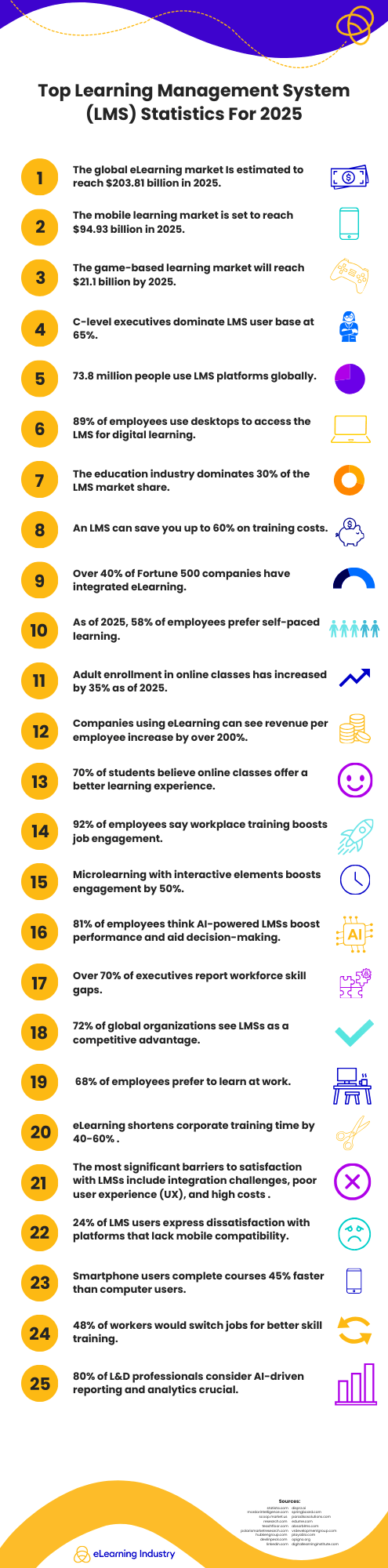
1. The Global eLearning Market Is Estimated To Reach $203.81 Billion In 2025
The online education market is projected to reach US$203.81 billion in 2025, with a Compound Annual Growth Rate (CAGR) of 8.20%, leading to a market volume of US$279.30 billion by 2029. This growth is driven by the increasing adoption of LMS, the demand for self-paced learning, and corporate training programs.
Additionally, the Asia-Pacific LMS industry is experiencing significant growth. It is fueled by digital transformation in the education sector and professional development initiatives. As students prefer online learning, the LMS industry continues to experience substantial growth. This growth provides comprehensive training programs and online learning tools for educational institutions and businesses worldwide.
2. The Mobile Learning Market Is Set To Reach $94.93 Billion In 2025
The mobile learning market is set to expand from USD 94.93 billion in 2025 to USD 287.17 billion by 2030, growing at a CAGR of 24.78%. The extensive use of smartphones, online learning tools, and mobile-friendly LMS platforms drives this surge. These digital learning tools enhance the accessibility of education. The rise of corporate training, professional development, and self-paced learning has also increased demand for mobile-first learning technologies in the LMS industry.
Additionally, AI, Machine Learning (ML), and Virtual Instructor-Led Training (VILT) are enhancing learner engagement and strengthening knowledge retention in educational initiatives. Businesses and academic institutions are also prioritizing flexible learning. These initiatives support employee development and modern education trends.
3. The Game-Based Learning Market Is Projected To Reach $21.1 Billion By 2025
The game-based learning market value is projected to reach $21.1 billion by 2025. AI, VR, and interactive learning technologies drive the massive boom in the market. Studies show that 74% of educators use game-based software applications for learning. At the same time, 54% of U.S. teachers see gamification as essential for learner engagement. These innovations are transforming traditional education into interactive digital experiences.
4. C-Level Executives Dominate LMS User Base At 65%
Large enterprises account for 30% of the LMS market value. Prioritizing scalable and efficient training solutions improves employee development and workforce productivity. C-level executives make up 65% of LMS users, while managers account for 35%. This shows the growing emphasis on corporate training and leadership development.
Digital transformation, AI-driven learning technologies, and the demand for adaptable upskilling programs fuel the growth in LMS adoption. Corporate LMS platforms are widely used across industries such as healthcare, retail, BFSI, manufacturing, government, defense, and telecommunications. These platforms offer advanced analytics tools to track learner progress, personalize training programs, and measure training effectiveness.
5. 73.8 Million People Use LMS Platforms Globally
The global LMS market serves approximately 73.8 million users, emphasizing the demand for seamless digital learning. Accessibility is a key driver of this change. Many LMS platforms now offer excellent features like speech-to-text, support for multiple languages, and adaptive learning powered by AI. These advancements help cater to the needs of all types of learners. Enhanced mobile compatibility and offline learning options mean that users can learn anytime, from anywhere, ensuring a more inclusive educational experience for everyone.
6. 89% Of Employees Use Desktops To Access The LMS For Digital Learning
Laptops and desktops are the top choices for accessing LMSs. A remarkable 89% of employees use desktops, and 78% opt for laptops. Mobile use is currently at 25%, in part due to design challenges. Yet, 67% of organizations are embracing mobile learning strategies and making strides toward better accessibility.
Laptops are especially popular for essential tasks such as checking emails, viewing course materials, completing assignments, and participating in discussions. As mobile-first learning continues to grow, LMS providers and platforms are working hard to create smooth learning experiences across all devices.
7. The Education Industry Dominates 30% Of The Market Share
The academic sector continues to lead the way in LMS adoption, making up more than 30% of the market share. This growth is due to the shift toward online and hybrid learning. Strong LMSs play a vital role in managing courses, tracking student performance, and supporting digital learning initiatives. On the corporate side, the LMS market is set to hit $40 billion by 2031. This growth is driven by essential sectors like healthcare, finance, and manufacturing, where training for compliance and employee skill enhancement is necessary.
8. Cost Savings Of Up To 60%
An LMS can save you up to 60% on training costs. LMS saves you money on travel, printing, and instructor fees. Unlike traditional classroom training, which can really add up financially, cloud-based LMS platforms provide a flexible and budget-friendly solution. Embracing a corporate LMS not only helps you cut costs on trainers, venues, and materials, but it also boosts administrative efficiency with automated tracking and reporting features.
9. 40% Of Fortune 500 Companies Have Integrated eLearning
Over 40% of Fortune 500 companies have integrated eLearning, with more than half of them utilizing it regularly to enhance employee training and professional development. By 2025, 98% of businesses worldwide plan to adopt LMS, driving market growth.
10. 58% Of Employees Prefer Self-Paced Learning
As of 2025, 58% of employees prefer self-paced learning, reflecting the growing demand for eLearning and microlearning. Moreover, millennials value development opportunities and often seek ways to learn independently at work. This trend shows a growing demand for LMS platforms that provide flexible, on-demand learning, helping to support both workforce upskilling and career advancement.
11. Adult Enrollment In Online Courses Has Increased By 35%
According to LMS statistics, adult enrollment in online classes has increased by 35% as of 2025, driven by the demand for flexible, self-paced learning and career advancement opportunities. LMS platforms and eLearning tools make it easy for working professionals to enhance their skills and learn new ones. All without interfering with their busy schedules.
12. Up To 200% Higher Revenue Per Employee
42% of U.S. companies are reporting increased revenue thanks to online learning and digital training programs. Several studies highlight that companies embracing eLearning can experience a remarkable rise in revenue per employee. Some reports even show increases of over 200%. It indicates that companies with eLearning initiatives possess the potential to generate considerably greater revenue per employee than those lacking such programs.
13. 69% Of Students Prefer An Online Learning Experience
The global market for LMS continues to grow as 69% of students prefer entirely online, hybrid, or blended learning over traditional classroom settings. LMS statistics show that 70% of students believe online classes offer a better learning experience, emphasizing the benefits of flexibility, accessibility, and self-paced learning.
14. 92% Of Employees Say Workplace Training Boosts Job Engagement
Over 92% of employees report that practical workplace training boosts job engagement, with online learning playing a key role in providing flexible and personalized learning experiences. Companies leveraging LMS, such as AT&T and IBM, have significantly reduced turnover rates by aligning corporate training with career development. The strategic use of eLearning enhances employee retention, ensuring that learning initiatives support professional growth and talent management.
Choose the Best Learning Management System
15. 50% Higher Engagement Rate In Microlearning
Microlearning modules leverage interactive elements such as videos, quizzes, and gamification, resulting in a 50% higher engagement than traditional training methods. Their compatibility with mobile learning allows employees to access learning materials on smartphones and tablets, supporting just-in-time learning.
Created by dedicating a portion of their week to training, this "microlearning" technique allows them to learn parts of the information at a time rather than all of the information at once. If you try to implement eLearning and training all at once, it's clear that it could have the opposite effect, making employees feel unmotivated and that you're pushing them to learn at a pace that they aren't comfortable with.
Offering training across a wide range of subjects will increase profit margins. Increasing the value of an LMS will bring operational costs down. At the same time, it will help ensure that businesses are getting good ROI on their LMS.
16. 81% Of Employees Believe AI Will Enhance Their Performance
AI integration in LMSs is truly revolutionizing workplace training. 81% of employees believe this technology will not only boost their performance but also facilitate data-driven decision-making. With AI-powered LMS platforms, we can automate workflows, detect fraud, and create personalized learning experiences. This makes training not just more efficient but also much more engaging for everyone involved.
17. Over 70% of Executives Report Workforce Skill Gaps
As 70% of executives acknowledge skill gaps in their workforce, businesses are investing in LMSs to deliver targeted employee training. AI-driven learning technologies and online learning tools make it possible for companies to provide personalized training programs. This not only enhances skill retention but also boosts overall workforce productivity.
18. 72% Of Global Organizations See Learning Management Systems As A Competitive Advantage
A recent study revealed that a remarkable 72% of organizations felt that an LMS provided them with that valuable competitive advantage, helping them flourish in their field. It is key to give employees the knowledge needed to support key operational processes. This allows them to adapt to any technological advancements within their industry. Managers are using eLearning tools to train their employees in new working practices and industry-related material.
19. 68% Of Employees Prefer To Learn At Work
According to recent statistics, 68% of employees prefer to learn at work. People really appreciate how convenient online platforms make it to blend learning into their everyday work routines. This enables them to put new skills into practice right away. Employees value training that not only promotes their career development but also provides flexible and personalized learning experiences. This trend highlights the importance of workplace learning in enhancing employee engagement and retention.
20. eLearning Reduces Corporate Training Time By 40-60%
eLearning shortens corporate training time by 40-60% compared to traditional classroom settings, which enables businesses to cut costs while enhancing employee productivity. By leveraging LMSs, digital learning tools, and AI-driven training, companies unlock higher learner engagement and improved knowledge retention. This cost-effective approach not only reduces training expenses but also contributes to higher profitability and overall business growth.
21. Integration Issues, Poor User Experience, And Cost Are the Biggest Barriers To LMS Satisfaction
The most significant barriers to satisfaction with LMSs include integration challenges (52%), poor user experience (UX) (51%), and high costs (44%). The lack of seamless integration with other digital platforms hinders usability, while complex interfaces reduce learner engagement. However, the cost factor is being addressed by the increasing adoption of affordable online learning programs, making professional development and education more accessible across industries, including social work and corporate training.
22. 24% Of Users Are Dissatisfied With LMS Programs Lacking Mobile Capability
As mobile learning adoption rises, 24% of LMS users express dissatisfaction with platforms that lack mobile compatibility. People are increasingly seeking flexible, on-the-go learning options, which is creating an excellent opportunity for mobile-friendly LMS platforms. These platforms empower users to access learning materials, complete training programs, and connect with content whenever and wherever they choose.
23. Smartphone Users Complete Courses 45% Faster Than Computer Users
Mobile learning enhances efficiency, with learners using smartphones to access online educational platforms, completing courses 45% faster than those on computers. The easy accessibility and quick, bite-sized learning format help learners finish their courses faster. This makes mobile-friendly LMS platforms a must-have for today's digital learning strategies.
24. 48% Of Workers Would Switch Jobs For Better Skill Training
Nearly half of U.S. workers are willing to change jobs for access to better skills training, highlighting the growing demand for employee development. When organizations put their resources into LMS platforms, corporate training, and upskilling initiatives, an LMS fosters retention and job satisfaction as well as enhances workforce productivity. It is an investment that gives employers an edge in managing talent.
25. 80% Of Learning And Development Professionals Prioritize AI-Powered Reporting And Analytics
Around 80% of L&D professionals consider AI-driven reporting and analytics crucial, with 47% of LMS tools projected to be AI-enabled by 2024. The AI-powered LMS market is set to grow at a CAGR of 17%, driven by demand for personalized learning experiences. AI makes tracking performance easier and supports personalized learning paths, quick feedback, and insights into future trends in education. This allows for informed decisions that truly enhance learner engagement and boost the effectiveness of training programs.
Final Thoughts
eLearning continues to transform workforce development, making LMS adoption essential for organizations aiming to enhance learning outcomes and stay competitive. With software development, AI-driven personalization, mobile learning, and immersive technologies like VR, the possibilities are becoming limitless. These LMS statistics will guide you toward better decision-making.
Before investing in an LMS platform, it is important to weigh the benefits and challenges to ensure the alignment of your chosen solution with your training needs. Leveraging the right learning technologies can boost engagement, efficiency, and retention, whether focusing on employee training, compliance, or professional development.
Staying ahead in the eLearning industry requires embracing digital transformation and keeping pace with emerging trends. By integrating scalable, data-driven LMS solutions, companies can create dynamic learning experiences that drive long-term success.
References
Mobile Learning Market Size & Share Analysis - Growth Trends & Forecasts (2025 - 2030)
Game-based Learning Statistics 2025 By Fun Way to Grow
39 Interactive Learning Statistics: 2026 Data, Trends & Predictions
27 Must-Know LMS Statistics for 2025: Key Insights into Edtech Market Trends
Infographic: 5 cost saving benefits of an LMS
eLearning Statistics and Facts: The Ultimate List in 2025
Adult student enrollment: Growing concentration and more online
Leveraging LMS for Knowledge Retention
45+ LMS Statistics 2025 - Regional & Industry Stats for L&D
Workforce Skills Gap Trends 2024: Survey Report
Learning Management System Examples and 5 sectors that have benefited most
Six Statistics That Highlight the Power of Mobile Learning
What LinkedIn’s 2025 Workplace Learning Report means for you
The Top Benefits of Learning Management Systems For Continuing Education
Mobile-Friendly eLearning: 12 Expert Tips for Customized Training