


 ChatGPT
 Perplexity
 Claude
 Grok
Grok
A Guide For L&D Professionals
Organizations are required to master a series of "ups" in the present fast-changing global business market. These include upskilling, reskilling, and elevating workforce performance. Nevertheless, the one fundamental idea that keeps getting ignored among the Learning and Development (L&D) professionals when they are designing new learning strategies is the learning curve. For them, understanding the concept is not just theoretical knowledge; it affects practically everything, i.e., the way the training is designed, the duration of the training, the level of performance expected, and the Return On Investment of a certain activity. As companies are increasingly seeking top training, the need to thoroughly understand the learning curve has turned into a strategic imperative.
This article is a dive into the concept of the learning curve, what it means for employee development, and how L&D leadership can use it to unleash the enormous potential of employees while also saving training time and increasing the number of employees who get trained and skilled.
In this guide...
- What Is The Learning Curve?
- Why The Learning Curve Should Be Important For Corporate L&D
- Different Learning Curves And Their Corporate Implications
- What Causes The Learning Curve In Corporate Training
- How L&D Professionals Can Use The Learning Curve
- Learning Curve And Current L&D Trends
What Is The Learning Curve?
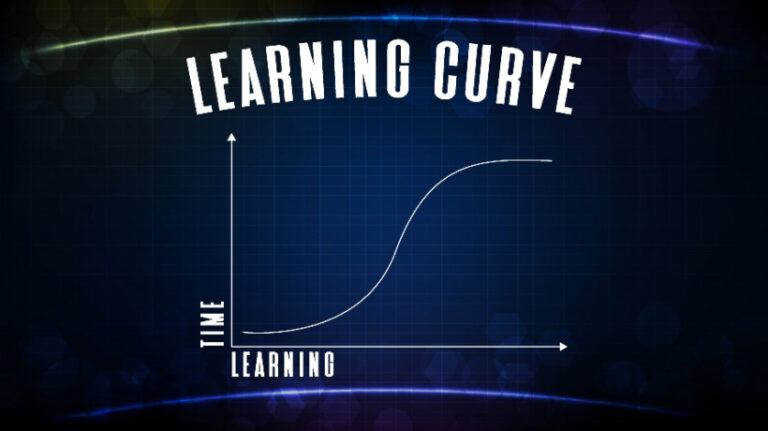
The learning curve is a graph depicting the rate of acquiring new knowledge, skills, or competencies of a learner over time. It shows the gradual improvement of proficiency through repeated exposure and practice. Corporate training using the learning curve allows us to figure out:
- The duration needed by learners in order to reach competency.
- The level of steepness of the learning progression.
- How to design training to obtain mastery in less time.
The learning curve was first researched by psychologist Hermann Ebbinghaus in the early 20th century. Since then, this concept has been essential to productivity research. Today's L&D teams rely on the learning curve to orchestrate training capable of reducing time-to-proficiency, alleviating performance declines, and improving knowledge retention.
Why The Learning Curve Should Be Important For Corporate L&D
1. Cuts Training Time And Supports Faster Achievement Of Desired Outputs
An accurately managed learning curve plays a role in the "time to competence" prediction. As an instance, a 2023 Training Industry report illustrates that organizations are using up to 25% of their training hours in vain due to the misalignment between learning progression and their employees. When L&D teams bring learning curve insights to Instructional Design, they have the capacity to not only adjust the length of training but also the speed for the best results.
2. Supports Planning For Resource Allocation
A team that is aware of the performance dips during the learning curve will also know how to efficiently allocate support structures like coaching, reinforcement tools, or just-in-time learning. One way companies can use analytics is to thoroughly map learners' performance at different stages of the curve, thus making it easier to plan resources.
3. Realistic Expectations For Managers
One of the major problems that corporate L&D is dealing with is misaligned expectations. Managers usually anticipate immediate performance improvements after training, and therefore, ignore the natural progression learners must go through. By getting familiar with the learning curve, leaders will have the ability to set realistic goals, thus making the management of talents conversations easier and less frustrating.
4. Upgrades Training ROI
By analyzing situations when learners are struggling, plateauing, or accelerating, L&D professionals gain an opportunity of making their modules more interesting, engaging, and easier to retain. One of the findings of McKinsey research states that companies that adopt data-driven learning design methods are able to improve their training effectiveness by 30–40%, which could be interpreted as a direct consequence of mastering the learning curve.
Different Learning Curves And Their Corporate Implications
Knowledge of differences in learning curves will help L&D departments to come up with the right interventions.
1. Increasing Returns (Steep Learning Curve)
Learners are quite fast to comprehend new skills at the initial stage of a steep learning curve. The following are perfect examples of it:
- Modules based on microlearning
- Learning experiences enriched by gamification
- Simple procedural tasks
The use of microlearning and simulation-driven techniques purposely creates steep learning curves for the speedy acquisition of skills.
2. Diminishing Returns
In this case, learners make very rapid progress initially; however, gradually, they hit a slowdown. Such a learning curve is often found in:
- Leadership development
- Complex technical training
- Behavioral change programs
These kinds of programs should provide reinforcement, coaching, and spaced learning to deal with plateaus.
3. S-Shaped Curve
The learning curve depicted here shows slow progress at the beginning, steep improvement in the middle, and stabilization at the end. It is most frequently linked with:
- Digital transformation training
- Software onboarding
- Cross-functional skills
Knowing the S-shaped learning curve gives a hint to L&D professionals that the training plan would be long-term, with gradual leveling of difficulty.
What Causes The Learning Curve In Corporate Training
1. Instructional Design Quality
A well-thought-out plan, a topic that is both interesting and helpful, and an appealing format all work to accelerate the grasping of the material. A less-than-ideal designed training will only make the curve steeper than necessary.
2. Learning Delivery Methods
Blended learning, Virtual Instructor-Led Training, microlearning, and scenario-based learning methods each impact the curve differently. For instance, microlearning has been demonstrated to have a positive effect on retention by 22%, according to the Journal of Applied Psychology.
3. Learner Motivation
Motivation is the main factor that determines how fast a person will move forward on the learning curve. Incentives such as recognition programs, gamification, and rewards are very useful in maintaining the momentum.
4. Organizational Learning Culture
Supportive culture that, among other things, means the provision of necessary resources, coaching, and the opportunity to practice, will definitely lower the resistance factor, thus the learning curve will be gentler.
5. Technology And AI
With modern learning analytics, L&D leaders get insights into a learner's performance and take the right actions at the right moment to ease the curve.
How L&D Professionals Can Use The Learning Curve
1. Employ Learning Analytics To Uncover Bottlenecks
Studying the behavior of the learners is of great help in understanding where certain individuals are struggling. Quick interventions that are in the form of a nudge, microlearning boosters, or coaching can have a profound effect on the reduction of the learning curve.
2. Facilitate Spaced Repetition
Ebbinghaus' forgetting curve reveals that learners forget almost 70% of new knowledge within 24 hours if there is no follow-up. The use of spaced repetition, together with the learning curve, results in more durable memory.
3. Simplify Complex Skills
The technique of "chunking" greatly reduces the difficulty of learning especially when dealing with S-shaped or diminishing-return curves. It is a method of ensuring that learners have grasped the basic concepts before taking a further step.
4. Incorporate Practice And Application
The rate of learning is greatly increased when employees do practice in real scenarios. For instance, simulators, role-play, and AR/VR setups are some of the ways through which the fear of failure can be lessened and the confidence of a person enhanced.
5. Introduce Microlearning To Reinforce Learning
Short, digestible modules are an excellent means for reinforcement as they deliver the content at exactly the right time.
6. Establish Realistic Competency Goals
L&D staff members will be better off if they come up with a milestone-based system for tracking progress rather than just expecting human learning to be strictly linear. This practice is consistent with actual human learning patterns.
7. Benefit From Social And Collaborative Learning
Study groups, communities of practice, and peer learning all have the effect of flattening the curve since they facilitate shared problem solving and knowledge exchange.
Learning Curve And Current L&D Trends
Innovative training technologies have led to a change in the way the learning curve is perceived by organizations:
AI-Powered Learning Paths
Artificial Intelligence takes care of the analysis of the learner's behavior and, based on that, it creates a tailor-made training path for each employee. Hence, the learning curve is optimized for the individual only.
Learning Experience Platforms (LXPs)
LXPs empower learners to get over plateaus by smartly fetching personalized content, which will most likely be of their interest and benefit.
Simulation-Based Learning
Simulations help the skill-based learning curve to shorten because they provide a practice environment free of any risk.
Microlearning At Scale
Microlearning remains one of the main strategies used for ensuring a faster progression at the first stages of the learning curve.
Conclusion
For L&D professionals, understanding the learning curve is indispensable for the creation of training programs that are not only time-efficient but also learner-centric and performance-driven. The question of how fast employees learn and what is the most effective method for them has never had more significance than now. When paired with contemporary Instructional Design, data analytics, and cutting-edge learning solutions, the learning curve turns into a strategic lever for workforce transformation.
In the end, understanding the learning curve provides organizations with the opportunity of setting realistic expectations, enhancing training results, decreasing time-to-competence, and creating a stronger learning culture that is in a perpetual state of change and development to meet the requirements of the business.