




Evaluating VR Training Based On Outcomes
Virtual Reality (VR) in Learning and Development works best for high-stakes, hands-on, or high-pressure skills where mistakes are expensive or dangerous in the real world: equipment operation, emergency response, difficult conversations, spatial or procedural tasks. It's a poor fit for policy training, basic onboarding, or anything primarily informational. The rest of this piece is a way to tell, quickly, which category your program falls into.
Why This Question Gets Asked So Often
VR training entered corporate L&D with a lot of hype and a lot of expensive pilot programs that quietly got shelved. That's left two camps: people who assume it's the future of every training program, and people who assume it's a gimmick that never proved itself. Neither is right. The technology has a narrow but real sweet spot, and the organizations getting value out of it are the ones who identified that sweet spot before they built anything.
What "Immersive Learning" Actually Covers
Before going further, it's worth being precise, because the terms get used interchangeably when they shouldn't be:
- Virtual Reality
A fully simulated environment, usually headset-based. The learner is "inside" the scenario with no view of the real world. - Augmented Reality (AR)
Digital information overlaid on the real world, typically through a phone, tablet, or AR glasses. The learner still sees their actual surroundings. - 360° Video-Based Learning
Filmed (not computer-generated) environments a learner can look around in, often viewed on a headset or even a standard screen. Cheaper to produce than full VR, less interactive. - Mixed Reality (MR)
Digital objects that interact with the real environment, blending AR and VR.
When people say "VR training," they often mean any of these. The right one for a given program depends entirely on what's being trained for, not on which sounds most impressive in a proposal.
In practice, each format tends to show up in different corners of L&D: VR dominates high-stakes, full-attention scenarios (emergency response, hazardous equipment, difficult-conversation roleplay); AR shows up in on-the-job technical support where a worker needs guidance while still touching real equipment (maintenance, assembly, field service); 360° video is the common low-cost entry point for orientation and facility walkthroughs; and Mixed Reality remains the least common today, appearing mostly in collaborative design and remote expert-assisted work.
The hardware and authoring landscape has shifted enough to matter here. Standalone consumer headsets now start at roughly $500, well below the PC-tethered rigs that made early corporate pilots expensive, and no-code or low-code authoring platforms have started letting Instructional Designers build interactive 3D scenarios without a dedicated game-engine development team. That combination is a large part of why VR training has moved from a novelty budget line to a realistic option for mid-sized L&D teams.
The Real Question: Is This A Fit For You?
Run your training program against this list. If three or more "strong fit" signs are true, immersive learning is genuinely worth evaluating. If fewer than three are true, it probably isn't, no matter how good the demo looks.
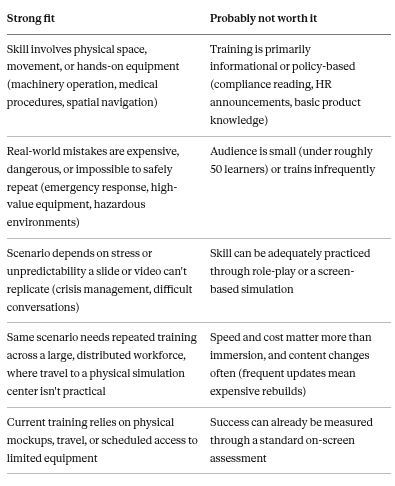
If a program lands mostly in the right-hand column, a well-built microlearning module or a standard on-screen simulation will typically outperform VR on cost and speed. That's not a consolation prize, it's the correct answer for that kind of content.
The Cost Reality Nobody Puts In The Brochure
Immersive learning content costs more to build than a standard eLearning module, and the gap is real. Development typically runs higher per finished minute of content because of 3D asset creation, testing across headset hardware, and more complex QA. That cost is justified when the alternative is flying employees to a physical training site repeatedly, replacing damaged equipment during practice runs, or accepting a higher real-world error rate on a dangerous task. It's not justified when the alternative is a well-written module someone reads in 15 minutes.
The data backs this up more precisely than most vendor pitches let on. In a widely cited PwC study conducted with enterprise learning platforms, VR training reached cost parity with classroom training at around 375 learners, and parity with standard eLearning at around 1950 learners. Below those thresholds, the fixed development cost usually isn't worth it. Above them, VR can end up cheaper per learner than the alternative, not just more effective. The same research found VR learners reported substantially higher confidence in applying what they'd learned than classroom-trained peers, which lines up with a separate University of Maryland study that measured meaningfully higher recall accuracy for VR-trained subjects than desktop-trained ones on the same task.
The organizations that get burned on VR training are almost always the ones that skipped this comparison and built the immersive version because it seemed innovative, not because the math supported it.
How To Pilot It Without Overcommitting
For organizations that land in the "strong fit" list but are still uncertain, the answer isn't to commit to a full rollout or walk away entirely. It's to pilot narrowly:
- Pick one scenario, not a program, and set the success bar in measurable terms before development starts, not after the demo looks impressive enough that everyone wants it to have worked.
- Test it against a real comparison group, however the skill is currently trained, using the same evaluation criteria for both, so a pilot that "went fine" isn't mistaken for one that outperformed the status quo.
- Cap hardware and scope to what the pilot needs, and decide in advance what happens if it doesn't work. A pilot that's honestly allowed to fail is more useful than one designed to justify a decision that's already been made.
What To Actually Measure
Completion rate is the easiest metric to pull and the least useful one for judging whether immersive training worked. It only confirms someone finished the module, not that they learned anything that transfers to the real task. More meaningful measures include:
Task Performance Improvement
Direct, observed change in how well the skill is performed on the job or in a controlled assessment, compared to before training or against a non-VR trained group.
Error Reduction
A measurable drop in mistakes on the real task, particularly relevant for safety-critical or procedural skills, where the entire justification for using VR is reducing costly real-world errors.
Time-To-Competency
How quickly a learner reaches an acceptable performance standard, which is often where VR shows its clearest advantage over traditional methods for hands-on skills.
Retention Over Time
Whether the skill holds up weeks or months later, not just immediately after training. This is where the University of Maryland recall data referenced above becomes directly relevant to a pilot's evaluation criteria, not just a talking point.
If a pilot can't show movement on at least one of these, it's a sign the training either wasn't the right candidate for VR in the first place, or the scenario design needs rework before scaling it further.
What This Looks Like In The US Vs. India
Adoption patterns and the economics behind them differ enough between these two markets that a generic global take on VR training misses what actually matters locally.
In the US, adoption concentrates in manufacturing, aviation, energy, and healthcare, largely because workplace safety obligations under OSHA create real financial and legal exposure for training gaps, and the cost of a workplace injury or a compliance failure is high enough that VR's up-front cost clears the bar faster. Higher average labor costs also push the cost-parity math in VR's favor sooner: since the classroom alternative already costs more per trained hour in the US than in most other markets, VR reaches breakeven at a lower learner count.
In India, the fastest adoption is currently in manufacturing (driven by the shift toward smart factories and Industry 4.0), mining, construction, and BFSI, where distributed industrial sites make standardizing safety training across locations a bigger practical problem than it is for a single-site US facility. Indian enterprise L&D budgets also tend to be more cost-sensitive, which is exactly why the recent drop in headset hardware pricing matters more here than it does in the US: it moves VR training from an option reserved for large manufacturers to something mid-sized industrial and BFSI organizations can realistically pilot. Indian corporate training is also visibly shifting away from generic, session-based training toward outcome-linked, measurable programs, which lines up directly with the "what to actually measure" framing above rather than a completion-rate mindset.
- The practical takeaway
A US-based safety or compliance leader is usually evaluating VR against the cost of an injury or a regulatory finding, while an Indian L&D leader is more often evaluating it against the logistical cost of training the same skill consistently across multiple, geographically spread facilities. Both are legitimate reasons to adopt it, but they lead to different pilot designs.
What To Look For In A Vendor
Once a program clears the fit test, the vendor conversation should focus on a short list of things that actually predict whether the build succeeds:
- Instructional Design first, technology second.
A vendor that leads with headset specs rather than asking about the actual skill gap and how it will be assessed is optimizing for the wrong thing. - A track record with the same category of scenario, not just "VR experience" in general.
Building a soft-skills role-play and building an equipment-operation simulation are different disciplines. - Clear answers on data and tracking, not vague reassurance.
Ask specifically how learner interactions inside the VR environment get recorded and reported, not just whether the module "integrates with your LMS." - A realistic timeline and a pilot-first proposal.
A vendor pushing straight to a full rollout without recommending a scoped pilot is optimizing for contract size, not for a defensible outcome. - Post-launch iteration built into the plan.
Since VR scenario design rarely gets everything right on the first build, the vendor relationship should account for revision after the pilot's data comes back.
How VR Training Data Gets Back Into Your LMS
This is the part most VR training conversations skip, and it matters more than almost anything else in this article for an L&D team that already runs a Learning Management System (LMS). Standard SCORM packaging, built for linear eLearning modules, wasn't designed to capture the kind of interaction data a VR scenario produces (branching choices, spatial actions, time spent per decision point). That's why most enterprise VR training platforms report data using xAPI (Experience API) or its more structured successor, cmi5, both of which can record granular in-scenario actions and send them back to a compatible LMS as a completion record, score, or custom data point.
Before committing to a VR training build, it's worth confirming with both the immersive-content vendor and your LMS provider that this reporting pipeline is proven, not theoretical—and whether your LMS is cloud-based or on-premises can affect how that integration gets handled. A scenario that looks impressive in a demo but drops its data on the floor once deployed defeats the entire measurement approach covered above.
Image Credits:
- The image within the body of the article was created/supplied by the author.