
 ChatGPT
 Perplexity
 Claude
 Grok
Grok
Why Visual Language Matters In Modern Learning
Visual language is essential in modern learning because humans process visuals faster than text. This speed difference matters in corporate learning design where attention, retention, and clarity directly affect performance outcomes. It is where visual language becomes a foundational cognitive and instructional framework, not just a design choice. For L&D, HR, and Instructional Design professionals, understanding the visual language definition helps create clearer learning experiences.
In practice, visual language design and the visual language model support digital transformation, AI learning systems, and multimodal learning environments that combine text, visuals, and interaction. As organizations adopt visual language models into their learning strategies, they move toward more scalable, adaptive learning systems.
Common examples of visual language include diagrams, icons, dashboards, and scenario-based visuals used in eLearning. In the age of AI, visual languages are becoming central to how knowledge is delivered and understood at scale. This makes clarity in visual communication a core skill for modern Instructional Designers and learning leaders. Next, we define visual language clearly as a foundation for learning design practice.
What Is Visual Language?
Visual language is the system we use to communicate meaning through visual elements like shapes, colors, symbols, layout, and imagery instead of relying only on words. A clear visual language definition is that it is a structured way of organizing visual information so people can understand ideas quickly and consistently. In simple terms, the visual language meaning is how visuals "speak" to us.
Visual language is different from visual communication, although they are closely related. Visual communication is the act of sharing information visually, while visual language refers to the underlying system or "grammar" that makes those visuals understandable. It also differs from written or verbal language because it does not depend on letters, syntax, or spoken structure. Instead, it uses symbolic systems, which are shared visual cues that carry meaning across contexts, such as icons, colors, and spatial relationships.
The idea of visual languages is important because different fields develop their own systems. For example, design, data visualization, and instructional content all use distinct visual rules to communicate effectively.
The Components Of Visual Language
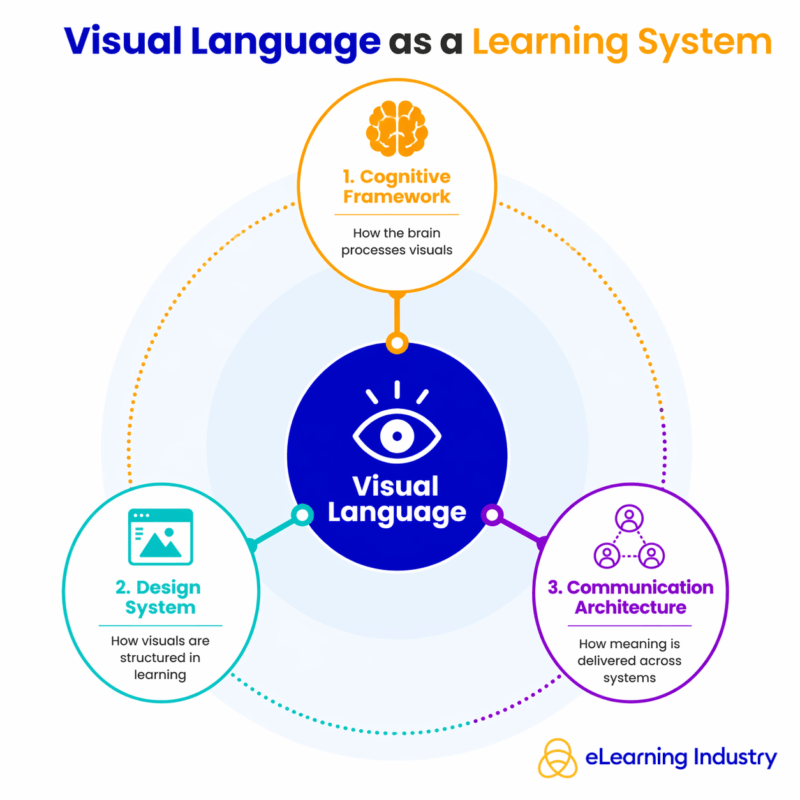
Visual language design is built on a set of core components that work together like a grammar system, helping people quickly and consistently understand meaning. For Instructional Designers and learning leaders, these components are not just visual choices, but cognitive tools that shape how learners process and retain information.
Color
One of the most important elements is color, which influences emotion, attention, and hierarchy. For example, red may signal urgency or error, while blue often supports calmness and trust. In learning design, color helps guide attention and reduce confusion by highlighting what matters most.
Shape
Shape plays a different role. It supports symbolism and categorization. Circles can suggest continuity or completion, while squares often signal stability and structure. These visual cues help learners organize information without the need for additional explanation.
Typography
Typography affects tone and readability. A clean sans-serif font can improve clarity in digital learning environments, while bold or italic styles help emphasize key ideas. In hybrid learning systems, typography also supports consistency across modules.
Space And Composition
Space and composition are critical for managing cognitive load. Proper spacing creates visual breathing room, allowing learners to process information step by step. A strong layout establishes hierarchy and reduces mental effort, thereby supporting better comprehension.
Motion
Motion, used in digital learning environments, can guide attention and demonstrate processes over time. When applied carefully, it improves engagement without overwhelming the learner.
Icons And Symbols
Finally, icons and symbols act as universal comprehension systems. They simplify communication by replacing or supporting text with recognizable visuals, which is especially useful in global or multilingual learning contexts.
Together, these elements form the grammar of visual language design. In Instructional Design, this grammar helps reduce cognitive overload, improve retention, and enhance accessibility.
Visual Language Model: How Meaning Is Constructed
A visual language model explains how people turn what they see into meaning. In Instructional Design and learning strategy, it is useful because it shows that visuals are not just supporting content, but are part of how thinking and understanding are built. At its core, the model works in three simple stages: input, processing, and output.
- First, input (visual stimuli) refers to what learners see. This can include diagrams, icons, dashboards, animations, charts, or even layout structures in an eLearning module. These visual elements are the raw material of communication.
- Next comes processing (perception and interpretation). Here, the brain organizes what it sees, connects it to prior knowledge, and begins to assign meaning. This is where Instructional Design choices matter. Poor design creates confusion, while structured visual language design guides attention and reduces unnecessary effort.
- Finally, there is output (meaning construction). This is the point at which understanding is formed, so learners can explain a concept, apply it, or make decisions based on what they have processed visually.
This model closely aligns with key learning theories.
- Dual coding theory explains that people learn better when information is presented through both visual and verbal channels.
- The cognitive load theory highlights that learners have limited mental capacity, so well-structured visuals help reduce overload.
- Meanwhile, Mayer's multimedia learning principles emphasize that people learn more effectively when words and visuals are integrated in a purposeful, non-redundant way.
From an L&D perspective, the visual language model is highly practical. It shapes how eLearning modules are designed to guide attention and improve retention. It also influences onboarding systems, where new employees rely heavily on visual structure to understand processes quickly.
Visual Language Examples In Learning And Communication
Understanding visual language examples helps Instructional Designers and business leaders see how meaning is built through visuals, not just decoration, but structured systems that guide thinking, decision-making, and learning.
Instructional Design Examples
In Instructional Design, examples of visual language are everywhere in how learning experiences are structured.
- Onboarding dashboards are a clear example. They use progress bars, icons, and modular layouts to show learners where they are and what comes next. This reduces confusion and supports self-directed learning.
- Interactive simulations are another strong example of visual language in action. Instead of reading instructions, learners engage with visual scenarios that respond to their choices. The visuals communicate consequences, relationships, and processes in real time.
- Even microlearning visuals rely heavily on visual language design. Short learning cards, infographics, and step-based visuals simplify complex topics into digestible formats. Here, visual structure replaces long explanations.
Corporate Communication Examples
In corporate environments, visual language examples are central to how information is shared quickly and clearly.
- KPI dashboards translate performance data into charts, gauges, and color-coded indicators. This allows leaders to interpret business health at a glance without reading detailed reports.
- Organizational charts are another form of visual language. They communicate hierarchy, reporting lines, and team structure through spatial relationships rather than text-heavy explanations.
- Data storytelling visuals, such as trend graphs or comparative charts, also play a key role. They turn raw data into meaningful narratives that support faster decision-making.
Digital Learning Systems
Modern visual language examples are deeply embedded in digital learning platforms.
- LMS interfaces use navigation menus, icons, and progress tracking to guide learners through content. The structure itself communicates how learning should happen.
- Adaptive learning pathways use visuals to show personalized progression, adjusting based on learner performance. This makes the learning journey easier to understand and follow.
- Finally, scenario-based visuals present real-world situations in a visual format, helping learners apply knowledge in context rather than memorizing information.
Visual Linguistic Systems: The Science Behind Interpretation
Visual linguistics refers to the study of how visual systems function in a way similar to language. In other words, it explores how images, symbols, color, layout, and design elements "communicate" meaning without relying on written or spoken words. For Instructional Designers and learning leaders, this is not just a design concept, but a way to understand how learners interpret information before they even read a single word.
At the core of visual linguistic systems is semiotics, the study of signs and symbols, and how meaning is created from them. A sign can be anything visual that represents an idea: an icon, a color cue, or even a layout pattern. Meaning is not fixed in the object itself; it is constructed by the viewer based on context, experience, and cultural background. This is why the same visual can be interpreted differently across audiences.
For example, certain colors or symbols may carry strong meanings in one culture but be neutral, or even confusing, in another. This introduces a key distinction between universal visual cues and culturally influenced interpretation. Universal cues, such as arrows indicating direction or a red stop sign, are widely understood. However, many visual elements are not universal and depend heavily on cultural learning.
This is where risks in global learning design appear. When instructional content is scaled across regions, misinterpretation of visuals can lead to confusion, reduced learning effectiveness, or even incorrect decision-making. A well-designed visual linguistic system must therefore anticipate these differences rather than assume shared interpretation.
The main point for L&D and Instructional Design is clear: localization goes beyond mere translation. It also involves understanding visual signs and ensuring that images, symbols, and layouts communicate effectively across different cultures. In global learning settings, meaning is created not only through text but also through visuals.
How Instructional Designers Use Visual Language Strategically
Instructional Designers use visual language to help make learning clearer and faster. This approach also makes it easier for employees to apply what they learn at work. In businesses, visual language is not just about looks; it helps improve the way knowledge is organized, shared, and remembered by large teams.
Improving Cognitive Efficiency
One of the primary uses of visual language design is improving cognitive efficiency. Instead of relying on dense text, designers use structured visuals like diagrams, icons, flowcharts, and spatial layouts to reduce mental effort. This helps learners focus on meaning rather than on decoding information, leading to better comprehension and faster decision-making in real-world situations.
Aligning Visuals With Learning Objectives
Instructional Designers also align visual elements with learning objectives. Every component of a module, like color, hierarchy, spacing, or symbol, should reinforce what the learner needs to understand or do. This ensures that visuals are not decorative but functional, acting as part of the instruction itself. This is where a strong visual language model becomes essential: it provides consistency in how meaning is communicated across different learning assets.
Reducing Confusion
When learners interpret content differently, performance outcomes become inconsistent. Clear visual language, such as standardized icons or process maps, helps reduce confusion and ensures everyone understands instructions consistently.
Accessibility And Inclusivity
Effective visual languages support diverse learners, including those with language barriers or neurodiverse needs. Thoughtful contrast, labeling, and structure ensure content is usable by a wider audience.
Building Scalable Learning Systems
Finally, visual frameworks help build scalable learning systems. When organizations adopt consistent visual standards, they can reuse components across courses, improving development speed and ensuring consistency in knowledge retention metrics and overall training effectiveness.
Conclusion
Visual language is more than design; it's a way to think and communicate clearly. It helps people understand information more quickly and easily. In learning design, it serves as a system for organizing and presenting content. It also ensures that meaning remains consistent across visuals, interfaces, and learning materials. When organizations use visual language well, they reduce confusion, boost engagement, and improve knowledge retention. In the end, those who excel at visual language design will create more effective learning experiences and better knowledge sharing among teams.