

 ChatGPT
 Perplexity
 Claude
 Grok
Grok
How Immersive Learning Improves Corporate Training
Immersive learning is reshaping corporate training by moving learning closer to real work. Instead of asking employees to absorb information passively, it places them in realistic contexts where they must make decisions, solve problems, and practice responses that reflect actual job demands. That is what makes immersive learning different: it creates involvement, not just exposure.
This matters because many workplace skills are best learned through experience, not explanation alone. Whether the goal is handling a compliance situation, operating equipment, responding to a customer, or applying product knowledge in context, immersive learning helps employees practice in a way that feels real, relevant, and memorable. As a result, training becomes more engaging, more practical, and more closely tied to on-the-job performance. These immersive learning experiences can be delivered through custom eLearning, microlearning, and others designed around real workplace applications.
In this article, we explore what immersive learning is, how immersive learning experiences and environments work, and how enterprises can implement immersive learning solutions.
TL;DR
- Immersive learning creates realistic, interactive learning experiences.
- It improves engagement, retention, and real-world performance in corporate training.
- Core methods include scenario-based learning, simulations, gamification, storytelling, and video-based learning.
- It is highly effective for compliance training, technical training, product training, and sales enablement.
- Industries like healthcare, manufacturing, pharmaceuticals, aviation, and energy benefit the most.
Table Of Contents
- What Is Immersive Learning?
- How To Implement Immersive Learning In Corporate Training Programs
- Where Is Enterprise Immersive Learning Most Effective?
- Frequently Asked Questions About Immersive Learning In Corporate Training
- Put Immersive Learning To Work
What Is Immersive Learning?
Immersive learning helps people learn by experiencing work-like situations. It puts learners in realistic contexts where they need to think, respond, and apply what they know.
It makes training feel closer to the job itself, where employees actively engage with situations that help them practice, understand, and remember better.
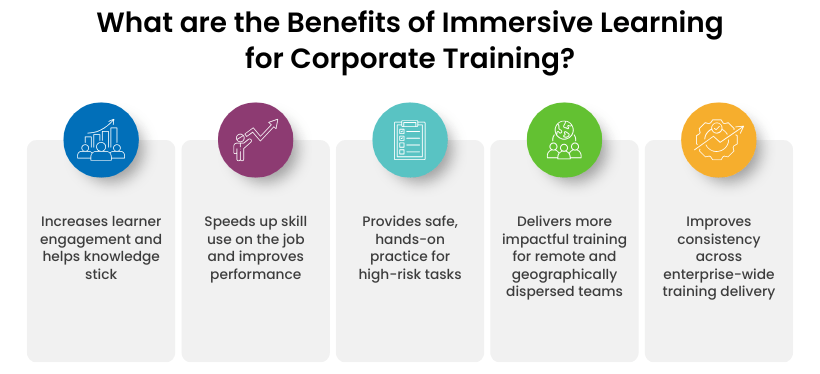
Image by CommLab India
How To Implement Immersive Learning In Corporate Training Programs
To implement immersive learning in corporate training, enterprises should use immersive learning technology aligned with real job tasks. The following strategies form the foundation of scalable and impactful immersive learning solutions.
1. Simulations
In immersive learning, simulations are one of the most practical ways to bridge the gap between knowing and doing. They allow employees to interact with realistic situations, test decisions, repeat tasks, and learn from mistakes without real-world consequences. This makes them especially valuable in corporate training areas where precision, safety, and confidence matter.
They make complex processes easier to understand, prepare learners for high-pressure situations, and support faster skill readiness across locations, roles, and teams.
Best for: Technical training, safety training, equipment handling training.
Immersive learning example: In the energy sector, employees can practice emergency shutdown procedures through digital simulations, helping them build confidence and procedural accuracy before facing real-world situations.
2. Scenario-Based Learning
At its core, immersive learning is about context, and scenario-based learning delivers that context most directly. It places learners in realistic, job-relevant situations where they must make decisions and see the consequences of those decisions.
Instead of presenting rules or concepts in isolation, it embeds them within situations employees actually face. This shifts training from "what you should know" to "what you should do," making learning immediately applicable.
Best for: Compliance training, sales enablement, leadership training.
3. Storytelling
Storytelling is an effective immersive learning strategy because it makes training more relatable, contextual, and memorable. A common challenge in corporate training is that employees often treat learning as content to finish rather than something to understand deeply or apply on the job. Storytelling addresses this by organizing learning around a narrative, giving the content emotional meaning, practical context, and a clearer sense of relevance.
This approach is especially valuable when training focuses on behavior, decision-making, or topics that can feel abstract in a standard format. By showing how situations unfold in a realistic sequence, storytelling helps employees understand not only what action to take, but also why that action matters in the flow of real work.
Best for: Compliance training, behavioral training, leadership training.
4. Gamification
In corporate training, one of the biggest challenges is sustaining attention and motivation across corporate training programs that employees may otherwise experience as routine or mandatory. Gamification helps address this by making learning more participatory. It introduces momentum into the experience through clear goals, visible progress, and a sense of achievement, which encourages learners to stay engaged and keep moving forward.
Gamification for corporate training gives learners reasons to interact, make choices, complete tasks, and improve performance over time. For enterprise learning teams, this makes it a practical way to increase participation, reinforce behaviors, and create more consistent engagement across large and distributed workforces.
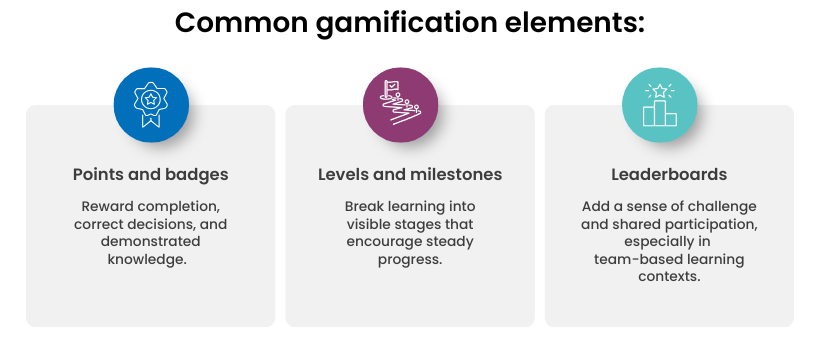
Image by CommLab India
Best for: Sales enablement, technical training, product training.
Immersive learning example: In sales training, employees can complete objection-handling challenges, earn badges for strong responses, and progress through levels as conversations become more complex.
5. Video-Based Learning
Not every immersive learning experience needs to place learners inside a simulation. Sometimes, immersion begins by helping employees see work as it actually happens—how a process unfolds, how a customer interaction develops, or how a decision affects the next step. Video does this well because it presents learning in motion, with context built in. It allows employees to watch, interpret, and connect training to the realities of their role.
This makes video-based learning especially useful when the goal is to bring clarity to real work without oversimplifying it. It can show nuance, sequence, environment, and human response in ways text-heavy formats often cannot. Depending on the objective, enterprises can use explainer videos, talking-head videos, scenario-based videos, screencast videos, 360-degree videos, and animated videos.
Best for: Product training, equipment handling training.
Where Is Enterprise Immersive Learning Most Effective?
Enterprise immersive learning is most effective in industries that require high-stakes decision-making and hands-on skills.
Healthcare
Aids learners to learn and respond better in situations that require speed, accuracy, and compliance.
- Emergency response training
- Compliance training
Manufacturing
Allows employees to operate equipment correctly while improving efficiency and process understanding.
- Equipment operation training
- Safety procedures
Pharmaceuticals
Helps teams apply product knowledge and handle customer interactions in regulated environments.
- Product training
- Sales enablement
Aviation
Prepares employees for operational scenarios that require precision, coordination, and quick decisions.
- Safety and crisis training
- Decision-making drills
Energy
Helps employees handle complex operations while responding effectively to challenging environments.
- Hazard response training
- Safety compliance
Frequently Asked Questions About Immersive Learning In Corporate Training
How does immersive learning improve employee performance?
Immersive learning improves employee performance by giving learners opportunities to practice in realistic, job-relevant situations before they apply those skills at work. This builds confidence, strengthens decision-making, and improves execution in real workplace tasks.
Which industries benefit the most from immersive learning?
Immersive learning is most valuable in high-risk and complex industries such as healthcare, manufacturing, financial services, pharmaceuticals, aviation, and energy. It improves safety, compliance, and job readiness through realistic practice.
Is immersive learning effective for remote and distributed teams?
Yes, immersive learning works well for remote and distributed teams because it makes digital training more interactive, engaging, and consistent across locations. It helps reduce passive learning and creates a more active training experience.
Put Immersive Learning To Work
Immersive learning and training have become important for a simple reason: much of today's work cannot be mastered through passive training alone. When employees need to make decisions, apply judgment, follow critical procedures, or respond well in real situations, training has to do more than explain. It has to let them experience, think, and practice in context. That is where immersive learning brings real value to corporate training.
The real advantage for enterprise learning teams is not novelty, but relevance. Immersive learning makes training feel closer to the work itself, which is why it can lead to better engagement, stronger recall, and faster application on the job. For organizations looking to make training more useful, more scalable, and more performance-focused, immersive learning is not just a better format. It is a better way to prepare people for the realities of work.