
 ChatGPT
 Perplexity
 Claude
 Grok
The Follow-Through Gap In Performance Reviews
In many organizations, performance reviews and individual development plans live separate lives. Reviews follow the HR calendar, with ratings, calibration, and formal conversations. Development plans may be written months later, managed by different people, and stored in a different system. Even when both processes are well established, the connection between them can be surprisingly weak.
And there's reason to question how well performance management supports development. APQC's 2025 research found that 67% of employees had goals related to developing for future roles, yet only 33% strongly agreed that their performance management process had helped them build the necessary skills.
Ideally, the two are links in a single chain. In practice, it tends to break for mundane reasons. Managers are stretched thin, and turning review findings into a thoughtful plan takes time they rarely have. L&D teams may never see the review data at all. And even when everyone agrees the two should connect, there's seldom a clear picture of what a connected plan looks like, or how to tell whether it's working.
A Practical Framework For Post-Review Development
Let's walk through a simple example. Picture Dave, a team lead who was promoted a few months ago. Enough time has passed for their first performance review since the promotion, and leadership wants to see how they're settling into the new role.
On the technical side, we'll use iSpring LMS, a platform for full-cycle employee training and development. The specific tools we'll look at belong to iSpring, but the overall logic holds no matter which system a company uses.
1. Analyze Performance Review Findings And Other Evidence
Start by examining what the review tells you about the employee's performance. Depending on the role, this might include KPIs, competency assessments, manager observations, or feedback from colleagues.
For Dave, our newly promoted team leader, we're particularly interested in how his leadership skills show up in everyday interactions. One popular way to assess this is through 360° feedback, which gathers perspectives from managers, peers, direct reports, and the employee themselves.
In iSpring LMS, you can run the entire 360° review online, with responses automatically collected and presented in a competency radar:
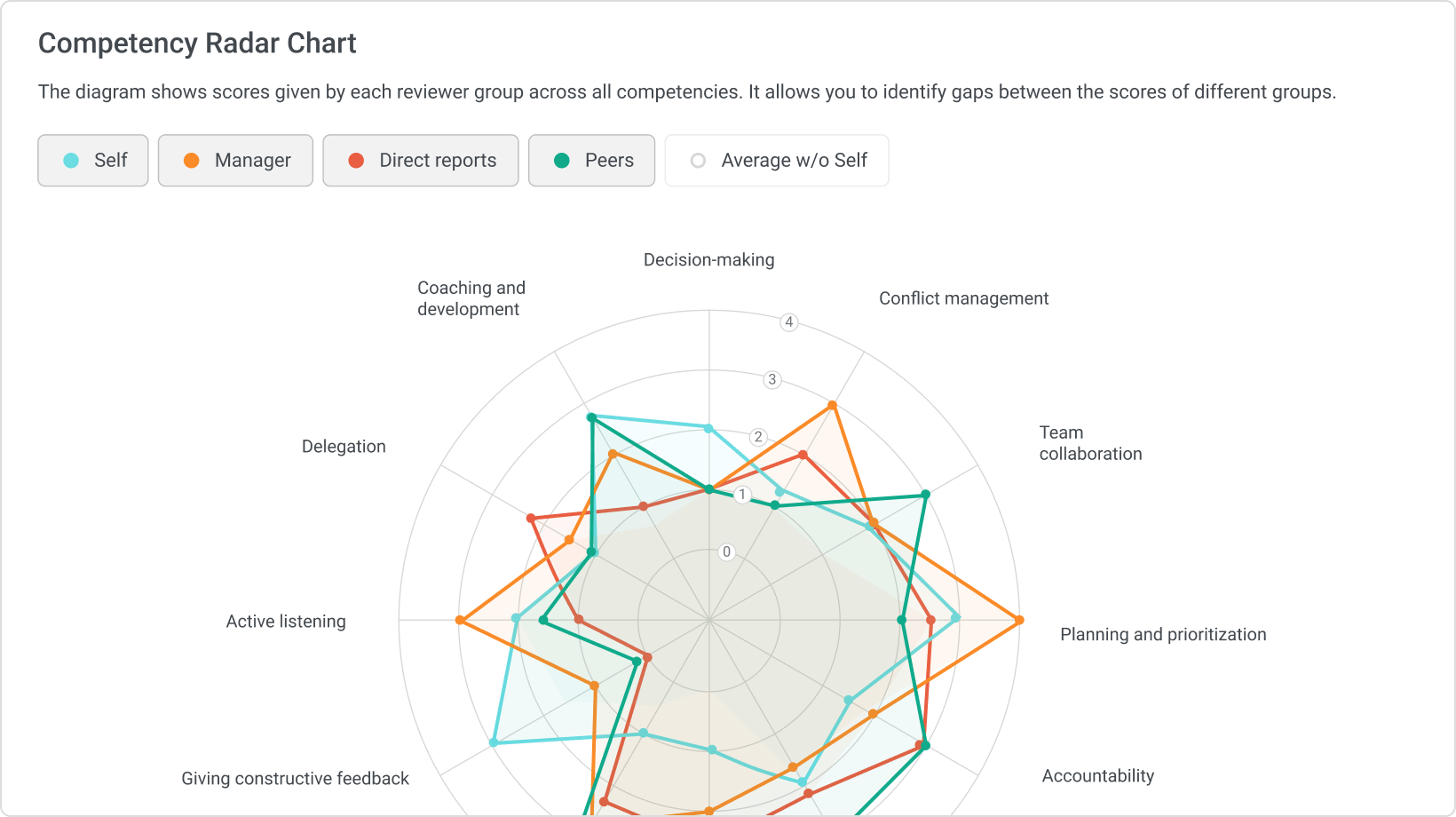
The radar helps you spot:
- gaps between Dave's self-assessment and feedback from others;
- competencies that consistently receive lower ratings across reviewer groups;
- strengths and potential development priorities.
Suppose Dave rates his communication skills highly, while his direct reports consistently flag difficulties with constructive feedback. That's worth investigating, but it isn't a diagnosis. Look for supporting evidence in team performance metrics, manager observations, and actual workplace situations.
2. Identify One Or Two Observable Development Goals
"Improve communication skills" might seem like a reasonable goal after Dave's review. But six months later, how would you know whether he'd achieved it?
Here's a useful exercise: start by imagining Dave's next performance review. What would need to change in the results for you to consider his development successful?
For example, we'd want his direct reports to consistently report that Dave gives specific, actionable feedback. We could even set a target for the relevant 360° indicators, provided the rating scale and role requirements support it.
With that outcome in mind, we can build Dave's upskilling program using the Development Plans module in iSpring LMS:
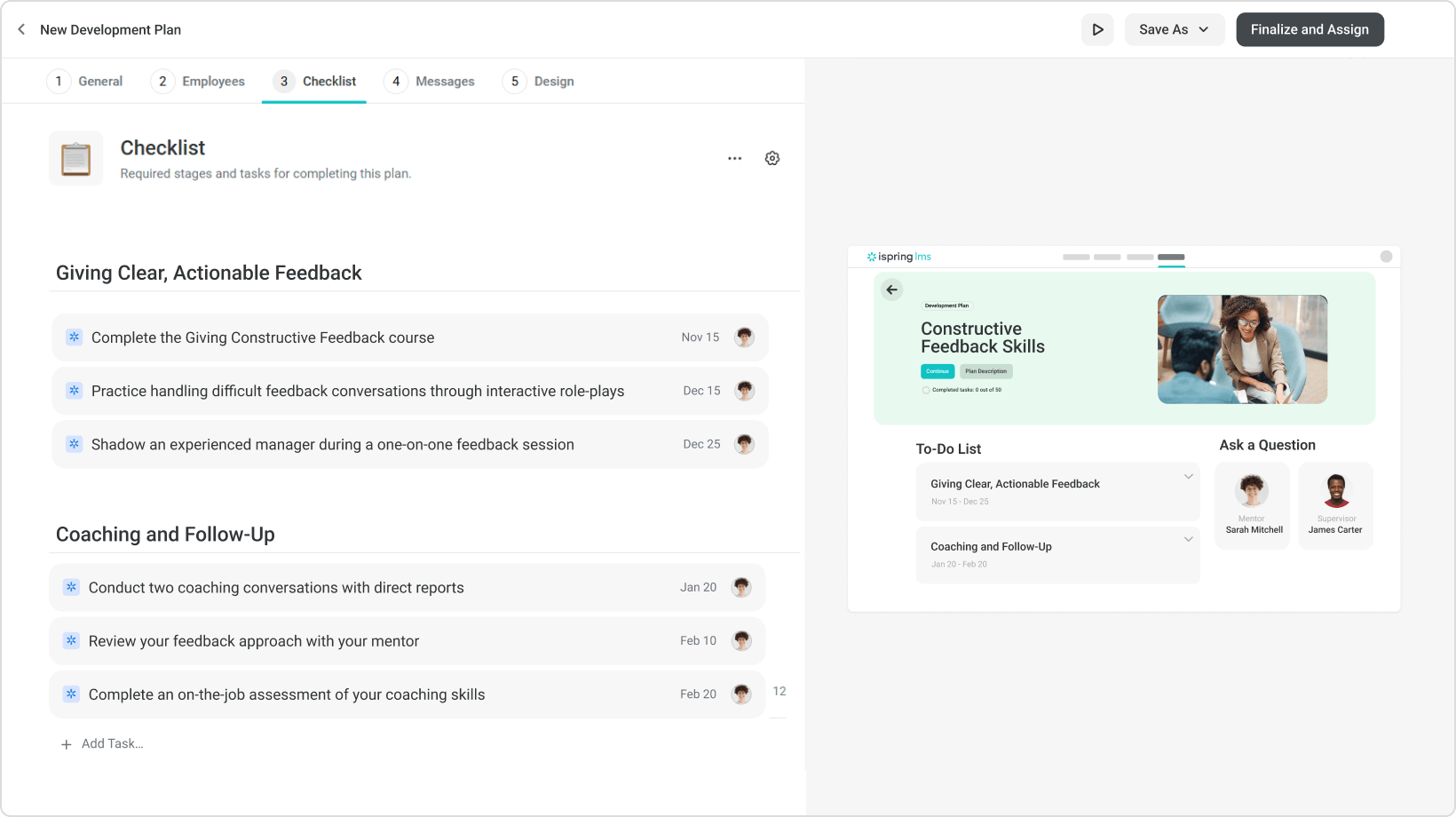
The idea is to give Dave and his manager a shared roadmap for the next 90 days. You can break it into manageable tasks and milestones, assign a mentor or supervisor, and set deadlines. Both Dave and his manager can see what's expected, while progress reports help them keep track of completed and outstanding activities.
3. Choose Development Activities That Match The Gap
So what will actually help Dave improve? That depends on what's behind the gap. A lack of knowledge might call for targeted training, while difficulties applying that knowledge are better addressed through practice and feedback.
Let's say Dave understands the principles of constructive feedback but struggles to put them into practice during difficult conversations. We can address this by combining several activities within his iSpring LMS Development Plan:
Scenario-Based Training
Assign an interactive course with realistic feedback conversations and branching role-plays where Dave can practice handling difficult situations, explore different responses, and learn from his mistakes.
Mentoring
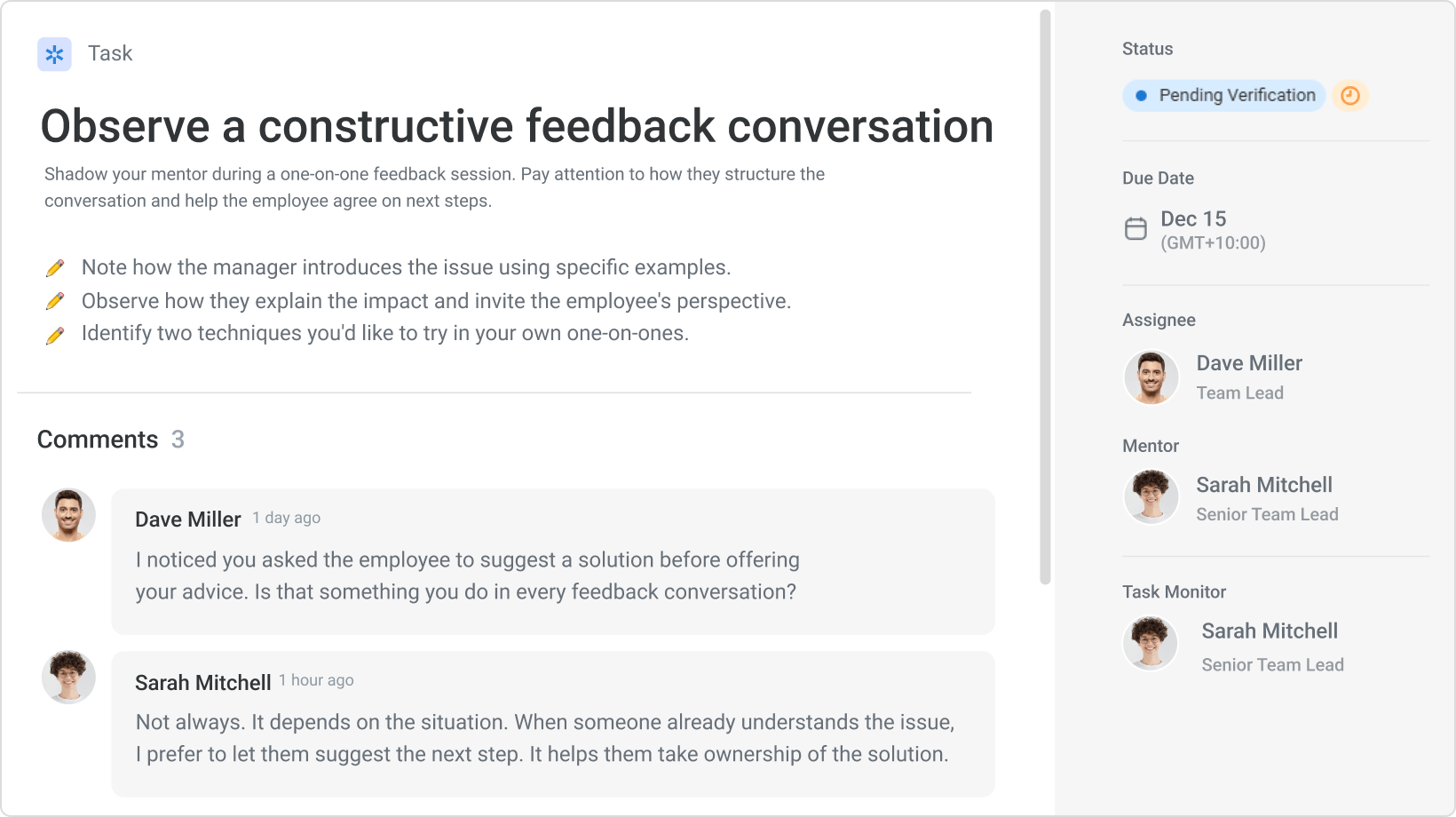
Add a task for Dave to shadow an experienced manager during a feedback session. In iSpring LMS, each task can have its own instructions, deadline, and assigned mentor.
Dave can ask questions and share observations in the comments, while his mentor can provide feedback and verify that the task has been completed.
On-The-Job Training (OJT)
Set up an OJT session in iSpring LMS, where a supervisor observes Dave giving feedback in a real conversation: using concrete examples, explaining their impact, and agreeing on next steps.
4. Structure The Plan Around A Realistic 90-Day Cycle
Even the right development activities won't help much if Dave has to tackle them all at once. A skill like giving constructive feedback takes repeated practice, with gradually less guidance:
- Learn and observe (Day 1–30). Complete the assigned training and shadow a mentor.
- Practice with support (Days 31–60). Apply new techniques in real conversations and get feedback.
- Apply independently (Days 61–90). Handle feedback conversations independently and complete an OJT assessment.
Keep in mind that 90 days is an illustrative timeline. It works well for a focused skill like Dave's, but more complex competencies, such as strategic thinking or leading change, may need a longer cycle or several consecutive plans.
In iSpring LMS, each phase can become a separate stage of Dave's Development Plan, with its own tasks and deadlines. Check-ins can be added as tasks too, so they don't depend on someone remembering to schedule them. As Dave moves through the plan, both he and his manager can see what’s done and what's coming up next.
5. Evaluate Progress And Adjust The Plan
So, Dave has completed his courses, practiced with a mentor, and worked through his OJT assessment. Does that mean we've achieved our development goal?
To find out, we'll look at three levels of evidence:
- Learning activity. Did the employee complete the required training?
- Skill demonstration. Can they perform the target behavior?
- Workplace outcomes. Has relevant performance improved?
In iSpring LMS, all three levels of evidence are available in one place. Course reports show completion and test results, OJT observations capture how Dave performs in real situations, and the Team Development Dashboard gives managers an overview of where each person stands in their plan.
When the next 360° review comes around, you can compare the new competency radar with the previous one to see whether the gap between Dave's self-assessment and his team's view has narrowed.
Pro tip: Be careful about interpreting every low competency score as a training need. The employee might lack the necessary knowledge, struggle to apply it in practice, or receive ratings that don't fully reflect their performance. That last possibility deserves a closer look: differences in perception can stem from limited visibility into someone's work, unclear expectations, or assessment bias. Before assigning another course, make sure you understand what's actually behind the score.
Final Tips
Think of continuing professional development as a working hypothesis. You're making an educated guess about what's holding someone back, what might help, and what improvement should look like.
Sometimes you'll get it right. Other times, an employee will complete every assigned activity, yet their performance will barely change. That's useful information, too. It may be time to revisit the original assessment, try a different approach, or look at workplace conditions that training alone can't address.
The advantage of connecting performance reviews and development plans is that you can keep testing those assumptions instead of starting each review cycle with a blank slate.
If you're looking to connect performance reviews and employee development more closely, book a demo of iSpring LMS to explore how the process can work in your organization.