
 ChatGPT
 Perplexity
 Claude
 Grok
Grok
What Is AI Adoption In Learning And Development?
AI adoption in Learning and Development has become one of the most talked-about trends in corporate learning, but many organizations are not seeing the results they expect. Even though AI is transforming learning technology, only a small number of L&D teams have managed to incorporate it into their daily learning strategies.
eLearning Industry's research, based on responses from over 500 L&D buyers and learning technology vendors, shows that 42% of vendors have fully integrated AI into their products, but only 7.5% of buyers have done the same. Meanwhile, 45% of organizations say they plan to adopt AI, indicating a significant gap between what companies want and what they are actually doing. This leads to a key question: if AI is seen as the future of workplace learning, why is it taking so long for organizations to adopt it?
The main reason is that adopting AI in L&D is much more than just buying new software. To succeed, organizations need to make AI part of their learning processes, connect it with their current LMS and LXP systems, use it to personalize and automate learning, and help employees and managers feel comfortable using it every day. It also requires good planning, change management, skill development, and result tracking.
Many companies think having access to AI is the same as actually using it, but that is not the case. In this article, we will look at what is causing the adoption gap, where organizations are struggling, and how learning leaders can use AI to deliver real business results rather than just follow a trend.
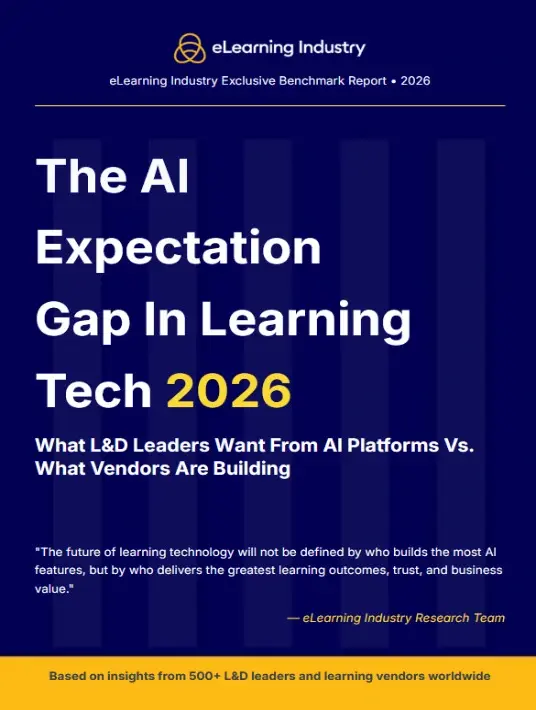
The AI Expectation Gap In Learning Tech 2026: What L&D Leaders Want From AI Platforms Vs. What Vendors Are Building
AI Adoption Is Growing, But Not Equally
AI adoption in Learning and Development is accelerating, but the speed of adoption is quite different for learning technology vendors compared to the organizations they work with. Both groups agree that Artificial Intelligence is key to the future of workplace learning, but they are not at the same stage when it comes to putting it into practice.
Among L&D buyers, AI has clearly moved beyond the experimental stage. More than 8 in 10 respondents (82%) consider AI capabilities either extremely important (37%) or moderately important (45%) when evaluating learning technologies. Yet recognizing AI's importance is not the same as successfully integrating it into learning ecosystems. As the report explains, "L&D buyers and learning technology vendors are aligned on AI's growing importance, but they remain at different stages of adoption, investment, and maturity."
The numbers show this gap well. 42% of learning technology vendors say they have fully integrated AI, but only 7.5% of L&D buyers say the same about their own learning environments. Meanwhile, almost 45% of buyers plan to adopt AI, suggesting that most organizations are preparing for it rather than avoiding it.
This difference is what the report calls the AI expectation gap. Vendors are investing heavily in AI products because they expect the market to move in that direction. On the other hand, organizations are moving more slowly. As the report notes, "Vendors are building for future demand, while many L&D buyers are still determining where AI delivers meaningful value."
Why is this important? Successful AI adoption in L&D is about more than just adding new features. Vendors are focused on making their products scalable, innovative, and ready for the future. Organizations, however, are looking for technology that solves current problems, helps people learn better, and shows clear business value. Until these goals are more closely aligned, the gap between AI innovation and its actual use will continue to affect the future of learning and development.
Why AI Adoption In Learning And Development Is Slower Than Expected
Even though many organizations see AI as a key priority, most L&D leaders are careful, looking for long-term benefits instead of jumping on every new feature. Let's see why that is.
Organizations Still Prioritize Business Value
For most organizations, adopting AI is a business choice, not a race to be first. Leaders want proof that AI-powered learning tools will actually improve results, save time, or boost performance before they invest. They focus on questions like: Will this help employees learn better? Will it save time for Instructional Designers? Can we show real business results? These concerns matter more than whether a platform just claims to use AI.
This careful approach signals a broader shift in corporate learning. Organizations now see AI as just one part of a larger learning strategy, not the main goal. For AI to succeed in L&D, it needs to solve real performance problems, not just add new technology.
User Experience Matters More Than AI
Our report highlights that User Experience (70%), pricing (63%), and integration (59%) are much more important to buyers than AI capabilities (30%) when they choose learning platforms.
This shows that organizations prefer to invest in full learning ecosystems, not just single AI features. Even the best AI assistant is not very helpful if learners find the platform hard to use, administrators deal with complicated workflows, or content is hard to reach. In reality, AI can improve a good learning experience, but it cannot replace it.
Integration Is Still Difficult
Another major barrier to AI adoption in Learning and Development is technical integration. Few organizations operate AI in isolation. Instead, it must connect seamlessly with existing LMSs, HR information systems (HRIS), analytics platforms, content libraries, and governance processes.
If these systems are not connected, AI can make things more complicated instead of easier. L&D teams do not want to add another separate tool that increases admin work, splits up learner data, or interrupts current workflows. For AI to work well, it needs to fit into the tools employees already use daily.
Trust Is Becoming A Competitive Advantage
Trust is now a key factor in adopting AI, not just the technology itself. The report says buyers are looking for vendors who offer responsible AI with strong governance, clear processes, and secure data handling. Organizations want to be sure that AI-generated recommendations are reliable, easy to understand, and match their internal policies.
Privacy, transparency, explainability, and governance are now must-haves, not just nice extras. In the end, organizations will feel more confident adopting AI when they trust both the technology and the companies providing it. In L&D, lasting AI adoption depends on credibility, not just new features.

What Organizations Actually Want From AI
AI adoption in Learning and Development is often discussed in terms of new features. However, our recent research shows that organizations are now asking a different question: Will AI actually make learning better? While technology vendors keep adding AI tools, L&D leaders are looking at how these tools affect learner outcomes, ease of use, and real business value, not just innovation. As our report notes, buyers are mainly interested in "whether these capabilities solve real problems, improve learning effectiveness, and justify additional investment."
The report highlights this gap most clearly by comparing what buyers want with where vendors are investing.
What L&D Buyers Want |
What Vendors Are Building |
| Personalized learning | AI-generated content |
| Learning relevance | Automation |
| Better learner outcomes | Chatbots |
| Practical implementation | More AI features |
Personalization is the biggest opportunity right now. Almost 65% of L&D buyers said personalized learning paths are the most valuable AI feature, making it the top choice in the study. However, only 44% of learning technology vendors are working on or planning to add personalization. Instead, 70% of vendors are focusing on AI-generated content, even though less than half of buyers see it as a top priority.
Our report points out that "the market's biggest opportunity may not lie in building more AI features, but the right ones." Vendors often focus on features that can be used by many customers, like content generation and automation. On the other hand, L&D buyers look at AI differently. They care more about learner engagement, how relevant the learning is, and whether it leads to real results.
This difference matters for how AI is used in Learning and Development. Organizations are not turning away from AI. Instead, they are being more careful about where it adds value. More and more, they want AI to help with personalization, fit smoothly into their current learning systems, and improve the learner experience, not just automate content creation.
The Biggest Barriers To AI Adoption In Learning And Development
Although most organizations see the potential for AI to improve workplace learning, they often struggle to demonstrate clear ROI, develop a practical plan, integrate AI into their current systems, establish governance, and close internal skills gaps. When L&D teams lack AI experience, it can slow things down even more, making it harder to choose vendors, manage change, and expand successful projects.
These challenges are not just for buyers. Our report shows that vendors also face issues such as keeping up with AI innovation, managing complex integrations, limited resources, and gaps in customer education. This means that if the companies creating AI learning tools are working through these problems, organizations using them should expect similar challenges and not see them as failures.
The findings show that AI adoption in L&D takes more than just picking the right technology. Organizations need to set realistic goals, work across teams, maintain strong governance, and focus on business results rather than just AI features. As AI evolves quickly, those who succeed will be the ones who build their own skills, teach their teams, and introduce AI step by step rather than trying to make big changes all at once without a clear plan.
A Practical Framework For AI Adoption In Learning And Development
AI adoption in Learning and Development is most successful when organizations approach it as a business transformation rather than just a tech upgrade. According to the latest eLearning Industry benchmark report, AI adoption is accelerating, but L&D buyers remain focused on practical benefits. They care most about business value, learner outcomes, trust, and usability, rather than just chasing the newest innovations. As the report points out, vendors are pouring resources into AI, but buyers want to know one thing: Does it actually make learning better?
A clear, practical framework helps organizations shift from just trying out AI to using it in a lasting, effective way.
Step 1: Begin by focusing on business problems, not on AI itself.
Rather than looking for places to use AI, start by pinpointing your main learning or business challenges. For instance, is onboarding taking too long? Are compliance courses hard to keep updated? Do learners have trouble finding the right content? Bring in AI only when it can clearly solve a problem and help meet your organization's goals.
Step 2: Look for repetitive learning tasks.
AI is most useful when it takes over repetitive, time-consuming tasks. For example, it can help update course content, create assessment questions, improve search, or suggest personalized learning resources. When these tasks are automated, Instructional Designers and L&D teams have more time to focus on strategy and designing better learning experiences.
Step 3: Test one high-impact use case first.
Instead of rolling out AI everywhere at once, start with a small, focused pilot. This could mean using AI to help create courses, offer personalized learning suggestions in your LMS, or support learners with a chatbot. By starting small, you can see what works, collect feedback, and make improvements before expanding further.
Step 4: Set up governance right from the start.
To make AI work well in L&D, you need clear rules and oversight. Set up human reviews for AI-created content, keep learner data private, create responsible AI policies, and add quality checks. The report highlights that trust, transparency, governance, data privacy, and explainability are becoming more important for long-term success. It also points out that the real advantage now comes from building trust in AI, not just adding new features.
Step 5: Focus on measuring real outcomes, not just how much AI is used.
In the end, focus on what really matters. Counting prompts or tracking feature use does not show if your business is succeeding. Instead, look at time saved, learner engagement, course completion, job performance, productivity, and overall business impact. As the report says, organizations should "position AI as an enabler of outcomes, not as the outcome itself." Showing real, measurable value, not just using new technology, is what leads to successful AI adoption in Learning and Development.
Conclusion
The gap in AI adoption in Learning and Development does not mean organizations are reluctant to innovate. Instead, it shows they are carefully considering how AI can support real business and learning goals. L&D leaders are focusing on User Experience, smooth integration, trust, personalization, and measurable results, rather than just flashy features. Organizations that make AI a core part of their learning systems, instead of treating it as an add-on, will be better prepared for long-term success.