
 ChatGPT
 Perplexity
 Claude
 Grok
Grok
What Are The Top AI Trends And Statistics In 2026?
AI trends are changing more quickly than most organizations expected, so businesses are moving past the testing phase and starting to use AI on a larger scale. In 2026, companies are not debating if Artificial Intelligence will transform work. Instead, they are focused on how fast they can use AI in a responsible, secure, and competitive way. This change is affecting how leaders think about technology investments, workforce planning, and long-term business strategy.
Many of the latest developments in AI show a clear transition from standalone AI tools to integrated systems that support everyday operations. Companies are focusing on real results rather than hype, using everything from generative AI and automation to new technologies built into their workflows. As a result, AI trends in 2026 are increasingly centered on governance, scalability, and ROI rather than simple experimentation.
At the same time, the latest AI advancements are influencing how companies train their staff, share knowledge, and boost productivity in different departments. These trends are also transforming industries such as retail, marketing, and workplace learning, where the use of AI for personalization and decision-making is becoming more common. This article looks at the latest AI trends, statistics, and strategies that are shaping how businesses learn, operate, and adapt their workforce in 2026.
The State Of AI In 2026: Key Statistics And Market Signals
AI trends in 2026 show that Artificial Intelligence is no longer operating at the edge of business strategy. Across industries, organizations are moving from AI experimentation to enterprise-wide implementation, under growing pressure to demonstrate measurable value, improve productivity, and build governance frameworks for new AI technologies.
Enterprise AI Adoption Continues To Accelerate
The latest AI trends data for 2026 point to rapid enterprise adoption, especially in operations, customer support, marketing, and workforce enablement.
- 78% of Global 2000 companies now have at least one AI workload in production, up from 41% in 2024.
Takeaway: Enterprise AI adoption trends in 2026 show that AI has moved beyond pilot programs into core business systems. - Worker access to AI tools increased by 50% in 2025.
Takeaway: According to Deloitte's 2026 AI report, AI industry trends 2026 increasingly focus on workforce-wide AI integration rather than isolated technical teams. - Half of the surveyed healthcare organizations in the US have already implemented generative AI, while more than 80% have deployed their first use cases to end users.
Takeaway: Recent AI developments are advancing fastest in industries with large-scale data and complex workflows. - 96% of B2B marketers now use AI in their daily work.
Takeaway: Most still rely primarily on AI for productivity support rather than for strategic transformation. AI marketing trends for 2026 suggest widespread adoption, but operational maturity still varies significantly. - AI adoption is accelerating—but a large implementation gap remains.
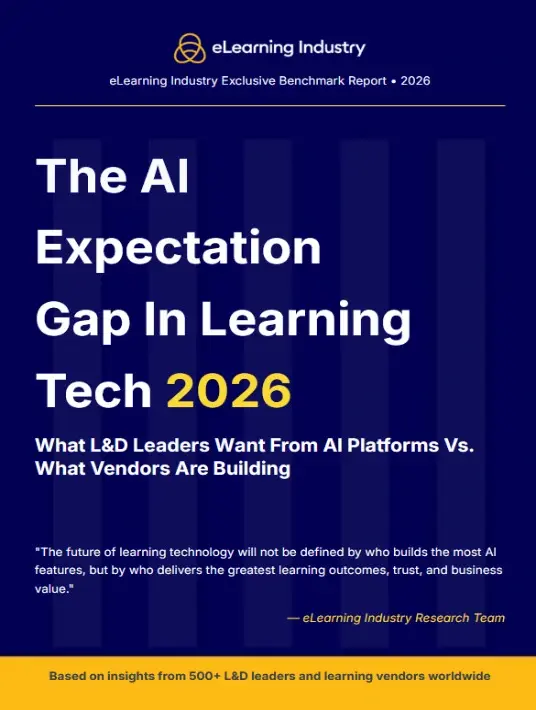
Based on eLearning Industry's benchmark report, 42% of learning technology vendors have already fully integrated AI into their platforms, while only 7.5% of buyers report having fully integrated AI into their organizations. Another 45% of buyers say they plan to adopt AI in the future. - AI is important—but it isn't the top purchasing factor.
According to our report, more than 80% of buyers consider AI capabilities important when evaluating learning technology. However, AI ranks behind user experience (70%), pricing (63%), and integrations (59%) as a purchasing criterion. - Organizations are still struggling to implement AI.
Our report identifies the biggest challenges facing organizations adopting AI:- 48% cite keeping pace with rapid AI advancements.
- 45% struggle with integrating AI into existing systems.
- 41% report limited internal resources for implementation.
Regional growth patterns also continue to shift. North America remains the largest AI investment market, while Asia-Pacific is scaling AI infrastructure rapidly through manufacturing, robotics, and automation initiatives. Europe, meanwhile, is prioritizing AI governance, regulatory oversight, and adoption.
The AI Expectation Gap In Learning Tech 2026: What L&D Leaders Want From AI Platforms Vs. What Vendors Are Building
Investment Is Shifting From Experimentation To Infrastructure
One of the biggest Artificial Intelligence trends in 2026 is the scale of AI investment flowing into infrastructure, compute, and enterprise deployment.
- Private AI companies raised $226 billion in Q1 2026 alone.
Takeaway: This surpasses the total AI funding raised during all of 2025. AI startup funding trends 2026 show investors are concentrating capital around infrastructure-heavy AI ecosystems and foundation model providers. - Mega-rounds of $100M+ accounted for 94% of total AI funding in Q1 2026.
Takeaway: AI innovations increasingly require large-scale compute, energy, and data investments that smaller players may struggle to match. - The global AI market could exceed $4.2 trillion by 2030, driven largely by enterprise adoption.
Takeaway: This is according to Citigroup estimates. AI investment trends 2026 reflect growing confidence that AI will become a foundational business infrastructure rather than a standalone software category.
At the same time, organizations are paying closer attention to workforce impact statistics, AI literacy, and productivity outcomes. According to Deloitte, twice as many leaders now report transformative AI impact compared to last year, signaling that the conversation around AI developments is shifting from possibility to measurable operational value.
The Top AI Trends Defining 2026
AI trends are reshaping how organizations operate, learn, and compete in 2026. What makes this moment different is that businesses are no longer experimenting with AI in isolated projects. Instead, they are integrating Artificial Intelligence into daily workflows, decision-making, customer experiences, and workforce development strategies. The latest developments in AI show a clear shift from curiosity to operational value, especially as organizations seek scalable, measurable outcomes.
1. Agentic AI Is Moving Beyond Assistants
One of the biggest agentic AI trends in 2026 is the move from chat-based AI to action-based systems. Traditional AI assistants mainly respond to prompts. They answer questions, summarize information, or generate content in response to user requests. Agentic AI, however, can complete multi-step tasks with limited human input.
For example, an AI agent can analyze sales data, generate a report, schedule follow-up actions, and automatically notify teams. This kind of orchestration is becoming more common across enterprise workflows, especially in operations, HR, customer support, and project management.
These latest AI trends in 2026 are pushing organizations to rethink their automation strategies. Instead of using AI as a simple assistant, businesses are deploying autonomous systems that can coordinate tasks across platforms and tools.
Still, these AI advancements in 2026 also raise concerns. Companies need strong governance frameworks to ensure AI agents operate within approved boundaries. Human oversight remains essential, especially when AI systems make recommendations related to hiring, compliance, finance, or customer interactions. Organizations are increasingly balancing efficiency with accountability.
2. Generative AI Is Becoming Embedded Into Everyday Work
Generative AI trends are evolving quickly as organizations move beyond experimentation. In earlier stages, businesses used AI tools mainly for testing or occasional productivity gains. The latest trends in generative AI for 2026 show that AI is becoming embedded in everyday work.
Teams are using AI for writing, research, meeting summaries, learning content creation, and communication support. Marketing departments are adopting AI-generated campaigns, while training teams use AI to create personalized learning materials at scale.
The latest generative AI trends 2026 also include major growth in video and visual content. AI image generation trends 2026 are influencing branding, Instructional Design, and digital learning experiences. At the same time, market trends in AI video creation 2026 show growing demand for AI-powered training videos, simulations, and multilingual content production.
This shift matters because generative AI is helping organizations scale content creation more efficiently. Businesses can personalize learning pathways, customer experiences, and employee communications without dramatically increasing production costs.
However, concerns about synthetic media are also growing. Companies are paying closer attention to misinformation, copyright issues, and the ethical use of AI-generated content. As AI becomes part of operational workflows, governance and transparency are becoming critical.
3. AI Governance Is Becoming A Business Requirement
AI governance trends are now central to enterprise AI strategies. As organizations expand AI adoption, leaders are realizing that innovation without oversight creates operational and legal risks. AI governance refers to the frameworks organizations use to manage AI risks, ensure compliance, maintain accountability, and ensure ethical deployment. This includes regulations, transparency standards, bias mitigation practices, copyright considerations, and internal review processes. Many of the latest Artificial Intelligence developments in regulation are pushing organizations to formalize AI policies before deploying tools across departments.
Governance is also becoming tied to procurement decisions. Businesses increasingly evaluate vendors based on explainability, security practices, data handling, and compliance readiness. In many cases, cross-functional oversight teams now include IT, legal, HR, L&D, and business leadership stakeholders. The latest developments in AI make one thing clear: organizations that build governance early are better positioned to scale AI responsibly.
4. AI Adoption Is Becoming Industry-Specific
Another major shift in AI industry trends is the move away from generalized AI strategies. Businesses are realizing that AI delivers stronger outcomes when it is tailored to specific industry needs.
In retail, AI retail trends focus on inventory forecasting, customer personalization, and supply chain optimization. AI retail technology trends also include predictive analytics and AI-generated shopping experiences.
In HR and L&D, organizations are using AI-powered workforce training and adaptive learning systems to personalize employee development. Customer service teams are deploying AI-generated customer experiences that combine automation with human support.
Meanwhile, AI marketing trends for 2026 center on personalization, campaign optimization, and audience segmentation. These AI marketing trends reflect a larger shift toward data-driven engagement strategies. The most successful organizations are not applying AI everywhere equally. Instead, they are focusing on targeted use cases that align with business goals and workforce needs.
5. Multimodal AI Is Reshaping Content And Learning
Some of the latest AI technology developments involve multimodal AI systems that combine text, image, video, and voice capabilities within a single experience. This new Artificial Intelligence technology is transforming enterprise learning and content creation.
For Instructional Designers and enablement leaders, multimodal AI creates opportunities to build more engaging and adaptive learning ecosystems. Organizations can develop interactive simulations, AI-supported coaching tools, and personalized learning experiences faster than before.
This new AI technology is especially valuable for large organizations managing global training programs. Multimodal systems can support multilingual learning, accessibility improvements, and scalable content delivery across teams and regions.
As AI development continues to accelerate, businesses will increasingly focus on how these technologies improve learning effectiveness, workforce readiness, and operational agility.
Recent AI Developments Leaders Should Monitor Closely
AI trends in 2026 are moving beyond experimentation and becoming part of long-term business strategy. Many recent AI developments shaping the market are focused on efficiency, accessibility, and workforce readiness rather than on larger models or faster tools. For business leaders, understanding these recent developments in AI is becoming essential for planning future learning, operations, and technology investments.
Smaller, Specialized AI Models
One of the latest advancements in AI is the rise of smaller, specialized models designed for specific business tasks. Instead of relying solely on massive, general-purpose systems, organizations are adopting lighter AI tools that reduce compute costs and enable faster deployment. These models are also improving edge deployment, allowing AI systems to run closer to users and devices rather than relying entirely on cloud infrastructure.
This shift is accelerating departmental adoption across HR, L&D, marketing, and operations teams. Many recent AI advancements are now focused on practical use cases, including workflow automation, personalized training, and knowledge management.
AI And Search Transformation
Another major area of AI development is the transformation of search itself. AI Overviews, conversational search, and answer engines are changing how professionals discover information online. Instead of browsing multiple pages, users increasingly expect direct, contextual answers generated by AI systems.
These latest AI advancements are also changing content strategy. Organizations now need content that is structured, authoritative, and optimized for AI-driven search experiences, not just traditional rankings.
AI Skills Are Becoming Core Workforce Competencies
As Artificial Intelligence continues evolving, AI literacy is becoming a core business skill. Organizations are investing more heavily in upskilling, organizational learning, and responsible AI education. At the same time, new trends in AI master's programs reflect the growing demand for practical AI governance, ethics, and implementation skills. For leaders, the latest advancements in AI are no longer only technology trends. They are workforce and business transformation trends as well.
What These AI Trends Mean For Learning And Workforce Strategy
AI trends are no longer just about technology shifts; they are directly shaping how organizations design learning and workforce strategy in 2026. For L&D leaders, HR teams, and executives, the focus is on readiness, adaptability, and leadership capability rather than on tool adoption.
AI Literacy Is Becoming A Leadership Priority
One of the most important Artificial Intelligence developments is the rise of AI literacy as a core leadership skill. Leaders are expected to understand how AI systems work, where they add value, and where they create risk. This goes beyond technical knowledge. It includes judgment about when to use AI, how to interpret outputs, and how to guide teams responsibly. In many future AI examples, strong leadership depends on knowing how to balance human decision-making with AI-driven recommendations.
Learning Ecosystems Must Support Continuous Adaptation
Traditional training models are no longer enough. AI developments are changing job roles faster than static learning programs can keep up. Organizations now need learning ecosystems that support continuous adaptation. This means shorter learning cycles, on-demand content, and systems that evolve with business needs. In practice, Artificial Intelligence developments are also enabling personalized learning paths that adjust in real time based on employee performance and needs.
Human Skills Are Increasing In Strategic Value
As AI platforms handle more routine tasks, human skills are becoming more important, not less. Skills like judgment, communication, systems thinking, and ethical reasoning are now central to workforce success. These capabilities cannot be fully automated and are critical in guiding AI use in complex environments. As organizations respond to AI trends, they are realizing that long-term advantage comes from strengthening these human strengths alongside technical adoption.
The Future Of AI: What Organizations Should Prepare For Next
AI trends are shaping how organizations prepare for the future of work through better systems, skills, and governance. In 2026, top AI trends include agentic systems, automation, and governance maturity, while AI technology trends focus on multimodal tools, AI-native workflows, and enterprise scale adoption, showing how each AI trend is moving from experimentation to real business impact. Organizations must align strategy, governance, and learning to stay competitive in the fast-changing AI landscape ahead. The organizations gaining long-term advantage from AI are not necessarily adopting the most tools. They are building the strongest systems for experimentation, governance, learning, and adaptation.