
 ChatGPT
 Perplexity
 Claude
 Grok
Grok
What ChatGPT Training Actually Means
In a business setting, ChatGPT training means guiding employees to use AI in ways that are effective, responsible, and consistent, all to help the company succeed. Unlike taking a free ChatGPT course or a few classes on your own, enterprise training aims to build skills across the whole organization to boost productivity, encourage innovation, and support better decision-making.
For individual users, learning often means taking a ChatGPT course, joining an online class, or finding free ways to learn ChatGPT. These steps help employees pick up basic prompting skills, see common uses, and get familiar with AI-powered workflows. However, learning on your own usually does not lead to lasting change for the whole organization.
However, building skills across an organization takes a bigger-picture approach. Rather than just showing employees how to use ChatGPT, leaders set up frameworks, clear policies, and learning programs that align with the company's AI goals. This way, training people in different departments leads to real improvements in how the business performs.
Effective ChatGPT training usually covers three main skills.
- First, prompt literacy helps employees write clear, detailed prompts to achieve useful results.
- Second, workflow integration teaches teams how to integrate AI into their existing processes rather than using it separately.
- Third, ethical AI use ensures employees understand data privacy, bias, accuracy, and responsible decision-making.
For Instructional Designers, the aim goes beyond teaching people how to use ChatGPT. The real goal is to help build the skills, habits, and systems that support long-term, responsible AI use across the company.
Understanding The ChatGPT Training Process
ChatGPT training starts with understanding how the technology works and where its capabilities come from. Most employees use ChatGPT by entering prompts and having conversations, but Instructional Designers need a basic understanding of how ChatGPT is trained so they can create realistic and effective learning programs.
How ChatGPT Learns
At a high level, ChatGPT is trained on large amounts of information from a variety of sources, including websites, books, articles, and other approved sources. As it trains, the model finds patterns in language, which helps it create responses that sound natural and fit the context. However, employees do not need to know how to build AI models; they should learn to use them well, check the results carefully, and use them responsibly in their daily work.
ChatGPT Limitations
Instructional Designers should also be aware of important limitations.
One common issue is the ChatGPT training data cutoff, which is the date when the model stopped learning from new data. Because of this, ChatGPT might not have the latest information unless it is linked to outside data sources.
Another challenge is the risk of hallucination. Like other AI systems, ChatGPT can sometimes give answers that are wrong, incomplete, or misleading, even if they sound confident. That is why every ChatGPT course, certification, or workshop should focus on teaching people to use their own judgment rather than blindly trusting AI-generated content.
Core Skills Employees Need In ChatGPT Training Programs
ChatGPT training works best when it teaches practical skills that employees can use in their everyday work. Many people start by learning ChatGPT on their own, but organizations see better results when they offer structured training that builds both technical confidence and critical thinking.
Prompt Engineering
Prompt engineering is a key skill. Employees should know how to write clear, specific prompts to get accurate, helpful answers. Instead of using ChatGPT like a search engine, they need to give context, set goals, and ask follow-up questions to improve results. This basic skill helps employees use ChatGPT more effectively and achieve higher-quality results across different areas of the business.
AI Writing
AI-assisted writing and analysis are also important. ChatGPT can help draft emails, summarize reports, generate ideas, analyze information, and create learning materials. Still, training should make it clear that AI is a tool to boost productivity, not a substitute for human skills. Employees need to know how to review and improve AI-generated content before using it at work.
Decision-Making
Decision-making is just as important. Effective ChatGPT training shows employees how to think critically about AI outputs, verify facts, spot mistakes, and use their own judgment alongside AI insights. This skill is becoming more valuable as AI tools become part of daily work.
Responsible AI Use
Responsible AI use should be a key part of every training program. Employees need clear guidance on data privacy, confidentiality, intellectual property, and ethical AI practices. Knowing these basics helps reduce the organization's risk and supports responsible use.
AI Integration Into Workflow
Finally, actually using AI at work is the goal.
- HR teams can use ChatGPT for job descriptions and employee communications.
- L&D professionals can support content development.
- Marketers can accelerate campaign planning.
- Operations teams can improve documentation and processes.
- Many professionals also use ChatGPT for LinkedIn content creation and personal branding.
At eLearning Industry, we have taken several AI courses to help us leverage this new technology to its fullest. This is because we know that AI literacy is now just as important as digital literacy was a generation ago. When companies invest in structured ChatGPT training, they do more than boost productivity. They help their teams learn, innovate, and adapt more quickly to change.
-Christopher Pappas, CEO and founder of eLearning Industry
ChatGPT Courses, Classes, And Certifications
ChatGPT training comes in several formats, so professionals and organizations can choose what works best for them. The best choice depends on your learning goals, how much time you have, and the skills your team needs.
ChatGPT Courses
A ChatGPT course is usually self-paced and covers topics such as prompting, content creation, research assistance, workflow automation, and using AI responsibly. Some courses go further by including real business examples, showing how AI can boost productivity, communication, and decision-making. Online learning platforms have also added more options as demand grows. For example, Coursera offers ChatGPT courses as part of a larger set of AI and Generative AI programs to help professionals build both basic and advanced skills.
ChatGPT Classes
If you prefer more interaction, a ChatGPT class offers guided lessons, live demos, and time to ask questions. Organizations often pick ChatGPT workshops for team training, since these focus on practical uses and specific job needs. Workshops are helpful because employees can use what they learn right away.
ChatGPT Certifications
There are now many ChatGPT certification options, as the market has grown quickly. These programs aim to prove your AI skills, but it's important to look closely at what each one offers. Some are well respected, but there is no official OpenAI ChatGPT certification yet. Employers should pay more attention to the quality of training and the development of real skills than to the certificate name alone.
How To Build An Internal ChatGPT Training Program
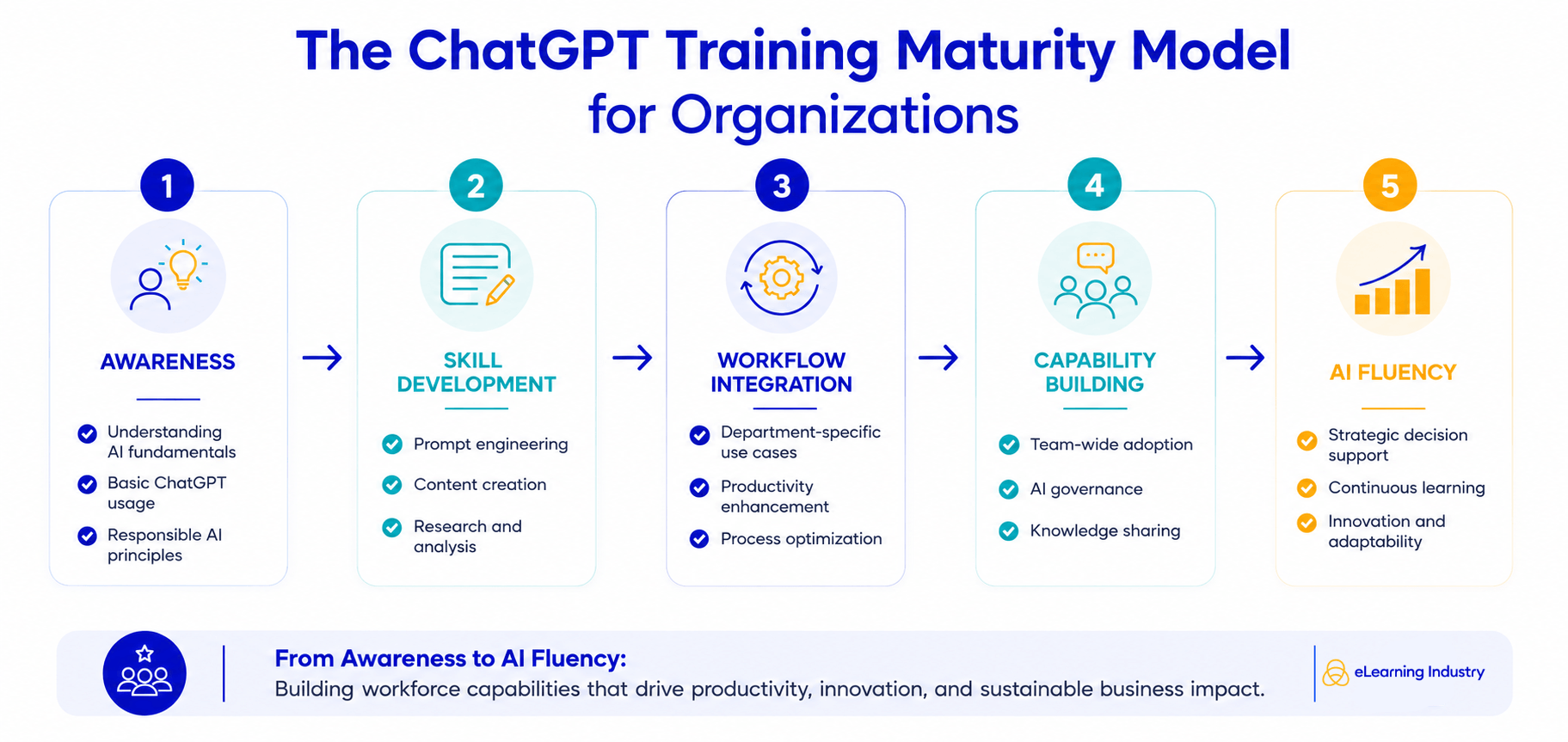
ChatGPT training works best when it is seen as a way to build workforce skills, not just a single tech lesson. Instructional Designers should aim to help employees use ChatGPT to boost productivity, make better decisions, communicate clearly, and perform better at work. Using a structured approach keeps learning relevant, measurable, and in line with business goals.
Step 1: Conduct A Needs Analysis
Before creating a ChatGPT training course, determine who needs it and the reasons behind it. Each team will use AI in its own way, so a single approach rarely works for everyone.
For example:
- HR teams may use ChatGPT for job descriptions, employee communications, and policy drafts.
- L&D professionals may use it for content creation, learning design, and assessments.
- Leaders may leverage AI for strategic planning, research, and decision support.
- Operational teams may use it to streamline documentation, reporting, and routine tasks.
After you know who needs training, list out how each department can use AI. This lets Instructional Designers focus on real-world uses instead of just showing how the tool works. Employees are more interested in training when they see how it relates to their everyday tasks.
Step 2: Design A Modular Curriculum
Effective ChatGPT courses meet different skill levels and learning needs. With a modular curriculum, learners can move at their own pace and build confidence as they go.
- A beginner module should cover AI basics and simple prompting techniques. While many employees start by learning ChatGPT through free videos or articles, structured guidance helps them build good habits from the beginning.
- An intermediate module can teach advanced prompting, workflow integration, content creation, and how to review AI outputs. This level is similar to what you find in professional ChatGPT courses and online programs.
- For advanced learners, a ChatGPT mastery course can cover process improvement, advanced prompt methods, responsible AI use, and applications for specific departments. The goal is to develop internal experts who can help spread AI adoption across the company.
Step 3: Select Appropriate Delivery Methods
Pick a delivery method that matches your company's culture, your team's needs, and the resources available.
- Many organizations start with a ChatGPT online course so employees can learn at their own pace. This self-paced approach is flexible and works well for teams spread across different locations.
- Live learning is still important. A ChatGPT workshop provides employees with hands-on practice, real-time feedback, and the opportunity to solve problems together. These sessions often help people feel more confident and comfortable using the tool.
- Many L&D teams find that blended learning works best. Mixing self-paced modules, virtual instructor-led sessions, peer discussions, and practical exercises makes learning more engaging and helps people remember what they learn.
Step 4: Establish Assessment And Certification
Training should have clear measures of success. Instead of only testing theory, organizations should check if employees can use ChatGPT well in real work situations.
- A competency-based approach can check skills like writing prompts, reviewing outputs, using AI ethically, and adding ChatGPT to workflows. This gives a better sense of job readiness than just using traditional quizzes.
- Organizations can set up an internal ChatGPT certification to recognize skills and motivate employees to join in.
- Some companies use micro-credentials for specific skills, while others offer broader certifications that cover several AI abilities.
No matter if organizations use micro-credentials or formal certification, the main goal should be practical skills. The best ChatGPT training helps employees go beyond just trying things out and build repeatable skills that add real business value.
Free Vs Paid ChatGPT Training Programs
ChatGPT training options include everything from free self-paced resources to in-depth programs for businesses. The best choice depends on your organization's goals, how experienced your team is, and what rules or policies you need to follow.
Free ChatGPT Training Programs
If you're just starting to explore AI tools, a free ChatGPT course can be a good way to begin. These resources teach you how to create prompts, show common ways to use ChatGPT, and help you boost productivity—all without any cost. Many professionals find that free courses give them enough basic knowledge to start using AI in their everyday work.
But free learning options have their drawbacks. Without structure, people may develop skills unevenly, miss important information, or pick up unsafe habits. Employees might learn a few tricks but not understand data privacy, responsible AI use, or how ChatGPT fits with company goals.
Paid ChatGPT Training Programs
As more companies use AI, many choose to go beyond free ChatGPT courses and invest in structured training. Paid programs like certification courses, online classes, or instructor-led workshops offer guided lessons, assessments, and clear results. The top ChatGPT courses also cover topics such as governance, compliance, and how to use AI in specific job roles, making them better for training large teams.
Conclusion
ChatGPT training has moved beyond simply showing employees how to use a new tool. Now, it focuses on helping people build the skills they need to work well with AI in their daily tasks and business processes. When organizations offer well-designed ChatGPT training, they can boost productivity, improve decision-making, and become more adaptable as AI becomes a bigger part of the workplace. Instructional Designers are key to this change because they create learning experiences that build real AI literacy, not just basic tool knowledge. In the end, companies that make AI fluency a core skill for their teams will be better equipped to handle change and achieve long-term success.