
 ChatGPT
 Perplexity
 Claude
 Grok
Classroom Management: A Learning And Workforce Issue, Not Just A Discipline Issue
Classroom management shapes how well teachers can use their time, knowledge, and technology to engage students. Too often, people think it just means discipline or keeping students quiet. But real classroom management is about setting clear expectations, creating routines, making lessons accessible, building positive relationships, and offering coordinated support.
This is not just a personal skill, though, but also an organizational issue. In 2026, U.S. public school teachers said that managing student behavior was their top source of job stress. Another RAND study found that teachers spent about eight hours each week helping students with behavior or mental health needs. These results show that teachers need practical management skills, but they also need resources, training, specialist help, and support from the whole school.
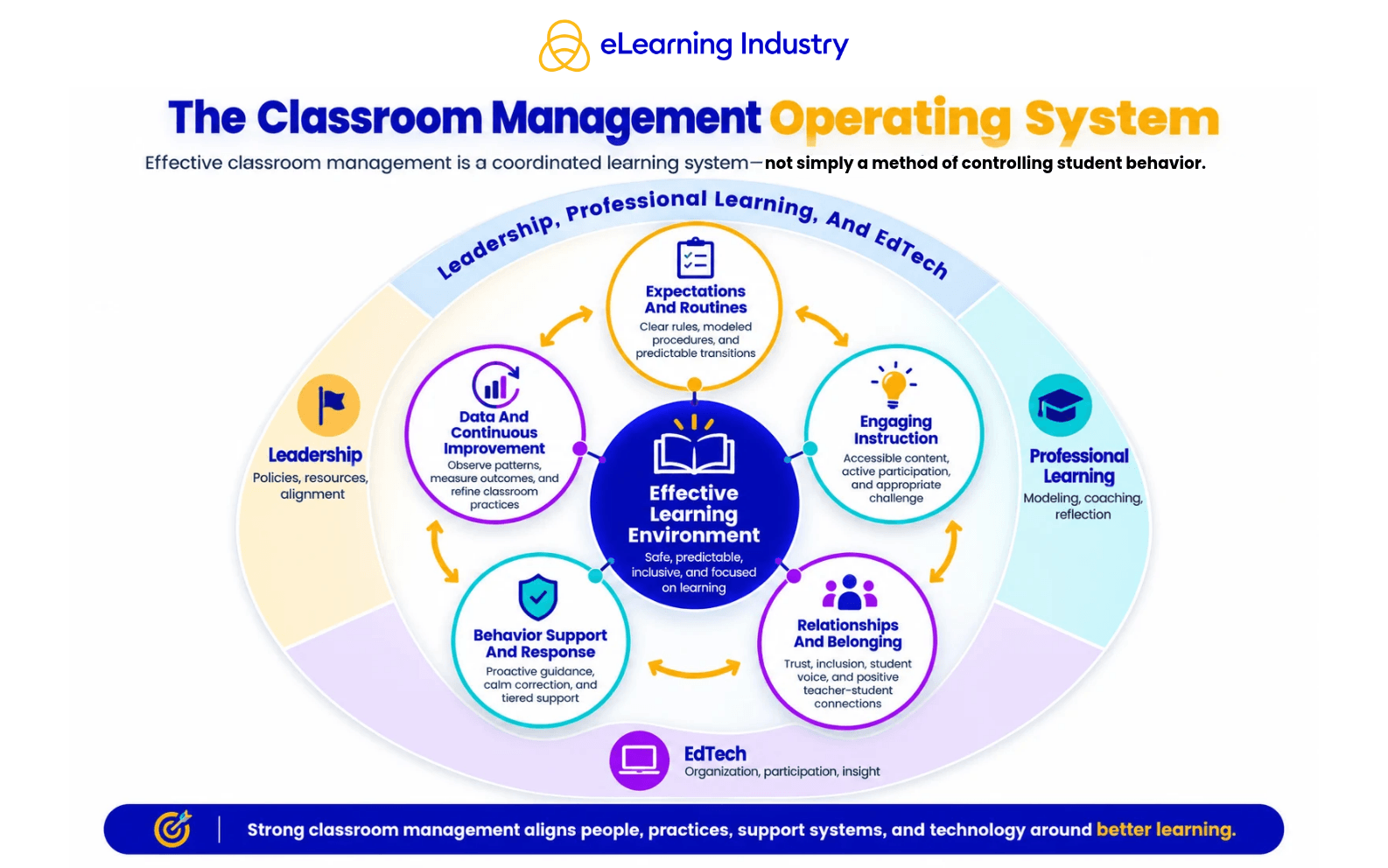
So, classroom management is more than just having a list of rules. It takes a thoughtful plan that connects routines, teaching, relationships, behavior support, and technology. This guide will show you how to build that system, use 10 proven strategies, and adjust them for different grades and learning settings.
What Is Classroom Management?
Classroom management means using expectations, routines, relationships, teaching methods, and behavior supports to make the classroom safe, predictable, and productive. It includes both proactive steps to prevent problems and consistent responses to challenges, while respecting students and making the most of learning time. This definition goes beyond just controlling behavior. It covers how teachers set up the classroom, give instructions, handle transitions, encourage students to join in, use technology, respond to behavior, and build relationships.
The American Psychological Association (APA) points out that students learn how to behave and interact with others; these skills are not automatic. So, teachers should teach expected behaviors as carefully as they teach academic subjects. Good classroom management also relies on setting high expectations, building positive relationships, and giving students the support they need.
Why Is Classroom Management Important?
Classroom management matters because it helps protect learning time, reduces uncertainty, encourages participation, and provides teachers with a consistent way to handle problems. When students know what to expect and how things work, they can focus better on learning.
The benefits extend beyond just keeping the room quiet. A clear approach can:
1. Cut down on time lost because of unclear directions or messy transitions.
2. Make it easier and more predictable for everyone to join in.
3. Help create a classroom that feels safer and more welcoming for everyone.
4. Help teachers respond in a steady way instead of having to make things up on the spot.
5. Show when a problem needs a change in teaching, extra support, or help from a specialist.
Positive and proactive classroom practices can help teachers feel better, help students feel like they belong, and support social, emotional, behavioral, and academic growth. These practices last longer when the whole school uses them, instead of leaving each teacher to do it alone.
So, classroom management matters for three reasons: how students experience school, how teachers experience their work, and how well the school can create good places to learn.
What Should A Classroom Management Plan Include?
A classroom management plan is a written guide that explains how learning will be organized, how expectations will be taught, and how teachers will respond when students need extra support. It turns broad goals like “create a respectful classroom” into clear, practical actions.
A good plan has seven key parts.
1. A Clear Purpose
Describe the kind of classroom you want. For example, students should feel comfortable asking questions, know how to join in, and know where to find help.
2. Observable Classroom Management Expectations
Pick three to five positive expectations, like "Be prepared,” “Respect the learning process,” or “Use technology responsibly.” Next, explain what each one looks like in different situations.
3. Classroom Routines And Procedures
Document procedures for:
- Entering and leaving the room
- Accessing materials
- Asking for help
- Moving between activities
- Participating in group work
- Using devices
- Submitting work
- Responding to attention signals
Classroom management rules set the boundaries that everyone must follow. Routines show how daily activities work. Both should match the school's overall policies, not go against them.
4. Instructional Engagement Practices
Show how your lessons will be clear, challenging, accessible, and include movement, choices, and regular checks for understanding. Good lesson planning is a key part of classroom management.
5. Feedback And Acknowledgment
Describe how you will recognize students when they meet expectations. Give feedback that clearly tells them what they did well and how it helped their learning.
6. A Response And Escalation Process
Explain how teachers will use reminders, redirection, reteaching, consequences, restorative talks, family contact, and help from specialists. Responses should be fair and consistent.
7. A Review Cycle
Decide what data and feedback you will review. Change your plan if you see that a routine, policy, or strategy is not working.
10 Effective Classroom Management Strategies
The most effective classroom management strategies work together as a system. Giving consequences will not fix unclear instructions, and a new management program cannot make up for lessons that are hard to access or a lack of consistent support.
Research-based advice highlights the importance of understanding what leads to certain behaviors, changing the environment, teaching new skills, and working with families and colleagues.
1. Establish A Small Number Of Clear Expectations
Set 3 to 5 expectations that students can see and understand. Rather than just saying “Be respectful,” explain what respect looks like during discussions, group work, independent tasks, and online communication.
When possible, let students talk about how shared expectations apply. Getting students involved can make expectations more meaningful, but the teacher is still responsible for ensuring the classroom remains safe and productive.
2. Teach Routines As Deliberately As Academic Content
Do not assume that students understand a routine because it was announced once. Explain it, model it, let students practice it, provide feedback, and reteach it when necessary.
Prioritize routines that affect the entire learning experience, including entry, attention signals, transitions, materials, help requests, device use, and dismissal. Explicitly teaching predictable routines is a central feature of positive classroom support.
3. Design Engaging And Accessible Instruction
Improving lesson design is one of the best ways to manage a classroom. Students often lose interest when work is confusing, hard to access, repetitive, or poorly paced.
Set clear goals, break content into smaller parts, offer multiple ways for students to participate, check understanding as you go, and ensure the work is challenging yet doable. If students seem disengaged, first check if they understand the task and can do it.
4. Use Active Supervision
Active supervision means watching the whole classroom, moving around purposefully, talking with students, and staying where your help is most needed.
This approach helps teachers spot confusion or problems early. A quick prompt, standing nearby, or a simple explanation often works better than waiting until the issue needs to be addressed in front of everyone.
5. Give Specific Feedback
Good feedback explains what the student did and why it matters. For example, “Your group began as soon as the instructions appeared, so you have the full ten minutes to complete the task” is more helpful than just saying “Good job.”
Also, pay attention to who receives positive feedback, who receives correction, and whether you are being fair in your expectations.
6. Manage Noise And Transitions Deliberately
Good noise management means knowing the difference between helpful discussion and noise that gets in the way of learning. Set clear voice-level expectations for independent work, group work, presentations, and transitions.
Tools like visible timers, attention signals, group roles, and clear step-by-step directions can help. But if noise keeps rising during the same activity, look at the task itself instead of just adding another rule.
7. Correct Behavior Calmly And Privately
Try the simplest response that will work. A gesture, standing nearby, or a quick private chat can often solve the problem without stopping the lesson.
Don't use sarcasm, humiliation, group punishment, or argue with students in front of the class. Corrections should explain what needs to change and help the student get back to learning.
8. Use Behavior Data To Identify Patterns
If a behavior keeps disrupting learning, write down what happens before, during, and after it. Look for patterns, like if it happens during hard tasks, transitions, certain peer interactions, unclear instructions, specific times, or when using technology.
The goal isn't to label students. It's to find out if something in the classroom, teaching style, or support system needs to change.
9. Build Relationships And Culturally Responsive Norms
Having strong teacher-student relationships doesn't mean you don't need structure. Instead, these relationships make your expectations and corrections more believable.
Get to know how your students communicate, take part, respond to feedback, and ask for help. Don't assume that unfamiliar ways of communicating are wrong. Supportive relationships matter in elementary, middle, and high school.
10. Match Support To The Level Of Need
General classroom strategies should help every student. Some students might also need extra help in small groups, and others may need one-on-one support with families, counselors, special educators, or behavior specialists.
When people search for "classroom management strategies for difficult students," it usually means they need real help. The answer is to give more specific support, not to use labels or harsher punishments. Classroom PBIS also organizes support into universal, targeted, and individualized levels.
How Should Classroom Management Change By Grade Level And Context?
While the main principles of effective classroom management stay mostly the same, how you apply them should depend on your students' development, the subject you teach, the size of your class, and how you deliver your lessons.
Context |
Primary Management Priority |
Classroom Management Examples |
New teachers |
Build a manageable foundation. | Begin with entry, attention, transition, help, and dismissal routines; rehearse correction language. |
Elementary classrooms |
Make expectations concrete and visible. | Use visual schedules, modeled routines, movement, brief transitions, and accessible choices. |
Middle school classrooms |
Balance structure with growing autonomy. | Use collaborative norms, student input, purposeful movement, defined group roles, and private redirection. |
High school classrooms |
Connect consistency with relevance and respect. | Establish clear device policies, meaningful choices, participation options, and predictable procedures. |
Virtual or hybrid classrooms |
Define digital participation explicitly. | Set expectations for chat, cameras, breakout rooms, LMS use, response times, and online communication. |
New teachers should focus on being consistent with their classroom management strategies before trying more complicated approaches. If you try too many ideas at once, it becomes hard to tell which ones are actually working.
In elementary classrooms, teachers often need to model behaviors clearly and repeat routines often. For middle school, it helps to consider how students interact with one another and their need for greater independence. In high school, it's important to keep clear rules, but also respect students as more independent learners.
No matter the grade level, classroom management should be flexible. This way, you can meet accessibility needs, support different learning styles, and give students a chance to share their opinions.
How Can EdTech And Professional Learning Strengthen Classroom Management?
EdTech can help with classroom management when it addresses a specific learning or organizational need. For example, digital tools can help teachers:
- Display agendas and instructions.
- Conduct formative assessments.
- Collect responses from more students.
- Organize assignments and resources.
- Communicate with families.
- Manage student devices.
- Identify participation or performance patterns.
A digital classroom manager can help teachers track or organize device use, but simply seeing more activity does not always lead to better learning. Before choosing a tool, decision-makers should consider how well it fits instruction, how accessible it is, privacy concerns, how it works with other systems, teacher workload, and the risk of excessive monitoring.
Technology should make things simpler, not add more rules or steps for the classroom. If students have to use several different platforms just to find an assignment, the technology might actually make management harder.
How Do You Measure Whether Classroom Management Is Working?
A quiet classroom isn't the only sign of success. It's more important to see whether students can participate, learn, and know what's expected of them.
Useful indicators include:
- Time required to begin lessons
- Length and quality of transitions
- On-task participation
- Frequency and context of disruptions
- Student perceptions of clarity, fairness, safety, and belonging
- Behavior referrals or escalations
- Differences in correction patterns across student groups
- Teacher confidence and workload
- Consistency in applying agreed routines
Use these indicators to help improve your classroom, not to punish anyone. Checking one or two of these each month is usually more helpful than gathering lots of data without a clear purpose.
Conclusion
Classroom management works best when it functions as a unified learning system, not just a set of separate techniques. Setting clear expectations is important, but so are lesson design, relationships, routines, behavioral support, professional development, and organizational capacity. If you are a teacher or learning leader, the best next step is not to add another rule right away. Instead, pick one ongoing classroom problem, look at what might be causing it, and work on improving the related routine, activity, or support. This way, classroom management becomes more about thoughtful learning design than just reacting to issues.


