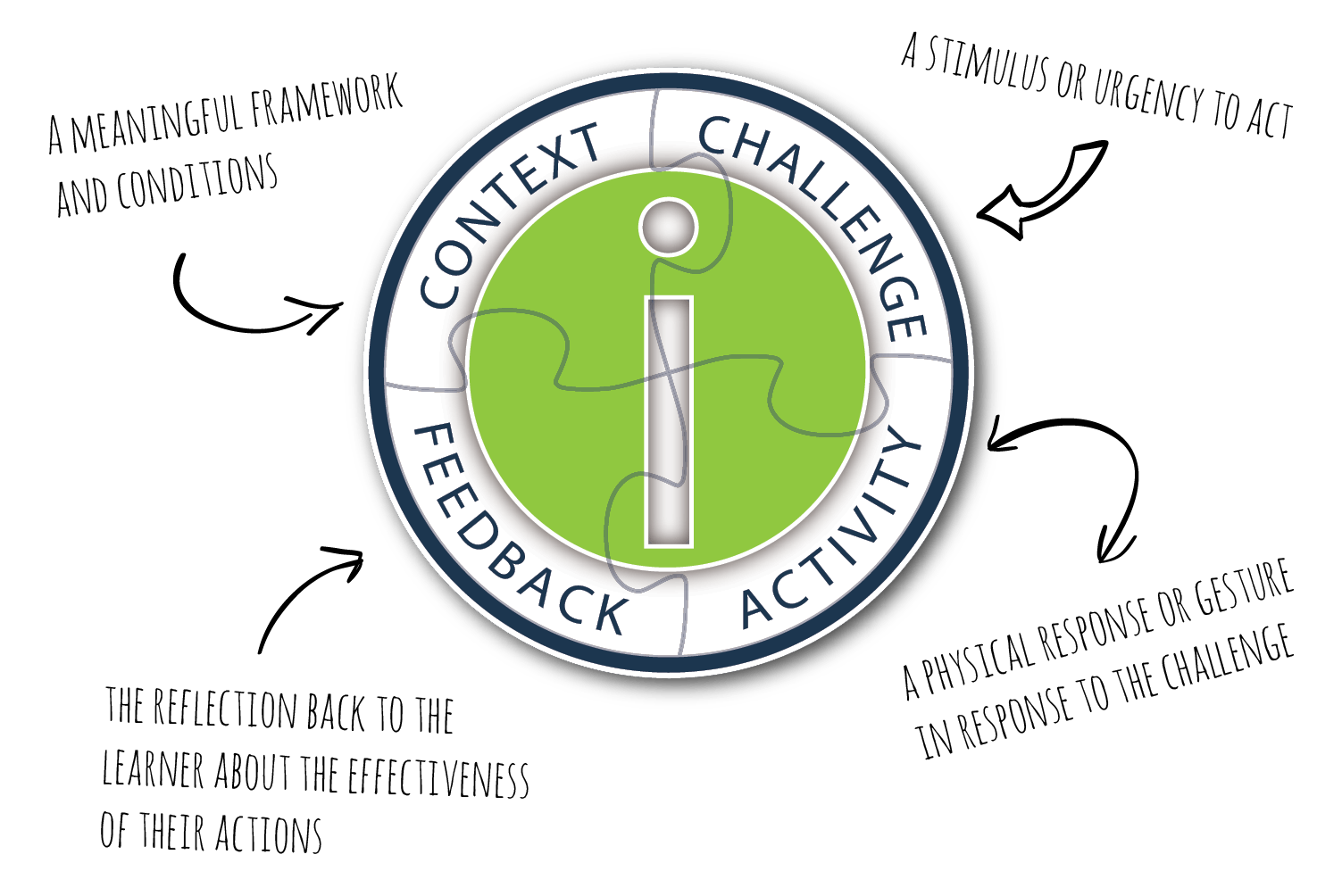



A CCAF-Driven Approach
At Allen Interactions, we continue to believe effective eLearning isn't about flashy technology—it's about harnessing all the best means of delivering great learning experiences. Learning experiences that elevate subsequent performance. For over three decades, our CCAF Design Model (Context, Challenge, Activity, Feedback) has guided our development of meaningful, memorable, and motivational learning solutions. Now, with the rise of Artificial Intelligence (AI), we're excited to see this powerful tool supercharging our approach and making interactions even more engaging and impactful. All without losing sight of the human learner at the center.
In this article, we'll explore how AI is enhancing digital learning experiences and delivering superior performance-elevated outcomes. We'll focus on real-world applications that align with effective instructional principles and provide specific examples of how AI can invigorate training. Whether you're an Instructional Designer, L&D leader, employer, or simply curious about the future of training, let's dive in and see how AI can help us achieve a whole new tier of eLearning effectiveness.
How Does AI Serve eLearning?
Researching and validating content as well as media production have long usurped so much of the budget for eLearning development that simplistic pedagogical and minimally effective designs have reigned. But with AI, content development costs are radically reduced, allowing time and effort for more sophisticated designs focused on individualization, shortening learning time, and delivering greater impact, which AI also assists big time.
Active Mentorship
AI brings Machine Learning algorithms, Natural Language Processing, and predictive analytics into online training platforms. Unlike eLearning restricted by cost and development expertise with its static content and one-size-fits-all paths, AI enables dynamic, responsive experiences that effectively adapt to individual learners, making the training feel and actually be tailor-fitted to each learner.
Sophisticated Instructional Design
From the Allen Interactions perspective, AI isn't a replacement for solid Instructional Design; it's a partner and enabler. It allows us to scale the personalized, interactive training we've been advocating with the introduction of Authorware's no-programming visual technology, the modernized Successive Approximations Model process (see Leaving ADDIE for SAM), and most recently adaptive learner empathy discussed in Rethinking eLearning: What works. What doesn't. What's missing. By automating routine tasks and providing data-driven insights, AI frees designers to focus on what matters: crafting dynamic simulations and interactions that intrigue, fascinate, and motivate learners while leading to measurable significant performance improvements.
How AI Is Elevating eLearning
AI is reshaping the landscape of digital training in ways that align perfectly with learner-centered design. Here are some practical and exciting transformations, viewed through the lens of creating more interactive and effective experiences.
Personalized Learning Paths
Traditional eLearning often forces learners through linear paths, leading to disengagement and disappointing, sometimes negligible outcomes. AI changes this by analyzing learner data—such as performance history, preferences, and real-time behavior—to tailor content delivery and instructional approach.
Using the powerful Context-Challenge-Activity-Feedback (CCAF) framework, AI can dynamically adjust each component. For instance, if a learner makes the same error repeatedly, AI can ask the learner why they think the action taken was correct. Instruction can then zero in on the underlying misconception(s).
Adaptive Content And Assessments
AI-powered systems can modify difficulty levels on the fly, ensuring content remains challenging yet achievable. This adaptive approach prevents frustration, rewards persistence, and promotes mastery.
At Allen Interactions, we've seen how this level of individualization ties into our motivational design principles. AI-generated challenge management can make embedded assessments feel less like tests and more like real-world problem-solving—and often even like game-playing.
Automated Content Creation
One of AI's most practical benefits is speeding up development. Generative AI can draft scripts, suggest visuals, or even prototype interactions, allowing teams to consider more alternatives and do so faster under iterative methodologies such as the Successive Approximation Model (SAM).
We caution against overreliance, however, AI-generated content must be validated and refined by human designers to ensure it supports meaningful interactions and doesn't simply fill screens as it is often prone to do. Many teams are finding AI interweaves invalid or unhelpful distracting content in with the good stuff.
Data Analytics For Continuing Improvement
AI excels at crunching data from learner interactions, providing actionable insights into engagement, drop-off points, confusion, and content gaps. This informs iterative improvements, aligning with our measurable outcomes focus.
For L&D teams, this means shifting from guesswork to evidence-based design, where every tweak enhances performance impact.
Virtual Assistants And Chatbots
AI-driven chatbots offer 24/7 support, answering queries or guiding learners through modules. When integrated thoughtfully, they can simulate mentorship, providing hints without spoiling the learning process. There is a problem here, however.
When AI is engaged to openly interact directly with learners, it becomes difficult, if not impossible, for Subject Matter Experts to approve the application. They cannot test every query or response a learner might enter to see if the AI comeback is appropriate. No one wants a training program teaching learners incorrect information or inappropriate procedures.
With caution and controls, AI can be used successfully to enhance feedback loops with minimal risk, ensuring learners receive timely guidance that feels personal and relevant.
Examples Of AI In Creating CCAF-Based Interactions
Now, let's get practical. The true power of AI shines when applied to our CCAF model, where each element works with the others to create immersive, performance-focused experiences. Below are examples of how AI can be leveraged at each stage.
Context: Generating Realistic, Personalized Scenarios
Context sets the stage by immersing learners in relatable, real-world situations. AI can analyze learner profiles (e.g., job role, industry, past performance) to generate customized scenarios on demand.
Example: In a sales training course for a retail chain, AI pulls from company data to create a virtual store environment tailored to the learner's location and customer demographics. If the learner is in a high-traffic urban store, AI generates a busy holiday rush scenario with diverse customer avatars. This not only makes the context feel authentic but also increases motivation by showing direct relevance to the learner's daily work, far beyond static storyboards.
Challenge: Adapting Difficulty For Optimal Engagement
Challenges present problems that require learners to apply knowledge, mirroring required on-the-job decisions. AI can monitor progress and adjust challenge complexity in real time, using algorithms to predict and prevent plateaus.
Example: In compliance training for healthcare professionals, AI starts with a basic patient interaction challenge (e.g., identifying privacy breaches). Based on the learner's responses, challenges escalate to more nuanced dilemmas, such as handling a data leak during a telehealth session. If the learner excels, AI introduces variables such as time pressure or ethical conflicts, ensuring the challenge stays motivational without overwhelming, directly supporting our goal of building confidence through progressive mastery.
Activity: Powering Interactive Simulations
Interactive simulations foster active learning by letting learners actively experiment. Learners can make both effective and ineffective choices, take actions, and observe their different consequences. AI enhances this by handling the complexity of interdependent variables so simulations respond realistically to learner inputs and by supporting authentic activities, whether multi-step, conversational, or involving physical or knowledge exploration.
Example: For leadership development in a corporate setting, AI drives a conversational simulation where learners "interview" virtual team members (powered by Natural Language Processing) to identify and resolve conflicts. AI adapts the dialogue based on the learner's questions and decisions, allowing for exploration of alternative conflict resolution strategies. This creates a safe space for trial and error, with endless variations generated by AI, which makes activities more replayable and memorable than traditional click-and-reveal interactions.
Feedback: Delivering Intelligent, Actionable Responses
AI provides instant, personalized feedback that goes far beyond "correct/incorrect." In the CCAF model, feedback is where primary instruction is delivered, responding to nuances in the learner’s pattern of actions. While the first and preferred form of feedback is a demonstration of consequences, AI can augment consequential feedback with hints, demonstrations, and links to related resources additional feedback, when appropriate. It can guide learning by explaining outcomes and providing helpful information, principles, and guidelines as the learner's actions call for, all within a relevant context. But since the objective is to get learners thinking and acting effectively on their own, it's important not to rush in with corrections before learners have an opportunity to correct themselves.
Example: In technical skills training for engineers, after a learner attempts a circuit design activity, AI analyzes the submission and simulates functionality visually. If the circuit fails, the learner is given the opportunity to correct it. If the learner is successful, the feedback would similate proper functioning. If not, the feedback might say, "Your configuration works for low-voltage scenarios but risks overload in high-demand situations." If the learner fails to correct or asks for help, then, in addition to visual simulation, feedback might say, "Try adjusting the resistor values here." It might also suggest remedial paths addressing applicable principles. This intelligent feedback loop, drawing from vast datasets, ensures learners receive coaching that's as nuanced as a human mentor, accelerating skill acquisition and retention.
The Future Of AI In eLearning: Opportunities And Considerations
Looking ahead, AI promises even more innovations, such as immersive VR integrations powered by generative models or predictive analytics that forecast training needs before gaps emerge. At Allen Interactions, we're optimistic but pragmatic. AI must serve the learner, not overshadow design fundamentals.
Key considerations include ethical use (e.g., data privacy), avoiding bias in algorithms, ensuring accessibility, and identifying sources of information. By grounding AI in proven models like CCAF, we can harness its potential to create training that's not just efficient, but also providing a compelling ROI far above what legacy training models achieve.
If you're ready to explore how AI can elevate your eLearning while saving you training costs, reach out to our team. Let's build interactions that make a real difference.