



Calibrating Self-Assessment With AI Feedback: The Core Purpose Οf Self-Assessment
Self-assessment and reflective practice stand as fundamental pillars of effective learning, serving as the necessary bridge between a student's experiences and the meaningful knowledge derived from them. Educational literature consistently emphasizes that reflection is not merely a supplementary task but a central feature of experiential education, designed to solidify the connection between what a student has done and the learning they have gathered. If students do not engage in deep reflection upon an experience, it is impossible to be certain of the learning outcomes or the meaning they attributed to the process.
Engaging students in self-assessment activities is pedagogically vital because it actively promotes the necessary skills for continuous growth and academic maturity [1]. These activities foster reflective practice and self-monitoring abilities, which are prerequisites for developing self-directed learning. When students can accurately judge their own performance, they take ownership of their educational journey, increasing their motivation and developing a crucial range of personal, transferable skills.
Post-experience reflection asks students to revisit their perceptions, assumptions, and understanding in light of what actually happened. This means challenging simple conclusions, considering alternative perspectives, and comparing their current insights with those formed earlier. True critical reflection requires reviewing existing knowledge, questioning assumptions, and forming new perspectives. When students connect these insights to broader academic ideas, they engage in the kind of rigorous analysis that defines deep learning.
The Fundamental Challenge: Why Students Struggle To Reflect Accurately
Despite the value of self-assessment, the process is often weakened by psychological and cognitive barriers that make subjective reflection unreliable. Students naturally lean toward self-enhancement, which creates a positive bias in self-evaluation. They focus on what went well and avoid negative feedback, which leads to frequent overestimation of their performance.
Because many students believe they are viewing their work objectively, they see little reason to adjust their judgments. This false sense of accuracy becomes a self-reinforcing cycle. Research shows that the more confident students feel about their performance, the less open they are to external correction. Their sensitivity to feedback decreases as their self-evaluation increases.
Traditional feedback usually arrives after the task is finished, which makes it too late to challenge the inflated perception that has already formed. External factors unrelated to performance, such as cultural norms around modesty or the fear of being embarrassed in front of peers, can also distort self-assessment [2]. These influences can cause students to undervalue their work or inflate it to protect their ego.
The aim of reflection is for students to judge their performance realistically. This is where technology becomes essential. By providing depersonalized, data-driven feedback at the moment reflection happens, AI helps calibrate the student's internal perception with objective external performance data.
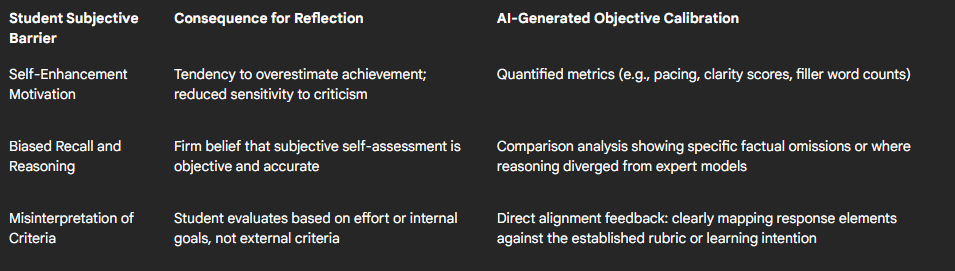
Fig. 1: Overcoming subjectivity in self-assessment
The Role Of AI: Introducing Objective External Feedback
Artificial Intelligence [AI] supports more accurate self-assessment by giving students feedback that is immediate, specific, and free of personal judgment. When used responsibly, AI works in a consultative role that strengthens the work of both students and educators rather than replacing human judgment. AI-guided feedback also captures details that traditional methods often miss. It can measure speaking patterns, coherence, structure, and the use of filler words. In analytical tasks it can show how a student's assumptions or biases shaped their conclusions. This timely data helps prevent subjective impressions from solidifying.
A powerful teaching strategy involves shifting the critique toward the AI output. For example, an instructor can ask students to generate an AI analysis of a literature passage or a market trend. Students then write their own analysis and critique the AI's version, pointing out where it missed nuance, introduced bias, or ignored historical or cultural context. This removes the pressure of defending their own work and helps them build critical judgment in a low-stakes environment.
To support academic integrity, educators should clearly state which AI tools are allowed and how they should be used. Students can then submit a short reflection explaining how the AI shaped their thinking and where their own reasoning went further. This turns routine practice into meaningful evidence of learning and discernment.
Structured Reflection: Frameworks For Turning Data Into Insight
Objective AI data becomes most useful when it fits into a structured reflection framework that guides students from simple recall toward real analysis and action. Borton's development framework is a clear way to do this, built around three stages:
- What
Students describe the experience using AI-generated data instead of memory. Metrics like clarity scores or filler word counts give an accurate starting point and remove uncertainty about what happened. - So What
Students interpret the data. AI reveals gaps between perception and performance, prompting them to examine why the result occurred and how their assumptions shaped it. - Now What
Students turn these insights into action. AI highlights specific weaknesses, making it easier to set focused next steps and build a steady improvement cycle.
Using AI within this structure turns self-assessment into a focused loop. Students work on a few priorities at a time, stay grounded in objective data, and make steady, meaningful progress.
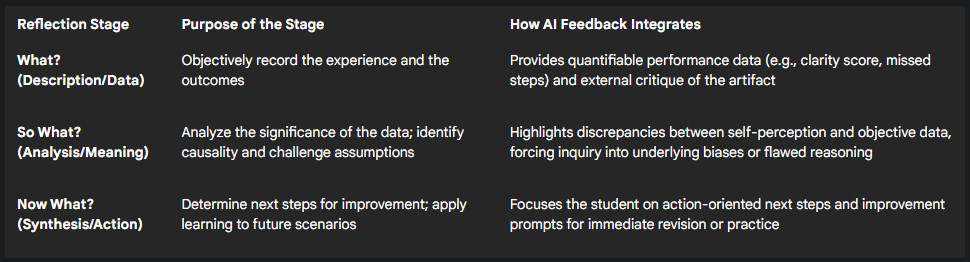
Fig. 2: Applying the structured reflection framework (Borton adaptation)
Practical Application: Guiding Reflection In High-Stakes Scenarios
AI-guided reflection is especially useful in high-stakes settings like academic or professional interviews, where students must show clear reasoning, strong storytelling, and an understanding of institutional values. In competitive fields such as medical admissions, candidates are expected to connect personal experiences to complex healthcare issues and broader policy ideas. AI tools help students meet these expectations by aligning their performance with the standards of top programs.
AI simulators offer a safe space to practice and refine answers. After each session, the technology breaks down responses across key areas like structure, clarity, pacing, and filler-word use. When questions become more complex, AI points out gaps in narrative flow, such as weak links between personal stories and policy arguments. Mock interviews can also expose students to ethical dilemmas, local policy contexts, and equity-focused scenarios, encouraging deeper and more thoughtful reflection.
In practice, students can even compare their performance with the expectations outlined in official school guidelines, such as those detailed in this guide for Harvard Medical School. This helps them see whether their answers align with the values and priorities of the institution and gives them specific areas for targeted improvement.
AI can also support reflection in areas that require policy understanding. A policy-brief mode can quickly summarize key frameworks, such as the Massachusetts Model for cost containment or the Mental Health ABC Act. Students can use these summaries to practice forming clear, solution-focused answers. By critiquing the AI's brief—spotting where it oversimplifies or misses local context—they build sharper judgment and a deeper grasp of the policy landscape they need to understand.
Actionable Steps For Students: Building Reflective Habits
To harness the objective power of AI and build strong reflective habits, students should adopt a systematic approach that emphasizes low-stakes, frequent engagement, and structured analysis.
- Seek immediate calibration
Start each session by running one scenario through the AI to get an objective baseline. Review the data right away while the experience is still fresh. - Critique the machine
For complex tasks, ask the AI for a sample answer, then critique it. Point out where it missed nuance or context. This builds critical thinking without the pressure of judging yourself. - Follow the framework
Use a clear reflection model. Begin with what (the AI data), move to so what (why the score happened and what assumptions you made), and end with now what (one specific action for the next attempt). - Prioritize one change
Focus on a single AI-flagged improvement at a time. Trying to fix everything at once weakens the feedback loop. - Track progress
Keep a brief log comparing your self-score with the AI score. Note how the data challenged your initial impression and how your understanding of the task evolved over time.
Conclusion: Fostering Discernment And Ownership For Self-Assessment With AI
Using AI in self-assessment helps students judge their performance more realistically. Immediate, objective data interrupts the usual patterns of self-enhancement and bias, making reflection more accurate and useful. The aim is not to replace reflection but to strengthen critical thinking. AI guides the process while the student remains responsible for judgment and ethical choices. When AI feedback becomes routine, students develop stronger self-monitoring and analytical skills that support both academic growth and long-term professional development.
References:
[1] Self-Assessment
[2] Accuracy in student self-assessment: directions and cautions for research
Image Credits:
- The images/tables within the body of the article were created/supplied by the author.