

 ChatGPT
 Perplexity
 Claude
 Grok
Grok
What Are Higher-Order Thinking Questions?
Higher-order thinking questions ask learners to analyze, evaluate, or create knowledge rather than just recall facts. They encourage deeper understanding and critical thinking, helping students apply what they know in new ways. These questions focus on the higher levels of Bloom's Taxonomy: Analyze, Evaluate, and Create. At the "Analyze" level, learners break down information to find patterns or connections. At the "Evaluate" level, they judge based on criteria and evidence. At the "Create" level, they generate new ideas, solutions, or perspectives. These levels form the core of higher-order thinking.
In contrast, lower-order questions emphasize recall, such as defining terms or listing steps. While these questions are useful for building foundational knowledge, they do not develop greater cognitive skills.
Higher-order thinking questions are important because they promote critical thinking, improve problem-solving, and help learners apply their knowledge in real-life situations. They enable students to make better decisions by actively using information instead of just remembering it.
The Science Behind Higher-Level Thinking
Higher-level thinking is effective because it helps learners actively use information instead of just memorizing it. Cognitive load theory shows that our brains have limited capacity. When learners focus only on memorization, they engage in surface processing. In contrast, higher-level thinking encourages deeper understanding, which helps reduce cognitive overload over time.
Understanding the difference between deep learning and surface learning is important. Surface learning is about short-term recall, while deep learning focuses on understanding connections, patterns, and meanings. Higher-order thinking questions encourage deep learning, as learners must analyze, evaluate, and apply knowledge rather than simply repeat it.
This approach improves retention because the brain stores information better when it's linked to reasoning and real-life situations. It also enhances problem-solving skills, as learners practice thinking through different scenarios instead of relying on fixed answers. For L&D professionals, this supports lasting behavioral change rather than simply checking off knowledge completion.
From a business viewpoint, this kind of learning leads to better results. It encourages innovation by helping employees generate new ideas. It also prepares future leaders by enhancing their judgment and decision-making skills. Overall, developing higher-order thinking skills helps organizations think more strategically and perform better in the long run.
Types Of Higher-Order Thinking Questions
Higher-order thinking questions are not all the same. In fact, they can be grouped into different types depending on the kind of thinking they require. Understanding these categories helps create stronger learning experiences that go beyond memorization and build real understanding.
Analytical Questions
Analytical questions ask learners to break information into parts and understand how those parts connect. They focus on comparing, contrasting, and identifying patterns or relationships. These questions help learners move from simply knowing something to actually understanding how it works.
For example:
"What patterns can you identify in this data set?"
This type of question encourages learners to look deeper and think logically about structure and meaning. Many higher-order thinking question examples in this category help develop strong reasoning skills. They are often used in case studies, data interpretation, and problem-solving tasks.
Evaluative Questions
Evaluative questions require learners to make judgments based on criteria. They involve critiquing ideas, justifying decisions, and prioritizing options. This is where learners begin to think like decision-makers rather than passive recipients of information.
For example:
"Which solution is most effective and why?"
These are common higher-order question examples used in leadership training, performance reviews, and scenario-based learning. They help learners defend their thinking and evaluate alternatives critically.
Creative Questions
Creative questions push learners to generate new ideas, solutions, or approaches. They focus on innovation, prediction, and design thinking. Instead of analyzing what already exists, learners are asked to imagine what could exist.
For example:
"How would you redesign this process to improve efficiency?"
These are strong, higher-level question examples that encourage innovation and problem-solving. In many examples of higher-level thinking questions, learners are challenged to apply knowledge in completely new contexts.
Higher-Order Thinking Question Stems (Practical Toolkit)
Higher-order thinking question stems are simple but powerful prompts that help educators, Instructional Designers, and L&D professionals design learning that goes beyond memorization. Instead of asking learners to recall facts, these stems encourage them to analyze information, evaluate choices, and create new ideas. In practice, higher-order question stems act as a toolkit for building deeper engagement and stronger critical thinking skills. Below is a structured set of higher-order thinking question stems organized by cognitive skill type.
Analytical Stems
Analytical stems help learners break information into parts and understand relationships.
- "What is the relationship between…?"
- "What patterns do you notice in…?"
- "How does this compare to…?"
- "What assumptions are being made?"
- "What evidence supports your answer?"
These critical thinking question stems are useful when you want learners to examine data, identify connections, or explore cause and effect. They are especially effective in reading comprehension, case studies, and problem-based learning scenarios.
Evaluative Stems
Evaluative stems focus on judgment, decision-making, and justification. They are key higher-level thinking questions used in leadership development and real-world training.
- "What criteria would you use to judge…?"
- "Which option is most effective and why?"
- "Do you agree or disagree with this approach? Why?"
- "What are the strengths and weaknesses of…?"
- "How would you prioritize these solutions?"
These higher-order question stems help learners move beyond surface-level understanding. They require reasoning, justification, and evidence-based thinking, all of which are essential for professional decision-making.
Creative Stems
Creative stems encourage learners to design, imagine, and innovate. They are the highest level of higher-order thinking stems and are often used in scenario-based learning.
- "How would you design…?"
- "What would happen if…?"
- "How could this be improved?"
- "What alternative solution would you propose?"
- "How would you approach this problem differently?"
These higher-order thinking question stems support innovation and adaptability. They are especially valuable in Instructional Design activities, leadership simulations, and strategic thinking exercises.
Real-World Applications
Higher-order thinking questions are not just theoretical tools. They are practical strategies used across classrooms, corporate learning, and Instructional Design to move learners from memorizing information to actually thinking with it. When used well, they strengthen reasoning, reflection, and decision-making in any learning environment.
In Classrooms (Teachers)
Teachers use Socratic questioning to guide students toward deeper understanding instead of giving direct answers. For example, instead of asking "What is the main idea?", a teacher might ask, "Why do you think the author made this argument?" This is a clear example of higher-order thinking questions for reading, helping students interpret meaning rather than just identify facts.
In discussion-based learning, students build ideas together by analyzing different viewpoints. These conversations naturally encourage higher-order thinking skills activities, especially when learners are asked to justify their reasoning or compare interpretations.
Even in early education, teachers can effectively use higher-order thinking questions in kindergarten. Instead of asking, "What color is this?", they might ask, "Why do you think this color fits this picture?" This approach is complex enough to challenge the little ones while still being suitable for their age.
In Corporate Learning (L&D)
In L&D, higher-order thinking is essential for performance-based learning. Scenario-based learning is widely used to present real-world workplace challenges in which employees must analyze and decide, not just recall policies.
In leadership development, learners are often asked reflective supporting questions, such as, "What would you do differently in this situation?" or "What factors influenced your decision?" These push leaders toward strategic thinking.
Even compliance training is evolving. Instead of focusing only on rules, organizations now use high-level questions that test judgment and application, not just memory.
In Instructional Design
Instructional Designers play a key role in embedding higher-level thinking questions into assessments. Rather than asking learners to repeat information, they design tasks that measure how well learners can apply and evaluate knowledge.
Strong higher-order thinking skills questions ensure that assessments reflect real-world performance, not just recall. This helps create learning experiences that are more meaningful, measurable, and impactful across both education and corporate environments.
How To Design Better Higher-Order Questions
Define Objective
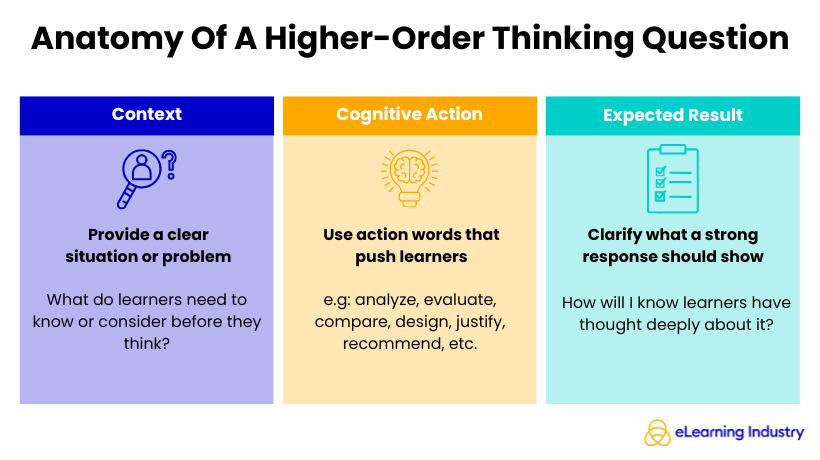
Designing strong higher-order thinking questions starts with clarity. First, define your learning objective. Ask yourself what you want learners to truly understand or be able to do. A clear objective keeps your thinking question focused and meaningful, rather than vague or surface-level.
Identify Thinking Level
Next, identify the thinking level, based on Bloom's taxonomy, you are targeting: Analyze, Evaluate, or Create. This step ensures you are not just testing recall but encouraging higher-level thinking. For example, "What is this concept?" is low-level, but "How does this concept compare to another in a real situation?" becomes a stronger, higher-order thinking question.
Use Structured Question Stems
Then, use structured question stems to guide your wording. Stems like "What would happen if…?", "Why do you think…?", or "How would you improve…?" help you build consistent higher-order questions that push deeper reasoning.
Add Context
After that, add real-world context. A good higher-order thinking question should feel relevant to workplace challenges, classroom scenarios, or decision-making situations. Context makes the question more engaging and harder to answer with simple memorization.
Add Depth
Finally, ensure depth. If the answer can be easily Googled, the question is likely too basic. Strong higher-level thinking questions require explanation, judgment, or creation. As a bonus, take any low-level question and upgrade it. For example, turn "What is this theory?" into "How would you apply this theory to solve a real-world problem?"
Conclusion
Higher-order thinking questions are more than just tools for assessment. They shape how people think, solve problems, and make decisions. When learners are asked better questions, they develop stronger thinking skills, which directly improve performance at school, work, and in real-life situations. For educators, Instructional Designers, and L&D leaders, the key insight is simple: the quality of learning depends on the quality of questions asked. Strong questions lead to stronger thinking, and stronger thinking leads to stronger outcomes.