


Technical Training With AI For Enterprise L&D
Technical training is about turning theoretical knowledge into confident, safety-critical decision-making. It enables people to apply what they learn on the production line, inside complex financial systems, or within live technology environments.
The most effective technical training programs go beyond slides. They rely on continuous development to build real capability. In large, globally distributed organizations managing complex products, processes, and compliance environments, this kind of technical skills training is operationally critical.
Today, AI tools are transforming how these technical training programs are created. This shift is not about replacing instructional designers or automating compliance. It is about accelerating course creation for custom eLearning, digital learning, and scalable technical training solutions across industries with mature learning ecosystems.
This article focuses specifically on AI in course creation, not analytics, and not operational AI. We will look at how AI strengthens technical training programs in manufacturing, pharma and healthcare, finance, and IT and software.
Where Do AI Tools Fit Within Modern Technical Training Solutions?
AI tools function best as first-draft accelerators within structured technical training programs. They support content creation, but they do not replace instructional design or SME validation.
AI enhances:
- Microlearning for rapid updates.
- Blended learning ecosystems.
- VILT and virtual training environments.
- Mobile learning deployment.
- Immersive learning solutions such as scenario-based simulations.
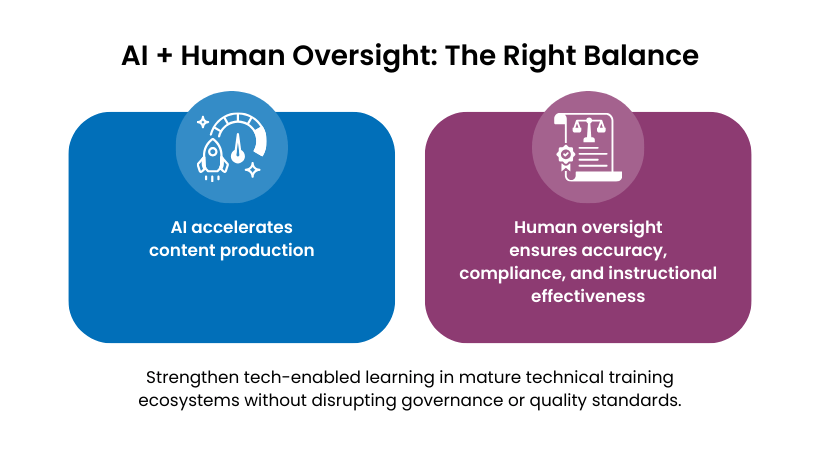
Image by CommLab India
How Is AI Improving Technical Training Programs Across Industries?
AI is improving technical training programs by accelerating content development, enhancing scenario design, and enabling scalable eLearning solutions for complex, multi-location enterprises.
Below is how this transformation plays out across major industries.
1. Manufacturing
Technical training programs typically focus on equipment operation, maintenance, and troubleshooting. These programs prepare employees to operate machinery safely, minimize downtime, and follow strict procedural standards across multiple facilities.
AI Use Cases In Course Creation
AI improves technical training solutions in the manufacturing sector in the following ways:
Safety scenario generation
AI creates realistic branching scenarios based on safety incidents. This supports immersive learning solutions that replace passive slide decks.
Visual job aid creation
AI generates process maps, annotated diagrams, and structured training videos.
Multilingual learning modules
AI accelerates translation and localization, enabling consistent technical training across regions.
What Pain Points Does This Solve?
AI-supported course creation reduces:
- Slow updates after equipment changes.
- Difficulty scaling across plants and regions.
- Overreliance on static, slide-based digital learning.
For complex manufacturing environments, this strengthens technical training programs without disrupting operations.
2. Pharma And Healthcare
Pharma and healthcare technical skills training typically covers lab procedures and clinical systems, as well as high-stakes operational skills. Teams also need training on calibration and maintenance routines to keep critical equipment audit-ready. These programs must stay tightly aligned with regulatory requirements and stand up to frequent inspections.
AI Use Cases In Course Creation
AI strengthens technical training solutions in regulated environments through:
Conversion of the procedure document to eLearning
AI tools convert standard operating procedures into structured custom eLearning modules. They extract step-by-step processes and generate aligned learning objectives and assessments.
Technical scenario generation to move beyond text-heavy digital learning
AI creates branching scenarios for real hospital and lab situations.
Practice-first assessments and simulations
AI drafts skill checks and virtual training practice tasks tied to equipment handling and process execution.
What Pain Points Does This Solve?
AI-supported course creation reduces:
- Delays in updating equipment and process training.
- Inconsistent delivery across multiple sites.
- Overuse of static, theory-heavy content instead of applied skill-building.
For large pharma and healthcare organizations, this enables more scalable and practical technical training programs while retaining human oversight.
3. Finance And Fintech
Finance and fintech technical skills training centers on system workflows—handling transaction monitoring queues, investigating flagged activity in case tools, and using core banking applications to complete high-volume processes. These programs must scale across teams while adapting to new tools and updates.
AI Use Cases In Course Creation
AI tools strengthen technical training programs in finance through:
System simulation scripting
AI drafts scripts for system walkthroughs and virtual training simulations.
Role-based personalization
AI adapts content for different functions without rebuilding entire courses.
What Pain Points Does This Solve?
AI reduces:
- Repetitive learning modules.
- Scenario creation bottlenecks.
- Complexity across multiple financial roles.
In large financial institutions operating across jurisdictions, this improves technical training solutions at scale.
4. IT And Software
Here, the technical skills training focuses on coding frameworks, cloud platforms, DevOps tools, and cybersecurity protocols. These skills evolve rapidly, making continuous updates essential.
AI Use Cases In Course Creation
AI supports through:
Scenario generation
AI creates coding challenges, debugging exercises, and simulated DevOps incidents.
Interactive video-based learning
AI assists in creating technical training videos that explain architecture and workflows clearly.
What Pain Points Does This Solve?
AI-driven course creation reduces:
- Slow updates when tools, interfaces, or workflows change.
- Heavy dependence on busy SMEs for system-specific content.
- Limited availability of hands-on practice.
For global software enterprises, this supports continuous upskilling and reskilling without overwhelming engineering teams.
The Future Of Technical Training Programs Is AI-Assisted
AI does not redefine what technical training is. It strengthens how technical training solutions are built.
For global organizations with complex products and continual learning demands, AI enables scalable digital learning, faster content updates, and smarter custom eLearning development. It reduces bottlenecks without compromising quality.
The future of technical training programs is AI-accelerated and human-validated. Organizations that adopt AI tools strategically within structured instructional design frameworks will scale upskilling and reskilling more effectively across global operations.