



 ChatGPT
 Perplexity
 Claude
 Grok
Grok
Choosing An LMS For Higher Education
Most Learning Management System (LMS) evaluations in higher education start with a feature list. That is the wrong place to start. A university is not a corporate training department—it runs across dozens of stakeholder groups, complex academic workflows, and institutional governance structures that generic vendor guides rarely address. The platform that performs well in a vendor demo can look very different six months into a real deployment.
Choosing an LMS for higher education means evaluating how the platform will perform in your specific institutional context—across integrations, accessibility, reporting, faculty adoption, student experience, and governance. This article gives higher education teams a practical framework to shortlist and assess LMS options with more confidence before procurement begins.
Why Universities Need A Different LMS Evaluation Framework
Corporate LMS buyers usually have one primary audience: employees who need to complete training. Universities have many. Registrars, IT teams, Instructional Designers, faculty, students—each group interacts with the platform differently, and each has requirements that matter to the institution.
The technology dependencies are also different. A higher education Learning Management System sits at the center of an ecosystem that includes student information systems, identity providers, library platforms, and third-party academic tools. Hybrid learning is standard practice at most institutions, not an edge case. And institutional governance—data privacy obligations, compliance requirements, policy alignment—has to be built into the platform from the start. That is why the evaluation logic needs to be different. A criteria-based framework helps institutions ask better questions and get more useful answers from vendors.
6 Criteria To Evaluate An LMS For Higher Education
Integrations
Integration is where implementation budgets and timelines most often go wrong. A university learning platform needs to connect with the student information system for enrollment and role-provisioning, support single sign-on through the institution's identity provider, and work reliably with gradebook integration and third-party tools via LTI 1.3. LTI 1.3 remains the core higher-education interoperability standard—platforms that implement it well reduce custom development costs significantly.
Accessibility
WCAG 2.2, published by W3C as the current web accessibility standard, sets the baseline for keyboard navigation, screen reader support, accessible course flows, and accessible authentication. Universities serving students with disabilities have legal obligations that predate any vendor contract. Platforms that treat accessibility as a secondary consideration create compliance risk—and retrofitting it after launch costs more than building for it from the start.
Reporting
Standard LMS reporting covers completion rates and grades. University academic operations need more—course-level visibility, early-risk indicators for students falling behind, and data exports that feed decisions across departments. The 2026 EDUCAUSE Students and Technology Report treats student experience, academic support, and institutional strategy as connected priorities, which means learning analytics have to work for registrars, advisors, and faculty as much as for LMS administrators.
Faculty Adoption
Faculty adoption is often the factor that determines whether a platform succeeds or stalls. The relevant questions are practical: how long does it take to build a course without IT support? How much friction does the platform add to daily teaching workflows? How easily can faculty bring in external tools? When adoption is inconsistent across departments, student engagement suffers and the platform never reaches its potential.
Student Experience
Student experience is not only a UX question. Navigation clarity, mobile learning support, consistent assignment and assessment flows, and meaningful hybrid learning continuity all affect whether students engage with the platform or route around it. When the experience is fragmented across courses—different layouts, inconsistent submission flows, poor mobile support—the result is higher support load and lower learning continuity. UNESCO's global higher education road map reinforces that digital learning environments need to support equitable access and genuine student agency.
Governance
Role complexity in a multi-school or multi-campus structure is where governance problems tend to start. Department-level control, template governance, and granular data access all need to be configurable without routing every change through IT. Who can publish what, how content gets reviewed, what data is retained—these are institutional policy questions, and the platform needs to reflect them. When access controls are too flat, the problems that follow tend to surface slowly and fix expensively.
Questions Universities Should Ask Before Shortlisting An LMS
Before a shortlist is finalized, the evaluation team should be able to answer these questions for each candidate platform:
- How does the LMS integrate with our SIS and identity systems—and what does maintaining that integration actually require?
- Which integrations are native, and which require custom development or third-party middleware?
- Does the platform support WCAG 2.2-aligned accessibility across course flows, forms, and authentication?
- What reporting is available out of the box, and what requires add-ons?
- How long does it take a faculty member to build and publish a course without IT involvement?
- How consistent is the online course delivery experience across departments?
- How are roles, permissions, and governance handled at the department and campus level?
- Which parts of the implementation road map create the most ongoing admin workload?
Teams that can answer these questions before demos begin are in a significantly stronger position during vendor conversations.
Common LMS Selection Mistakes In Higher Education
The same mistakes appear repeatedly in university LMS evaluations. Most of them are avoidable.
- Choosing features alone.
A platform that scores well on a checklist can still fail on integration effort, faculty workflow friction, or governance complexity. - Underestimating integration effort.
SIS connections, SSO configuration, and gradebook integration consistently take longer than vendor timelines suggest. - Treating accessibility as secondary.
Compliance exposure surfaces after launch, when remediation is far more expensive than building for it up front. - Ignoring faculty adoption.
Student engagement and learning continuity depend directly on how consistently faculty use the platform. - Assuming reporting can wait.
It rarely gets addressed after go-live if it was not planned for before. - Scaling without reevaluation.
Selecting a platform for one department and rolling it out campus-wide without reassessment is how institutions end up with a solution that worked in the pilot and struggled at scale.
A Simple LMS Scorecard For Universities
After the demos and vendor conversations, putting numbers on what you heard helps move the decision forward. Rate each candidate from 1 to 5 across the six criteria:
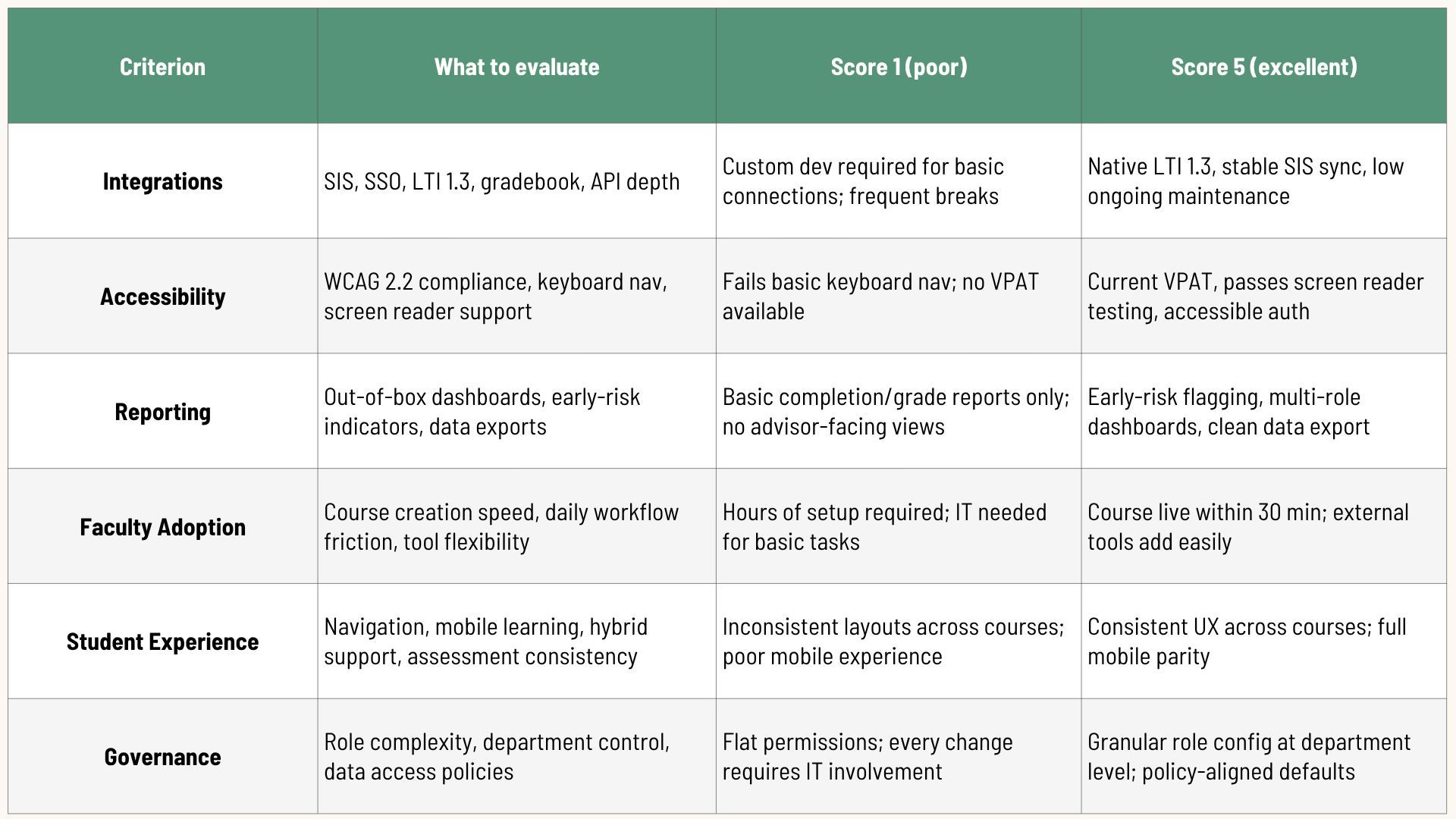
Weight each criterion based on institutional priorities. For instance, a university with complex SIS dependencies will approach integrations and governance differently than one focused on expanding online enrollment. The total score matters less than the conversation the exercise forces between stakeholders before a decision is made.
Conclusion
Getting the LMS for higher education right comes down to asking the right questions before shortlisting starts. Internal alignment on what the LMS platform for universities needs to do—across integrations, accessibility, reporting, and governance—is what makes procurement decisions hold up over time. Implementation reality matters more than feature volume, and the teams that recognize that early tend to make better choices.
Image Credits:
- The table within the body of this article has been created/supplied by the author.