



 ChatGPT
 Perplexity
 Claude
 Grok
How To Get On Podcasts: Expertise Alone Does Not Help
Learning how to get on podcasts is becoming a key way for Learning and Development professionals to share their ideas. But just having expertise usually isn't enough to get invited. Podcast hosts look for guests who can turn their knowledge into a focused conversation that benefits their audience.
For Heads of L&D, talent leaders, Instructional Designers, and EdTech professionals, being a podcast guest does more than boost personal visibility. The right appearance lets you share new research, question old habits, explain new technology, or shape how organizations think about learning strategy.
However, being a podcast guest takes more than just sending emails to hosts. You need to know your audience, have a strong point of view, back it up with evidence, and follow a repeatable strategy for being a guest.
How Do L&D Thought Leaders Get On Podcasts?
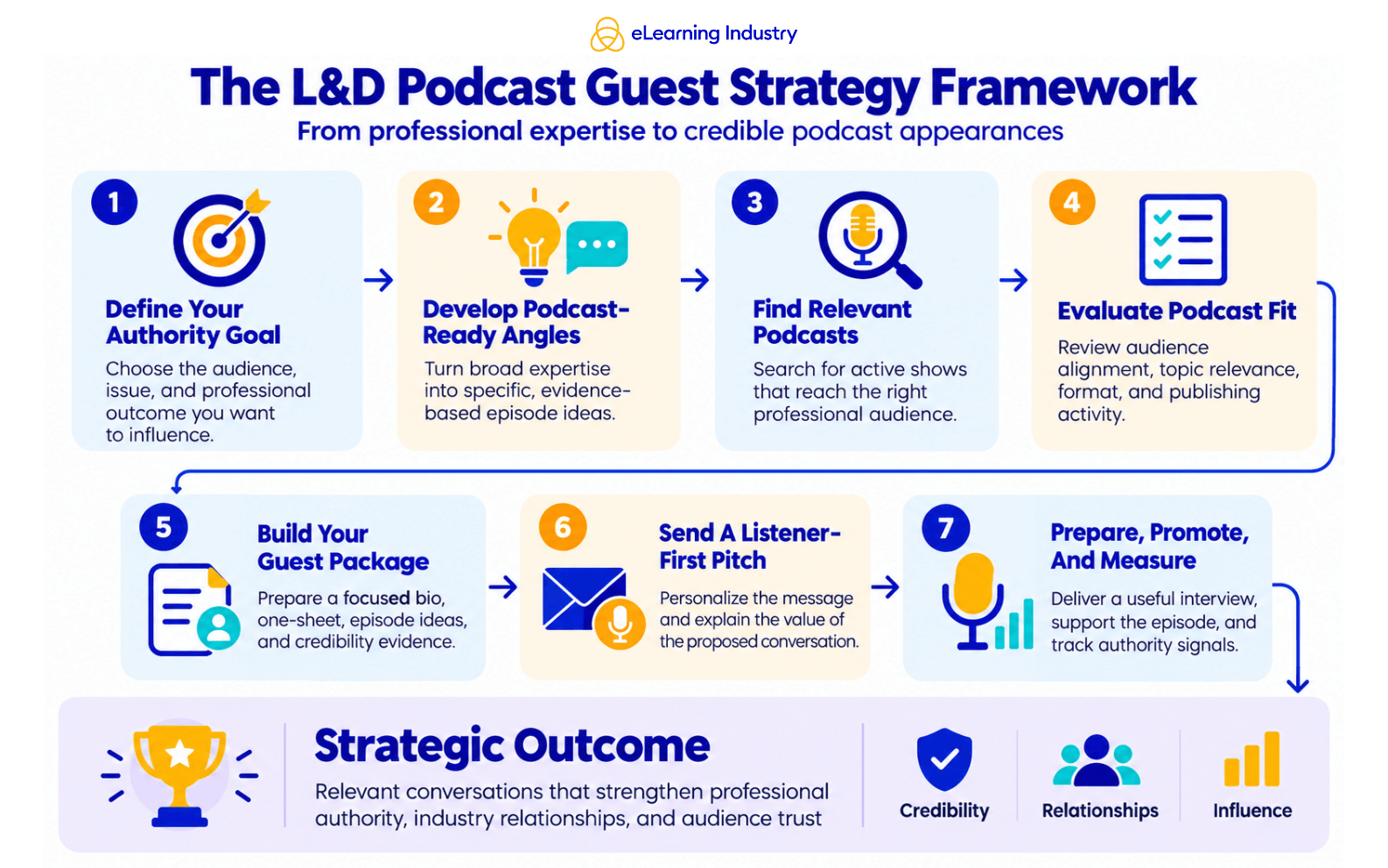
Getting on podcasts takes a clear process that matches your expertise with what a specific audience wants. The aim isn’t to be on every show, but to join the conversations that matter most. A good approach to being a podcast guest often includes these 7 steps:
- Decide what kind of authority you want to establish.
- Shape your expertise into clear episode topics.
- Look for podcasts that connect with your ideal audience.
- Check if each show is relevant, high-quality, and active.
- Put together a brief and clear guest package.
- Send a pitch that's personal and focused on the listeners.
- Get ready for each appearance, share it, and track your results.
The best pitches make it clear why the podcast's listeners would benefit from this conversation right now.
What Is A Podcast Guest Strategy?
Understanding how to get on podcasts starts with recognizing that a podcast guest strategy is a repeatable system, not a series of occasional outreach emails. A podcast guest strategy should cover:
- Who do you want to reach?
- What topics can you speak about confidently?
- What unique perspectives do you bring?
- Which podcasts match your expertise and point of view?
- How you'll pitch yourself, get ready, and follow up after.
- How does each podcast appearance fit into your bigger professional goals?
Being a guest is not the same as starting your own thought leadership podcast. The host sets the format, manages the audience, and decides the direction of the show. As a guest, your job is to add value within their setup.
It’s also not just about self-promotion. If you use every question to plug your company or service, you'll lose credibility fast. Good L&D thought leadership helps listeners understand issues, see their impact, and make smarter choices.
How To Get On Podcasts: A Guide For L&D
1. Decide What Kind Of Authority You Want To Build
Learning how to get on podcasts begins with deciding what you want your appearances to accomplish. Without a clear objective, it becomes difficult to choose the right shows, topics, and calls to action. An L&D professional might use podcast guesting to:
- Become associated with a particular area of expertise.
- Share original research or industry benchmarks.
- Influence how leaders approach an emerging issue.
- Reach HR, talent, or business decision-makers.
- Introduce a professional framework or methodology.
- Build relationships with experts in adjacent fields.
- Create future opportunities for speaking, advisory work, or collaboration.
Pick one main goal for each time you appear as a guest. If you try to promote a report, attract customers, recruit employees, build your brand, and get speaking gigs all in one conversation, your message will probably end up scattered.
Next, get specific about who you want to reach. Saying "L&D professionals" is usually too broad. For example, a talk meant for enterprise learning leaders should sound different from one for Instructional Designers, HR directors, startup founders, or learning technology buyers.
Use this framework to clarify your position:
Audience → Problem → Point of view → Evidence → Practical outcome
For example:
Enterprise learning leaders → struggling to move AI pilots into regular workflows → AI adoption is often a change-management problem rather than a tool problem → implementation evidence and organizational examples → a clearer plan for scaling adoption.
When you're that specific, podcast hosts can see what kind of conversation you'll bring to their show.
2. Turn Your L&D Expertise Into Podcast-Ready Angles
If you want to get on podcasts, you need to know the difference between a broad topic and a strong episode angle. Topics like "AI in L&D," "leadership training," and "the future of work" are just starting points. They aren't podcast pitches yet.
A good angle highlights a clear problem, question, tension, or argument. This gives the host a reason to dig deeper and keeps listeners interested. Here's a helpful formula:
Timely problem + clear point of view + solid evidence + benefit for listeners
Think about the difference:
Broad Topic |
Stronger Podcast Angle |
Listener Outcome |
| AI in L&D | Why AI adoption often stalls after the pilot stage | Identify barriers before investing further |
| Learning measurement | What completion rates fail to reveal about capability development | Choose more meaningful performance indicators |
| LMS selection | Why adding more platform features can make selection harder | Evaluate technology around usability and operational fit |
| Leadership development | Why manager training fails without workplace reinforcement | Build support beyond the training event |
A strong angle doesn't have to be controversial, but it should do more than just summarize familiar trends. You can find your angle in several ways:
- Original research
- Repeated patterns across organizations
- A common misconception
- An overlooked implementation challenge
- A gap between strategy and practice
- A change in technology, regulation, or workforce expectations
- A framework you have tested in real settings
Before you pitch, come up with two or three related angles. This gives the host choices and helps you stay focused.
3. Find And Qualify The Right Podcasts
It's much easier to get on podcasts when you focus on finding shows that reach the right audience, rather than just looking for the biggest ones. The biggest podcast isn't always the best choice. A smaller show with listeners like learning executives or workplace technology specialists can lead to more meaningful connections than a general business podcast with a wide audience.
If you're looking for podcasts to be a guest on, you can start with these steps:
- Google searches combining their subject with "podcast."
- Searches on Spotify, Apple Podcasts, and YouTube.
- LinkedIn posts from hosts, producers, and previous guests.
- Industry associations and professional communities.
- Conference programs and speaker lists.
- Podcast guest directories and matchmaking platforms.
- Appearances made by respected experts in adjacent fields.
- Recommendations from previous hosts and professional contacts.
Searching for podcasts that need guests can help you find open spots, but don't choose a show just because it's available. Make sure it matches your audience, expertise, and professional standards. Before you add a podcast to your outreach list, check it using a simple scorecard:
- Audience fit: Does the show reach the people I want to influence?
- Topic fit: Does my proposed idea match its editorial focus?
- Topical gap: Can I contribute something the show has not covered repeatedly?
- Activity: Has it been published consistently in recent months?
- Guest format: Does it regularly interview external experts?
- Depth: Does the format allow a substantive discussion?
- Distribution: Does it also publish through video, newsletters, or articles?
- Host fit: Does the host's style suit the conversation I can offer?
Listen to at least two episodes that fit your topic before reaching out. Notice the host's questions, how long episodes usually are, how much technical detail they include, and how they handle promotional content. Doing this research helps you turn a basic podcast outreach into a strong and credible proposal.
4. Build A Credible Podcast Guest Package
To get invited on podcasts, make it simple for hosts to see who you are, what topics you can cover, and why you're a credible guest. Your podcast guest one-sheet or media kit should include:
- A one-sentence positioning statement
- A short professional biography
- Three to five proposed episode angles
- Several sample interview questions
- Relevant research, results, or professional evidence
- Links to previous interviews, webinars, or presentations
- A current professional headshot
- Contact and scheduling information
Your podcast guest bio should focus on what's relevant, not just your seniority. Listing job titles, awards, and employers might look impressive, but it doesn't show the host what value you'll bring to their episode.
Instead of writing: "Jordan has 20 years of experience and has held senior positions at several global organizations."
Use a more focused description: "Jordan advises global learning teams on AI adoption, workflow integration, and capability development. Their work focuses on helping organizations move from isolated pilots to sustainable, governed use of AI."
L&D professionals should also be clear about what they can share publicly. You might need to anonymize client information, get approval for internal results, or disclose vendor or employer relationships.
5. Pitch Podcast Hosts With A Listener-First Email
Getting on podcasts comes down to writing a pitch that focuses on the show's audience, not just listing your own credentials. A strong podcast pitch email should include these 5 things:
1. A specific subject line
2. Evidence that you know the show
3. A focused episode idea
4. Brief credibility supporting that idea
5. A simple next step
The host needs to grasp your proposed topic quickly.
Here's an example of a podcast guest pitch for an L&D expert:
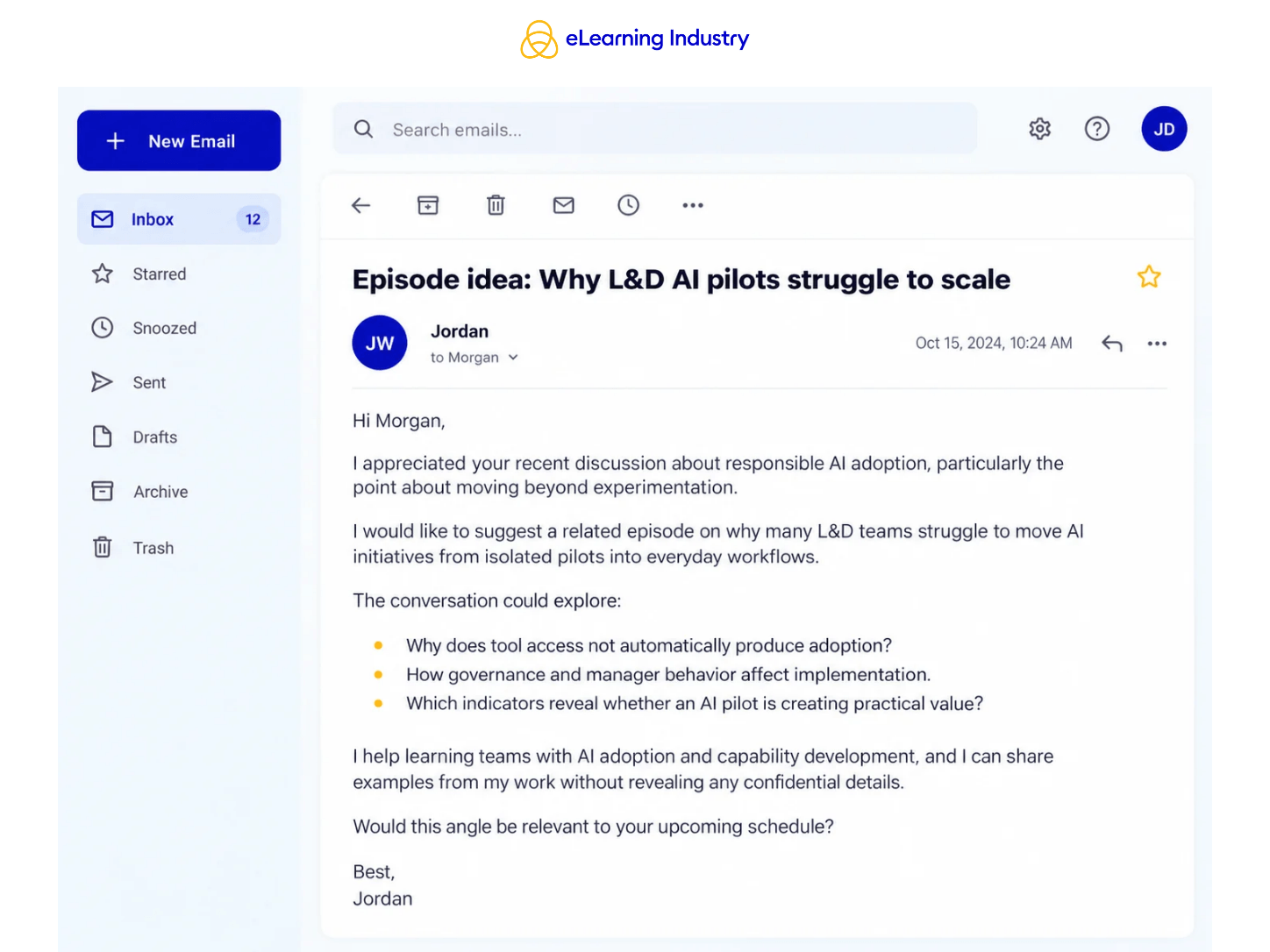
Notice that the message starts with the show, its audience, and the value it offers, not with a long biography. When pitching yourself as a podcast guest, don't offer five unrelated topics. While it might seem flexible, it usually shows you don't have a clear point of view.
Also, don't send the same AI-generated message to lots of hosts. AI can help you improve your pitch, but it can't replace real knowledge of the show.
When following up, wait approximately 5 to 7 business days. Add something useful, such as a sharper angle or a relevant new development, rather than writing only, "Did you see my previous email?" After one respectful follow-up, move on. A well-run podcast booking strategy depends on consistent, relevant outreach and not repeated pressure.
6. Prepare For An Interview Hosts Will Recommend
Knowing how to get on podcasts is only half the work. You must also know how to prepare for a podcast interview that earns trust from both the host and the audience.
Preparing well doesn't mean memorizing every answer. If you rehearse too much, you might sound less engaged because you’re focused on repeating what you practiced.
Before recording:
1. Listen to at least two episodes featuring comparable guests.
2. Identify the host's typical opening and closing questions.
3. Prepare three central messages.
4. Match each message with an example, source, or short story.
5. Anticipate objections and alternative perspectives.
6. Define technical L&D terms in plain language.
7. Decide on one useful next step for listeners.
8. Test your microphone, headphones, internet connection, and recording space.
To be a good podcast guest, pay attention to how you interact. Answer the questions you're asked, recognize any complexities, and let the host lead the conversation.
If you're speaking to an L&D audience, connect learning terms to real business outcomes. Remember, not everyone will define words like capability, personalization, learning experience, or performance support the same way.
Most importantly, make it clear what is fact and what is your opinion. Share your insights, but be open about what’s backed by research, what’s from your own experience, and what’s still unclear.
7. Turn Every Appearance Into A Repeatable Authority Asset
Getting on podcasts should do more than just give you one episode to share on LinkedIn. After publication:
- Thank the host and production team.
- Share the episode through relevant professional channels.
- Share one helpful takeaway instead of just posting the link.
- If you have permission, make short clips or visual quotes from the episode.
- Write a follow-up article that explores an important question from the episode.
- Include the appearance on your guest page or podcast guest one-sheet.
- Keep interacting with the host's work.
- Pay attention to which parts of the conversation got the most response.
It's also important to track your own guesting process. Useful campaign metrics include:
- Podcasts researched
- Personalized pitches sent
- Response rate
- Booking rate
- Publication rate
- Time from initial pitch to publication
- Broader authority signals may include:
- Relevant referral traffic
- Newsletter subscriptions
- Backlinks and citations
- Speaking invitations
- Partnership inquiries
- Introductions to other hosts
- Engagement from target professional groups
Don't assume every new opportunity comes from just one podcast appearance. Unless you have solid data, see these results as signs of influence, not direct proof. As you do more strong appearances, you'll build credibility, improve your guest materials and examples, and find it easier to get invited to podcasts that fit you better.
Common Podcast Guesting Mistakes L&D Professionals Should Avoid
If you want to get on podcasts, you also need to spot the habits that can make your outreach less effective.
- Pitching a broad topic.
When you pitch a broad topic, the host may not see what makes your episode unique. Try offering a specific question or argument instead. - Leading with credentials.
Focusing on credentials puts the spotlight on the guest, not the listener. Start by showing why your topic matters to the audience. - Targeting only large shows.
Aiming for big shows can mean your message has less relevance. It's better to focus on shows where your topic and audience are a good match. - Sending identical pitches.
Sending the same pitch to every show shows you haven't learned much about them. Mention something specific that connects your message to their content. - Promoting a product repeatedly.
If you promote a product too much, it can hurt trust and interrupt the flow. Focus on teaching first, and only mention resources when they fit the conversation. - Making unsupported claims.
L&D audiences want to hear evidence and context. Share only research, experience, or opinions that you can back up. - Sharing confidential examples.
Sharing confidential examples can lead to ethical or professional problems. Make sure to anonymize details and get approval before you share. - Rehearsing every sentence.
This way, the conversation might sound stiff. Prepare your main points, but don't script everything. - Offering several Calls To Action.
If you offer too many CTAs, listeners probably won't remember any. Pick just one clear next step for them. - Ignoring the published episode.
Ignoring the published episode lowers its value for both you and the host. When it's released, share it thoughtfully and keep building the relationship.
The biggest mistake is seeing podcast guesting only as a way to get noticed. Hosts work hard to build trust with their listeners. If you ignore that relationship, your guest strategy won't work well.
Don't Miss Our Podcasts
Whether you're leading an L&D team, growing a business, or navigating what's next in the world of work, there's a conversation here for you. Explore real experiences, expert perspectives, and fresh ideas on learning, leadership, AI, workplace challenges, and business growth.
Conclusion
Learning how to get on podcasts isn't just about raising your profile. It's about sharing your expertise in a way that helps a specific audience understand an important topic. Begin by choosing one audience, one problem, and a clear point of view. Next, come up with three strong episode ideas, make a list of ten relevant podcasts, and pitch the ones that fit you best first. A strong podcast guest strategy isn’t just about getting interviews. It helps L&D professionals take part in important conversations in their field.