
 ChatGPT
 Perplexity
 Claude
 Grok
Grok
The Importance Of Knowing How To Improve Critical Thinking
More professionals are wondering how to improve critical thinking as today's workplaces become more complex, faster, and driven by data. Although people often link critical thinking to school and academic achievement, it is also one of the most important skills for decision-making, solving tough problems, and leading teams confidently at work. When you weigh priorities, look at data, or choose between strategies, your critical thinking skills can have a direct impact on business results.
Still, many professionals do not use critical thinking consistently. When under pressure, it is common to fall back on assumptions, mental shortcuts, or incomplete information instead of using a clear reasoning process. This can cause mistakes, slow down problem-solving, and lead to missed chances, even for experienced leaders. That's why learning how to improve critical thinking skills is less about becoming more intelligent and more about developing repeatable habits that lead to better judgment.
This guide provides a practical framework for how to think critically at work, using proven methods to improve reasoning, evaluation, and decision-making. You will find useful strategies, exercises, and techniques for improving critical thinking and problem-solving skills. These tools can help you make better decisions, question assumptions, and handle uncertainty with more confidence.
What Critical Thinking Really Means In The Workplace
Learning how to improve critical thinking starts with understanding that it involves much more than just thinking harder. It involves looking at information objectively, interpreting evidence, considering different viewpoints, and using logic before making decisions. Strong reasoning skills and the discipline to question assumptions, spot biases, and tell facts from opinions are also important. These abilities help professionals make decisions based on evidence instead of gut feelings or incomplete details.
Critical thinking, problem-solving, and decision-making are related but not the same. Critical thinking means examining information and weighing options. Problem-solving is about finding and fixing challenges. Decision-making is choosing the best action after analyzing the options. These skills help leaders handle uncertainty, and L&D professionals can use them to create learning experiences that go beyond memorizing facts.
Today, critical thinking skills are essential in organizations. Business needs change fast, markets shift quickly, and professionals face a flood of digital and AI-generated information. Without careful thinking, people might accept the first answer they find or follow the crowd without checking the facts. Building stronger critical thinking skills helps people make better decisions, handle change with confidence, and offer valuable ideas to their teams and organizations.
Organizations gain a competitive edge not just by having more information, but by encouraging their people to ask better questions, challenge assumptions, and make smart decisions. Critical thinking turns knowledge into better business results.
-Christopher Pappas, CEO and founder of eLearning Industry
Core Components Of Strong Critical Thinking Skills
Understanding how to improve critical thinking starts with knowing the key skills that lead to better decisions, rather than just gathering more information. Professionals who make good judgments use these skills to analyze situations, question assumptions, and respond thoughtfully rather than react quickly.
Analytical Thinking
Analytical thinking means breaking down complex problems into smaller, manageable pieces. Instead of jumping to conclusions, effective professionals examine the evidence, identify patterns, and distinguish facts from opinions. This method helps them identify the real causes and develop useful solutions.
Logical Reasoning
Logical reasoning is about finding clear cause-and-effect links. It means connecting evidence to conclusions, checking assumptions, and noticing when arguments lack support or use poor logic. These skills help professionals compare ideas and make decisions based on reason, not guesswork.
Evaluation And Judgment
Not all information is equally trustworthy. Critical thinking means checking if sources are reliable, looking at different viewpoints, and spotting possible bias in data, advice, or opinions. Good judgment is especially important at work, where decisions often depend on fast-changing information.
Reflection And Self-Awareness
One of the most overlooked aspects of how to improve critical thinking skills is noticing your own biases. Taking time to reflect helps you review past choices, find blind spots, and improve your thinking over time. This habit makes your future decisions fairer, more balanced, and based on evidence.
How To Improve Critical Thinking Skills In The Workplace: 7 Ways
The best ways to improve critical thinking aren't based solely on intuition. Instead, adopting proven frameworks helps reduce bias, encourages deeper analysis, and leads to more consistent decisions. Whether you lead a team or solve business challenges, these methods can strengthen your reasoning and results.
1. Use Structured Decision-Making Frameworks
One of the most effective ways to improve critical thinking skills is to use structured frameworks rather than just relying on instinct. Even experienced professionals can fall into bias or miss key details. A clear framework helps you stay disciplined and consider all important factors.
- For simple decisions, a pros-and-cons list can be very effective. Writing out the positives and negatives of each choice helps you compare options objectively.
- For bigger decisions, a SWOT analysis lets you look at strengths, weaknesses, opportunities, and threats from different angles, making it easier to spot risks and long-term effects.
- For tough or recurring problems, root cause analysis helps you find the real reasons behind issues instead of just treating the symptoms. This not only builds critical thinking but also leads to lasting improvements.
2. Ask Better Questions Instead Of Seeking Faster Answers
Critical thinkers focus on asking better questions, not just finding quick answers. The Socratic method, borrowed from philosophy and used in business, relies on thoughtful questions to challenge assumptions and find stronger reasoning.
Before accepting a recommendation or making a decision, pause and ask questions such as:
- What evidence supports this conclusion?
- What are we assuming to be true?
- Could there be another explanation?
- What information might we be missing?
- How would someone with a different perspective interpret this situation?
These questions help slow down automatic thinking and encourage deeper analysis. They also reduce confirmation bias, which is the natural tendency to prefer information that supports what we already believe.
3. Practice Reflective Thinking After Decisions
Critical thinking does not stop once a decision is made. People often learn the most by looking back at what went well and what did not. A helpful method is the after-action review. This structured reflection is used in the military, healthcare, and top organizations.
Rather than focusing on blame, people discuss four simple questions:
- What was expected to happen?
- What actually happened?
- Why were there differences?
- What should we do differently next time?
This process turns daily experiences into chances to learn. Instead of making the same mistakes, professionals start to notice patterns in their thinking, spot biases, and improve future decisions.
Reflective thinking also builds self-awareness, which is key to strong critical thinking. Professionals who often review their reasoning become more flexible, more open to feedback, and better able to handle uncertainty.
4. Engage In Cross-Functional Discussions
Another way to build critical thinking is to look for viewpoints outside your own field. Working with people from other departments shows professionals new priorities, experiences, and ways to solve problems.
For example, a Human Resources leader might see a decision differently than someone in Finance. An Instructional Designer could notice learner needs that a business executive might miss. These different views help find blind spots and question assumptions before making final decisions.
Healthy disagreement is very useful. When teams respectfully look at different opinions, they are more likely to spot risks, check evidence, and reach better conclusions than if everyone just agrees right away.
Organizations that support open debate often make better decisions. Employees learn to back up their ideas with evidence, not just authority. This helps make critical thinking a regular part of work, not just something done once in a while.
5. Challenge Assumptions Regularly
Many bad decisions start with unchecked assumptions. These assumptions can slip by unnoticed and steer you in the wrong direction. To avoid this, make it a habit to question your conclusions before accepting them.
Begin by asking what evidence supports your current view or conclusion. Think about where this evidence comes from and if it is trustworthy. Also, consider if there are other explanations or viewpoints that could challenge your thinking.
When you identify hidden assumptions, you build stronger analytical skills and improve your reasoning. This habit helps you understand complex situations better and make more objective, informed choices. Adopting this approach reduces your risk of mistakes and leads to better results at work and in your personal life.
6. Practice Structured Problem Framing
Before you try to solve a problem, make sure you have clearly and fully defined it. Begin by separating the symptoms from the real root causes. If you only address the symptoms, you might end up with a short-term fix instead of a lasting solution.
Next, figure out who is affected by the problem. Knowing all the people involved helps you see the whole picture and makes sure their needs are included when finding a solution.
It also helps to be clear about what success means for this problem. Set specific, measurable goals that show progress and resolution. When you take time to frame the problem well, you are more likely to find effective solutions. This approach is a key critical thinking skill for professionals and lays the groundwork for good decisions and positive results.
7. Use Scenario-Based Thinking
Effective critical thinkers rarely focus on just one possible outcome. Instead, they look at different scenarios and ask questions like, "What if this assumption is wrong?" or "How could this decision affect the people involved?"
When people consider best-case, worst-case, and likely outcomes, they are better prepared for whatever happens. This helps them spot and plan for uncertainties, make smarter decisions, and avoid being overconfident. By doing this, they understand situations more deeply and improve their planning and risk management.
Critical Thinking Exercises To Build Daily Practice Habits
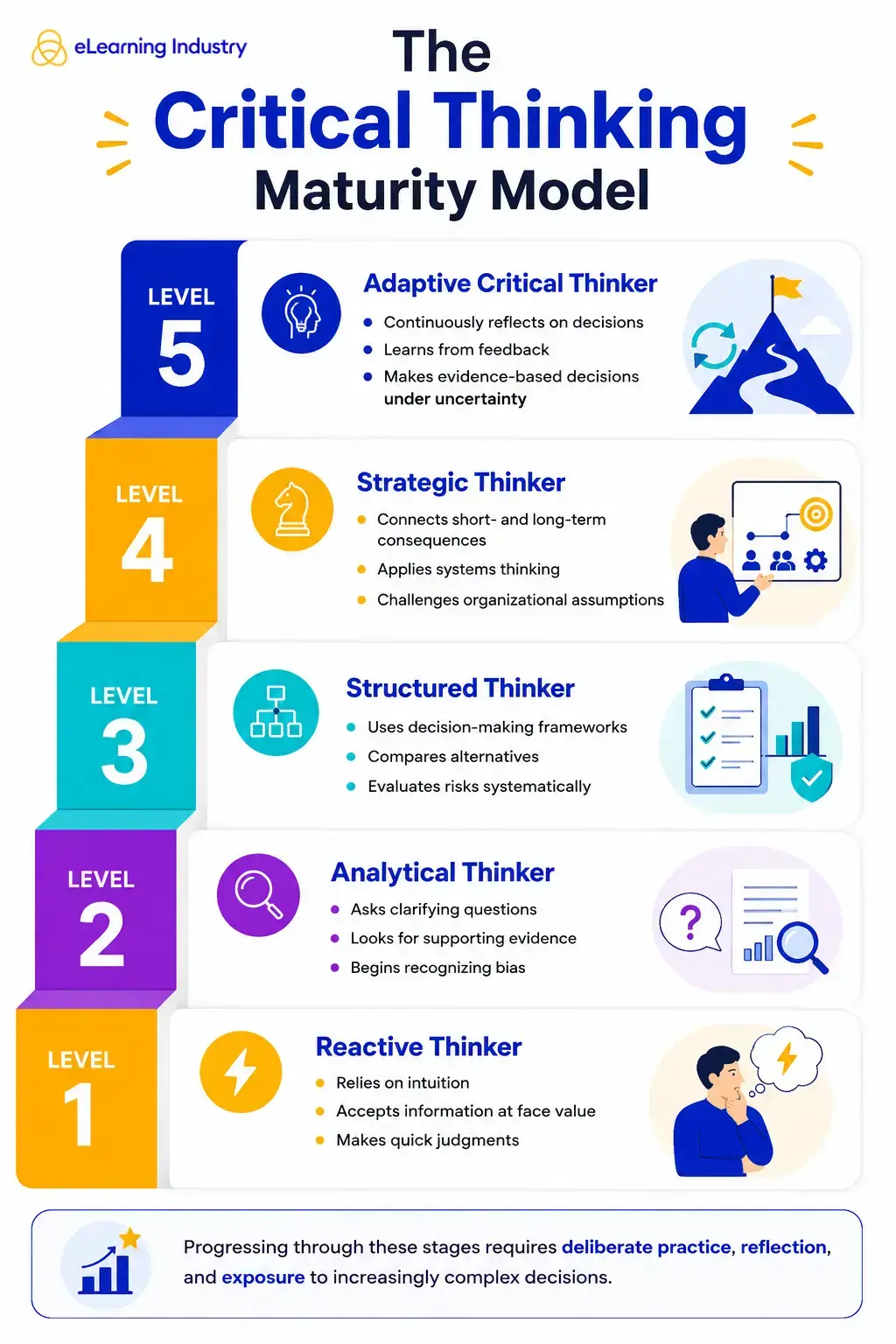
Knowing how to improve critical thinking is less about memorizing techniques and more about building habits that strengthen your reasoning over time. The best critical thinking exercises are simple enough to use often, but still powerful enough to help you analyze information, question assumptions, and make better decisions. Whether you lead a team, design learning experiences, or solve business problems, these exercises can help you turn critical thinking into a daily habit.
Exercise 1: The "Why Ladder"
Pick a problem or decision and ask "why?" several times, usually about five, to find the real cause instead of just the symptoms. This method, based on root cause analysis, helps you look past surface explanations. It is a simple way to practice critical thinking because it makes you question your first conclusions instead of just accepting them.
Exercise 2: Assumption Mapping
Before you make an important decision, list the assumptions that shape your thinking. Then check if each one is backed by evidence or just based on opinion, past experience, or bias. This exercise helps you spot hidden influences that might affect your judgment.
Exercise 3: Reverse Thinking
Try asking, "What would guarantee failure?" instead of just, "How do we achieve this outcome?" You can also work backward from your goal. Reverse thinking helps you find risks, dependencies, and new solutions you might miss otherwise. It is a useful way to build critical thinking skills, especially in complex situations.
Exercise 4: Case Reflection Logs
Each week, write about one important decision you made. Note the information you used, the options you considered, your reasoning, and what happened in the end. Over time, these notes will show patterns in your thinking and help you find ways to improve. This is a practical way to build your critical thinking skills.
Exercise 5: Debate Both Sides
If you strongly prefer one solution, make the best possible case for the other side. This exercise helps you think more flexibly, avoid confirmation bias, and judge evidence more fairly. These are important habits for anyone who wants to improve critical thinking in today's information-rich workplace.
Conclusion
Critical thinking is not a rare talent that only a few people have. It is a skill that anyone can build with the right learning experiences at work. Instead of relying on one-time training, organizations should make structured frameworks, reflection, and real-world problem-solving part of daily routines. These methods help employees assess information, question assumptions, and make better decisions over time. For L&D and HR leaders, focusing on critical thinking helps grow future leaders, makes learning programs more effective, and builds a culture where people make decisions based on evidence.