


Information Processing Theory
During much of the 1950s, psychologists involved in the Information Processing movement began to view the human brain as a neural computer that processes information with remarkable efficiency. They recognized the brain's exceptional performance in problem-solving and critical thinking, which improves over time. The concept of Information Processing is a key aspect of Cognitive Psychology. For more information, you can explore Cognitive Load Theory and Instructional Design, as this theory integrates multiple perspectives aimed at explaining human learning through the development of interconnected memory structures.
The 3 Main Functions Of Information Processing
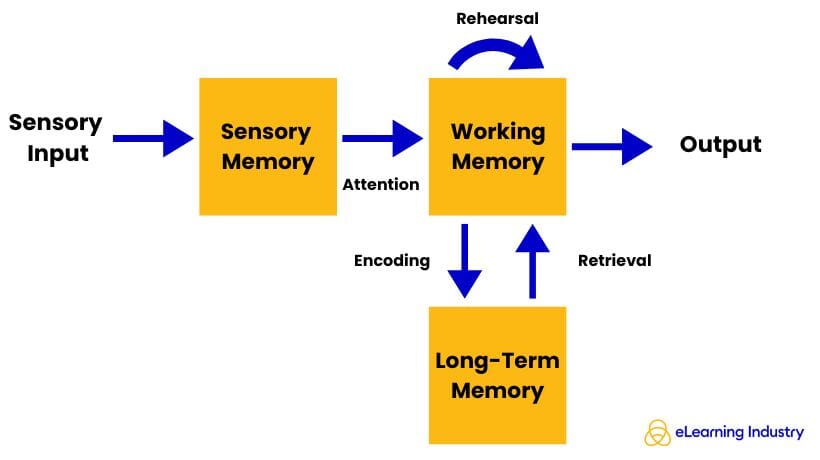
The Information Processing Model consists of three key functions:
1. Sensory Memory
This helps individuals screen incoming information, filtering out what is not necessary.
2. Working Memory
Working memory allows people to manage and store larger chunks of information while also performing visual-spatial mental tasks.
3. Long-Term Memory
This serves as a permanent repository for information, housing various types of knowledge that can be accessed at a later time. It enables individuals to continually build on their knowledge base.
Models Of Information Processing Theory
The Information Processing Theory explains how people encode, store, and retrieve information. It conceptualizes the mind as a mechanism similar to a computer that receives, processes, and recalls information. Two of the most well-known models that have been developed to explain memory and learning are the Atkinson and Shiffrin Model and the Baddeley and Hitch Model of Working Memory. We’re going to explore these models in detail below.
Atkinson And Shiffrin Model
Overview
The Atkinson and Shiffrin Model, commonly referred to as the MultiStore Model of Memory, was one of the first frameworks to systematically explain how memory works. Presented in 1968, this model categorizes human memory into three distinct stores: sensory memory, short-term memory (STM), and long-term memory (LTM). It outlines how information transitions through these stages and how specific processes, such as attention and rehearsal, help facilitate this progression.
Key Components
- Sensory Memory (SM)
- This is the initial point of entry for information from our surroundings.
- Sensory memory retains information (visual, auditory, tactile, etc.) for a very brief period. For instance, iconic memory (visual) lasts less than a second, while echoic memory (auditory) lasts between two and four seconds.
- Most of this sensory information quickly fades away without focused attention.
- Short-Term Memory (STM)
- Information from sensory memory enters STM if it receives attention.
- According to Miller's research, STM can hold information for 15 to 30 seconds and has a limited capacity of 7 ± 2 items.
- To extend retention in STM and increase the likelihood of transferring information to LTM, mental repetition or rehearsal is crucial.
- Long-Term Memory (LTM)
- LTM has virtually unlimited capacity and can store information indefinitely.
- It contains declarative information (facts and events) as well as procedural information (skills and tasks).
- Retrieval enables individuals to recall information from STM for active use.
Applications
The Atkinson and Shiffrin model has influenced various instructional practices, including:
- Breaking down information into manageable chunks to enhance retention in STM.
- Using repetition and review to facilitate the transfer of knowledge into LTM.
- Incorporating engaging elements in lesson plans to help ensure that information transitions from sensory memory to STM.
Baddeley And Hitch Model Of Working Memory
Overview
The Working Memory Model (WMM), proposed by Alan Baddeley and Graham Hitch in 1974, presents a more dynamic understanding of short-term memory. Unlike the linear framework of Atkinson and Shiffrin, this model emphasizes that memory functions as an active workspace where information is temporarily stored, modified, and utilized for tasks such as problem-solving, comprehension, and reasoning.
Key Components
The Working Memory Model consists of four primary subsystems:
1. Central Executive
- Acts as the control system that organizes and directs attention toward the other subsystems.
- Determines which information should be processed, prioritized, or ignored.
- Regarded as the "manager" of working memory, it has a limited capacity.
2. Phonological Loop
- Responsible for processing both spoken and heard information.
- Comprised of two parts: the articulatory rehearsal process (inner voice) and the phonological store (inner ear).
- Assists in understanding verbal instructions, learning languages, and remembering phone numbers.
3. Visuospatial Sketchpad
- Manages visual and spatial information.
- Often referred to as the "inner eye."
- Helps with problem-solving, visualizing objects, and navigation.
4. Episodic Buffer (added in 2000)
- Integrates data from long-term memory, the phonological loop, and the visuospatial sketchpad.
- Creates a cohesive representation of an experience or "episode."
- Illustrates how contextual, auditory, and visual information can merge.
Applications
The Working Memory Model has practical applications in everyday life, the workplace, and education, including:
- Designing educational resources that do not overload working memory.
- Engaging multiple subsystems through spoken instructions and visual aids.
- Utilizing visual diagrams or notes to alleviate the cognitive load on working memory.
- Implementing targeted strategies to support learners with working memory difficulties, such as those with dyslexia or ADHD.
The 3 Principles Οf the Information Processing Theory
The Information Processing Theory and Instructional Model are based on three key principles:
1. A complex series of systems continuously processes the information we receive from our environment.
2. These parallel processing systems modify the information people gather in systematic ways.
3. The primary goal of research in information processing theory is to explore the processes and brain structures that underlie cognitive functions and performance.
Applications Οf Information Processing Ιn Learning
There are several ways to apply the information processing framework in a learning environment. In a classroom setting, learners continuously absorb and store information presented by the instructor, while also actively retrieving the necessary information for the lesson. From an instructor's perspective, understanding information processing can help enhance learners' skills and deepen their understanding of the curriculum. A great way for teachers to develop their students' information processing skills is to assess their abilities in focusing, gathering information, remembering, and organizing.
- Focusing skills involve recognizing a situation and determining the best approach to address it.
- Information gathering skills include collecting relevant information about a situation and formulating questions to clarify it.
- Remembering skills pertain to encoding and recalling information, which are directly related to the use of mnemonics.
- Organizing skills involve making comparisons, categorizing information, sequencing events, and creating visual, verbal, or symbolic representations to facilitate understanding.
Implement the most Impactful Instructional Design Theories with the Best Authoring Tool!
Limitations Οf Information Processing Theory
Despite its ability to illuminate how people encode, store, and retrieve information, information processing theory has several limitations. Here are some of the key issues:
- Overemphasis Οn Computer Comparisons
It often likens the brain to a machine, ignoring the roles of emotion, creativity, and intuition in the learning process. - Oversimplified Memory Models
The theory divides memory into rigid phases, failing to recognize that these processes are fluid and interconnected. - Lack Οf Emphasis Οn Meaning
While it explains how data is stored, it does not address how learners interpret or utilize that information. - Neglect Οf Social Αnd Cultural Context
The theory overlooks the influence of environment, culture, and teamwork on the learning process. - Limited Real-World Applicability
It struggles to account for sophisticated, nonlinear thinking and problem-solving encountered in real-life scenarios.
Join us at the Instructional Design History Journey.
A New Instructional Design Model Will Be Added Every Week! You are more than welcome to let us know if you would like us to cover an Instructional Design model and theory that is not included in Instructional Design Models and Theories. Last but not least, you can embed the Information Processing Theory presentation on your blog.
References
- Information Processing Theory
- Cognitive Approaches to Learning
- Information Processing
- Cognitive Information Processing Theory
- Wikipedia: The Free Encyclopedia. Information Processing Theory. Retrieved September 29, 2013, from https://en.wikipedia.org/wiki/Information_processing_theory