

 ChatGPT
 Perplexity
 Claude
 Grok
Grok
The Reality Of AI Importance And Adoption, Visualized
Integrating Artificial Intelligence is considered a strategic priority in the learning technology landscape. eLearning Industry's exclusive industry benchmark report with insights from more than 500 practitioners and providers in Learning and Development backs that up. In this sneak peek of our exclusive findings, the data reveals an interesting distinction: buyers and vendors are aligned on AI's growing importance, but they remain at different stages of adoption, investment, and maturity.
Vendors are building aggressively for an AI-enabled future, while buyers continue evaluating AI through a practical lens, prioritizing usability, value, trust, and learner outcomes over innovation alone. Let's take a look at the findings in more detail.
The AI Expectation Gap In Learning Tech 2026: What L&D Leaders Want From AI Platforms Vs. What Vendors Are Building
AI Importance
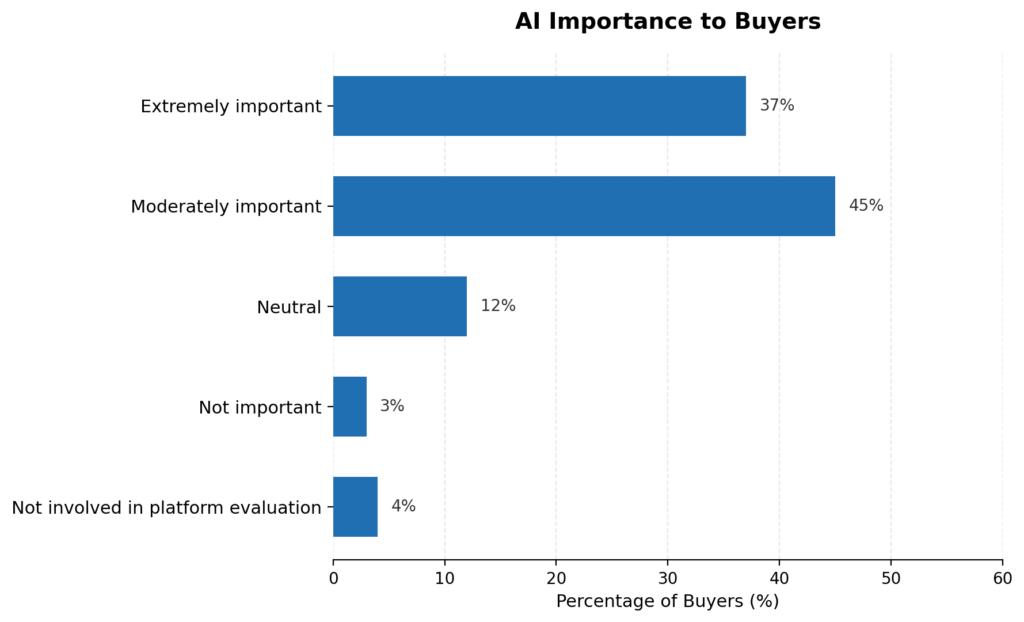
Among buyers, AI is clearly becoming an expected component of modern learning platforms. More than eight in ten respondents describe AI capabilities as either extremely (37%) or moderately important (45%) when evaluating solutions. Only 3% consider AI unimportant.
From the vendor perspective, AI has become deeply embedded in positioning and messaging strategies.
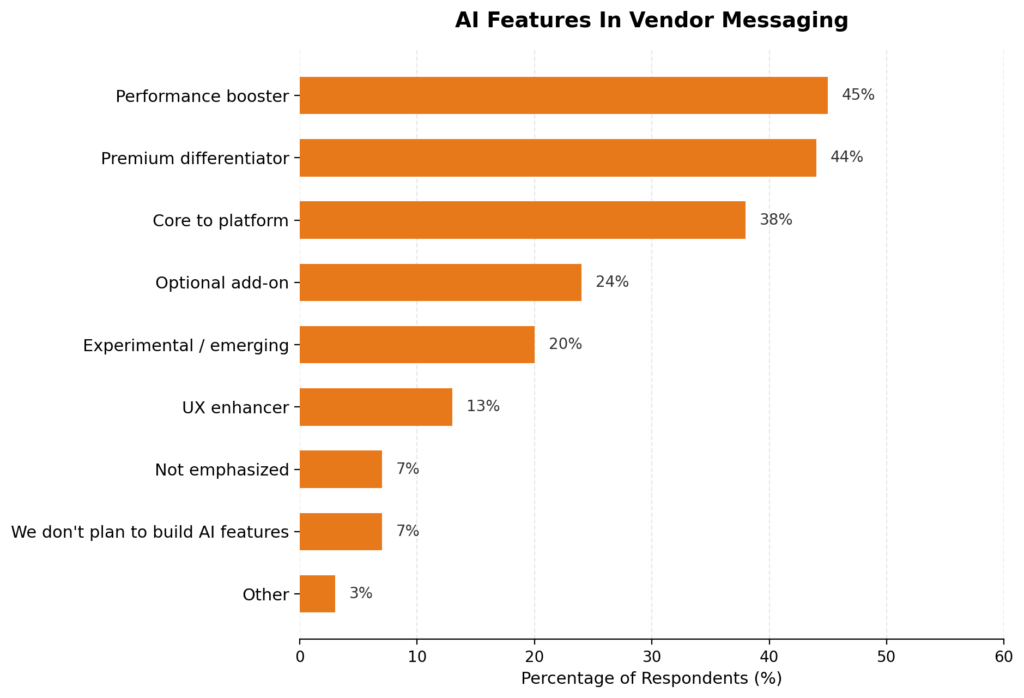
Most vendors position AI as either a performance booster (45%), a premium differentiator (44%), or a core platform capability (38%). Only 7% report not emphasizing AI in their messaging.
Market Signal
AI is rapidly becoming a competitive expectation. However, the data suggests buyers are evaluating AI as part of a broader platform experience rather than treating it as a standalone purchasing determinant.
Top Buying Priorities: AI Versus Fundamentals
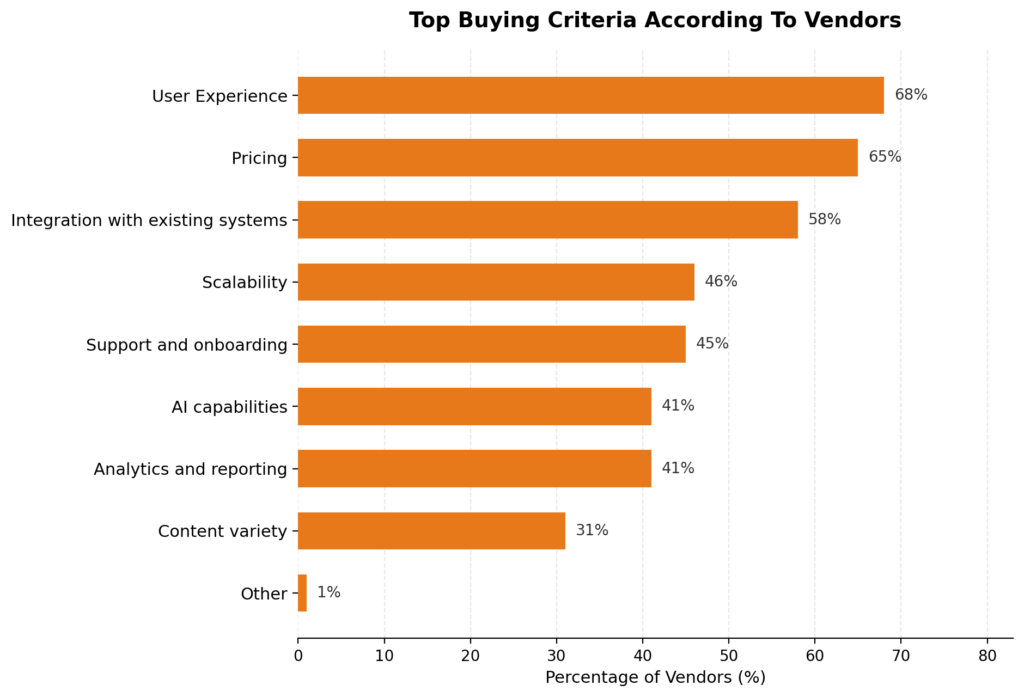
According to vendors, AI capabilities rank among the factors buyers care about most, but they do not outweigh foundational requirements. User Experience, pricing, and integration continue to lead decision-making.
This reinforces one of the central findings in our research: AI is becoming important, but practical business considerations still determine purchasing decisions.
AI Adoption And Integration
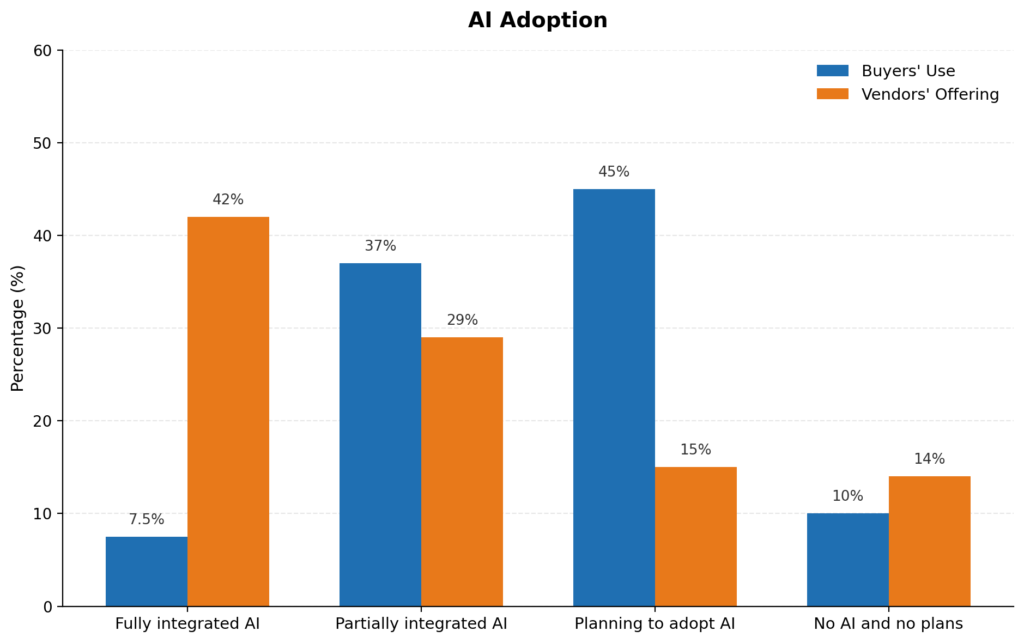
The adoption gap between buyers and vendors is one of the clearest findings in the study.
While 42% of vendors report fully integrated AI capabilities, only 7.5% of buyers describe AI as fully integrated within their own learning environments. Meanwhile, nearly half of buyers (45%) are actively planning future adoption.
The implication is that while vendors are already investing heavily in product development, many organizations remain in the evaluation and planning phase.
Market Signal
Vendors are building for future demand, while many buyers are still determining where AI delivers meaningful value.
Providers should bridge this adoption gap through education, implementation support, and practical use cases to gain a significant competitive advantage.
AI's Impact On Product And Team Structures
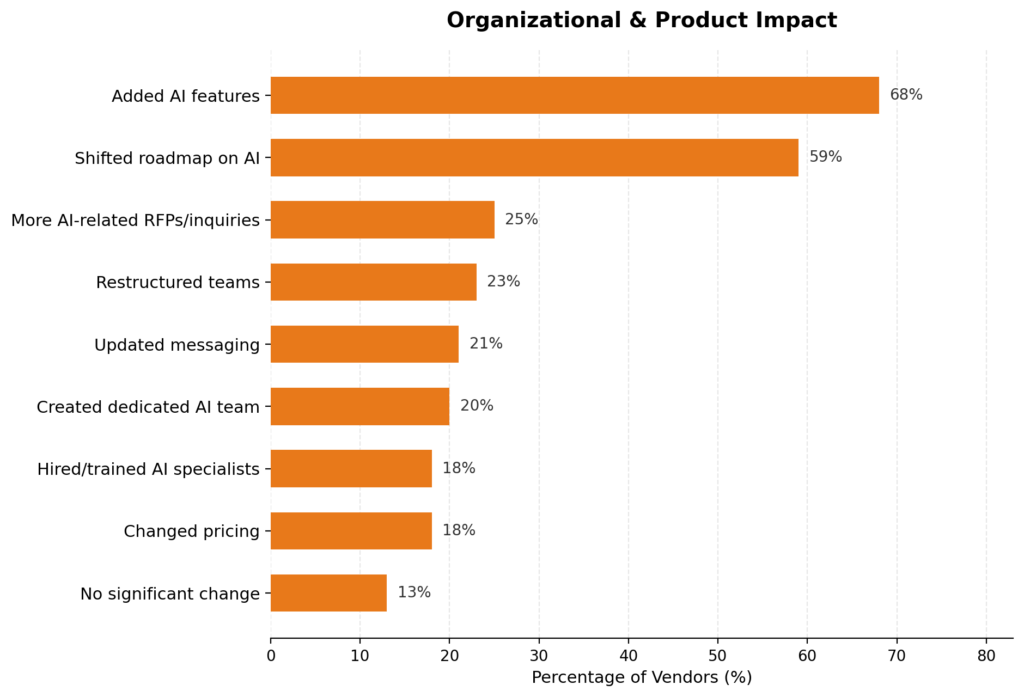
AI is influencing far more than product functionality. Most vendors report adding AI features (68%) and shifting product roadmaps around AI priorities (59%), demonstrating that AI is considered a strategic business initiative.
Organizational changes are also becoming increasingly common. Nearly one-quarter have restructured teams, while others have created dedicated AI groups or invested in specialist talent.
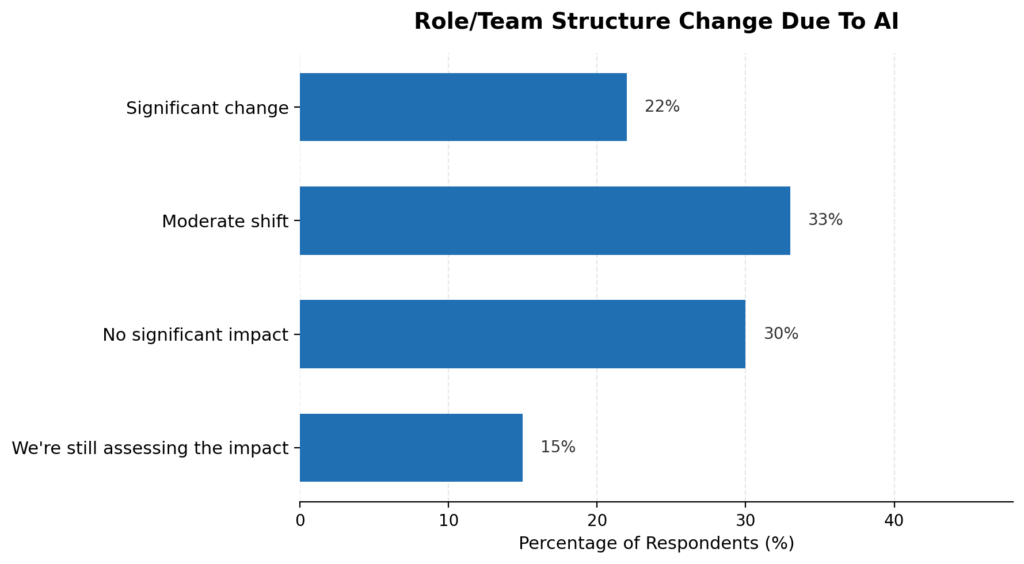
On the buyer side, the impact extends beyond platform adoption. Twenty-two percent report significant changes to roles or team structures due to AI, while another 33% report moderate changes. For 30% there is no significant impact to report, while an additional 15% are still assessing.
Together, these findings suggest that AI is influencing how organizations work, learn, hire, and plan, not simply which software they purchase.
What AI Is Solving For Clients
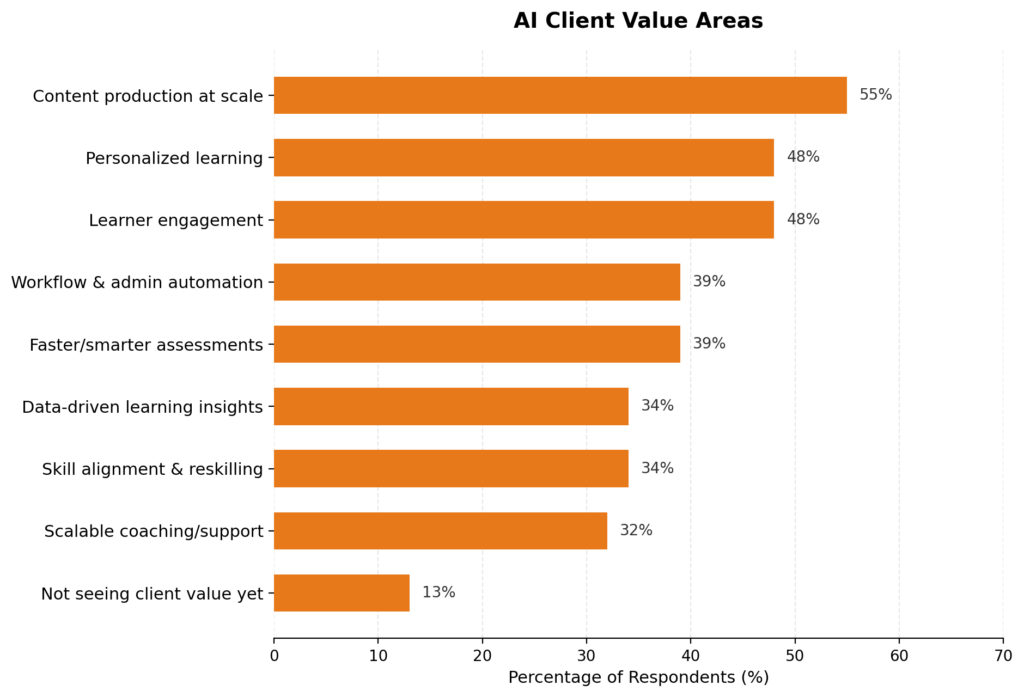
When vendors evaluate where AI delivers value for customers, two themes dominate: scalability and personalization. Content production at scale leads all responses (55%), followed by personalized learning and learner engagement (48% each). Administrative efficiency, assessments, coaching, and skills development also rank prominently.
These findings help explain why vendors continue investing heavily in automation and content-generation capabilities. However, as later sections will reveal, buyer priorities do not always align perfectly with these development investments.
AI Product Maturity And Development
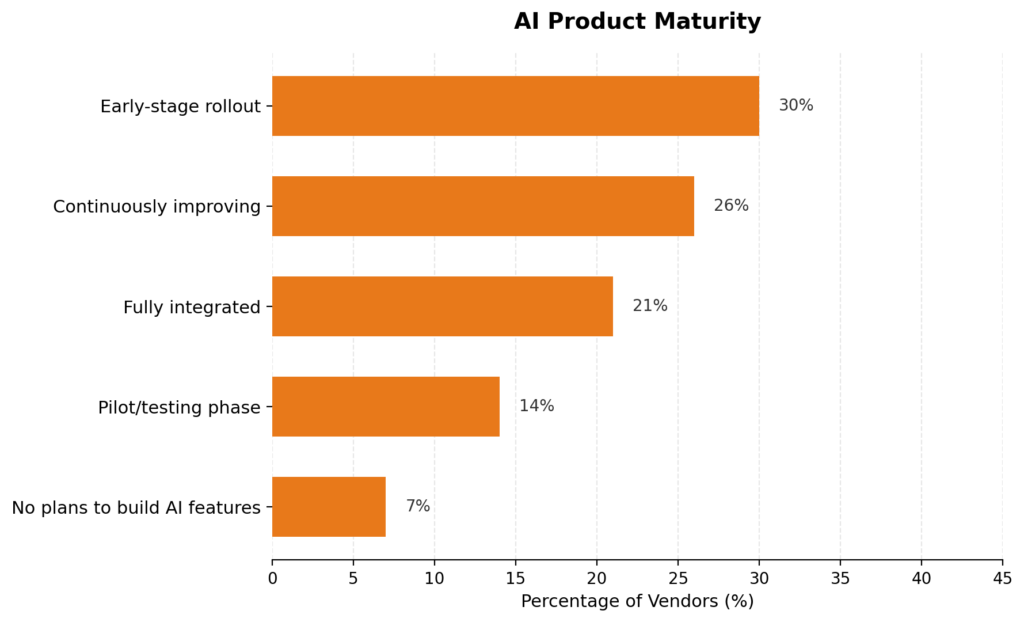
Despite the attention surrounding AI, relatively few providers describe their capabilities as fully integrated. Most vendors remain in early rollout, pilot, or continuous improvement phases, indicating that the market is still maturing and that many AI-enabled learning products remain works in progress.
At the same time, development motivations reveal a long-term strategic outlook.
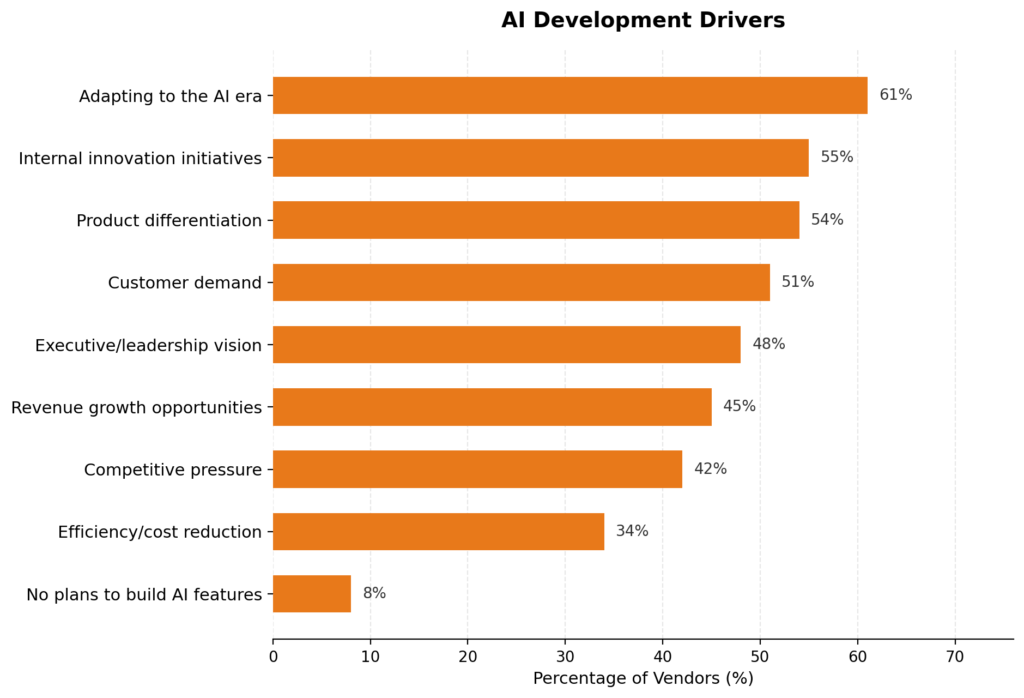
Adapting to the AI era (61%) ranks above competitive pressure (42%), suggesting that vendors increasingly view AI as essential to future relevance rather than simply a reaction to competitors.
Market Signal
The AI market remains early in its maturity cycle. Although AI dominates industry conversations, most providers are still actively refining capabilities, identifying use cases, and determining sustainable business models.
AI Features: Where Buyer Demand And Vendor Investment Diverge
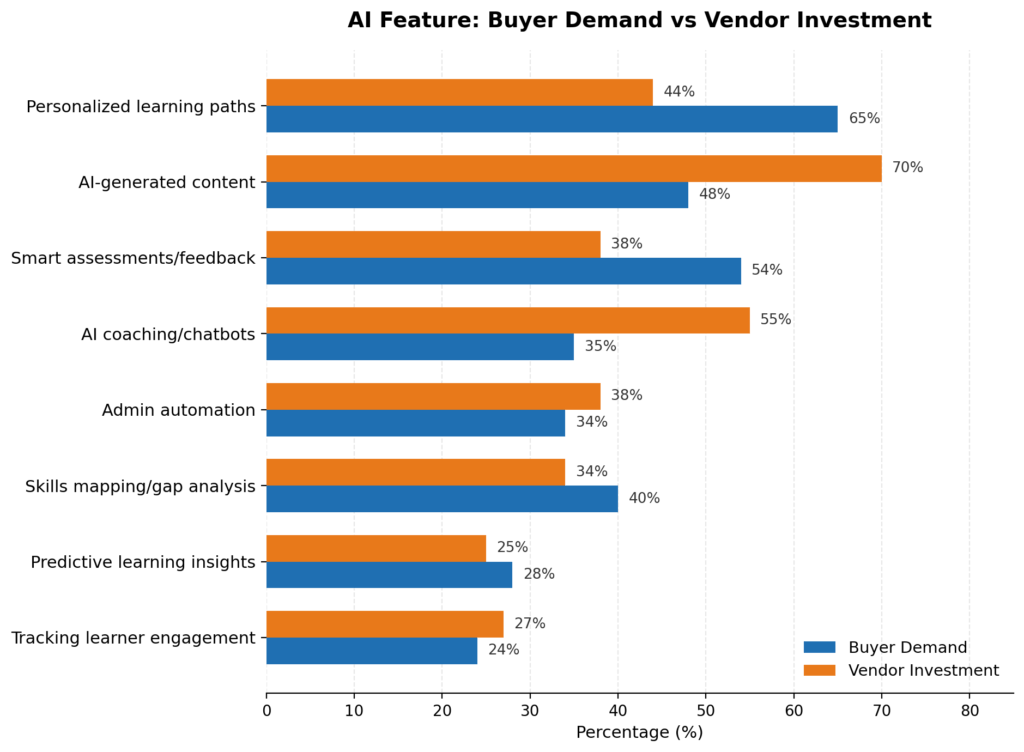
If there is one chart in our research that best illustrates the emerging AI expectation gap, it is this one. While both audiences recognize the value of AI, they do not always prioritize the same capabilities.
The clearest example is personalized learning paths. Nearly two-thirds of buyers (65%) identify personalization as one of the most valuable AI applications in learning, making it the highest-ranked feature overall. Yet only 44% of vendors report actively building or planning capabilities in this area.
By contrast, AI-generated content dominates vendor investment. Seventy percent of providers are investing in content generation capabilities, while fewer than half of buyers (48%) identify it as a top priority.
A similar pattern appears around AI coaching and chatbots. More than half of vendors (55%) are investing in these capabilities, compared with just 35% of buyers who rank them among the most valuable AI features.
The gap reflects a difference in perspectives. Vendors are often prioritizing capabilities that scale efficiently across customers, while buyers are evaluating AI through the lens of learner experience, engagement, and outcomes.
Market Signal
The findings suggest that the market's biggest opportunity may not lie in building more AI features, but the right ones. Personalization appears to be one of the most underserved opportunities in learning technology today. While it remains one of AI's most discussed promises, buyer demand currently exceeds reported vendor investment.
AI Development Challenges
Before vendors can fully deliver on AI's promise, they must overcome a number of operational, technical, and market-facing challenges.
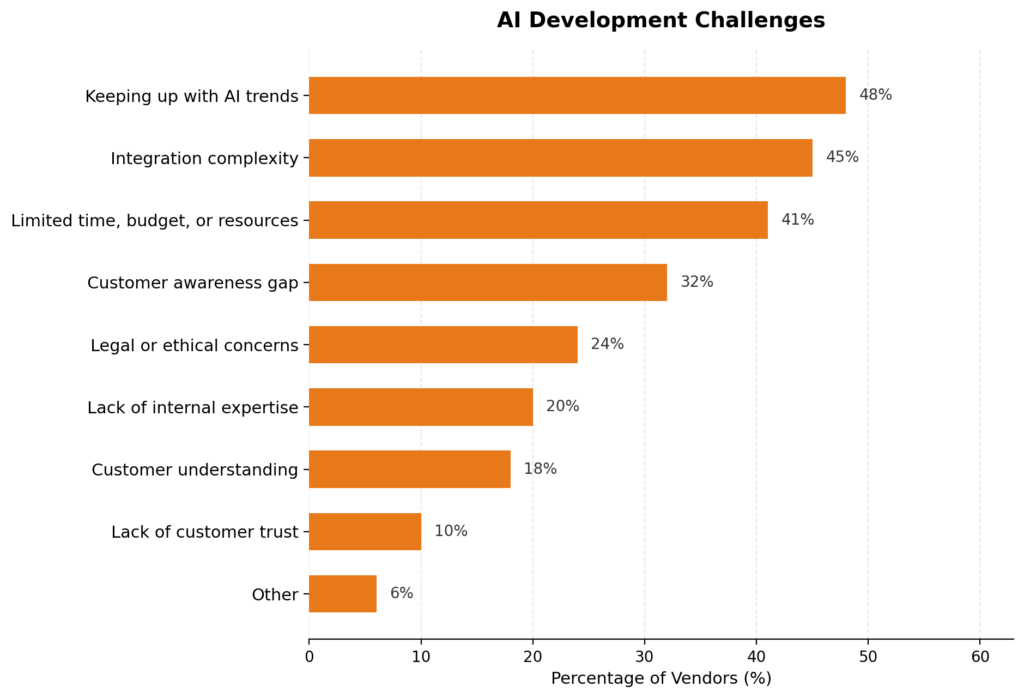
The biggest barriers to AI development currently center on execution.
Nearly half of vendors cite keeping pace with AI innovation (48%) and integration complexity (45%) as major challenges. Resource limitations also remain significant, with 41% reporting constraints related to budget, staffing, or available development time.
Beyond technical considerations, market readiness has emerged as another obstacle. Nearly one-third identify a customer awareness gap as a key challenge, suggesting that many buyers are still learning how AI fits into Learning and Development workflows.
Interestingly, lack of customer trust ranks relatively low (10%), while customer awareness and understanding score considerably higher. This suggests that market education may be just as important as technological advancement.
Market Signal
The next phase of AI competition may just be won through education. As AI capabilities become more accessible, vendors that help buyers understand practical applications, implementation strategies, and expected outcomes may gain an advantage over those focused solely on feature development.
Concerns About AI
As AI becomes increasingly embedded in learning technology, concerns around governance, transparency, and reliability are becoming more prominent.
The encouraging news is that buyers and vendors largely agree on the most important risks.
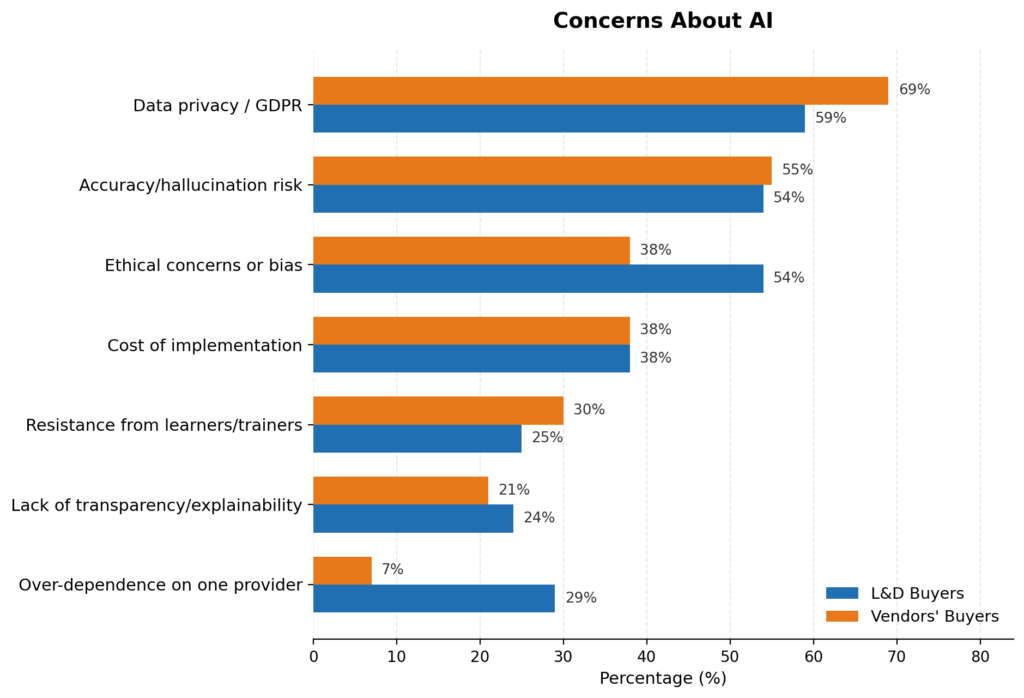
Data privacy and GDPR compliance emerge as the leading concern for both audiences, cited by 59% of buyers and 69% of vendors describing their customers' concerns. Accuracy and hallucination risk rank close behind, highlighting a shared demand for dependable and trustworthy AI outputs.
Where the groups diverge most is around ethics and dependency.
More than half of buyers (54%) express concern about ethical issues and bias, compared with 38% of vendors. Buyers also demonstrate substantially greater concern about becoming overly dependent on a single AI provider (29% versus 7%).
Market Signal
With AI capabilities becoming more widespread, competitive differentiation should increasingly depend on governance, transparency, and trust rather than feature breadth alone. Organizations want confidence that AI systems are accurate, explainable, secure, and aligned with organizational values.
Building Trust In AI-Powered Learning Platforms
If trust is becoming a competitive differentiator, what specifically builds confidence among buyers? The answer reveals another subtle but important difference between audiences.
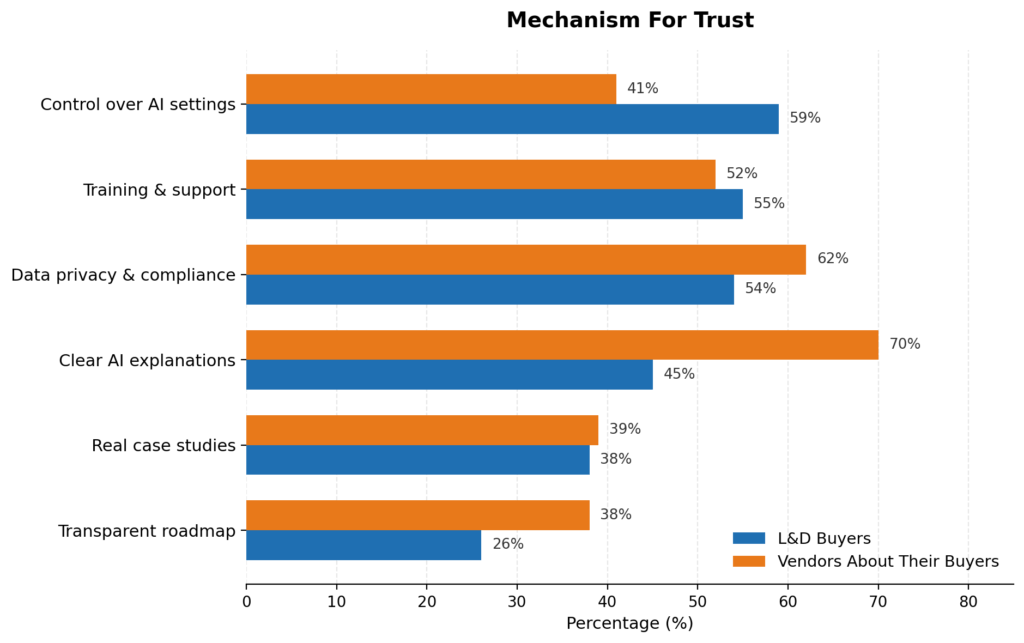
Buyers place the highest value on control. Nearly six in ten respondents identify control over AI settings as the strongest trust-building mechanism, suggesting a desire for transparency, customization, and human oversight.
Training and support (55%) and data privacy protections (54%) also rank highly, reinforcing the need for practical guidance alongside technical safeguards.
Vendors, meanwhile, report that their buyers place greater emphasis on clear explanations of how AI works (70%) and data privacy measures (62%).
Although priorities differ somewhat, both groups agree on one critical point: trust is earned through transparency.
Market Signal
The learning technology market is entering a trust-first phase of AI adoption. Future conversations are increasingly likely to focus on how responsibly, transparently, and effectively those capabilities are delivered. Ultimately, vendors that combine AI functionality with explainability, governance, and user control may be best positioned to build long-term buyer confidence.
Get Your Free Copy
Interested in learning more data about AI? Download The AI Expectation Gap In Learning Tech 2026: What L&D Leaders Want From AI Platforms Vs. What Vendors Are Building, eLearning Industry's exclusive industry benchmark report. Learn everything other L&D pros are doing, and get a peek into your competitors' next moves.