


More Development Capacity, Fewer SME Distractions
The organization we spoke with already had an experienced internal training team and highly knowledgeable technical SMEs. It also had a process for getting the right information from those SMEs and turning it into course material.
But the volume of eLearning was growing, and the same SMEs and internal team were spending a significant amount of time on course production.
The team was therefore looking at external support, not to replace the expertise it already had, but to take on more of the work involved in turning that expertise into learning.
That made the conversation around staff augmentation particularly relevant.
Where Was The Work Going?
The internal team already had a structured way of working with SMEs.
Before meeting with an SME, the team provided an instructional design document or template. SMEs identified learning objectives, misconceptions, topics, and the technical content that needed to be covered.
The development team then worked on scripts and PowerPoints. Senior leaders were involved in QA/QC and practice runs, while SMEs recorded the videos.
The process gave the team a way to bring technical knowledge into the development process. The challenge was the time it took.
The SMEs were highly technical and not always easy to get into the room. When they were involved, they were also spending considerable time scripting and developing course material.
That led to a practical question: How much of the course-building work really needed to sit with the SMEs?
They still needed to explain the subject, clarify technical questions, identify misconceptions, and review the final learning. But the work of shaping that knowledge into a course could be handled by a team with learning design and development expertise.
That is the role CommLab India can play.
What Did The Team Want From External Support?
The requirement was not simply to take technical content and put it into an authoring tool.
The organization wanted help making highly technical material simpler, more visual, and easier for learners to understand.
During the conversation, we discussed the kinds of changes that could help: defining terms, adding analogies, introducing visuals, giving learners context through scenarios, and thinking about where a learner might misunderstand a concept.
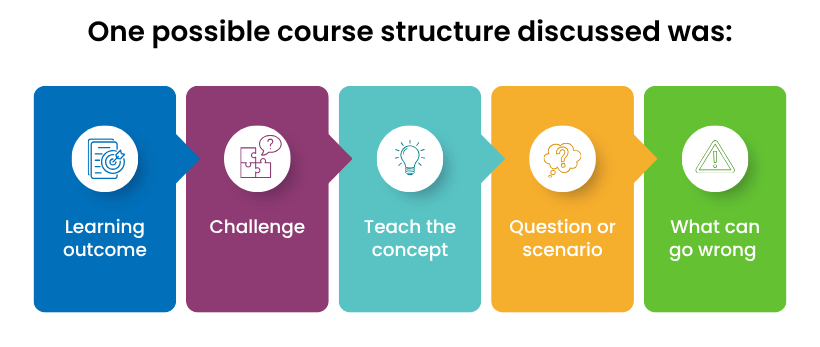
The technical content may already be accurate and comprehensive. The work is then to determine what the learner needs to understand, how the information should be sequenced, and where examples or interaction can help.
That is where CommLab India's learning specialists bring value. They work with the SME's knowledge and shape it into a learning experience rather than expecting the SME to develop the course themselves.
What Would The SMEs Still Need To Do?
The SMEs would remain an important part of the process.
They would provide the technical knowledge, explain difficult concepts, clarify questions, identify misconceptions, provide their voice where appropriate, and review the finished learning for accuracy.
What would change is the amount of production work they carry.
Instead of spending hours helping write and refine scripts or develop courses, SMEs can focus on the technical input only they can provide.
The external learning team can then take that input forward developing the script, shaping the course, building it, and making revisions based on feedback.
That keeps the SME close to the learning without turning the SME into part of the production team.
What Changes When The Course Volume Grows?
The immediate development work discussed on the call was relatively straightforward. Videos and resources were already available for some of the upcoming courses, and the plan was to bring them into Articulate, with SMEs providing their voice and existing content.
The longer-term requirements were different.
As the course volume increased, some courses were expected to need more learning design and interactivity. The internal team was also not looking to become deeply involved in authoring-tool production.
That led to a discussion about different levels of staff augmentation.
The organization wanted to understand what support might look like with a smaller external team and how that could change if more support was needed.
That flexibility was important because the amount and complexity of work would not necessarily remain the same throughout the program.
Could Τhe Internal Team Spend Less Time Οn Production?
This was one of the bigger changes the organization was considering.
As course development increased, the internal team wanted to spend more time on strategic work and less time producing courses.
That did not mean stepping away from the learning.
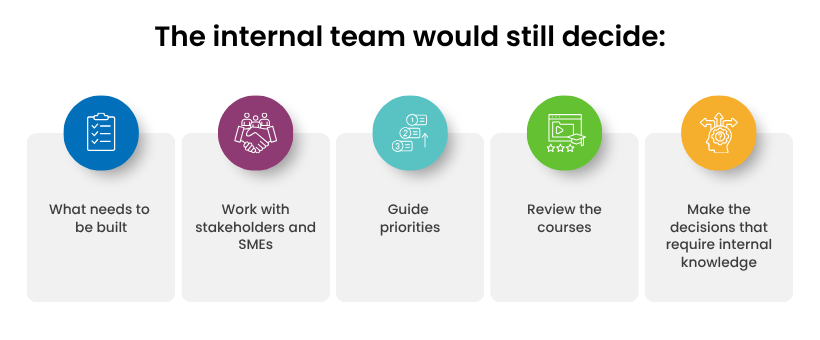
What changes is who handles the production.
CommLab India can take on scripting, course design, development, and revisions while working alongside the internal team and within its existing process.
The internal team remains involved, but it does not have to carry every production task itself.
What Should You Expect From The External Learning Team?
The organization was also looking for recommendations and project management, not simply additional development support.
An experienced learning team should be able to look at SME content and recognize where something needs to be simplified, where a visual would work better than text, or where a scenario would give the learner useful context.
It should also be able to work within the internal team's process and understand its review expectations.
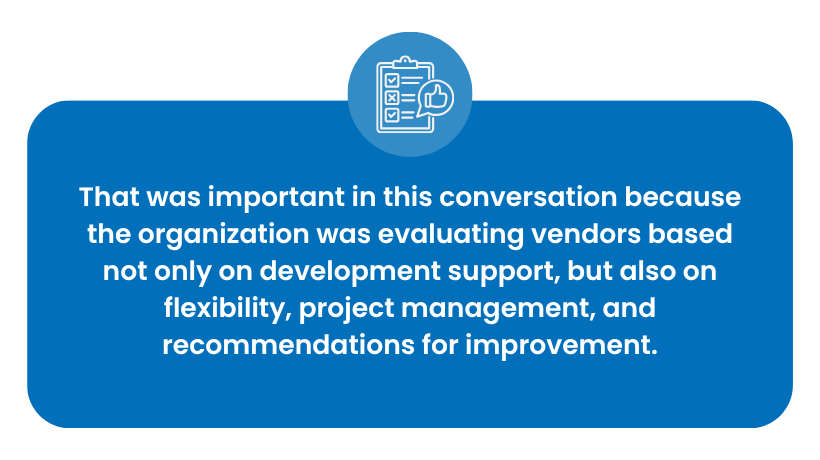
For CommLab India, that means bringing learning expertise into the work rather than simply waiting for a finished brief and returning a finished course.
What Happens When Work Changes?
The amount of external support does not necessarily have to remain the same.
There may be periods when more courses need to be developed and others when the workload is lighter. There may also be a difference between courses that already have usable source material and those that need more work before development can begin.
That is why the organization was considering different staffing options rather than one fixed arrangement.
The external team can support the internal function at the level the work requires, while the internal team continues to own the priorities, business context, and key decisions.
What About Maintaining Courses Later?
The conversation also looked beyond the immediate development work.
The organization was considering train-the-trainer support as a separate requirement for a future phase, so the internal team could take on more responsibility for maintaining the courses.
That changes the role of the external partner over time.
Initially, CommLab India may take on more of the work involved in turning SME knowledge into finished learning. Later, the internal team may want to handle more of the maintenance and updating itself and need support to build those skills.
The level of external support can change as the team's needs change.
So, Who Should Be Doing The Building?
The organization already had the technical knowledge, the SMEs, and an internal training team. What had changed was the volume of work that team was being asked to support.
So the real question was how to divide the work. SMEs could stay focused on technical expertise. The internal L&D team could spend more of its time on priorities, stakeholders, and the wider learning agenda. An external team could take on more of the work of turning that knowledge into eLearning.
That is how we approach staff augmentation at CommLab India. We work inside the client's existing process, take on the learning design and development, and scale support up or down as the volume changes.
If your course volume is growing, a useful exercise is to list the tasks only your internal team can do: deciding what gets built first, managing the business relationships, judging whether a course worked. Everything else on that list is work an experienced external team could take on. If your SMEs are writing scripts, or your L&D team keeps postponing its bigger priorities, that second list is probably longer than you think.
If you'd like to work through it with us, talk to CommLab India.