
 ChatGPT
 Perplexity
 Claude
 Grok
Grok
What Are The Levels Of Thinking?
Levels of thinking describe how people engage with information, from simple recall to complex reasoning. They represent a hierarchy of cognitive processes for understanding, analyzing, and applying information. This idea, also known as levels of thought or modes of thinking, is essential for effective learning design.
It's important to understand the differences between levels of thinking and related concepts. Types of thinking in psychology, like critical or creative thinking, describe how people think. Thinking styles refer to individual preferences for processing information. On the other hand, levels of thinking focus on how deeply someone thinks, which is also known as cognitive depth.
For learning and business leaders, it is important to understand the difference between types of thinking. If we design learning experiences based only on these types, we often get shallow results. To make a real impact, such as improving decision-making, solving problems more effectively, and changing behavior, Instructional Designers must focus on higher-level thinking. This helps learners move from just memorizing facts to applying their knowledge, analyzing information, and thinking strategically in real-life situations.
Why Levels Of Thinking Matter In Learning Design And Business Strategy
The levels of thinking directly shape how people make decisions, solve problems, and perform at work. In many organizations, the challenge is not a lack of information, but the inability to process it effectively. But what are the benefits of understanding different types of thinking?
Improved Decision-Making
Shallow or reactive thinking often leads to quick decisions based on assumptions. While this can work in simple situations, it limits long-term effects. In contrast, deeper thinking improves decision-making by promoting analysis, evaluation, and foresight. Employees who think critically are better at spotting risks, considering options, and making informed choices.
Better Problem-Solving
Teams that rely on limited ways of thinking often focus on quick fixes rather than solving real problems. Using different types of thinking, such as critical, analytical, and systems thinking, helps create better, more effective solutions. This improves the workforce's performance, especially in complex or fast-changing situations.
Measurable Outcomes
From an L&D perspective, designing for different thinking levels leads to measurable outcomes. Learning experiences that activate multiple thinking styles improve knowledge retention because learners engage more deeply with content. When learners are encouraged to apply concepts through varied thinking methods, they are more likely to transfer knowledge into real-world contexts, driving behavior change.
Stronger Internal Capabilities
Finally, organizations that focus on developing different thinking skills strengthen their internal capabilities. They go beyond simply training employees to gain knowledge and instead design programs that enhance judgment, adaptability, and strategic thinking.
The 3 Levels Of Thinking Explained
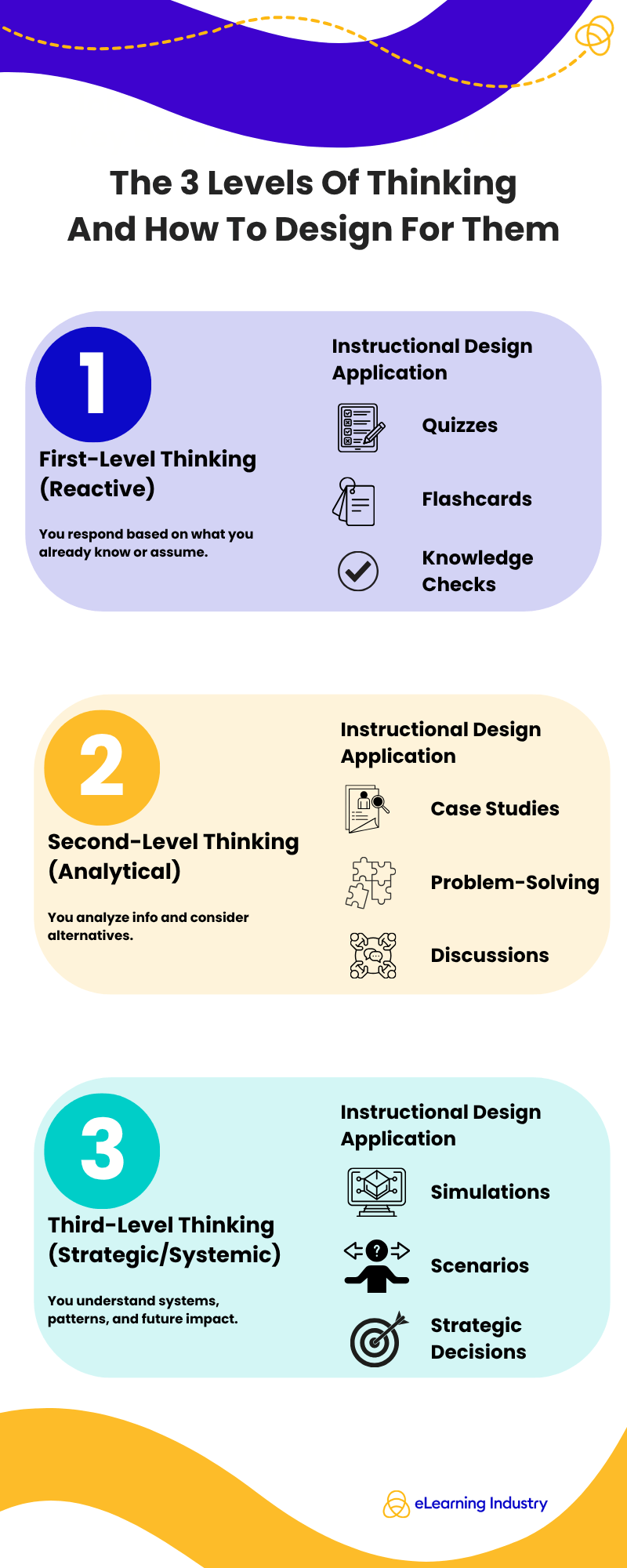
Understanding the 3 levels of thinking helps Instructional Designers move beyond content delivery and design for real cognitive impact. These levels show how deeply learners think about information, ranging from quick reactions to thoughtful, long-term reasoning.
1. First-Level Thinking (Reactive Thinking)
First-level thinking is fast and automatic. It relies on past experiences, assumptions, and familiar patterns. Learners at this level focus on immediate answers rather than deeper understanding. In the workplace, this shows up in quick decisions made under pressure. For example, people may choose a familiar solution without considering whether it still works for the situation. While this can be helpful for speed, it usually limits creativity and critical thinking.
2. Second-Level Thinking (Analytical Thinking)
Second-level thinking goes deeper. It involves evaluating alternatives, weighing consequences, and questioning initial assumptions. This level aligns closely with types of critical thinking used in problem-solving and decision-making. For instance, during strategic planning, a learner considers multiple scenarios before choosing a direction. In risk assessment, they analyze potential outcomes instead of reacting to the most obvious option. This level supports better, more informed decisions.
3. Third-Level Thinking (Systemic/Strategic Thinking)
Third-level thinking is the most advanced type of thinking. It looks at the long-term impact of decisions and how they connect to different systems. Learners think about how their choices affect various stakeholders and future outcomes. This kind of thinking is common among leaders, as it is important for managing complex situations. For example, in organizational change, it helps teams see how a single decision can create ripple effects across departments, not just the immediate results.
Comparison Of The 3 Levels Of Thinking
Level |
Depth |
Time Horizon |
Business Impact |
| First-Level Thinking | Surface-level | Short-term | Fast but limited decisions |
| Second-Level Thinking | Moderate depth | Mid-term | Informed and balanced decisions |
| Third-Level Thinking | Deep, systemic | Long-term | Strategic, high-impact outcomes |
Types Of Thinking In Psychology
Each type of thought serves a different purpose. Thus, understanding the types of thinking in psychology helps Instructional Designers design effective learning experiences to intentionally activate the right one at the right time.
Critical Thinking
Critical thinking involves evaluating information, questioning assumptions, and making informed judgments. It is used in decision-making, problem-solving, and risk assessment.
Use In L&D
- Case studies
- Debates
- Scenario-based learning
Creative Thinking
Creative thinking focuses on generating new ideas and exploring possibilities. It is essential in innovation, brainstorming, and adapting to change.
Use In L&D
- Open-ended tasks
- Challenges
- Ideation exercises
Analytical Thinking
Analytical thinking breaks down complex information into smaller parts to understand patterns and relationships. It is used in data analysis and strategic planning.
Use In L&D
- Comparisons
- Structured problem-solving tasks
Reflective Thinking
Reflective thinking involves reviewing experiences to gain insights and improve future actions. It is key to continuous learning and self-awareness.
Use In L&D
- Journaling
- Post-training reflections
- Feedback loops
Systems Thinking
Systems thinking looks at how different elements interact within a whole. It is used in complex problem-solving and organizational strategy.
Use In L&D
- Simulations
- Real-world business scenarios
- Cross-functional case studies
Logical Thinking
Logical thinking follows structured reasoning to reach conclusions based on facts. It is used in technical tasks and structured decision-making.
Use In L&D
- Rule-based exercises
- Sequences
- Logic-driven assessments
10 Types Of Thinking Every Instructional Designer Should Know
Different types of thinking, thinking styles, and ways of thinking influence how learners process content, solve problems, and apply knowledge in real-world situations. For Instructional Designers, the goal is not just to present content, but to activate the right levels of thinking at the right moment. Below is a practical breakdown of the key types of thinking in psychology, with simple examples you can apply directly to course design.
1. Critical Thinking
Focuses on evaluating information, identifying biases, and making reasoned judgments.
Example: Learners analyze a case study to identify risks and justify their decisions.
Use: Common in compliance, leadership, and decision-making training.
2. Creative Thinking
Encourages generating new ideas and exploring possibilities.
Example: Learners brainstorm innovative solutions to a business challenge.
Use: Supports innovation and problem-solving cultures.
3. Analytical Thinking
Breaks down complex information into smaller parts to understand relationships.
Example: Interpreting data trends in a business simulation.
Use: Critical for roles involving data and strategy.
4. Reflective Thinking
Involves reviewing experiences to improve future actions.
Example: Post-training reflection on what worked and what didn't.
Use: Strengthens long-term learning and self-awareness.
5. Logical Thinking
Uses structured reasoning to reach conclusions.
Example: Following a step-by-step process to troubleshoot a system issue.
Use: Often linked to structured problem-solving tasks.
6. Divergent Thinking
Explores multiple possible solutions to a problem.
Example: Generating many ideas during a design sprint activity.
Use: Encourages flexibility and open-ended exploration.
7. Convergent Thinking
Narrows down multiple options to find the best solution.
Example: Selecting the most effective strategy after evaluating alternatives.
Use: Complements divergent thinking in decision-making processes.
8. Abstract Thinking
Deals with concepts, patterns, and ideas that are not concrete.
Example: Understanding leadership principles or organizational culture models.
Use: Important for strategic and conceptual learning.
9. Concrete Thinking
Focuses on tangible facts and practical application.
Example: Learning how to use a specific tool or follow a procedure.
Use: Essential for task-based and technical training.
10. Lateral Thinking
Solves problems using unconventional and indirect approaches.
Example: Reframing a customer complaint to uncover hidden opportunities.
Use: Drives innovation and adaptability.
Importance For Instructional Design
Effective learning experiences combine multiple thinking methods to reflect real-world complexity. For example, a scenario-based module may require analytical thinking to assess a situation, critical thinking to evaluate options, and convergent thinking to make a final decision. By intentionally designing for different thinking styles and types of thinking skills, Instructional Designers can create more engaging and effective learning journeys. This approach also supports diverse types of thinkers, ensuring that content resonates across roles, industries, and cognitive preferences.
Applying Levels Of Thinking In Instructional Design
Designing effective learning is not about delivering more content. It is about shaping how people think. For Instructional Designers, understanding the levels of thinking is what turns a course from informative to transformational. This is where strategy matters.
Designing For Different Levels Of Thought
Every course should start with a simple question: What level of thinking do learners need to reach? Many programs stop at basic recall, which reflects first-level thinking. However, this means learners can remember information but cannot apply it. To move beyond this, learning objectives must align with levels of thought. For example:
- If the goal is awareness, recall may be enough.
- If the goal is decision-making, learners need critical thinking.
- If the goal is leadership, they need higher-order thinking skills, such as systems thinking or strategic thinking.
Matching Content To Thinking Types
Different formats support different ways of thinking. So, choosing the right format is a design decision, not a content decision.
For instance:
- Videos are effective for building conceptual understanding and introducing different ways of thinking.
- Simulations activate analytical thinking and critical thinking, allowing learners to test decisions in realistic environments.
- Interactive content supports multiple modes of thinking, especially when learners must choose, reflect, and adapt.
Instructional Designers should think in terms of thinking methods, not just content types. The question is not "What format should I use?" but "What type of thinking should this trigger?"
Activities That Trigger Deeper Thinking
To move learners beyond surface-level understanding, activities must challenge them to engage with different kinds of thinking.
Some of the most effective approaches include:
- Scenario-based learning: Encourages learners to apply knowledge in context, activating different thinking styles.
- Problem-based learning: Pushes learners to explore solutions, strengthening analytical and critical thinking.
- Case studies: Help learners examine real-world complexity and develop higher levels of thinking.
These methods turn passive learning into active learning. They also support different types of thinkers, from logical to creative, by offering multiple entry points into the content.
Assessment Strategies By Thinking Level
Assessment should reflect the level of thinking you expect and not just what learners remember.
- Recall-based assessments measure basic understanding and types of thoughts related to knowledge.
- Application-based assessments test whether learners can use what they know in realistic situations.
- Synthesis-based assessments assess advanced thinking, where learners must combine ideas, make decisions, or create something new.
For example, a quiz may test memory, but a simulation tests judgment. A multiple-choice question checks recognition, while a case analysis reveals how learners think.
Real-World Examples Of Thinking Levels In Learning Programs
Understanding levels of thinking is crucial for designing learning programs that truly engage learners. Let's explore three thinking examples that show how ways of thinking apply in professional learning contexts.
Example 1: Compliance Training (Low-Level Thinking)
Compliance training often requires learners to memorize rules, regulations, and company policies. This represents first-level thinking, where learners engage in surface-level recall rather than deep analysis. The focus is on understanding the types of thoughts related to specific tasks, such as recognizing what is acceptable behavior and what is not. In this case, learners rely on methods of thinking that emphasize repetition and recognition rather than creative problem-solving.
Example 2: Leadership Development (High-Level Thinking)
Leadership programs demand different ways of thinking. Participants are encouraged to practice critical thinking, reflect on their decision-making, and consider the broader impact of their choices. This represents third-level thinking, where learners integrate different thinking styles and explore types of thinking in psychology, such as analytical and strategic thinking. Activities such as scenario analysis and strategic simulations help learners apply different types of thinking to real-world challenges.
Example 3: Digital Transformation Training
Digital transformation programs combine technical skills with strategic insight, requiring learners to shift between different thinking modes. These programs often include problem-solving exercises that stimulate thinking styles, from analytical to creative. By presenting learners with complex, real-world problems, digital transformation training encourages diverse thinking and approaches to drive innovation and adaptability.
Conclusion
Understanding the levels of thinking is essential for creating impactful learning experiences. This is because thinking depth directly influences how well learners absorb, apply, and retain knowledge. Furthermore, different types of thinking serve unique purposes. Therefore, Instructional Design must intentionally target these thinking levels in order to move beyond surface-level knowledge and foster higher-order skills. By designing activities, assessments, and scenarios that challenge learners at multiple cognitive depths, L&D leaders can ensure that programs are not only more engaging but also practical and effective. Ultimately, this approach drives better business and learning outcomes.