

 ChatGPT
 Perplexity
 Claude
 Grok
Grok
The Business Impact Of AI
AI measurement strategies are still maturing. According to our research, in which we surveyed over 500 L&D professionals and learning technology providers, many vendors focus on usage and customer sentiment, but fewer have established frameworks to quantify financial or operational outcomes. As buyers increasingly demand evidence of business value, vendors that can demonstrate measurable ROI, productivity gains, or revenue impact may gain a significant competitive advantage. Take an exclusive look at our latest industry benchmark research findings from our report, and discover strategic recommendations for measuring AI impact in the L&D industry.
The AI Expectation Gap In Learning Tech 2026: What L&D Leaders Want From AI Platforms Vs. What Vendors Are Building
AI Success Metrics And Business Outcomes
While vendors are actively investing in AI capabilities, their approaches to measuring success remain heavily focused on adoption and qualitative feedback. The most common metrics are client feedback (65%) and user adoption of AI features (58%), followed by ROI or business impact studies (41%) and engagement analytics (39%). However, only one-third track revenue impact (34%) and one-quarter measure internal cost or time savings (25%), while 18% report that they are not currently measuring AI impact at all.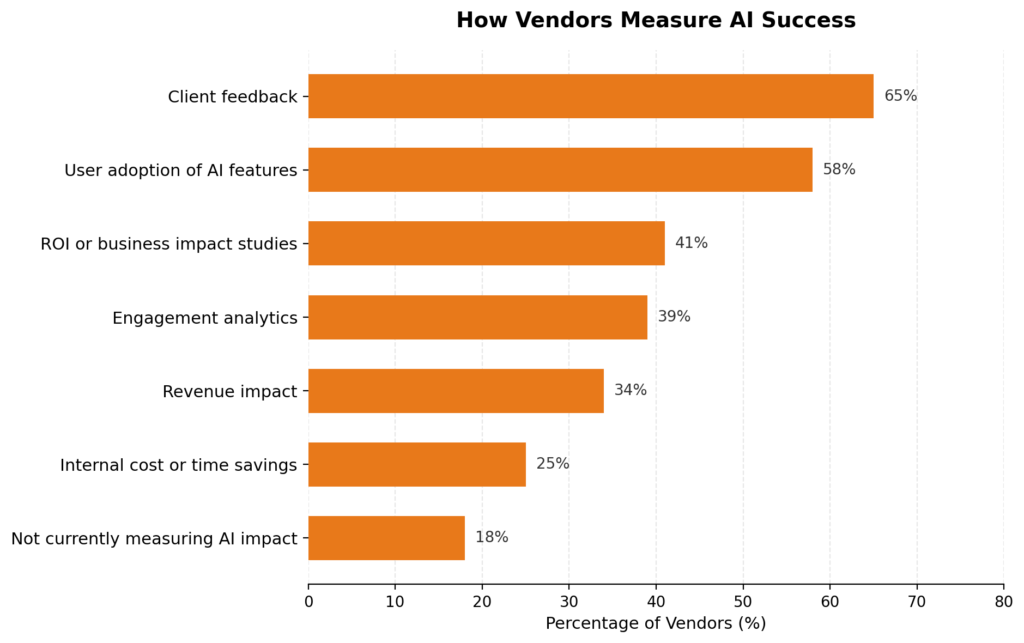 While AI adoption metrics are increasingly common, far fewer organizations have established frameworks for measuring business outcomes such as productivity gains, operational efficiency, learning effectiveness, or revenue impact. This suggests that the market is still in the early stages of AI measurement maturity.
Insights From eLearning Industry's Research
The findings from our study point to a learning technology market that is evolving quickly, but not uniformly. Artificial Intelligence is now firmly embedded in the strategic roadmap of most learning technology providers, shaping product development, influencing organizational structures, and redefining how vendors position their platforms.
However, the data consistently reveals that AI alone is not the defining factor in how learning platforms are evaluated, selected, or adopted. While vendors are accelerating investment in AI-powered capabilities, buyers continue to prioritize User Experience, integration, pricing, trust, and measurable business outcomes above individual AI features.
Across the market, a more nuanced reality is emerging: AI is becoming an expected capability rather than a primary differentiator. As AI adoption matures, competitive advantage will increasingly depend on an organization's ability to demonstrate value, build trust, and deliver meaningful learning and business impact.
The AI Expectation Gap
At the heart of this research is a structural mismatch between what vendors are building and what buyers are prioritizing. Vendors are investing heavily in scalable, efficiency-driven AI capabilities such as content generation, automation, and AI-powered assistance. Buyers, meanwhile, are placing greater emphasis on personalization, usability, trust, integration, and measurable learning outcomes.
This reflects different pressures shaping each side of the market:
- Vendors are optimizing for scalability, differentiation, and future competitiveness.
- Buyers are optimizing for practical value, ease of use, and immediate learning impact.
The result is an emerging expectation gap that will likely define the next phase of the learning technology market.
The AI Education Gap
While much of the industry conversation focuses on AI capabilities, our findings suggest that the market is also facing an AI education gap. Vendors are rapidly expanding AI functionality, while many buyers are still learning how to evaluate, implement, and govern AI-powered learning solutions effectively.
At the same time, buyers and vendors rely on different information sources throughout the learning process, creating potential disconnects in how AI value is communicated and understood. Successful AI adoption will depend not only on product innovation but also on education, guidance, practical use cases, and implementation support.
From AI Features To AI Value
One of the clearest themes throughout the research is that buyers evaluate AI through the lens of business value rather than technological sophistication. While vendors continue investing heavily in AI-powered capabilities, buyers consistently prioritize User Experience, integration, trust, measurable outcomes, and practical application. As AI capabilities become more common across learning platforms, competitive advantage will increasingly depend on demonstrating value, impact, and outcomes rather than simply expanding feature sets.
Buyers increasingly require evidence, validation, and practical proof before committing to AI-enabled learning technologies. Throughout the research, respondents consistently favored trial access, real-world use cases, customer reviews, hands-on testing, and measurable outcomes over feature-driven messaging alone. These findings suggest that trust is built through demonstrated value and real-world evidence rather than AI capabilities alone.
Human-Centered Learning Remains Critical In The AI Era
Despite the rapid growth of AI capabilities, eLearning Industry's findings consistently reinforce the importance of human-centered learning. Across both quantitative and qualitative responses, buyers emphasized the need for AI to enhance rather than replace human interaction, collaboration, coaching, mentorship, and critical thinking. While organizations continue investing in AI-powered learning technologies, long-term success will depend on balancing automation and efficiency with meaningful learner experiences, human oversight, and measurable learning outcomes.
Taken together, these findings highlight a market that is moving toward practical implementation. Our research suggests that the market is moving from an era of AI experimentation to an era of AI accountability, where success will increasingly be determined by outcomes, trust, and adoption rather than feature breadth alone. The implications for learning technology vendors are clear.
Implications For Learning Technology Vendors
The data in this report points to a clear reality: AI is reshaping learning technology, but buyer expectations are not evolving at the same speed as vendor innovation. To succeed in the next phase of the market, vendors should align AI capability with practical buyer needs, not just innovation for innovation's sake.
Below are the most important strategic takeaways from the research.
1. AI Is Becoming A Baseline Expectation
AI capabilities are becoming a baseline expectation in learning platforms. Buyers increasingly assume AI will be present, but they do not treat it as a primary reason to choose one platform over another. This means that AI alone will not win deals. Prioritize execution, usability, and outcomes.
2. Personalization Is The Clearest Underserved Opportunity
Among all AI capabilities, personalized learning paths show the largest gap between buyer demand and vendor investment. Buyers consistently prioritize personalization more than vendors prioritize building it.
3. Buyers Prioritize Outcomes, Not Capabilities
User Experience, pricing, integration, and measurable impact consistently outrank AI features in buying decisions. Even highly rated AI capabilities are evaluated through a practical lens. Buyers increasingly expect AI solutions to adapt to their workflows, systems, and industry-specific requirements rather than offering one-size-fits-all functionality.
4. Measure Business Outcomes, Not AI Adoption
Many organizations currently evaluate AI success through adoption rates, feature usage, and customer feedback. However, as buyers increasingly demand evidence of value, vendors should establish frameworks that measure business outcomes such as productivity improvements, learning effectiveness, operational efficiency, ROI, and revenue impact. Demonstrating measurable value will become increasingly important as AI capabilities mature.
5. Ethics And Trust Are Competitive Advantages
Concerns around privacy, transparency, ethics, and AI accuracy are consistent across both buyers and vendors. At the same time, buyers increasingly want control and explainability. Trust infrastructure will become a competitive advantage.
6. Invest In Buyer Education
A significant portion of the market is still learning how to evaluate and implement AI effectively. Buyers rely heavily on webinars, demos, peer groups, and hands-on testing. Vendors that invest in buyer education will accelerate adoption and shorten sales cycles.
7. Expand Messaging Beyond L&D Teams
Learning technology purchasing decisions increasingly involve cross-functional stakeholders, including IT, Finance, HR, and business leaders. Vendors should adapt messaging, proof points, and business cases to address the priorities of broader buying committees rather than focusing exclusively on Learning and Development audiences.
8. AI Monetization Models Are Still Unsettled
There is no dominant pricing model for AI features. Buyers are reluctant to pay significant premiums unless value is clearly demonstrated. Tie AI to measurable ROI to justify premium pricing or upsell strategies.
9. Adoption Is Ahead Of Readiness In Many Areas
Vendors are further along in AI integration than buyers are in implementation. Many buyers are still exploring, evaluating, or planning adoption. Successful vendors should meet buyers where they are, not where the technology is.
Get Your Free Copy
Interested in delving deeper into our research? Download The AI Expectation Gap In Learning Tech 2026: What L&D Leaders Want From AI Platforms Vs. What Vendors Are Building, eLearning Industry's exclusive industry benchmark report. Learn everything other L&D pros are doing, and get a peek into your competitors' next moves.