

Podcast Audience Engagement: A Podcast Audience Is Not Necessarily A Learning Community
Podcast audience engagement goes far beyond attracting subscribers, increasing downloads, or building a base of regular listeners. Those numbers can show that people are consuming your content, but they don't tell you whether listeners are reflecting on ideas, exchanging knowledge, or applying what they hear in their work.
This difference is important for L&D professionals. A podcast can share knowledge and insights, but it might not create much real interaction. The real goal is to make listening part of a continuous learning experience.
The best L&D podcasts do more than just draw in listeners. They build a space where professionals can ask questions, share stories, talk about challenges, and learn together. In this way, podcast audience engagement connects sharing content with building a real community.
This article explores practical ways to engage podcast audiences, the tools that can help, and the metrics L&D teams can use to see if listeners are becoming active members of a learning community.
What Is Podcast Audience Engagement?
Podcast audience engagement means how much listeners actively interact with the podcast, its ideas, the hosts, and other listeners. In L&D, this can look like having discussions, reflecting, asking questions, sharing knowledge, contributing content, or using podcast insights at work.
This difference is important because download numbers alone do not show if real learning is happening. One person might download an episode and never finish it, while another might listen, talk about the ideas with coworkers, try them out at work, and then share their experience with others. Both actions count as downloads, but they have very different learning value.
Audience Metric |
Engagement Signal |
| Download | Discussion |
| Play | Reflection |
| Subscriber | Repeat participation |
| Completion | Application |
| Follower | Community contribution |
| Reach | Knowledge sharing |
That's why effective podcast audience engagement strategies focus on more than just audience size. For L&D teams, reach shows how widely a podcast is shared, but engagement shows that learning continues after the episode ends. The right tools can help track this, though technology is only part of the solution. What really counts is whether listeners are thinking, joining in, sharing knowledge, and using new ideas.
Why Podcast Audience Engagement Matters For L&D Professionals
Podcast audience engagement gives L&D professionals an opportunity to turn audio content from a one-way channel into an ongoing learning experience. Instead of seeing each episode as a separate resource, L&D teams can use podcasts to link formal training with ongoing learning, reflection, and sharing knowledge.
Podcasts Can Extend Learning Beyond Formal Programs
Learning does not stop when a course, workshop, or webinar ends. Podcasts help keep important topics alive between formal sessions by reinforcing ideas, offering new viewpoints, and encouraging employees to think about these topics in their daily work. This makes podcasts a useful part of a larger learning system.
Engagement Turns Listening Into Social Learning
The real change comes when listeners participate. Effective podcast audience engagement strategies invite people to talk about episodes, answer questions, challenge ideas, and share their own stories. This way, listening alone can turn into social and group learning, helping people share knowledge and build communities of practice.
Communities Create Knowledge That The Podcast Alone Cannot
Importantly, the host does not have to be the only expert. Experienced professionals can share examples, lessons, questions, and different viewpoints. With the right podcast engagement tools, these conversations can turn a podcast from just a content channel into a network where people learn from both experts and each other.
Podcast Engagement Ladder: From Passive Listener To Learning Community
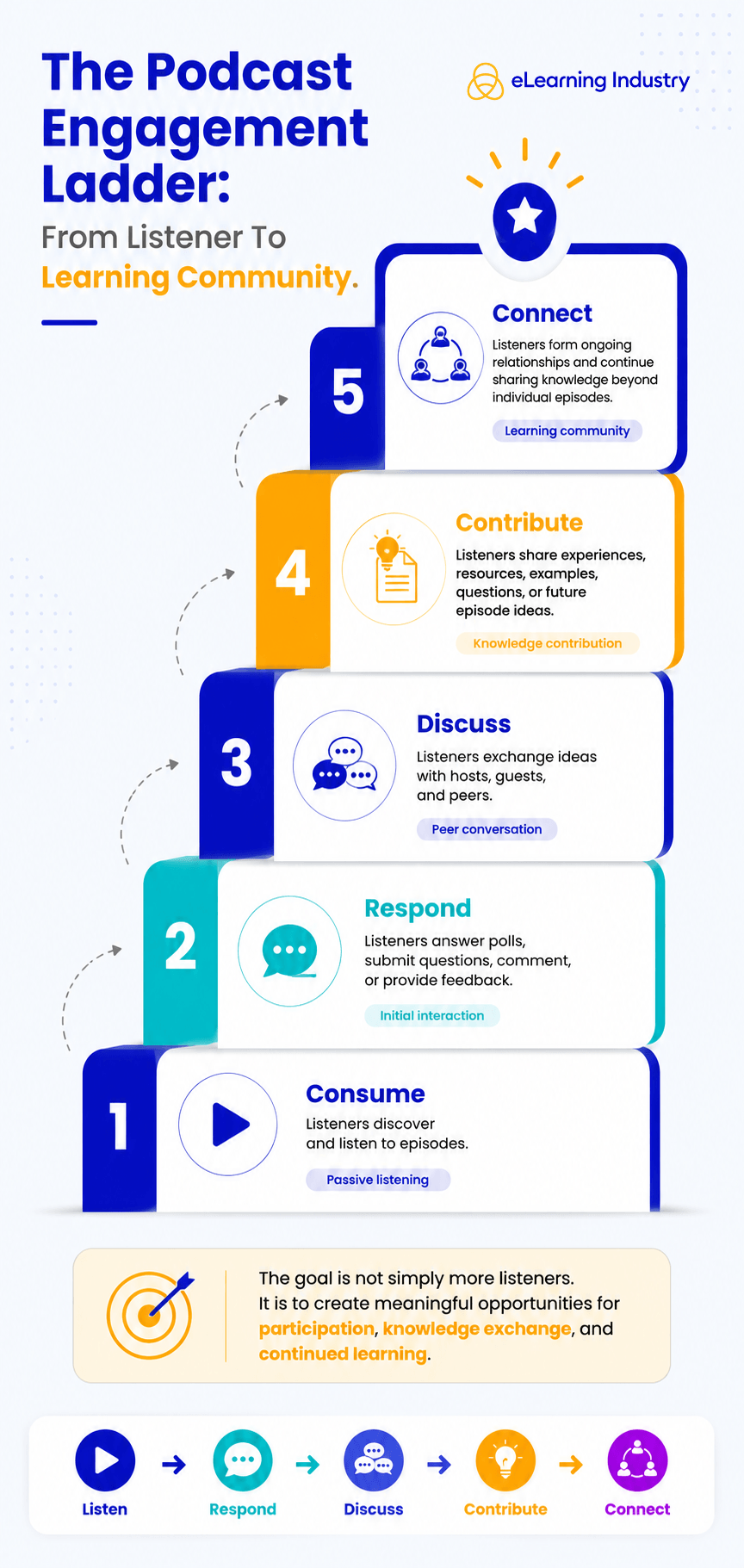
Podcast audience engagement is most valuable for L&D when it goes beyond just getting people to listen. While listening matters, the real benefit comes from helping professionals reflect, share knowledge, offer their expertise, and build connections. The Podcast Engagement Ladder is a five-stage framework that explains this process.
Consume
In the first stage, people find and listen to episodes. Metrics like downloads, unique listeners, completion rates, and repeat listening show if the content is reaching and keeping the right audience. Still, this stage is mostly passive.
Respond
Next, listeners start to interact with the content. They might answer a poll, ask a question, give feedback, or reply to a reflection prompt. Good engagement strategies make these actions meaningful for the listener's work, not just engagement for its own sake.
Discuss
Engagement grows when listeners share their views with hosts, guests, or other listeners. For L&D teams, these discussions can turn an episode into a starting point for social learning, where professionals compare experiences and question assumptions.
Contribute
At this stage, community members help shape the learning experience. They might share resources, workplace stories, lessons learned, questions, or ideas for future episodes. The audience is now adding their own expertise, not just receiving it.
Connect
The highest level happens when relationships and knowledge sharing continue outside of single episodes. Listeners connect with peers, keep up discussions, and may even build a lasting community of practice.
The goal is not to move every listener to the top of the ladder. Instead, L&D teams should offer more valuable ways for those who want to get involved. Each stage needs different design choices and engagement tools, from analytics for listeners to discussion and community platforms for deeper involvement. In the end, stronger engagement comes from creating a clear path from listening to responding, discussing, contributing, and connecting.
7 Podcast Audience Engagement Strategies For L&D
Podcast audience engagement strategies for L&D should go beyond just boosting comments, shares, or subscribers. The real value comes from turning listeners into active participants who reflect and share knowledge. When engagement is built into the experience, a podcast can become a lasting part of your learning ecosystem, not just another piece of content fighting for attention.
1. Design Episodes Around Questions, Not Just Topics
Broad topics might draw in listeners, but asking questions gives them something to consider and respond to. For example, rather than making an episode about "AI in Instructional Design," try focusing on a challenge: Where should Instructional Designers draw the line between AI assistance and human judgment?
This approach ties the episode to real decisions L&D professionals face. It also gives listeners an easy way to start a discussion once the episode is over.
2. Build Participation Into Every Episode
Instead of waiting until the end to ask listeners to "leave a comment," include meaningful chances for participation throughout the episode.
Ask questions like: What would you do differently? Have you faced this challenge? Which approach works in your organization? What would you question about this argument?
Effective podcast audience engagement gives professionals a reason to share their expertise, not just react to what they hear.
3. Turn Listener Questions Into Future Content
Listener questions can help shape your editorial strategy. A useful feedback loop could look like this:
Episode → Audience Question → Discussion → New Episode → Further Discussion
For example, if you get several questions about measuring leadership development, you could create an episode focused on showing business impact. This way, the audience helps guide the podcast and future content stays relevant to real L&D challenges.
4. Create A Dedicated Space For Discussion
Social media comments can be helpful, but conversations often get scattered. Try setting up a consistent space where listeners know they can keep the discussion going.
Depending on your audience, this space could be an internal learning community, a Slack or Microsoft Teams channel, a LinkedIn Group, an LMS or LXP discussion area, or another professional community. The goal is not to add another platform to check, but to give important conversations a clear home.
5. Connect Episodes To Workplace Application
For L&D, engagement matters most when ideas are put into practice. Wrap up episodes with prompts that encourage action, like: "What is one practice from this conversation you could test with your team this month?"
Follow-up discussions can explore what people tried, what worked, and what they learned. This turns the podcast into a spark for experimentation instead of just something to listen to.
6. Make Experts And Listeners Part Of The Same Conversation
Expert guests add credibility, but knowledge should go both ways. Invite listeners to submit questions, host follow-up Q&As, share practitioner responses, or bring professionals together to compare their approaches.
These podcast audience engagement strategies recognize that valuable knowledge often comes from the audience itself. Letting professionals contribute supports peer learning and helps close the gap between "expert" and "listener."
7. Repurpose Episodes Into Community Touchpoints
Finally, take each episode beyond just the audio. A single conversation can lead to discussion questions, polls, short clips, reflection prompts, follow-up resources, or live discussions.
A successful podcast doesn't just build an audience, but a conversation. We've seen that the real value comes when listeners stop being passive consumers and start exchanging ideas, challenging perspectives, and applying what they learn. That's when a podcast becomes more than content; it becomes a learning community.
-Christopher Pappas, CEO and founder of eLearning Industry
Podcast Audience Engagement Tools: What Does L&D Actually Need?
Podcast audience engagement tools should help L&D teams turn listeners into active participants who share knowledge and keep learning. The best technology stack is not always the one with the most features. It is the one that helps your audience take action before, during, and after each episode.
Each tool plays a unique role in supporting audience engagement along the way:
Tool Category |
L&D Purpose |
| Podcast hosting and analytics | Understand listening behavior |
| Polling/survey tools | Capture reactions and feedback |
| Community platforms | Enable peer discussion |
| LMS/LXP integrations | Connect podcasts to structured learning |
| Collaboration tools | Continue workplace conversations |
| Live-event platforms | Host Q&As and follow-up discussions |
| Transcription/content tools | Make knowledge searchable and reusable |
For example, analytics can reveal whether people are listening, returning, or completing episodes. However, those signals tell only part of the story. Polls and surveys can capture reactions, while community and collaboration platforms give professionals share ideas, talk about experiences, and learn from peers. Meanwhile, LMS or LXP integrations can link podcast content to formal learning, and transcripts make it easier to find and review important insights.
Choose Tools Around The Desired Behavior
Effective podcast audience engagement strategies start with behavior, not technology. Before looking at tools, L&D leaders should think about what they want listeners to do differently after each episode.
One helpful way to make decisions is to use this framework:
Desired behavior → engagement mechanism → tool → metric
For instance:
Peer discussion → episode discussion thread → community platform → active contributors and replies
This approach works whether your goal is to reflect, share knowledge, get feedback, or apply ideas at work. Instead of asking, "Which engagement platform should we buy?" ask, "What do we want listeners to do differently after listening?" Once you know that, choosing the right podcast engagement tools becomes a smarter, more strategic choice.
Common Podcast Engagement Mistakes L&D Teams Should Avoid
Getting your podcast audience involved takes more than just putting out helpful episodes and waiting for listeners to join in. For L&D teams, the main aim is to spark interactions that build learning, promote knowledge sharing, and keep important conversations alive. Still, some common mistakes can get in the way of even the best podcast engagement plans.
Treating Downloads As Engagement
Downloads show how far your podcast spreads, but not what listeners do next. Someone might download an episode but never finish it, think about it, or use what they learned. L&D teams should separate reach from real engagement and look for better signs, like repeat listeners, active discussions, and people using ideas at work.
Asking For Engagement Without Giving People A Reason
Saying "Leave a comment" or "share your thoughts" usually does not lead to real participation. Instead, offer listeners a question that matters. Invite them to challenge an expert's view, explain how their workplace handles a problem, or think about how they would use an idea in their own work.
Creating Too Many Community Channels
Having more channels does not always build a stronger community. If conversations are spread out across LinkedIn, Slack, Teams, an LMS, and other places, it can be hard for people to keep up. Pick one main space where listeners know they can keep the discussion going.
Making Every Interaction Promotional
A learning community loses its value if every conversation just promotes another episode, product, or project. The best communities focus on helpful exchanges between professionals instead of always pushing promotions.
Expecting Participation Without Facilitation
Communities need active guidance, especially at the start. L&D teams should start discussions, reply to people's posts, connect similar ideas, and point out useful insights from practitioners. Podcast engagement tools can help, but technology alone cannot take the place of good community management.
Measuring Activity Instead Of Value
Finally, do not assume that more activity means better engagement. Ten people sharing real experiences can offer more learning than hundreds of likes or quick reactions. The real question is not just, "How many people took part?" but "Did those interactions help people learn, share knowledge, or make better choices?"
Conclusion
For L&D professionals, podcast audience engagement is about much more than generating clicks, likes, downloads, or subscriptions. The real opportunity is to use podcasts as a starting point for conversations that help knowledge flow between teams and professional communities. A good episode might introduce a useful idea, but an active community will take it further by asking questions, sharing different views, and using it in real situations. Over time, these exchanges can make a podcast more than just another content channel. It can become part of a learning ecosystem where people connect, share knowledge, and keep learning from each other long after the episode is over.
Frequently Asked Questions (FAQ) About Podcast Audience EngagementPodcast audience engagement refers to how actively listeners interact with a podcast beyond simply pressing play. This can include responding to questions, joining discussions, sharing insights, engaging with hosts or guests, contributing experiences, and applying ideas. In L&D, meaningful engagement can turn podcast content into an ongoing opportunity for learning and knowledge exchange.
To increase podcast audience engagement, give listeners meaningful reasons to participate. Ask relevant questions, invite listener contributions, create dedicated community spaces, and continue conversations after episodes. L&D teams can go further by connecting podcast topics to workplace challenges, reflection activities, peer discussions, and opportunities to apply new ideas in real-world situations.
Effective podcast audience engagement strategies for L&D include using reflection questions, facilitating peer discussions, inviting listener questions, and connecting episodes to workplace applications. L&D teams can also involve subject matter experts, encourage listeners to share experiences, and build dedicated community spaces where conversations and knowledge sharing continue between episodes.
Podcast audience engagement tools can include podcast analytics platforms, surveys and polls, online community platforms, workplace collaboration tools, LMSs and LXPs, and live-event technology. Rather than choosing tools based on features alone, L&D teams should consider the behaviors they want to encourage, such as discussion, feedback, knowledge sharing, or application of learning.
Podcast audience engagement can be measured across several levels. Consumption metrics include downloads, unique listeners, completion rates, and repeat listening. Participation metrics track comments, questions, polls, and event attendance. Community metrics examine recurring contributors and peer interactions, while learning metrics look for reflection, knowledge sharing, continued learning, and evidence that listeners are applying ideas.
Podcasts can support social learning by giving people shared ideas, questions, and experiences to discuss with others. Instead of ending when an episode finishes, learning can continue through peer conversations, community discussions, reflection activities, and collaborative problem-solving. This allows listeners to compare perspectives, share practical experience, and build knowledge collectively.
Yes, a podcast can help build a learning community, but publishing episodes alone is not enough. L&D teams need to intentionally create opportunities for recurring discussion, peer interaction, contribution, and application. When listeners regularly exchange experiences and build on each other's knowledge, the podcast can become a foundation for an active professional learning community.
