
 ChatGPT
 Perplexity
 Claude
 Grok
Podcast Vs. Blog Vs. Video: Which Is Best For Learning?
The podcast vs. blog debate can start with what people prefer to produce. One person might want to do interviews, another prefers writing articles, and someone else suggests making videos. But it is more helpful to start by looking at the learning challenge you want to solve.
Think about a manager who needs to have a tough conversation. An expert interview can explain why certain feedback works. A checklist can help the manager get ready. A demonstration can show how tone and timing affect the conversation. Each resource meets a different need, even if they all focus on the same subject.
For Learning and Development teams, choosing a format should start with what employees need to know, remember, look up, or do. The aim is not to create more content, but to provide helpful learning support.
Podcast Vs. Blog Vs. Video: What's The Difference?
The main podcast vs. blog difference is that podcasts share spoken content over time, while blogs present written information that readers can quickly scan and return to later. Videos add moving images, which help show how things work or highlight visual details. These are just differences in how the content is presented, not in how effective they are for learning.
In this context, "podcast" refers to audio-based content, though there are also video podcasts. Likewise, blogs can feature diagrams and other media, not just text.
Consideration |
Podcast |
Blog Or Article |
Video |
Suggested use |
Interviews and reflection | Explanations and reference | Demonstrations and modeling |
Navigation |
Chapters and timestamps | Headings and page search | Chapters and timestamps |
Visual detail |
Requires supporting resources | Images and diagrams | Movement and visual sequences |
Screen-free use |
Possible | Generally requires text access | Essential visuals require viewing |
Treat this comparison as a starting point, not a universal ranking.
When Do Podcasts Work Best For Learning?
A podcast vs. blog decision may come down to whether hearing an expert's reasoning is more helpful than just reading a summary. For example, interviews about leadership decisions, customer stories, or project lessons often work better in audio.
When creating podcasts for professional development, focus each episode on one main question. Encourage speakers to explain their decisions, the options they considered, and the results rather than just telling stories.
However, audio learning requires more than just a good conversation. A 2020 randomized trial with 137 emergency medicine trainees found that adding questions to a podcast helped people remember the material better after two to three weeks, especially for the topics covered by those questions. This shows the value of this design approach, but it does not mean podcasts are better than other formats.
For workplace learning, start with a reflection prompt and follow up later with a question to help people recall what they learned. Remember, listening without a screen is not always easy learning. Give employees enough time and focus, rather than expecting them to learn while handling other demanding tasks.
When Do Blogs And Articles Work Best For Learning?
When employees need to find, compare, or review specific information, blogs are often more helpful than podcasts. For instance, a manager searching for an escalation procedure wants a clear answer, not an entire podcast episode.
When creating learning blogs, use clear headings, brief explanations, examples, and straightforward next steps. If the material is complex, tables can help organize conditions, exceptions, and decisions.
Still, it is important not to say that reading is always better than listening. A University of Maryland dissertation with 130 undergraduates found that recall and inference were similar for print and audio, but print helped more with finding the main idea. These results apply to certain tasks and learners, not every article or podcast.
Text-based learning has a clear advantage: readers can choose which sections to read and return to. So, use articles for technical comparisons, policy explanations, or reference guides. Make sure the information is up to date and that any required actions are easy to find, especially if the article is also used for performance support.
When Does Video Work Best For Learning?
Sometimes choosing between a podcast and a blog isn't enough, especially when people need to see something in action to understand it. In these cases, video-based learning is worth considering for things like software tutorials, equipment demos, coaching sessions, or any process where the order or movement is important.
For example, while an article might explain how to give feedback, a training video can show two different versions of the conversation. This lets learners see and compare elements such as interruptions, pauses, and responses.
However, just watching is not the same as practicing. In two experiments with 80 students, adding memory tests to an online video lecture reduced mind-wandering and improved learning. This suggests it is better to include opportunities for learners to recall information, rather than only having them watch.
When creating instructional videos, show the process, pause at key moments, ask learners to make decisions or remember information, and give feedback. If the video only shows the speaker's face and adds nothing else, it may be better to skip making a video.
Podcast Vs. Video Learning: Which Is Better?
Expanding the podcast vs. blog question into podcast vs. video learning reveals a useful design test: what would learners lose if the images disappeared?
If learners miss an important demonstration, a sense of space, or a behavioral cue, video is the better choice. If the main value is in explanation or discussion, audio with some text support may be enough.
But just recording an interview does not make it a visual learning tool. In the same way, explaining a diagram only by talking about it can make things harder than they need to be.
No matter which format you choose, you still need to provide accessible alternatives. The W3C explains that transcripts, captions, descriptions of key visuals, and accessible players each meet different accessibility needs.
Which Format Is Best For Different L&D Goals?
The podcast vs. blog choice becomes clearer when you specify the performance need before selecting a medium. Use these recommendations as hypotheses to test with learners.
Learning Need |
Starting Format |
Add For Application |
Explore leadership judgment |
Podcast | Reflection and discussion |
Check a procedure |
Article or job aid | Worked example |
Learn a software workflow |
Video | Guided practice |
Compare technical options |
Article | Decision criteria |
Observe a coaching conversation |
Video | Role-play and feedback |
Revisit expert insights |
Podcast | Retrieval questions |
For instance, "understand coaching" is too general. Instead, "identify an ineffective response and demonstrate an alternative" provides Instructional Designers with a clearer way to select content and practice activities.
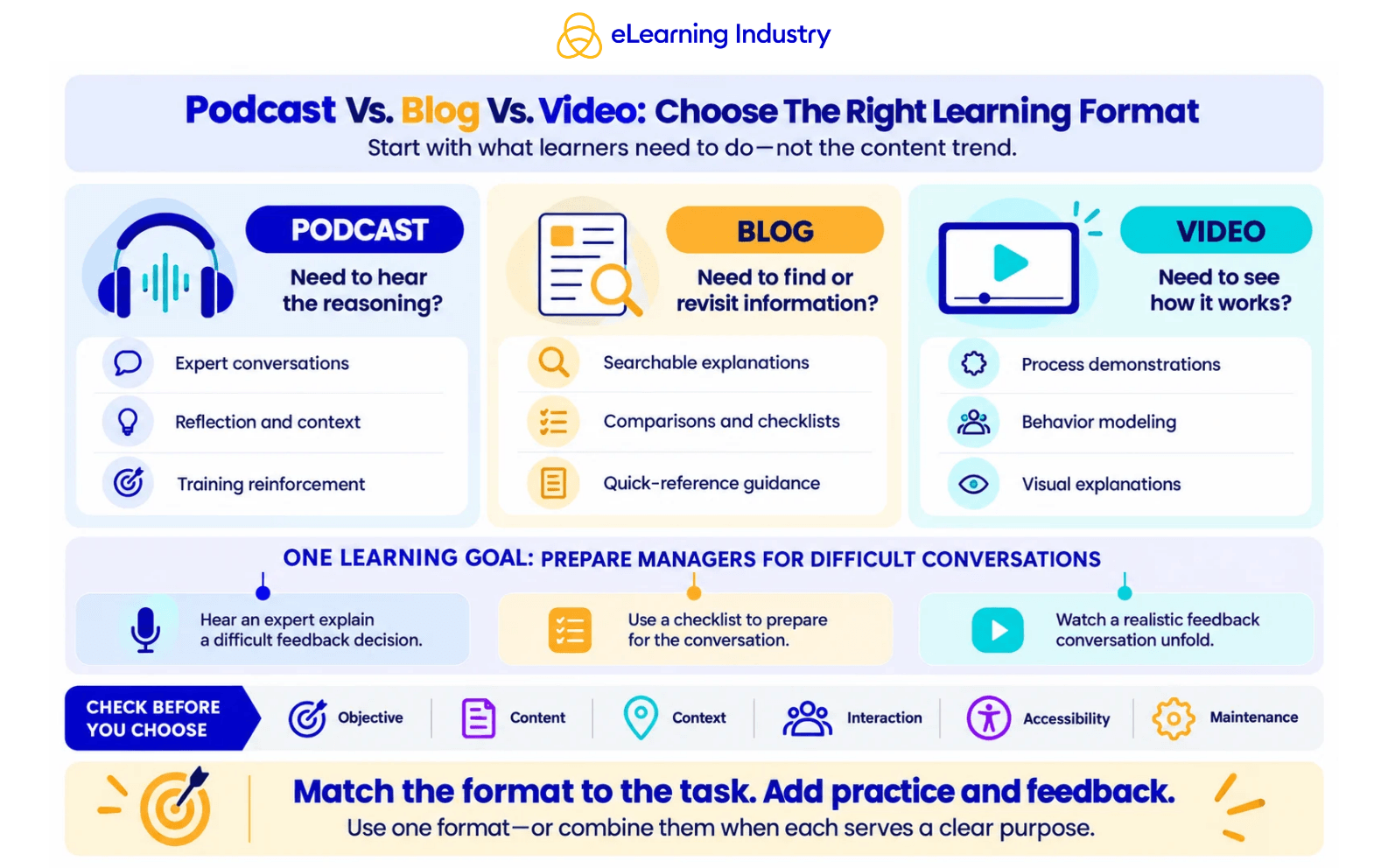
The 7-Factor Framework For Choosing A Learning Content Format
A podcast vs. blog decision should account for 7 factors: objective, content, context, interaction, accessibility, maintenance, and budget.
1. Objective
Start by clarifying what you want employees to do after engaging with the resource. If the goal is to help them look up information, focus on making it easy to find. If you want them to practice a skill, create chances for them to show what they can do.
2. Content
Decide what needs to be heard, seen, or closely examined. Avoid using audio if people will need to picture an unfamiliar interface repeatedly.
3. Context
Think about where people will be learning and how much time they can realistically spend without interruptions. For example, a detailed interview and a quick troubleshooting guide are useful in different situations.
4. Interaction
Consider how learners will find information, make decisions, practice, or get feedback. These activities can happen around the main resource and don't always need a complex platform.
5. Accessibility
Prepare transcripts for audio, add captions to videos, and include descriptions if important visuals are not explained in the audio. The W3C suggests planning for accessibility while you are scripting and producing, not after publishing.
6. Maintenance
Think about how much work it will take to review, translate, and update each version. Changing a few words in text is easy, but in audio or video, it might mean re-recording and editing.
7. Budget
Remember that costs go beyond just recording or writing. Plan for expert reviews, editing, transcription, captions, translation, hosting, and updates. Sometimes, a basic screen recording costs less than a well-researched article, so don't judge production effort by format alone.
All these questions lead to a simple rule: pick the easiest accessible format that meets your goal, then add any activities needed for people to apply what they learn. Don't let fancy production get in the way of real learning.
Should L&D Choose One Format Or Combine Them?
You don't always have to choose between a podcast and a blog. Using both can work well, as long as each format meets a different learning need instead of repeating the same content.
Take a manager development program, for example. You could share an expert interview about handling tough feedback. Next, write an article that summarizes the decision-making process, create a short video showing a feedback conversation, and provide a checklist to help with preparation. Finally, encourage managers to practice giving feedback themselves.
Each resource serves a unique purpose: giving context, explaining ideas, showing examples, offering reference material, or helping with practice.
This approach is better than just turning every podcast into a video and transcript. While transcripts make content more accessible, they don't always have the clear structure of a good article. Interactive transcripts can also help people find the parts of a recording they need.
In your LMS or knowledge library, group related resources under a single, clear topic. Use descriptive titles, summaries, and timestamps for recordings, and put supporting articles right next to them. Learners shouldn't have to guess where to find a helpful explanation—everything should be easy to locate.
When you repurpose learning content, use the same terms across all resources and ensure each resource has a clear owner. This helps prevent new articles from conflicting with older episodes or demonstrations.
Conclusion
In the debate podcast vs. blog, start by thinking about what your learners need to learn, not just which format you prefer. Use audio for expert insights, text for reference and comparison, and video when you need to show something important. Next, think about how learners will use the information. Practice, feedback, access, and ongoing support should be considered along with the format. For L&D leaders, the best approach is not to pick one format over another, but to make sure employees get the support they need when they need it.


