
 ChatGPT
 Perplexity
 Claude
 Grok
Grok
On Business Outcomes, Learning Impact, And AI
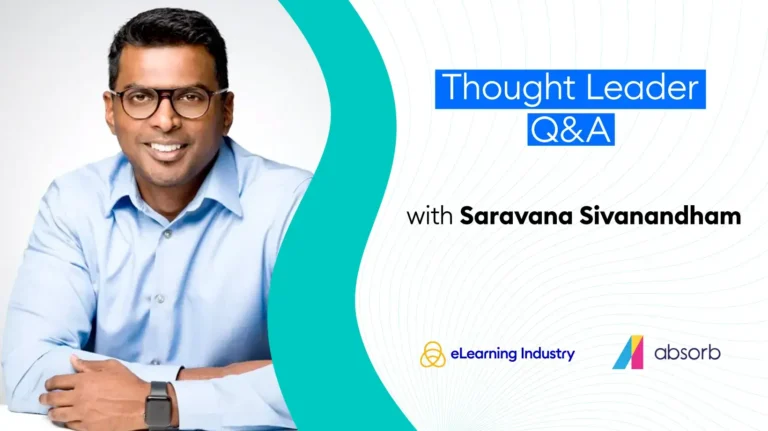
Saravana Sivanandham is Chief Product and Marketing Officer at Absorb Software, where he leads strategy and execution of Absorb's product, marketing, AI, and growth teams to deliver market-leading solutions that help organizations build critical skills, transform their workforce, and drive measurable business outcomes. Outside of work, he enjoys spending time with his family, running in the Texas hill country, and playing competitive table tennis.
Today, we are discussing learning impact, business outcomes, and the use of AI right where performance lives.
The industry has promised to prove the business impact of learning for years, and delivery has been mixed. Can AI actually solve that, or does it just create more activity to measure?
Yes. For the first time, the gap is genuinely closable, because the three things that were always missing are now solved. We can reach the data where work actually happens, reason over it generatively, and loop the result back to the outcome. The caveat is that it only closes if you measure the outcome rather than the activity. Otherwise, AI simply industrializes the same vanity metrics, faster.
The old gap was never about ambition. It was about plumbing. Learning systems could not see the work, so completions and quiz scores were the only signals, and impact was inferred rather than observed. Technologies like MCP and A2A change that. An agent can now read where capability gaps actually live from the systems where work happens, such as CRM, support, code, and conversations, using the user's own permissions and without a twelve-month data-lake project. Generative AI turns that signal into a specific intervention, then reads back whether performance moved. That is a closed loop, not another dashboard.
The risk you name is the real one. AI makes it trivially easy to generate more content and track more activity, and most platforms will fall into exactly that trap. The discipline is to anchor on the outcome the enterprise already counts, such as ramp time, win rate, and retention, and let everything else serve it. Even the most rigorous skills-measurement approaches are explicit that they measure capability, not business results. Measurement is the means. Proof of outcome is the end, and that last step is the one AI finally lets us take.
For anyone evaluating AI-powered learning platforms right now, what are the two or three questions you'd tell them they have to ask?
Three questions separate an AI-native platform from AI features bolted onto an LMS. Where does the AI get its data? Can it act, or only answer? And can it prove the business outcome?
First, where does the AI get its data? Everyone has access to the same foundation models, so the model itself is not the advantage. The data is. The strongest systems are grounded in two things at once. One is the provider's own proprietary learning data, meaning who learned what, what they can now do, and what actually worked. The other is a live connection to the business systems where work happens, such as CRM, support, and HR. Be clear-eyed here: no learning vendor is the system of record for business performance, and you should be wary of any that claims to be. What matters is whether the platform is the system of record for capability and readiness, and whether it can read context from the systems that do own performance. A wrapper on a public model with neither is a demo.
Second, does it act, or only answer? A chatbot answers a question. An agent detects a gap, delivers the intervention, and follows up to see whether it worked. Ask to see the full workflow it runs, not the chat box.
Third, can it prove it worked, in the language the CFO already uses? Ask how it ties learning to a metric the business already measures, and whether it can show cause rather than only correlation. If the answer is engagement and completions, that is the old game in new packaging.
A quick way to test all three at once is to ask to see the architecture and the public changelog. Platforms that are genuinely AI-native show how the system is built and ship visibly. The ones that are not cannot.
What's the question enterprise customers are bringing to you now that they weren't asking a year ago?
A year ago, much of the conversation was still about features and systems. Customers asked whether a platform could do a particular thing, or they asked us to help them stand up a new system or build a map. Today, the question is about outcomes embedded in the work. Across every use case, employee development, customer education, partner enablement, and compliance, customers are asking the same thing in different words. Will this actually change what our people can do, and can you prove it?
The clearest example is skills. A year ago, enterprises asked us to build them a skills taxonomy. Today, they are asking close to the opposite. Not map all our skills, but close the gaps that actually move the business, in the flow of work. The top-down skills project, where you catalog every skill, map every role, and then try to close the gaps, has largely become a theoretical exercise. The map takes a year to build, it begins decaying the moment it is finished, and the learner never actually sees it. Skills became a means that forgot its end.
What customers want now is the thing skills were always a proxy for. People who can do the job, and proof that it worked, delivered as a workflow embedded in the work that improves on its own, rather than a standalone catalog they have to maintain. That is what an ambient, context-aware system does. Because it understands the learner and the business context, it grounds development in what moves the business forward. It accomplishes what skills intelligence was trying to do, done the right way.
Every learning platform is calling itself AI-powered. What does that actually mean in practice, and what should buyers be skeptical about?
AI-powered today covers everything from a thin wrapper on a public chatbot to a system that diagnoses, acts, and proves outcomes, which makes the label almost meaningless on its own. What matters is the architecture underneath, and it falls into three honest tiers. The first is AI features, such as a content generator or a question-and-answer bot added to an LMS. Useful, but it does not change the job. The second is AI-assisted, where the system surfaces recommendations and insights for a human to act on. Better, but still human-paced. The third is AI-native, or agentic, where agents detect a gap, act on it, and measure the result across a closed loop. That is the only tier that changes outcomes rather than effort.
Buyers should be skeptical of a few things. A born-AI claim with no proprietary data underneath it. A demo that dazzles but cannot name the business outcome. AI that turns out to be one feature rather than a system. And any vendor that will not show its architecture or a public changelog.
There is also a reframe most buyers miss. In AI, incumbency can be the advantage rather than the drag. The hard part is not the model, because everyone has the same models. The hard part is the proprietary learning data, being the system of record for capability and readiness, and the reach to act inside the tools where work already happens. A platform that has run enterprise learning for years has exactly the learning data and the installed base that a new entrant lacks. AI is only as good as the data and the context it runs on.
Learning, upskilling, compliance, customer training, partner enablement—enterprises are managing all of this with a patchwork of disconnected tools. What does a better model actually look like?
Most enterprises run four or more learning systems. One for employees, another for customers, something stitched together for partners, and another for compliance. That fragmentation is the single biggest reason learning cannot prove its impact. You cannot build business-grade evidence from systems that are deliberately separate.
Every system is a separate record, a separate budget, and a wall the intelligence cannot see across. The data you would need to prove impact is scattered by design. The better model is one platform for every audience the business depends on, including employees, customers, partners, and vendors, with a single intelligence layer running through all of it, grounded in the company's own context.
It also has to reach beyond formal courses. Most of what an organization knows lives outside the LMS, in places like SharePoint, Confluence, Google Drive, support tickets, and recorded calls. A modern system connects to that knowledge where it already lives, so learning is grounded in how the company actually works rather than in courses alone. This is also where a learning system parts ways with a horizontal knowledge or search tool. Enterprise search can find you the answer. Only a learning system can prove that someone can now do the job.
When learning finally lives in one place, the system can see the whole picture. How customer education affects renewals, how partner readiness affects channel revenue, and how employee upskilling affects productivity. That is not a nicer integration story. It is the difference between managing tools and actually understanding what your workforce can do.
You recently launched Absorb Aura, an agentic learning system built to tie every learning interaction to the business outcomes the enterprise already measures. What does it make possible for L&D teams that wasn't possible before?
For the first time, L&D can answer the question it has been dodging for twenty years. Did it work?
Aura is the intelligence layer, Absorb's agentic learning system, that ties every learning interaction to the outcomes the enterprise already measures. It reads where capability gaps actually live from the systems where work happens, delivers the right intervention, and reads back whether performance moved, across employees, customers, and partners. Architecturally, it is a closed loop on four systems. A system of record for capability and readiness, which answers whether a person can do a given task right now. A system of action, which intervenes in the flow of work. A system of intelligence, which learns what actually works. And a system of measurement, which ties the result to the business outcome. That combination is what makes it agentic rather than only AI-assisted.
What changes is the job itself. Instead of delivering programs and reporting completions, teams run agent-driven workflows that surface a gap, close it, and prove the result. The admin who spent Monday chasing compliance lists can spend it building next quarter's skills strategy instead. And when learning can finally show up in CFO language, such as ramp time, retention, and revenue, L&D stops defending its budget and starts earning a seat at the strategy table. That is the shift.
Looking three to five years ahead, what excites you most about where the learning industry is heading?
Two shifts, and both move learning from the periphery of the enterprise to the center of how it performs.
First, learning becomes the differentiator rather than the support function. AI is raising every person's productivity and widening every manager's span of control, so people will do more and lead more than ever before. Traditional people-based training and apprenticeship simply do not scale to that. In that world, how fast an organization can build capability becomes a primary competitive advantage. Learning stops being a background function and becomes a core organizational muscle, arguably the one that compounds the fastest.
Second, a one-to-one coach for every learner, finally. We have always known that people learn best one-to-one, but there were never enough tutors, so we invented classrooms, books, and courses. Every one of them is a one-to-many compromise. AI removes that constraint. Every learner can have a coach that knows them, knows the organization's needs, and is singularly focused on their outcomes. That is the most human thing technology has done for learning in a century, and it is exactly the model Aura is built on.
Wrapping Up
Thanks so much to Saravana Sivanandham for sharing his expertise on connecting learning impact to real business outcomes by embedding AI right where the work actually happens. If this subject caught your interest, check out Absorb's exclusive insights in their AI in learning report: How L&D leaders can turn AI into business impact.