

 ChatGPT
 Perplexity
 Claude
 Grok
What Is A Training Needs Analysis?
A training needs analysis helps organizations figure out what employees really need to learn before spending time, money, and resources on a new training program. This is important because not every performance problem comes from missing knowledge or skills. Sometimes, employees need better processes, clearer expectations, improved technology, or more support from management.
For L&D and HR leaders, it's best to start by looking at the business problem instead of jumping straight to a course. A structured training needs assessment helps organizations find performance gaps, understand why they happen, focus on the most important skills, and decide if training is actually the right solution.
Put simply, TNA means:

Desired performance → Current performance → Performance gap → Root cause → Appropriate intervention
For example, if customer service ratings drop, the company might first think agents need communication training. But a careful analysis could show the real issue is an old knowledge base, slow software, or unclear steps for handling problems. In this case, just offering more training would not solve the real problem.
This guide covers what a training needs analysis is, how to do one, what questions to ask, and how to use the results to build a strong learning strategy. You'll also get a practical template and an example to show how the process works in real life.
Training Needs Analysis Vs. Training Needs Assessment
A training needs analysis is similar to a training needs assessment, and people in L&D and HR often use these terms interchangeably. However, understanding the difference between them can help you make better decisions.
- A training needs assessment looks at the bigger picture. It helps you find out if there is a real gap in performance, knowledge, or skills, and explores what might be causing that gap.
- A training needs analysis takes a closer look after you decide that learning could help. It figures out exactly what knowledge and skills are needed, who needs them, and the best way to deliver the training.
Training Needs Assessment |
Training Needs Analysis |
| Identifies whether a performance or capability gap exists | Examines the specific learning requirements behind that gap |
| Investigates potential causes | Determines what employees need to know or do differently |
| May identify training and non-training solutions | Helps define an appropriate learning intervention |
| Supports broader business diagnosis | Supports learning design and implementation |
Why Is Training Needs Analysis Important?
A training needs analysis matters because it helps organizations focus their learning investments where they will actually improve performance, instead of using training as the answer to every business issue. As L&D leaders are asked more often to show real results, this approach becomes even more important.
If organizations skip a proper training needs assessment, they might create programs based on guesses, requests from stakeholders, or what employees want, instead of relying on real evidence. A good training needs analysis can help L&D and HR teams in several ways:
- Connect training investments to business priorities.
- Identify specific knowledge, skill, and competency gaps.
- Avoid training employees who do not need training.
- Distinguish learning problems from process or technology problems.
- Prioritize limited L&D resources.
- Define measurable performance expectations.
- Improve Instructional Design decisions.
- Establish baseline data before training begins.
- Build a stronger case for learning investment.
Most importantly, a training needs analysis shows its value when it reveals that training is not actually needed. If employees know what to do but still cannot perform because of broken processes, unclear roles, poor tools, mixed incentives, or too much work, adding another training course probably will not help.
The 3 Levels Of Training Needs Analysis
A training needs analysis is more effective when L&D professionals look at training needs on three levels: organizational, task or role, and individual. Focusing on just one level often gives an incomplete picture.
1. Organizational Analysis
An organizational-level training needs analysis links learning needs to the company's goals. Rather than just asking employees which courses they want, L&D leaders look at what changes the business needs from its workforce.
For instance, a company might start an organizational training needs analysis because of a digital transformation, new regulations, entering new markets, adopting AI, changing customer expectations, or a new leadership approach.
This step is similar to a business needs analysis, as it makes sure that learning priorities match what the organization really needs.
2. Task And Role Analysis
A task-level training needs analysis finds out what knowledge, behaviors, and skills are needed to do a specific job well. The aim is to set the standard first, then see how current skills measure up.
For example, someone in sales might need to know the product, have negotiation skills, be good with CRM tools, and run effective discovery calls.
A task analysis helps identify which skills are most important, which are missing, and where gaps have the greatest impact on performance.
3. Individual Analysis
An individual-level training needs analysis identifies which employees need help and how their needs differ. This stops organizations from thinking everyone in a department needs the same training.
One person might need basic knowledge, another might get the idea but have trouble using it, and someone else might already be skilled. Learning analytics, assessments, manager observations, performance data, and employee feedback all help build a clearer picture.
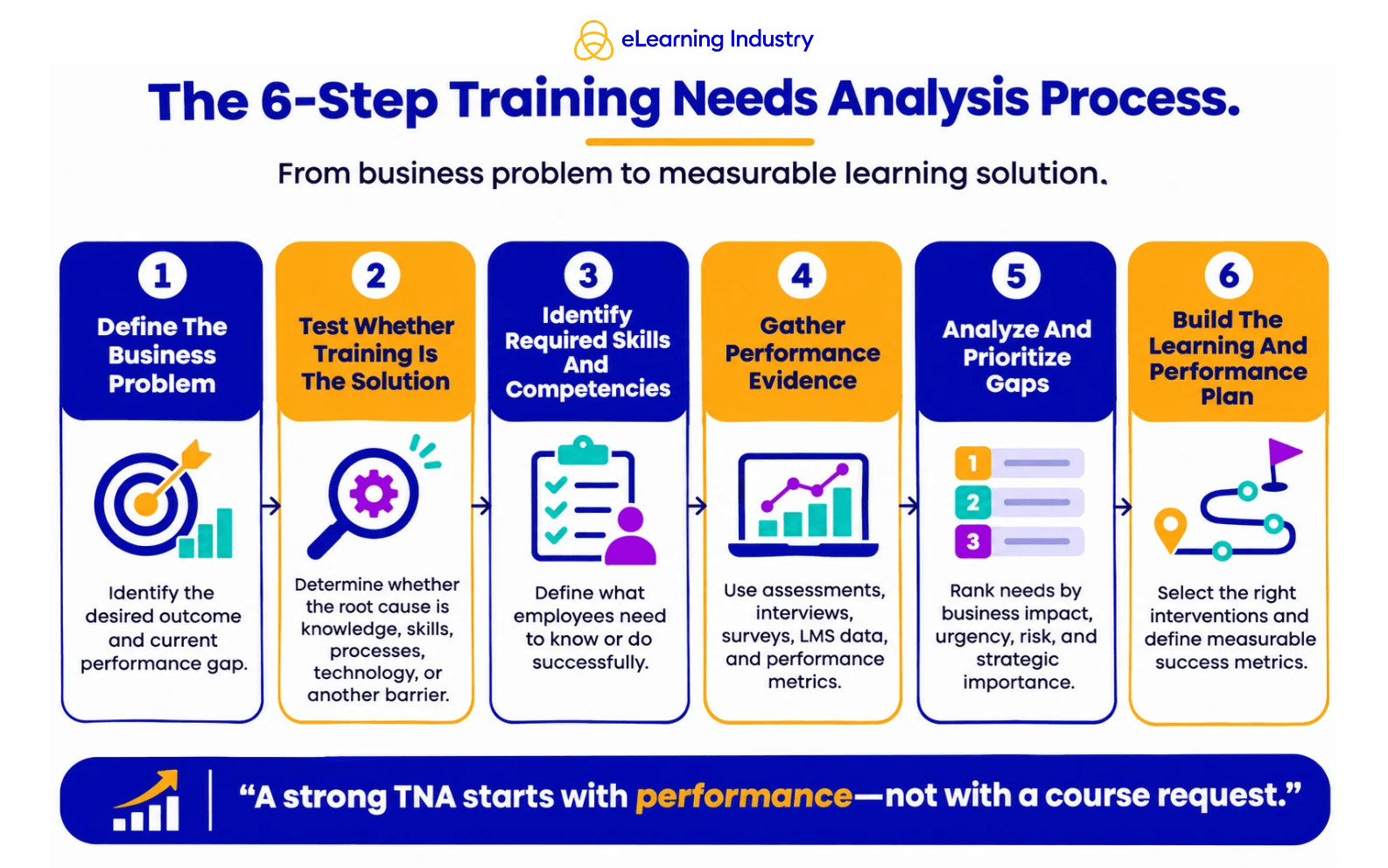
How To Conduct A Training Needs Analysis In 6 Steps
A training needs analysis is most effective when it follows a clear process, starting with business performance and ending with measurable recommendations. While organizations can adjust the method as needed, the 6 steps below offer a practical framework.
1. Define The Business Goal And Performance Problem
Start by clearly stating what the organization wants to achieve and how current performance falls short. Without a clear business goal, it's hard to know if training is truly necessary. Start by asking:
- What business outcome needs to improve?
- What should successful performance look like?
- What is happening today?
- Who is affected?
- What evidence proves the gap exists?
- What will happen if the problem continues?
For example, "Managers need leadership training" is not yet a useful problem statement. A stronger starting point would be:
Voluntary turnover among new employees has increased, and exit interviews show inconsistent manager feedback and onboarding support.
Now the organization has a specific outcome to investigate.
2. Determine Whether Training Can Solve The Problem
Determine whether employees lack the knowledge or skills they need, since training can't fix every performance issue. Consider whether the root cause involves:
- Knowledge
- Skills
- Confidence
- Behavior
- Technology
- Processes
- Workload
- Role clarity
- Incentives
- Management support
- Policies
- Access to information or resources
A useful distinction is:
- Employees can't perform because they don't know how: Training may be appropriate.
- Employees know how but something prevents them from performing: A non-training solution may be required.
For example, if employees consistently enter incorrect information into a system because they do not understand the process, needs assessment training may help. If the errors occur because the software interface is confusing, redesigning the workflow may provide a better solution. Often, the best solution combines learning with changes to how work is done.
3. Identify The Required Skills And Competencies
You should then define the capabilities employees need to produce the desired result. This gives the organization a clear standard against which current performance can be measured. Depending on the situation, required capabilities might include:
- Technical knowledge
- Job-specific skills
- Product knowledge
- Digital skills
- Leadership competencies
- Communication skills
- Compliance knowledge
- AI literacy
- Decision-making capabilities
- Customer service behaviors
Be specific. Instead of saying employees need "better communication skills," identify the specific behaviors they need. For instance, managers might need to give actionable feedback, handle tough conversations, or clearly explain changing priorities. The clearer you define successful performance, the easier it is to spot training needs.
4. Gather Evidence About Current Performance
Use several sources of evidence in a training needs analysis to see what employees can actually do, not just what they say they need. Self-reported data is helpful, but it shouldn't be the only source. Evidence can come from:
- Employee surveys
- Manager interviews
- Focus groups
- Skills assessments
- Performance evaluations
- Work samples
- Direct observation
- Customer feedback
- KPI data
- LMS reports
- HRIS data
- Skills platforms
- Compliance records
- Quality assurance data
For EdTech-enabled organizations, learning and workforce systems can add another layer of evidence. For example, an LMS may reveal low assessment scores in one topic, while performance systems show whether that knowledge gap actually corresponds with weaker workplace outcomes. Using several data sources usually gives L&D leaders a clearer picture than simply asking employees, "What training would you like?"
5. Analyze And Prioritize The Gaps
Compare what's needed with current skills, then prioritize the gaps based on how important they are to the business. Not every gap needs immediate attention. A simple starting formula is:
Required capability – Current capability = Capability gap
However, a gap becomes a priority only when it matters. Evaluate each one based on factors such as:
- Business impact
- Strategic importance
- Number of employees affected
- Risk
- Urgency
- Frequency of the task
- Cost of poor performance
- Regulatory consequences
- Feasibility of improvement
L&D teams can use a simple high, medium, or low priority rating. Alternatively, an impact × urgency matrix can help stakeholders compare needs more objectively.
For instance, a minor presentation skills gap affecting five employees may be less urgent than a compliance knowledge gap affecting hundreds of employees. Prioritizing gaps helps keep the TNA focused on real decisions, not just a list of wishes.
6. Translate Findings Into A Learning And Performance Plan
In the end, a training needs analysis should create a plan that spells out what needs to change, who needs help, and how you'll measure progress. The result should help leaders make decisions, not just record requests for more training. For every priority gap, define:
- Target audience
- Required capability
- Desired workplace behavior
- Recommended intervention
- Delivery method
- Owner
- Timeline
- Baseline measure
- Success metric
Depending on the need, the learning solution might include:
- eLearning
- Instructor-led training
- Virtual training
- Coaching
- Simulations
- Microlearning
- Peer learning
- Job aids
- Performance support
- Knowledge resources
Also, make sure to note any recommendations that don't involve training. For example, employees may need a short digital course plus a redesigned checklist, clearer manager expectations, and improved software access. This mix is usually much more effective than treating learning as a separate solution.
Training Needs Analysis Questions To Ask
A training needs analysis is more effective when stakeholders ask questions that reveal performance expectations, current gaps, root causes, and measurable outcomes. The specific questions will differ by organization, but they should do more than just ask employees which courses they prefer.
Business Questions
Start with business questions that explain why the issue is important. Ask:
- What business outcome needs to change?
- What evidence shows a performance problem exists?
- Which strategic objective does this issue affect?
- What would successful performance look like?
- What is the cost or risk of leaving the gap unresolved?
Role And Performance Questions
Also, look at what employees need to do differently in their roles. Ask:
- Which tasks have the greatest impact on the desired result?
- What do high performers do differently?
- What knowledge or skills are required?
- Where do errors occur most often?
- Which tasks create the most difficulty?
- Has the role changed recently?
Employee And Learner Questions
Consider learners' perspectives, but self-reported needs should not be treated as definitive evidence. Ask employees:
- Which tasks are most difficult?
- Where do you feel least confident?
- What prevents you from performing effectively?
- What knowledge or resources are difficult to access?
- What support would help you perform better?
- Which parts of the workflow require the most assistance?
Solution Questions
End the training needs analysis by checking if learning will truly solve the problem. Ask:
- Is the gap caused by insufficient knowledge or skills?
- What solutions have already been attempted?
- Could a job aid or process improvement solve the issue?
- What behavior should change after the intervention?
- How will we know whether performance improved?
These answers help turn raw needs assessment data into a solid learning strategy.
Training Needs Analysis Template
A training needs analysis template helps L&D teams record their findings in a consistent way and makes it easier for stakeholders to review decisions. Instead of making a complex template, focus on the key information that links performance, causes, solutions, and measurement.
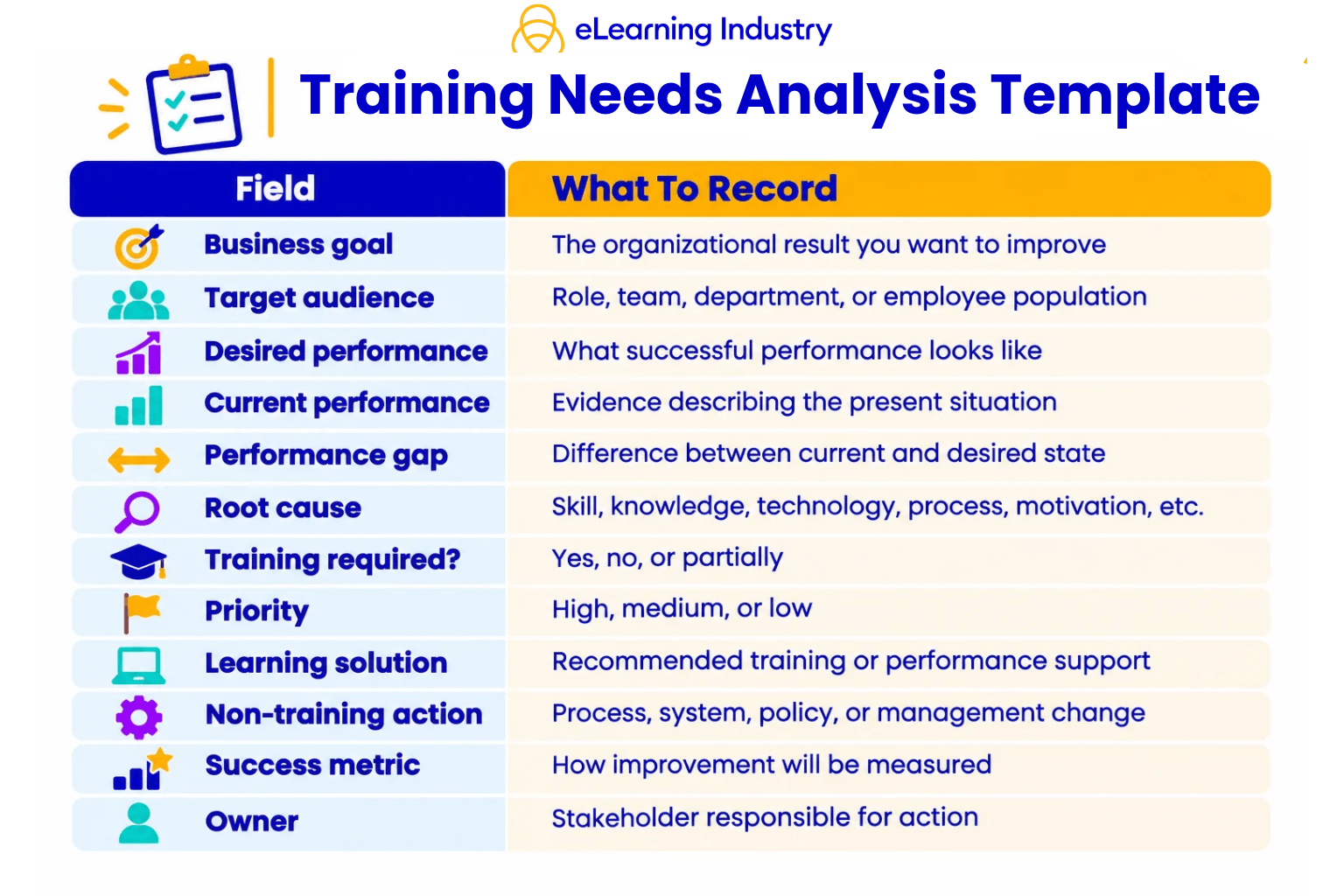
You can adapt this needs analysis template into a training needs assessment form, a spreadsheet, a Word document, an HR system workflow, or a digital questionnaire.
If your organization needs a training needs assessment template in Word, you can turn these fields into a fillable table. Instructional Designers can also use this structure and add details like learner characteristics, learning constraints, prerequisite knowledge, delivery environment, and assessment requirements. What matters most is the quality of the information you enter, not the format you use.
How Training Needs Analysis Supports Instructional Design And EdTech Decisions
A training needs analysis helps Instructional Designers and learning technology teams gather the evidence they need to make better choices about content, delivery, assessment, and technology. That's why TNA should take place before making major design decisions, not after a solution is picked. A learning needs analysis can influence:
- Learning objectives
- Audience segmentation
- Content depth
- Training modality
- Personalization
- Assessment strategy
- Practice activities
- Performance support
- Measurement
It can also help organizations decide if learning technology is really needed. For example, a large, spread-out workforce might benefit from digital learning through an LMS. On the other hand, a small leadership group dealing with complex behavioral issues could get more out of coaching and guided practice.
Modern L&D teams can also use technology to strengthen the needs assessment. Data from LMS, skills platforms, HRIS systems, assessment tools, performance systems, and AI analytics can show patterns that manual surveys might miss.
However, having more data doesn't always lead to a better TNA. Learning leaders need to interpret the evidence, understand the context, and decide if a gap really matters. Technology can help with the analysis, but it can't take the place of good performance diagnosis.
Conclusion
By focusing first on the business problem, figuring out what skills are needed, looking at current performance, finding the root causes, and choosing the most important gaps to address, organizations can use a training needs analysis to see where learning will truly have an impact. It's also important to remember that assessing training needs can show when the solution isn't training at all. For learning leaders, this means TNA is a key part of workforce planning. When organizations do this regularly, especially as roles, technology, and business goals change, they can invest in learning with more confidence and link development efforts more closely to important results.