




Introduction: Training For Safety Before The Real-World Risk
Manufacturing environments are becoming more advanced, automated, and electrified—but they are also becoming more dangerous. High-voltage (HV) systems, robotics, advanced machinery, and tightly coupled production lines introduce risks that traditional training methods are no longer equipped to address effectively. Instructor-led classroom training, PDFs, videos, and even supervised shadowing have long been the foundation of manufacturing training. However, when the consequences of error include severe injury, fatal accidents, equipment damage, or production downtime, "learning by observing" or "learning by doing" without sufficient preparation is no longer acceptable.
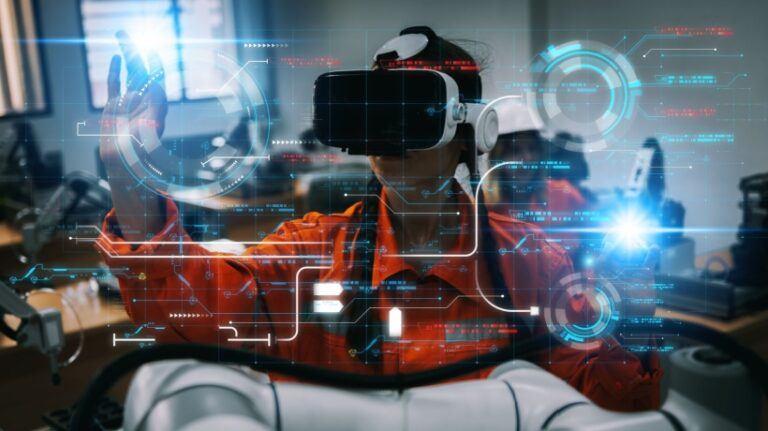
This is where Virtual Reality (VR) and Augmented Reality (AR) step in—not as experimental technologies, but as essential tools for modern manufacturing training. By enabling safe, repeatable, and immersive simulations of high-risk scenarios, VR and AR are redefining how manufacturing organizations prepare technicians before they ever touch real equipment. This article explores:
- The core problems in high-risk manufacturing training.
- Why simulation is essential before hands-on practice.
- How VR and AR uniquely address these challenges.
- Real-world examples from Tesla and Fisker.
- Practical guidance on implementing VR and AR training.
- The future of immersive learning in manufacturing.
The Core Problem: High-Risk Manufacturing Training Has Little Room For Error
Manufacturing training faces several systemic challenges, especially in high-risk environments:
1. Safety Constraints Limit Real Practice
Many hazardous procedures—such as high-voltage diagnostics, lockout/tagout failures, arc flash exposure, or battery thermal runaway—cannot be safely practiced repeatedly in real life. As a result, learners are often trained theoretically and expected to "figure it out" when the real situation arises.
2. Inconsistent On-The-Job Exposure
Not every technician encounters the same failure scenarios. Critical but rare incidents—HV isolation faults, damaged battery modules, or emergency shutdowns—may occur infrequently, leaving large skill gaps across the workforce.
3. High Cost Of Mistakes
Errors in manufacturing environments can result in:
- Severe injuries or fatalities.
- Damage to high-cost equipment.
- Production downtime.
- Regulatory violations.
The margin for error is minimal, yet traditional training methods often fail to adequately prepare learners for these risks.
4. Knowledge Decay Between Training And Application
Even when technicians complete initial training, time gaps between learning and real-world application can erode procedural memory—especially for complex, multistep safety processes.
Why Simulation Is Critical Before Hands-On Practice
To address these challenges, manufacturing training must shift from knowledge transfer to experience preparation. Simulation-based learning allows technicians to:
- Practice dangerous procedures without physical risk.
- Make mistakes and learn from consequences safely.
- Build muscle memory and situational awareness.
- Rehearse rare but critical incidents.
This mirrors how pilots, surgeons, and emergency responders are trained—simulation first, real-world execution second. VR and AR enable this shift by placing learners inside realistic, interactive environments where safety, repetition, and consistency are guaranteed.
VR And AR: Complementary Technologies For High-Risk Training
While often grouped together, VR and AR solve different training problems and are most powerful when used together.
Virtual Reality: Full Immersion For Hazard Simulation
VR places learners in a fully simulated environment, making it ideal for:
- High-risk procedures.
- Emergency response training.
- Situational awareness development.
- End-to-end process rehearsals.
In VR, learners can safely experience:
- Electric shock hazards
- Arc flash events
- Incorrect tool usage consequences
- Failure to follow safety protocols
The immersive nature of VR triggers emotional and cognitive engagement, significantly improving retention and behavioral transfer.
Augmented Reality: Contextual Guidance In The Real World
AR overlays digital information onto physical environments, making it ideal for:
- Equipment familiarization.
- Component-level understanding.
- Just-in-time procedural support.
- Reducing cognitive load during complex tasks.
AR excels at answering the question: "What am I looking at, and what should I do next—right now?"
Real-Life Applications: VR And AR In HV Manufacturing Training
In electric vehicle manufacturing and service environments, high-voltage systems pose one of the most significant safety risks. Technicians must follow strict procedures when working with HV components, yet real-world practice opportunities are limited due to safety concerns.
At EV companies now, VR and AR can be used to simulate:
- HV system identification and hazard zones.
- Proper PPE selection and inspection.
- Step-by-step HV power-down procedures.
- Consequences of procedural errors.
Learners could:
- Enter a virtual vehicle or manufacturing environment.
- Interact with HV components using tracked controllers.
- Practice correct sequencing without time pressure.
- Experience simulated failure outcomes safely.
Impact observed:
- Improved procedural accuracy before hands-on work
- Higher confidence levels among new technicians
- Reduced safety incidents during early on-the-job tasks
VR and AR transformed HV training from abstract instruction into an embodied experience.
How To Implement VR And AR In Manufacturing Training: A Practical Guide
1. Start With Risk And Task Analysis
Not every task needs immersive technology. Begin by identifying:
- High-risk procedures.
- Rare but critical failure scenarios.
- Tasks with high error rates or long ramp-up times.
These areas deliver the highest ROI for VR and AR.
2. Define Clear Learning Objectives
Avoid using VR or AR as a novelty. Each experience should map to:
- Specific safety behaviors.
- Procedural accuracy.
- Decision-making under pressure.
Ask: what must the learner be able to do differently after this experience?
3. Choose The Right Modality
- Use VR for:
- Dangerous procedures.
- Emergency scenarios.
- Full workflow simulations.
- Use AR for:
-
- Equipment walkthroughs.
- Step-by-step guidance.
- On-the-job reinforcement.
Blended approaches often yield the best results.
4. Design For Instruction, Not Just Realism
High fidelity is valuable—but instructional clarity matters more. Effective VR/AR training includes:
- Guided onboarding.
- Progressive difficulty.
- Embedded feedback.
- Clear success and failure indicators.
Learners should know why something went wrong, not just that it did.
5. Integrate With Existing Training Systems
VR and AR should complement—not replace—existing programs. Integrate them with:
- LMS or LXP platforms.
- Certification workflows.
- Safety compliance tracking.
This ensures immersive training is measurable and scalable.
6. Measure Impact Beyond Completion Rates
Success metrics should include:
- Reduction in safety incidents.
- Faster time-to-competency.
- Improved assessment performance.
- On-the-job behavioral changes.
Data-driven evaluation strengthens executive buy-in and long-term adoption.
Looking Forward: The Future Of Immersive Manufacturing Training
As manufacturing continues to evolve, immersive technologies will move from optional enhancements to operational necessities. Key trends ahead include:
- AI-driven adaptive VR scenarios.
- Digital twins integrated with real-time data.
- AR-enabled remote expert support.
- Scalable enterprise deployment through standalone headsets.
Most importantly, VR and AR will shift training from reactive instruction to proactive risk prevention—preparing workers not just to perform tasks, but to handle the unexpected safely and confidently.
Conclusion
High-risk manufacturing environments demand training approaches that prioritize safety, realism, and preparedness. Traditional methods alone are no longer sufficient. By leveraging VR for immersive, risk-free simulation and AR for contextual, real-world guidance, organizations can:
- Reduce accidents.
- Accelerate skill development.
- Improve confidence and compliance.
- Build a safer, more resilient workforce.
Real-world applications at companies like Tesla and Fisker demonstrate that immersive learning is not a future concept—it is already transforming manufacturing training today. For Learning and Development professionals, the question is no longer whether to adopt VR and AR, but how strategically and effectively they are implemented.